The “Feeding the Family” Club

pot roast slices, potatoes, and carrots on plateA hundred years ago, a group of women in Long Beach California belonged to a “Feeding the Family” club. It was organized by the local public schools. There were many similar clubs throughout the U.S. at that time. Here is what a 1921 magazine article said about the Long Beach group:
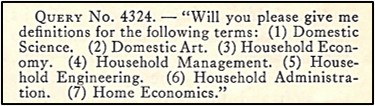
“Feeding the Family” Club

Women are waking up to the fact that upon their shoulders rests the responsibility of having a healthier nation. Too many people are dying of avoidable diseases. Rich foods have taken more toll of life than war and pestilence, dieticians tell us. More and more stress is being placed upon diet – not for the sick only, but for those in good health, that they may preserve it. By diet we mean the proper combinations of foods and the scientific uses of vitamins, starches, proteins and acids.  What we need is more than a reading acquaintance with those subjects.

A certain group of women in Long Beach , Calif. have decided that the acquisition of knowledge concerning food properties is the only way to better living for their families. They have grouped together under the name of the “Feeding the Family” Club, and under the leadership of the head of the department of domestic science of the public schools, they meet on Wednesday evening each week for two hours to learn how to prepare healthful, nourishing meals for the average family.

There sixteen women in the group, representing fifty-six persons, most of whom are children in school. Think what it means to those children to have mothers who are vitally interested in seeing them grow up to be strong, virile men and women. “Knowledge makes Power” aye, the knowledge of the mothers of today makes for the powerful citizens of tomorrow.

American Cookery (November, 1921)

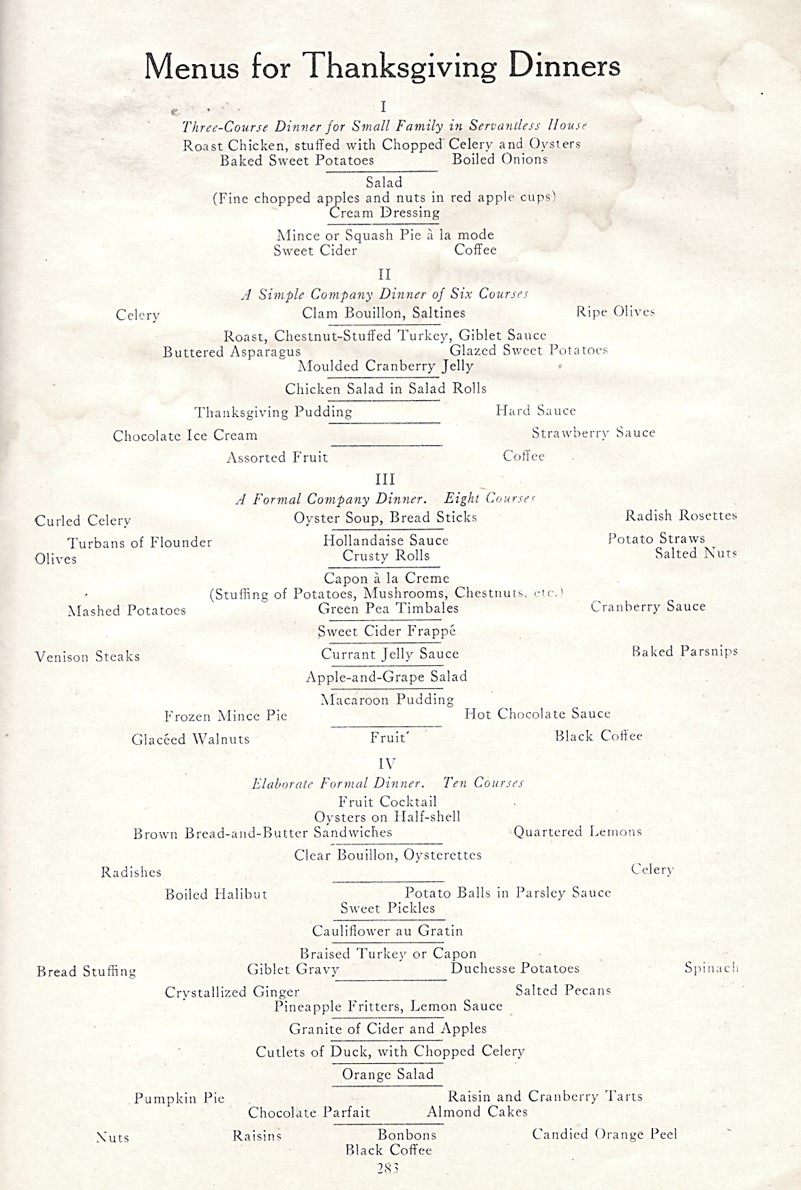
1921 Thanksgiving Menus

1921 Thanksgiving Menus
Source: American Cookery (November, 1921)

The November, 1921 issue of American Cookery provided four menu options for Thanksgiving meals:

  • Three course dinner for small family in a servantless house
  • A simple company dinner of six courses
  • A formal company dinner. Eight courses
  • Elaborate formal dinner. Ten courses

My Thanksgiving meals clearly lean toward the three course option (though with turkey instead of chicken) – but if I could get in a time machine and go back a hundred years, I’d head to a house serving the ten course meal.

HAPPY THANKSGIVING

1921 Description of High-Quality Pie Crusts

Slice of Lemon Apple Pie

Here’s how a 1921 home economics textbook describes a high-quality pie:

A pie should have a light, flaky, tender crust that is thoroughly baked. Pie crust must be chewed thoroughly, since even the best is hard to digest. It is easier to make tender pie crust from pastry flour because that contains less gluten and more starch than bread flour. Bread flour may be used, however. Many kinds of fat are used in pie crust, such as lard, butter, vegetable fats and oils. Fat make the crust “short” and flaky, and is often called “shortening.” The crust is made tender by careful handling, and by folding and rolling several times so that air is folded into the dough. This air, and the steam formed from the water used in the mixture, expand the dough during baking and make the pie crust light.

Elementary Home Economics (1921) by Mary Lockwood Matthews

12 Ways to Preserve Food a Hundred Years Ago

jars of pickles

The 1921 edition of the Boston Cooking-School Cook Book lists 12 ways to preserve food. Some still are commonly used – others less so.

Ways of Preserving

  1. By Freezing. Foods which spoil readily are frozen for transportation, and must be kept packed in ice until used. Examples: Fish and poultry. 
  2. By Refrigeration. Foods so preserved are kept in cold storage. The cooling is accomplished by means of ice, or by a machine where compressed gas is cooled and then permitted to expand. Example: meat, milk, butter, eggs. etc. 
  3. By Canning. Which is preserving in air-tight glass jars, or tin cans hermetically sealed. When fruit is canned, sugar usually added. 
  4. By Sugar. Examples: fruit-juices and condensed milk
  5. By Exclusion of Air. Foods are preserved by exclusion of air in other ways than canning. Examples: grapes in bran, eggs in lime water, etc. 
  6. By Drying. Drying consists in evaporation of nearly all moisture, and is generally combined with salting, except in vegetables and fruits. 
  7. By Evaporation. There are examples where considerable moisture remains, through much is driven off. Example: beef extract. 
  8.  By Salting. There are two kids of salting, –dry, and corning or salting in brine. Examples: salt, codfish, beef, pork, tripe, etc. 
  9. By Smoking. Some foods, after being salted, are hung in a closed room for several hours, where hickory wood is allowed to smother. Examples: ham, beef, and fish. 
  10. By Pickling. Vinegar, to which salt is added, and sometimes sugar and spices, is scalded, and cucumbers, onions, and various kinds of fruit are allowed to remain in it. 
  11. By Oil. Examples: sardines, anchovies, etc. 
  12. By Antiseptics. The least wholesome way is by the use of antiseptics. Borax and salicylic acid, when employed, should be used sparingly. 

What is Food? 1921 Description

Two men in food laboratory
Source: The Science of Food and Cookery (1921) by H.S. Anderson

How would you define food? Here’s what a 1921 cookbook called The Science of Food and Cookery had to say:

Foods are substances which, when taken into the body, supply the necessary elements for promoting growth, repairing its broken-down tissue, and furnishing it with heat and power for muscular work. True foods contain the same elements as are found in the human body, and thus they are able to build and maintain the body.

Should Children Eat Candy? One Hundred-Year-Old Advice

Candy in binsWhen my children were younger, I always worried that they would get sick from eating too much candy after trick or treating.  I wondered –  how much candy is too much? And, should I be firm and ration the candy they’d collected? . . . or was it okay if I let them binge? Here’s what a hundred-year-old home economics textbook says:

Small children are better without candy, but it may be used by older persons if it is eaten in reasonable amounts. Candy is more easily digested at the end of a meal than between meals. Candy contains a large proportion of sugar, and sugar when eaten alone is irritating to the digestive organs.

Elementary Home Economics (1921) by Mary Lockwood Edwards

The Perils of Hasty Eating

Potato Croquettes on plateA hundred years ago people believed that food should be well-chewed before swallowing, and that eating food too rapidly was not healthy. Here is what it said in a 1921 book:

Hasty Eating

 Digestion begins in the mouth. But when food is improperly masticated, it enters the stomach with only slight alteration. The ptyalin of saliva is not present in sufficient quantity, under such conditions to produce any effect on the preliminary digestion of starches, with the result that the food passes through the duodenum practically unchanged, and in coarse particles, where it is likely to produce irritation. One authority says: 

“Although much of the mechanical preparation and mixing of foods is of a necessity done in the stomach, some of it may advantageously be done in the mouth. The stomach should not be required to perform the function of the gizzard of a fowl.” –Human Foods, page 227.

Hasty eating, or bolting of food, is a fruitful cause of over-eating. The food does not remain in the mouth long enough under this condition, to give the satisfaction that it gives when thoroughly masticated; so, in an effort to satisfy the craving for food, more is taken than the body requires. This habit leads, moreover, to the taking of too large a quantity in too short a time, which serves to paralyze, as it were, the nerve impulses that communicate with the brain, and as a result the important message “Enough” does not reach the brain until an excess of food has been consumed.

When farinaceous foods (breads, cereals, potato, etc.) are well chewed and intimately mixed with saliva, they are more efficiently digested, and go farther, less food being required than when not well digested. Bread made from the entire grain requires more mastication before it can be swallowed than does spongy white bread, and itself promotes good digestion. Dry foods, which induce mastication should have a prominent place in the history. 

The Science of Food and Cookery (1921) by H.S. Anderson