Food for week-end breakfasts and brunches should be special – yet I also want convenience. I found a hundred-year-old recipe that fits the bill.
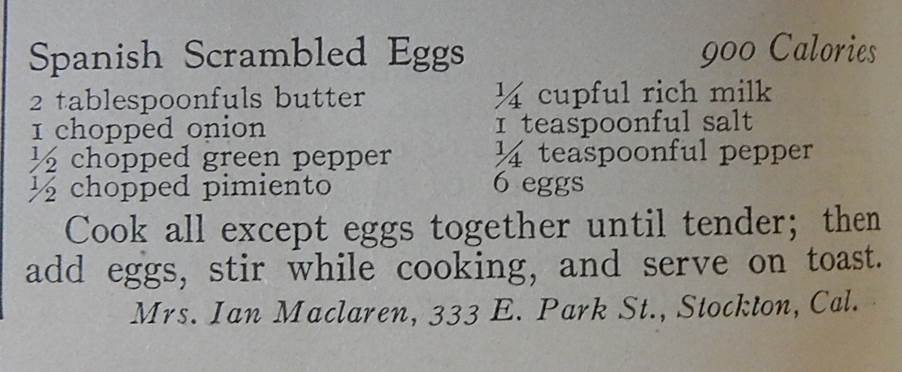
Spanish Scrambled eggs are colorful, tasty, and easy to make. These savory scrambled eggs have flecks of green pepper, pimento, and onion that delight both the eye and the taste buds. This recipe is a keeper.
Whisk the eggs together in a bowl, then stir in the milk, salt, and pepper. Set aside.
In the meantime, melt the butter in a skillet, add the onion and green pepper and saute until tender. Add the egg mixture and the pimento. As the mixture begins to thicken, use a spatula to lift and fold the curds. Continue cooking and folding until no liquid remains. Remove from heat. If desired, may be served with toast.
Cook’s note: The old recipe called for 1 teaspoon salt. This seemed excessive to me, so I reduced it to 1/2 teaspoon when I updated the recipe.
Sometimes simple foods are the best. Toast toppers are a favorite of mine for lunch or a light dinner, so when I saw a recipe for Onion Toast in a hundred-year-old magazine, I had to give it a try.
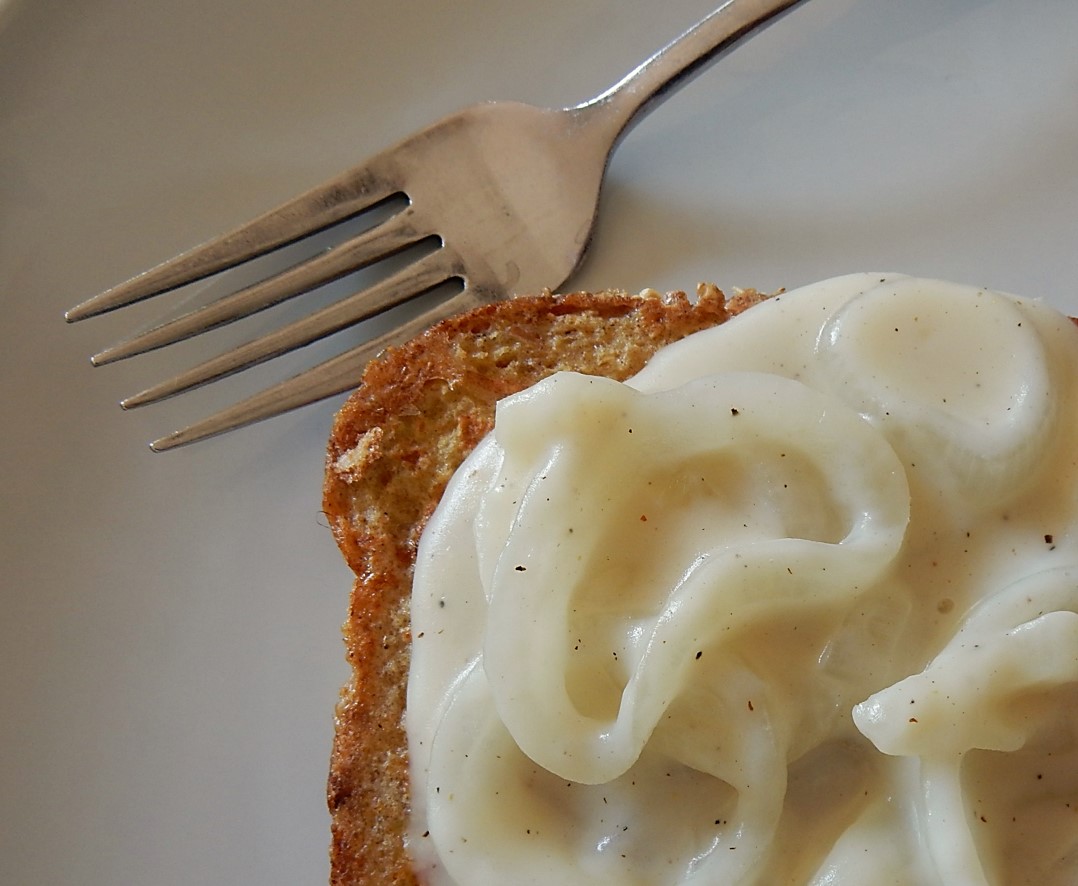
Mild, sweet onion slices embedded in a rich, creamy sauce are served over a classic French toast. The bread was soaked in beaten eggs, and then grilled to create a delightful French toast that added an unexpected, but delightful, dimension to this dish.
In days gone by, this simple dish was probably seen as a way to stretch budgets when money was tight – but I would put this dish in the category of gourmet comfort food. This recipe is a keeper, and will become part of my repertoire of recipes that I regularly make.
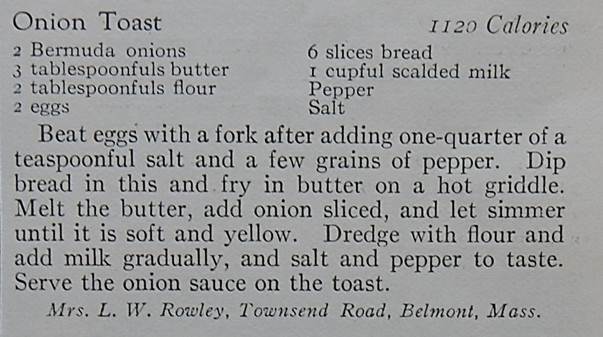
Here’s the original recipe:
Source: Good Housekeeping (August, 1917)
When I made this recipe I wasn’t exactly sure what a Bermuda onion was, so I googled it and determined that it was a large, mild onion. But I was surprised to discover that in the late 1800s and early 1900s that large quantities of onions actually were imported into the U.S. from Bermuda. According to the Bermuda 4U website, after Mark Twain visited Bermuda, he wrote about its wonderful onions in Rambling Notes of an Idle Excursion:
The onion is the pride and joy of Bermuda. It is her jewel, her gem of gems. In her conversation, her pulpit, her literature, it is her most frequent and eloquent figure. In Bermuda metaphor it stands for perfection — perfection absolute.
Onion Sauce: Melt butter in a skillet using medium-low heat, then add the onion slices and saute until the onions become soft and translucent. Stir in the flour, salt, and pepper. Slowly add the milk while stirring constantly. Continue stirring until hot and bubbly. Remove from heat and serve over the French Toast.
French Toast: Beat eggs with a fork, then stir in salt and a dash of pepper. Dip the bread slices in the egg mixture then place on a hot griddle that has been generously greased with butter. Using medium heat, grill until the bottom side of the bread is browned, then flip and cook the other side.
Cook’s notes: The original recipe called for 6 slices of bread, but I used 4 slices. I only had enough of the beaten eggs to coat 4 slices – and the amount of onion sauce seemed about right for 4 slices. I also did not scald the milk prior to stirring it into the onion mixture.
Source: The Housewife’s Cook Book by Lilla Frich (1917)
The apples on my tree are ripe. It’s time to dig out the apple recipes, which for me means searching for apple recipes in hundred-year-old cookbooks. I found a recipe with an unusual name, Apple John. Intrigued, I decided to give it a try.
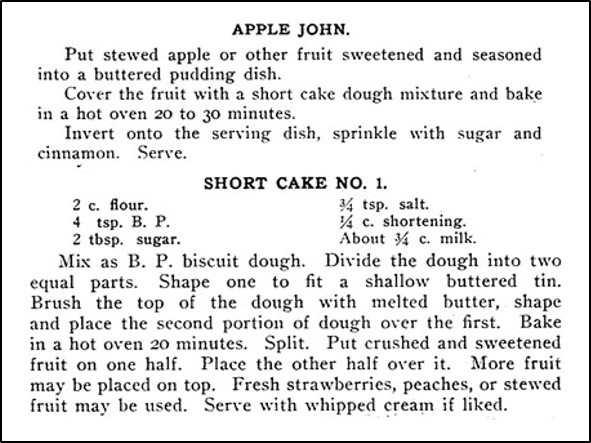
I think I found a winner. The Apple John is kind of like an upside-down cobbler made with shortcake dough. It was tasty, attractive, and easy to make.
To make stewed apples, place the sliced apples in a large saucepan, then add sugar, cinnamon, and water. Bring to a boil and then reduce heat. Continue to simmer gently until the apples are soft (approximately 10-15 minutes). If needed, add additional water. Remove from heat and put the stewed apples in a 9″ X 9″ X 3″ or similar-sized greased baking dish or pan.
In the meantime, preheat oven to 425° F. Put flour, baking powder, sugar, and salt in a mixing bowl; stir to combine. Cut the shortening into the flour mixture Add milk and stir just enough to combine using a fork.
Drop spoonfuls of the shortcake dough on top of the stewed apples to cover them. Bake in the oven for 20-30 minutes or until the top is lightly browned. Remove from oven and invert on serving plate.
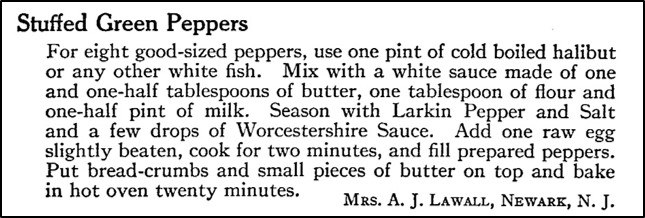
It’s always fun to find a “new” way of serving a classic in a hundred-year-old cookbook. I recently was browsing through an old cookbook and found a recipe for Green Peppers Stuffed with Fish. Of course, I had to give it a try.
The Green Peppers Stuffed with Fish were delightful. The tender and flavorful peppers balanced nicely with the mild, delicate taste of the fish. (I used flounder.)
3-4 medium peppers (The number of peppers needed will vary depending upon size. Green peppers must have been very small a hundred years ago. The amount of stuffing would not come even close to stuffing 8 modern “good-sized” peppers.)
2 cups cooked halibut or other white fish, flaked (I bought 1 pound of frozen flounder, baked it, and then flaked it. It made approximately 2 cups.)
1 1/2 tablespoons butter + approximately 1 teaspoon butter for bread crumb topping
1 tablespoon flour
1/4 teaspoon salt
1/8 teaspoon pepper
1/8 teaspoon Worcestershire sauce
1 cup milk
1 egg, beaten
1/4 cup bread crumbs
Preheat oven to 350 degrees. Cut thin slice from stem end of each pepper. Remove all seeds and membranes. Wash inside and out. Put peppers in a large sauce pan; cover with water. Bring to a boil. Cook peppers for 5 minutes; drain.
In meantime, melt 1 1/2 tablespoons butter in a saucepan. Stir flour, salt, pepper, and Worcestershire sauce into melted butter. Slowly pour in milk and bring to a boil over medium heat while stirring constantly. Place a small amount (approximately 1 – 2 tablespoons) of the hot white sauce mixture into dish with beaten egg, stir quickly. Then add egg mixture to the remaining white sauce, and cook for two minutes using medium heat. Stir in the flaked fish and continue cooking until the mixture is hot.
Lightly stuff each pepper with the fish mixture. Stand peppers upright in ungreased baking dish. Top the fish mixture with bread crumbs and small dabs of butter. Cook until the bread crumbs are lightly browned and the stuffing is very hot (20-30 minutes).
A hundred years ago, companies were already branding their products and aggressively competing with one another. At that time, General Mills advertisements for Gold Medal flour asked, “Eventually, why not now?”
A very successful Pillsbury ad campaign responded, “Because Pillsbury’s best.”
Remember the first time you had corn on the cob this summer? . . . and, how special it was? . . . and, how much you ate? The corn was so sweet and tender. Back then, I’d buy a half-dozen ears at the farmer’s market – and my husband and I could easily polish it off at one meal.
Now, as the season winds down, I’m getting a little tired of corn. So when a neighbor gave me ten ears of corn a few days ago, I was looking for ways to use it. And, then I remembered Corn Fritters. . .
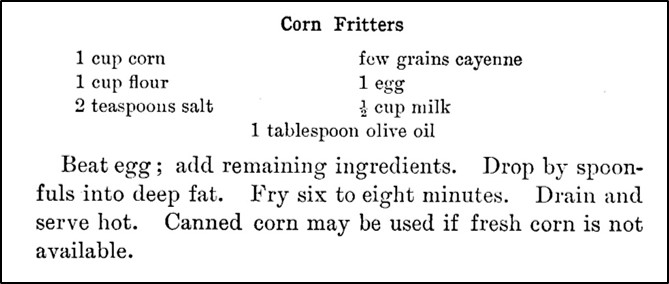
I found an incredible recipe for Corn Fritters in a hundred-year-old cookbook. The Fritters were crispy on the outside and contained just the right amount of corn. The recipe was perfect – it was both easy to make and tasty. Bring on the corn!
1 cup corn (fresh corn cut from the cob is best; canned creamed corn could also be used)
1 cup flour
1 teaspoon salt
dash red pepper
1 egg
1/2 cup milk
1 tablespoon olive oil
shortening or lard
Put flour, salt, red pepper, egg, milk, and olive oil in a mixing bowl; beat until combined. Add corn and stir until the corn is evenly distributed throughout the batter.
Heat 1/2 inch of shortening until hot in large frying pan. Drop spoonfuls of batter into hot shortening. Flip fritters and fry until golden brown on both sides. Remove from heat and drain on paper towels. Serve immediately.
Cook’s note: The original recipe called for 2 teaspoons salt. This seemed like a lot to me, so when I updated the recipe I only used 1 teaspoon.
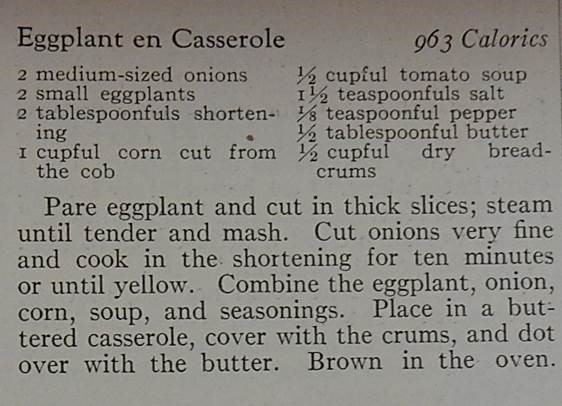
During these last days of summer I’m enjoying all the wonderful fresh vegetables, so when I saw a recipe for Eggplant en Casserole in a hundred-year-old magazine, I was intrigued and had to give it a try. The recipe had an old-fashioned goodness, with a taste and texture that was a little different from more modern eggplant casseroles.
The recipe is made with mashed eggplant that blended nicely with the other ingredients. In addition to the eggplant, the recipe called for corn and onion – as well as a little tomato soup, and it was topped with a crispy bread crumb topping.
2 small classic eggplants (approximately 4 cups mashed)
2 tablespoons shortening
2 medium onions, chopped
1 cup corn cut from the cob (approximately 1 cup)
1/2 cup tomato soup (I used canned tomato soup.)
1 1/2 teaspoons salt
1/8 teaspoon pepper
1/2 cup bread crumbs
1/2 tablespoon butter
Preheat oven to 375° F. Peel eggplants and cut into slices. Put into a steamer basket, and steam until tender (about 15 minutes). Remove from heat and mash.
In the meantime, melt the shortening in a skillet using medium low heat; add chopped onion and saute until tender. Stir in the mashed eggplant, corn, tomato soup, salt and pepper. Put into a casserole, cover with bread crumbs and dot with butter. Put in over and bake until hot and bubbly (about 1/2 hour).