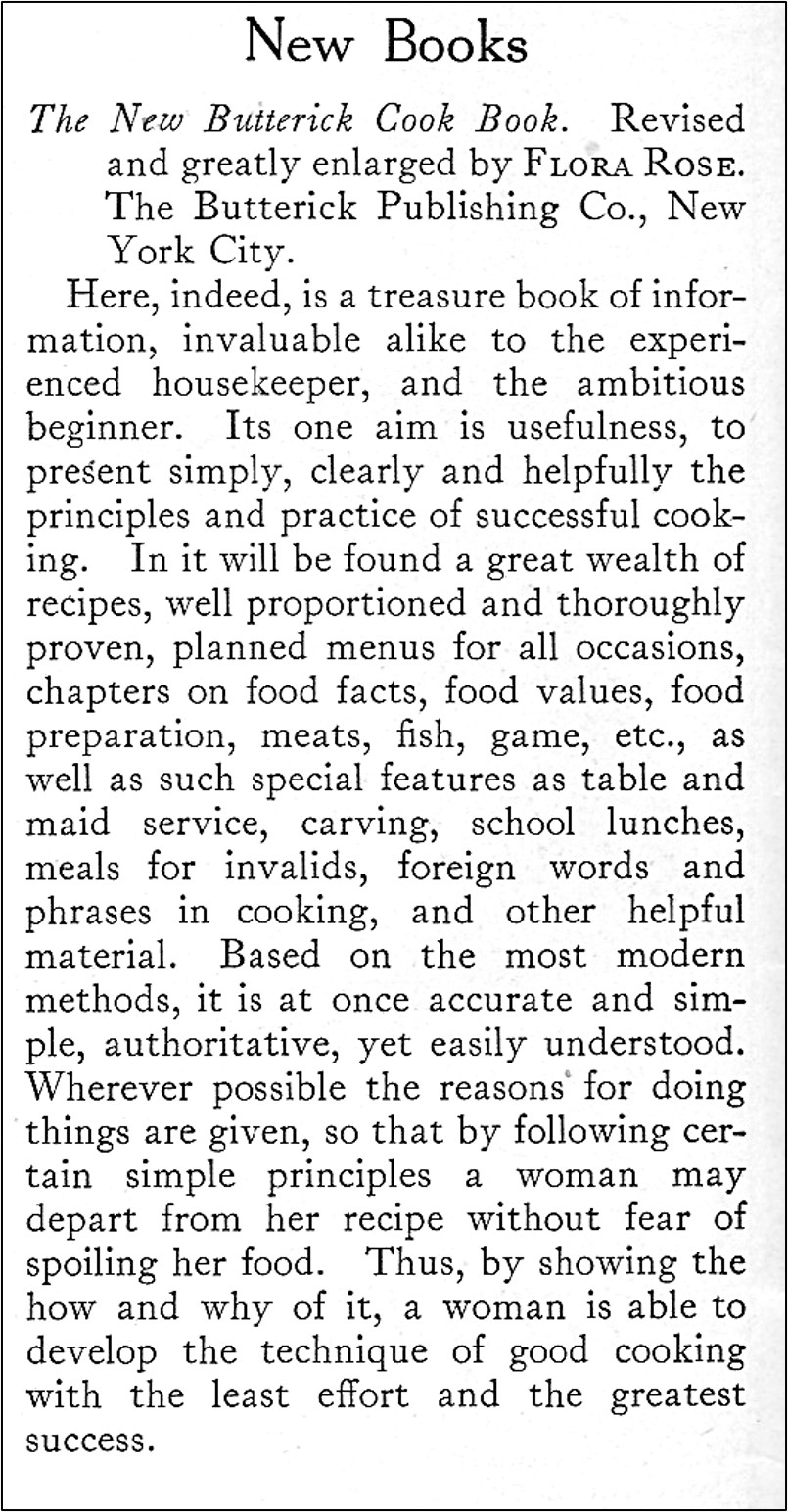
I recently flipped though the May, 1924 issue of American Cookery magazine and was surprised to discover a book review of a hundred-year-old cookbook that I’d purchased off eBay. It’s nice to know that the magazine liked The New Butterick Cook Book. I’ve enjoyed this cookbook, and have made several recipes that were in it.
When browsing through hundred-year-old cookbooks, I often skip the yeast bread section while thinking that breadmaking is too much work and too time consuming. But I recently had a little spare time – and thought that it might be relaxing to make bread – so I looked at the old bread recipes. The one that piqued my interest was a recipe for Raisin Bread. It had been year since I’d eaten Raisin Bread – and suddenly I was very hungry for it. (I know that I can buy it at the store, but I never do.)
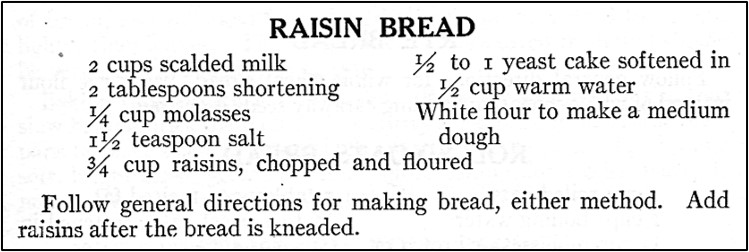
Here’s the original recipe:
Source: The New Butterick Cook Book, 1924
Sounds easy peasy. Right?
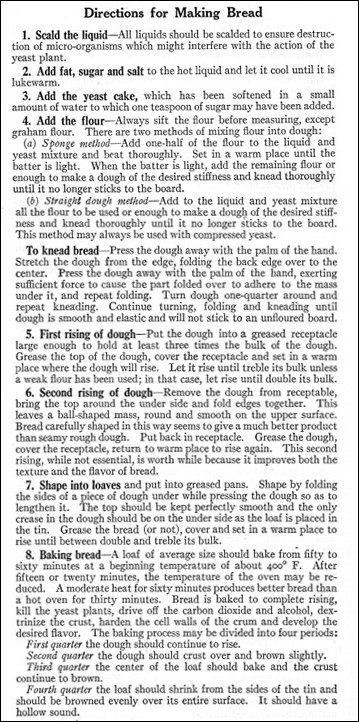
Next I found the general directions for making bread, as well as the directions for making white bread, and realized it was a little more complicated than I originally thought. Here are the general directions in the 1924 cookbook for making bread:
Source: The New Butterick Cookbook (1924)
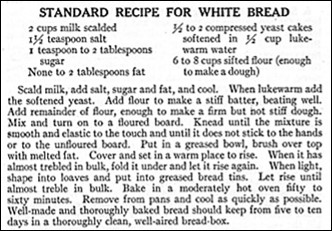
And, here is the “standard recipe for making white bread” that was in that cookbook:
Source: The New Butterick Cook Book, 1924
After reading all of these directions, I realized that this bread recipe is different from most other bread recipes that I’ve made. It called for allowing the bread to rise three times (rather than two times like I typically do), and instead of kneading the bread the second time, the directions called for folding the dough under. Also, the recipe indicated that the dough should be allowed to “almost treble” for the first and third times the dough was allowed to rise, while the second time, the dough should be allowed to rise until it was “light.”
My head was starting to spin, so I did several online searches, and discovered that bread dough can be allowed to rise three times (though there is a risk of the bread collapsing during baking if it is allowed to rise too much) – but that stretching and folding bread dough instead of kneading it the second time is gentler on the dough, so it reduces the risk of the bread collapsing. The online searches also indicated that folding the bread dough and allowing it to rise three times had the potential to improve the texture.
Since yeast cakes a hundred years ago, aren’t the same as modern dried yeast, I did another online search and determined that a yeast cake was about the same as a packet of dry active yeast. I used a packet of yeast when making this recipe.
As indicated in the old directions, I started baking the bread in a 400° F. oven. After 15 minutes, I reduced the heat to 350° F. After baking an additional 25 minutes (for a total of 40 minutes), the bread was nicely brown and sounded hollow when I tapped it, so I removed it from the oven. (I didn’t bake if for the 50 to 60 minutes called for in the old directions.)
Onward–
The verdict: This recipe was worth the effort. The Raisin Bread turned out great. It was tasty and had a lovely texture. It should be noted that most modern Raisin Breads contain cinnamon, but that this recipe didn’t call for any – so it tastes a little different than modern Raisin Breads. That said, this Raisin Bread is lovely warm, spread with butter, and sprinkled with cinnamon.
Scald the milk by heating to just below boiling (about 180 – 185° F.). Remove from heat and add shortening, molasses, and salt. Allow to cool until lukewarm.
In the meantime, chop the raisins (I cut each raisin into 3 – 4 pieces.). Then dredge the raisin pieces with approximately 1-2 tablespoons flour and gently stir to coat the pieces with flour. Set aside.
In the meantime, dissolve the yeast in the warm water. Combine the dissolved yeast, and lukewarm scalded milk mixture in a large bowl. Add half the flour; beat until smooth beat. Then add additional flour until the dough reaches a consistency where it can be handled. Turn onto a floured surface and knead until the dough is smooth and elastic (about 10 minutes). Flatten the dough and sprinkle about one-fourth of the chopped raisins on top; then fold over and knead a little more to incorporate the raisins. Repeat until all the raisins are embedded in the dough. Put in a large greased bowl, and grease the top of the dough. Cover and place in a warm spot that is free from drafts until it has almost tripled in size (about 1 1/2 hours).
Fold the dough by pulling each side of dough to stretch it, and then fold underneath the other dough. Cover and allow to rise until light (about 30 minutes). Divide dough into two equal parts and shape into loaves. Place in two greased loaf pans, and cover. Let rise until tripled in size (about 1 hour).
Bake loaves in 400° F. oven for 15 minutes, then reduce heat to 350° F and continue baking until lightly browned (about an additional 25 minutes for a total of about 40 minutes).
Each morning my husband reads Morning AgClips. A few days ago, he said, “You’ve got to read this. You have a seriously strange hobby.” He was referring to an article titled, SeriouslyStrange Hobbies You Didn’t Know About.
I read the article and learned about Extreme Ironing where people iron clothes while rock climbing and sky diving, about Cheese Rolling where rounds of cheese are rolled down a hill, and about Soap Bubble Art where people use a variety of techniques to create interesting effects with soap bubbles. And, then the article went on to describe . . . drum rolls please . . . Historical Cooking which “which involves trying out recipes from the past.”
Oh, my goodness, who knew? Do I have a seriously strange hobby?
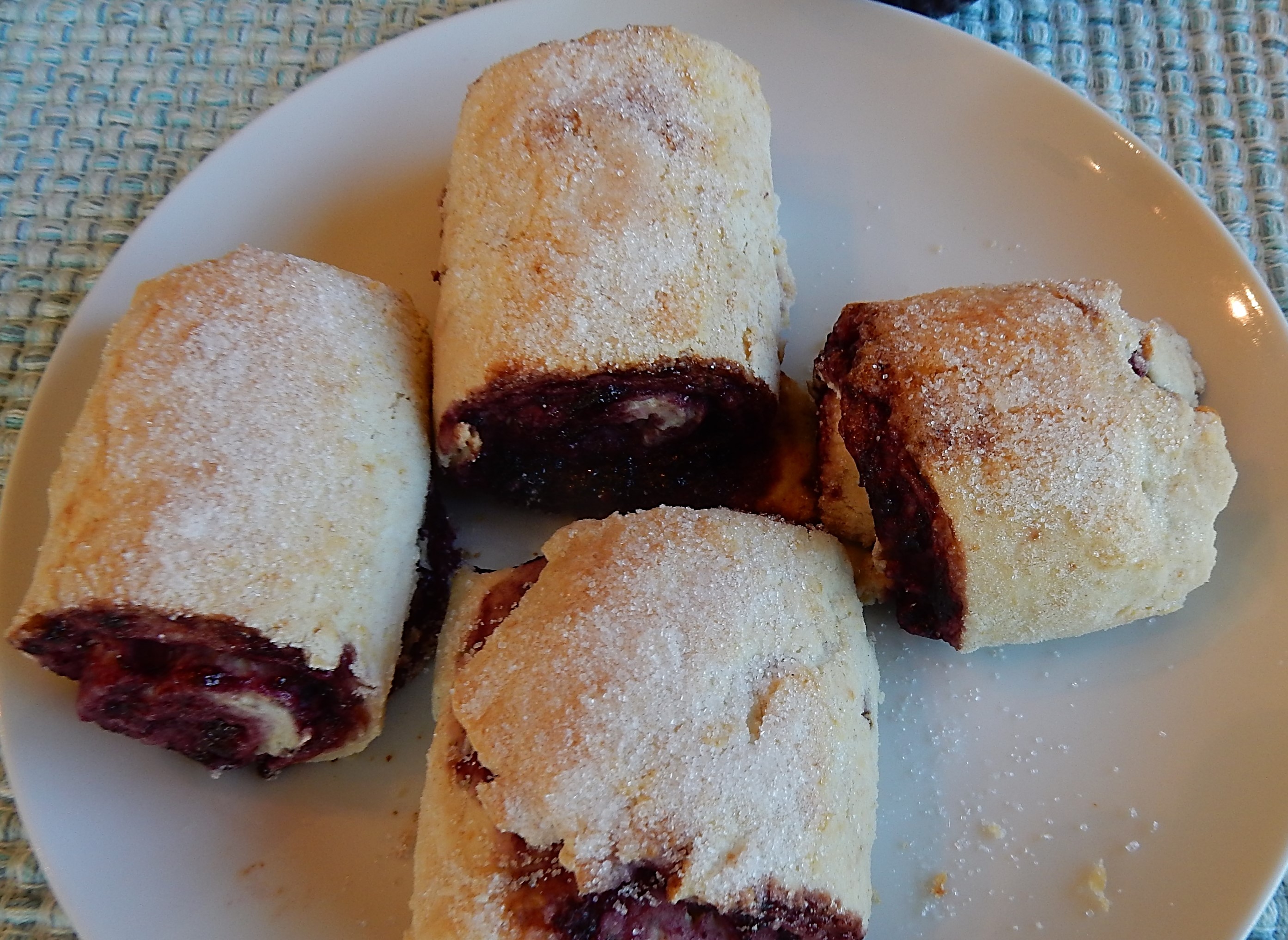
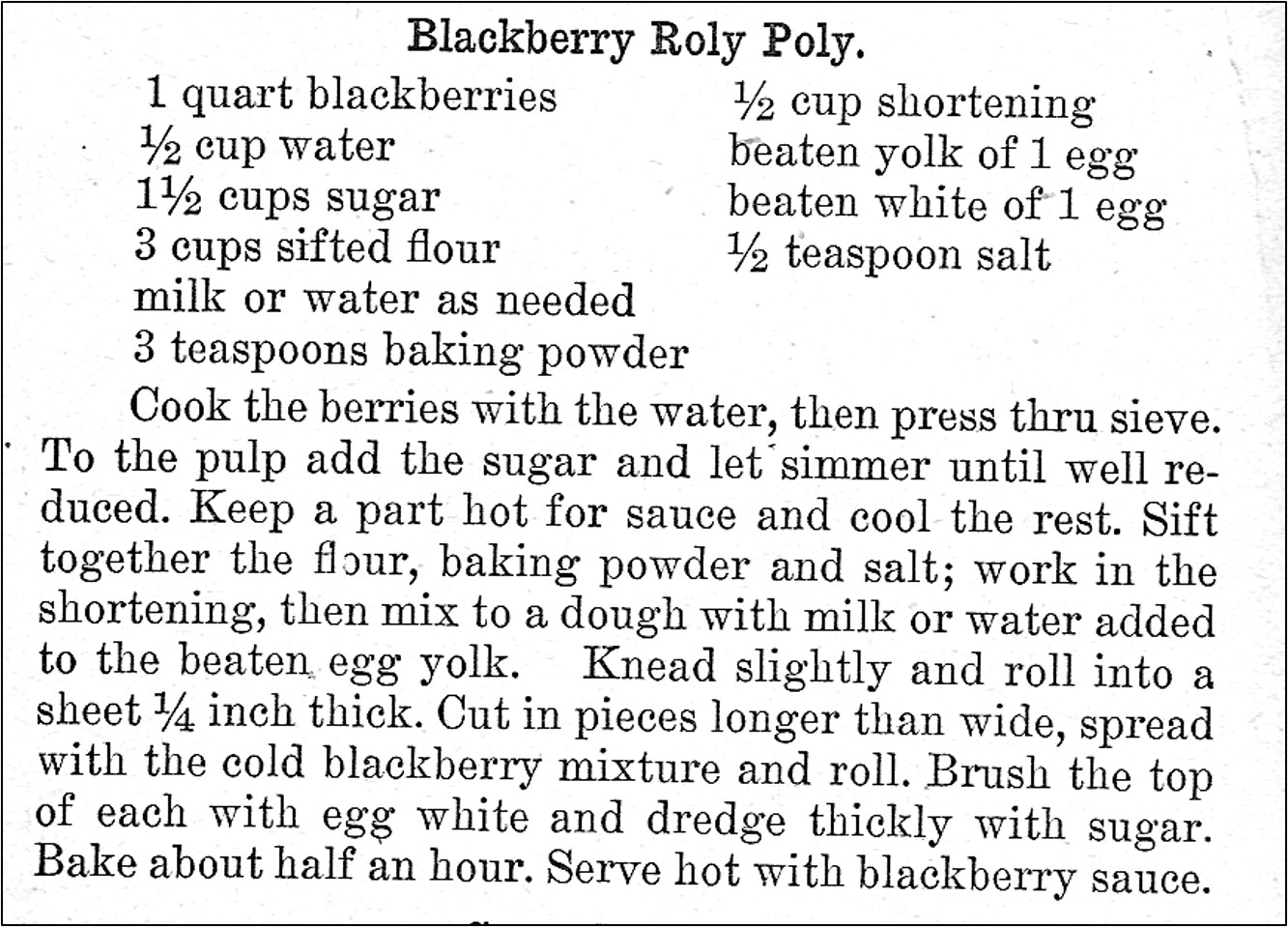
It’s berry season – and time to make berry desserts. I recently came across a recipe in a hundred-year-old cookbook for Blackberry Roly Poly and decided to give it a try. Rectangles of pastry are topped with a sauce made from fresh blackberries, and then rolled and baked. The roly polys are served hot, smothered in additional raspberry sauce.
The BlackBerry Roly Polys were delightful. The pastry was flaky and lovely with the embedded blackberry sauce and topping.
Source: The New Home Cook Book: 1924 Edition, Published by Illinois State Register, Springfield, Illinois
1 egg, separated (lightly beat, separately, the yolk and white)
Put the blackberries in a saucepan and add 1/2 cup water. Using medium heat, bring to a boil. Then reduce heat and simmer until the berries are very soft; stir periodically. Remove from the heat and press the cooked berries through a sieve. (I used a Foley mill.) Rinse out the saucepan, then put the strained pulp back into the pan. Stir in 1 1/2 cups sugar. Bring to a boil using medium heat, then reduce heat and simmer until the sauce thickens while stirring periodically (about 20-30 minutes). Remove from heat and cool.
In the meantime, Preheat oven to 425°. Sift together the flour, baking powder, and salt, then cut in the shortening. Add beaten egg yolk and 1/2 cup water; mix using a fork until dough starts to cling together. If needed, add additional water. (If desired, a food processor can be used to make the dough.) Knead dough slightly then roll part of the dough into a rectangle 1/4 inch thick. Cut into small rectangles each about 4″ by 2″. Spread the cooled blackberry sauce onto the small rectangles, and then roll. (Reserve about a quarter of the sauce to use when serving.) Put on a baking sheet. Brush with egg white, then generously sprinkle with sugar. Bake until lightly browned (about 1/2 hour).
Serve hot with the reserved blackberry syrup that has been reheated .
According to a hundred-year-old cookbook, there are four reasons for using a pressure cooker:
Value of a Steam Pressure Cooker
Less time for cooking – Whatever food is inside the pressure cooker is subjected to moist heat at a high temperature and cooks in much less time than it would at an ordinary temperature in an ordinary kettle. This fact has advantages for the housekeeper who has to meet emergencies in hasty preparation of meals.
Cereals may be deliciously cooked in twenty minutes in the pressure cooker, as compared with three hours of cooking on the stove. Beans may be well cooked in forty minutes instead of requiring five or six hours of cooking on the stove. A steamed pudding placed in the pressure cooker is ready to serve after being cooked for thirty minutes under ten pounds of pressure. Three hours would be required to accomplish this in any other way.
Even beef neck or flank, which would required from three to five hours of cooking on the stove, may be cooked in forty minutes in the pressure cooker.
Less fuel used – In most pressure cookers, only a short period of time is required to attain ten pounds of pressure. A low fire will maintain the pressure throughout the cooking process.
Micro-organisms killed – Micro-organisms that cause spoilage in canned foods are killed at the high temperature made possible by the use of steam under pressure.
Thorough cooking – The combination of high temperature and moist heat attained by the pressure cooker is probably more effective than any other methods of cooking for making certain foods digestible and tender. Cereals, with their large proportion of cellulose, and meats with tough fiber are among such foods.
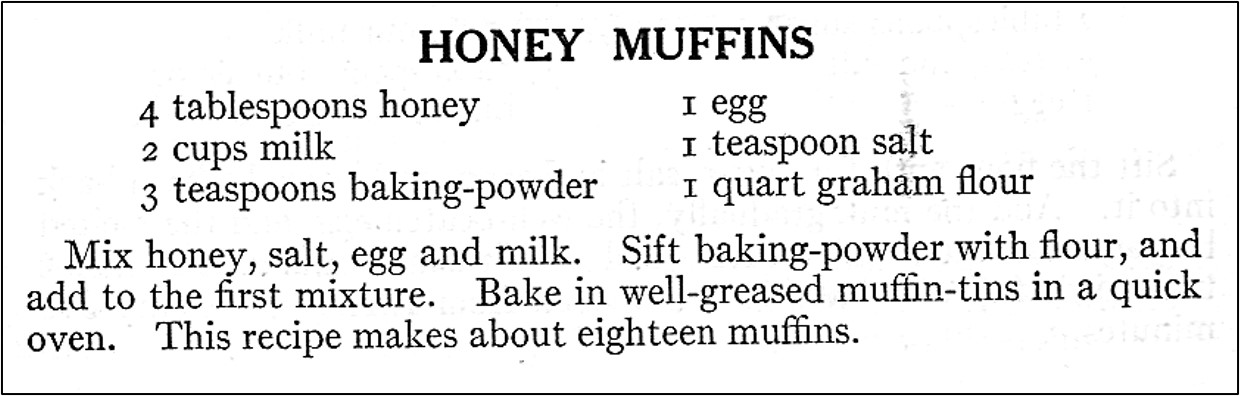
I’m a fan of muffins, so when I saw a recipe for Honey Muffins in a hundred-year-old cookbook I decided to give it a try. In addition to honey, the recipe called for graham flour. Graham flour is a coarsely ground whole wheat flour that contains the endosperm, the bran, and the wheat germ. It is traditionally considered a health food.
The Honey Muffins were not very sweet, but tasted good in a “healthy way.” They are a fairly dense muffin. They were lovely when served with jelly or jam.
Here’s the original recipe:
Source: The New Butterick Cook Book (1924)
Graham flour is sometimes difficult to find. Whole wheat flour, preferably coarsely ground whole wheat flour, can be substituted for the graham flour.
4 cups graham flour (whole wheat flour – preferably coarsely ground – can be substituted for the graham flour)
3 teaspoons baking powder
4 tablespoons honey
1 egg, beaten
1 teaspoon salt
2 cups milk
Preheat oven to 400° F. Sift the baking powder and graham flour into a mixing bowl.
Put the honey, egg, salt, and milk in a separate bowl; stir to combine. Then add to the flour mixture and stir to combine.
Grease muffin pans (or use paper liners). Spoon batter into muffin cups; fill each cup about 3/4ths full. Place in oven. Bake 20-30 minutes or until lightly browned and the muffins spring back when lightly touched.
Somehow I don’t think that having a box of tapioca in my cupboard will resolve my terror of unexpected company – but maybe it’s just me. Others may find tapioca very useful in this situation.