There’s an old saying that when a hog is butchered you can “eat everything but the squeal.” An image in a hundred-year-old cookbook suggests that this is an accurate statement. According to the cookbook, even the tail can be eaten. It says that the tail is an economical cut that can be boiled or sautéed. . . . Who knew?
Here’s some more pork facts that were in the old cookbook:
Facts to Remember about Pork
When pork is in proper condition the skin and fat are white and clear, except the kidney or leaf lard which is slightly pinkish in hue. The flesh is composed of fine-grained tissues and is pink in color.
The thicker the skin of pork the older the animal from which it was cut.
Pork contains a larger proportion of fat than any other meat. Consequently its food value is higher and special care should be taken in selecting other foods to combine with it.
Pork should always be thoroughly cooked. It is not only distasteful but even dangerous to health when underdone.
Ham that is very salty should be freshened before cooking. A slice is freshened by being covered with cold water and brought slowly to the simmering point. A whole ham should stand in cold water over night or at least for several hours.
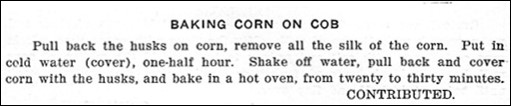
I love corn on the cob, and make it several times a week during the peak season. I’ve always boiled the corn, but was intrigued by a hundred-year-old recipe for Baking Corn on Cob, and decided to give it a try.
The recipe called for pulling the husk back and removing the corn silk, then soaking in water. After the corn has soaked for half an hour, the husk is pulled back into place, and the corn is baked.
The verdict: The corn was tasty, and the cooked corn was attractive in the husk. Baking the corn on the cob is a nice variation.
Here’s the original recipe:
Source: Cook Book of the Susquehanna Valley Country Club, Sunbury, PA (1924)
Pull back the husks on the corn, and remove all the silk. Put the corn (with the pulled-back husks) in a large pan of cold water; let soak for 1/2 hour.
Preheat oven to 400° F. Remove the corn from the pan, and shake off the water. Pull the husks back into place and cover the corn with the husks. Put directly on the wire rack in the oven; bake 30 minutes.
The husk can either be removed before serving or it can be served with the husk still on.
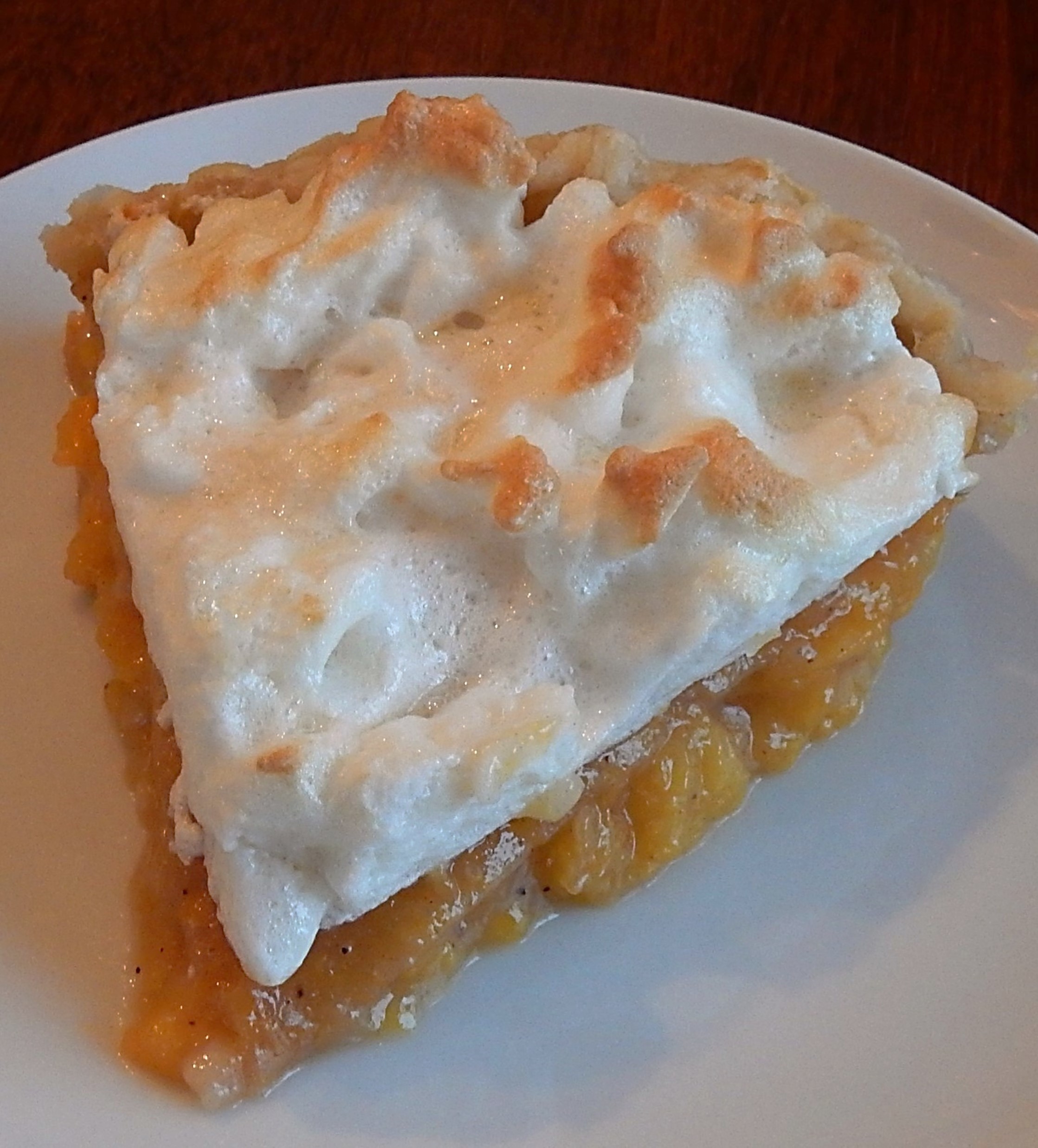
We’re getting to the peak of peach season. Succulent peaches are wonderful fresh, and are also wonderful when baked into various delectable desserts. I recently came across a recipe for Peach Meringue Pie in a hundred-year-old cookbook, and decided to give it a try.
The pie was a winner. The peach filling was sweet with a hint of tartness, and the meringue topping was refreshingly light with a nuanced vanilla flavor which nicely balanced the peaches.
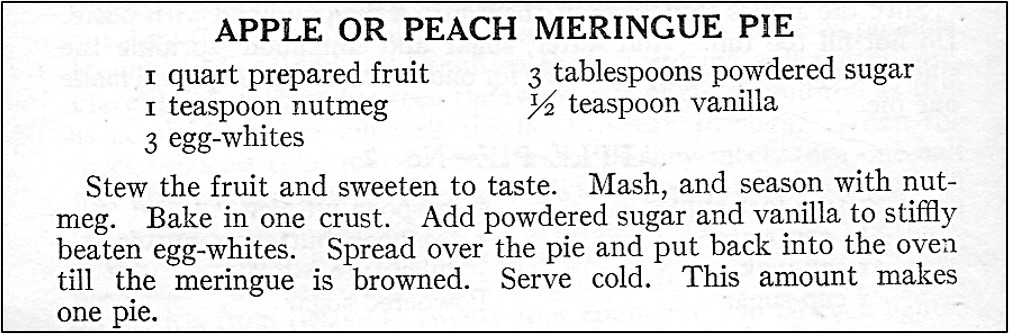
Here’s the original recipe:
Source: Butterick Cook Book (1924)
I’m not sure why the recipe called for cooking and mashing the peaches prior to putting them in the pie shell, but I followed the directions. Maybe the recipe author did not want distinct slices of peach in the baked pie.
I sweetened the peaches with 1/2 cup sugar. When I made this recipe the cooked peaches were very juicy -and I knew that they would not hold their shape in a pie, so I added 1/4 cup of flour. This worked well, and the cooked peach pie filling was an appropriate consistency when the pie was baked.
It’s intriguing that the old recipe indicated that the recipe was for either apple or peach meringue pie. I would think that the spices that are used in an apple pie would be somewhat different than the spices in a peach pie. Similarly, I would think that more flour would be needed to thicken the filling of a peach pie than an apple one (though, of course, no flour or other thickener was called for in the old recipe).
Preheat oven to 400° F. Put the sliced peaches and the sugar in a saucepan; stir together. Using medium heat bring to a boil while stirring occasionally; simmer, until the peaches are soft, while continuing to stir occasionally (about 5 minutes). Remove from heat and mash the cooked peaches. (I used a potato masher). It is okay if the mashed peaches are chunky. Stir in the flour and nutmeg. Put the peach mixture into the pie shell and bake in oven until the filling begins to bubble, and the crust is lightly browned.
In the meantime, make the meringue. Place egg whites in a bowl, and beat the egg whites until they form stiff peaks. Gradually add powdered sugar and vanilla while continuing to beat. Then spoon on top of the pie and swirl. Reduce oven temperature to 350° F. Return pie to oven and cook for an additional 8-10 minutes or until the meringue is lightly browned.
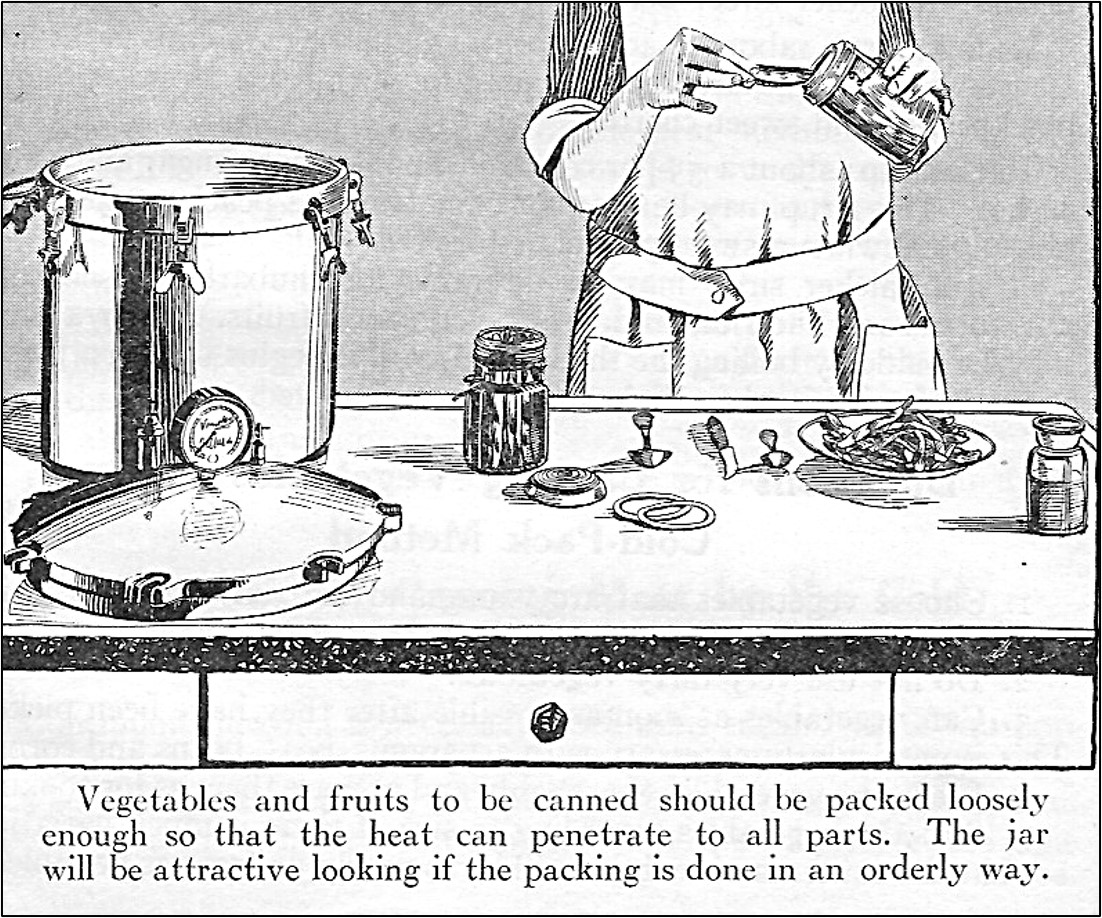
Venders at the farmers market often have bushel baskets filled with fruits and vegetables, but I’m never sure how many quarts of canned goods they’ll yield, so I was pleased to find a canning guide in a hundred-year-old cookbook. Many things change over time, but I assume that yield ratios stay the same.
I was intrigued by a recipe in a hundred-year-old cookbook for Cucumber Sauté, so decided to give it a try. Cucumber spears are briefly boiled, then rolled in flour and sautéed.
The Cucumber Sauté spears were slightly crunchy and very tasty.
Here’s the original recipe:
Source: The New Butterick Cook Book (1924)
Except for the number of cucumbers, the amounts are not listed for any of the ingredients. When I updated the recipe, I added amounts for some of the ingredients.
2 tablespoons minced parsley or chives (I used parsley)
Fill a saucepan about 2/3’s full of water; bring to a boil using high heat.
In the meantime, peel the cucumbers, and then quarter them lengthwise. Put the quartered cucumbers into the boiling water, reduce heat so the water simmers and cook the cucumbers 3 minutes. The drain the cucumbers and lay on a paper towel to eliminate any excess moisture.
In the meantime, combine the flour, salt, and pepper. Then roll the cooked cucumbers in the flour mixture.
In a skillet, heat enough butter or cooking oil to cover the bottom of the pan. When hot, add the floured cucumbers. Cook until they begin to lightly brown, then turn and lightly brown the other side. When the cucumbers are turned add the parsley or chives and evenly distribute over the cucumbers. When lightly browned on both slides remove from heat, drain on paper towels, and serve.
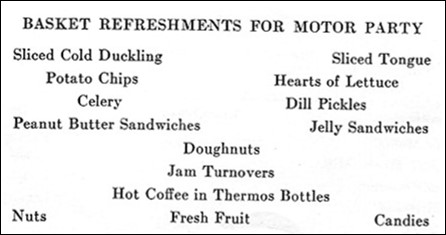
I recently came across a menu for basket refreshments for a motor party in a hundred-year-old magazine. A motor party picnic sounds like so much fun. If I could only get in a time machine, and go back to the early days of automobiles, dirt roads, and adventures. I’d wear a short dress that only came to my knees (this was the flapper era) and a huge bonnet with ribbons that tied under my chin. I’d put the refreshments in a wicker basket; and, I’d spend all morning cooking and packing refreshments for the trip. We’d drive out into the country and spread out a blanket in a grassy field, and then lay out the spread of food.
Things start to get blurry – Is this motor party a date? An event with friends? A family trip?
Then I come back to reality, and 2024. Sigh. . . maybe I should pack a picnic lunch and take it a nearby park. Somehow it just doesn’t seem the same.





 I was intrigued by a recipe in a hundred-year-old cookbook for Cucumber Sauté, so decided to give it a try. Cucumber spears are briefly boiled, then rolled in flour and sautéed.