I have a lot of fun making hundred-old-recipes. Often old recipes have less detailed directions than modern ones, and I need to try to interpret what the recipe author meant. Usually it is fairly easy to figure out what to do, but occasionally an old recipe just leaves me scratching my head. This is one of those times. Here’s the original recipe for Marshmallow Pudding:
Cook Book of the Susquehanna Valley Country Club, Sunbury, PA (1924)
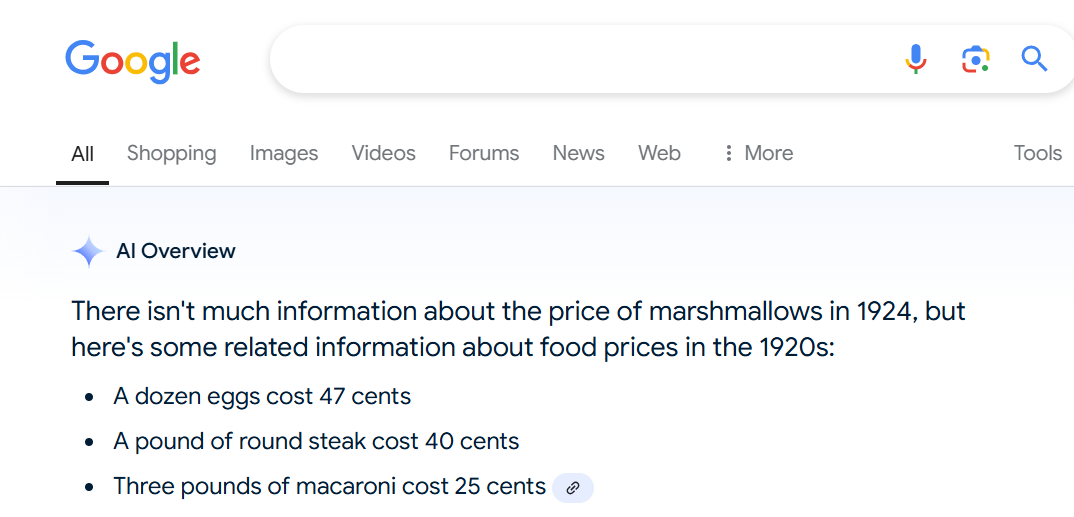
What the heck is 10¢ worth of marshmallows and 10¢ worth of shelled nuts? I quickly did a few online searches with relatively little luck. Amazingly even the artificial intelligence (AI) feature in my search engine doesn’t know what marshmallows cost in 1924. (I thought that AI took at stab at answering all questions and would try to give me a price for marshmallows. Rather it redirected me to the prices of eggs, round steak, and macaroni in 1924.)
I decided to use with 3 cups miniature marshmallows and 1/2 cup chopped walnuts. I have not idea whether this is similar to what the recipe author used, but it worked okay.
I used canned pineapple tidbits when making this recipe. The old recipe calls for chopped pineapple. I had a vague memory that years ago gelatin packages said not to use fresh pineapple when making gelatin, so did another search that was more successful. Gelatin won’t set when mixed with fresh pineapple because of an enzyme it contains; however, it will set if canned pineapple is used.
I had difficulty getting the gelatin dissolved. One tablespoon cold water plus 2 tablespoons boiling water just did not seem like enough liquid to get it successfully dissolved. I ended up heating 1/4 cup of pineapple juice (from the canned pineapple) and adding that to the gelatin that I was trying to dissolve.
I assumed that “1-3 cup sugar” meant “1/3 cup sugar.” I also assumed that “1 pint whipped cream”, meant 1 pint of unwhipped heavy cream that I then whipped.
The verdict: My interpretation of this recipe was very nice. The Marshmallow Pudding was creamy and sweet with bits of tart pineapple and crunchy walnuts. It reminds me of similar dishes that I’ve had at reunions, pot luck dinners, and family gatherings over the years.
1 cup canned pineapple tidbits, drained (Reserve 1/4 cup pineapple juice)
2 cups heavy whipping cream
1/3 cup sugar
3 cups miniature marshmallows
1/2 cup walnuts, chopped
Place the cold water in a small bowl; then sprinkle the gelatin over the 1 tablespoon cold water. Let the gelatin absorb the water and soften for a few minutes. In the meantime, heat 2 tablespoons of water plus 1/4 cup pineapple juice to boiling. Reduce heat to low and stir in softened gelatin; stir until dissolved. Add 1/3 cup sugar; stir until dissolved. Remove from heat. Set aside and allow to partially cool.
Put the whipping cream in a bowl. Beat until stiff peaks form. Gently stir in the dissolved gelatin and sugar. Fold in the pineapple tidbits, miniature marshmallows, and walnuts. Put in serving bowl. Refrigerate until chilled (at least 2 hours).
Need some ideas for a Halloween dinner? Look no further than the October, 1924 issue of American Cookery magazine. The menu calls for serving 16 foods plus coffee. Whew, what a lot of food! That said, I’m off to a good start making the foods on the menu:
I love browsing through hundred-year-old cookbooks and selecting recipes to make for this blog. Generally I choose recipes that I think I will enjoy. But, old cookbooks also contain some recipes that seem very unusual and that I don’t think that I will like. I tend to ignore those recipes, but occasionally I’m intrigued enough to give one a try – while not having very high expectations. The recipe that I’m sharing this week is one of those times.
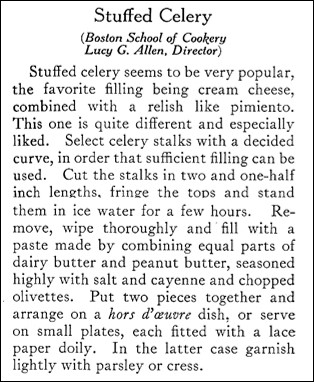
I made Stuffed Celery. The recipe called for “fringing” celery pieces with a knife, putting in ice water for several hours, and then stuffing and putting two pieces together and standing on a plate. What seemed really unusual was that the stuffing contained butter, peanut butter, salt, cayenne (red) pepper, and chopped olives. I couldn’t even begin to imagine what this mixture might taste like, but definitely had my doubts that I’d like it.
The verdict: The Stuffed Celery looked very dramatic, though some of the pieces didn’t want to stay together or stand for very long. The stuffing mixture actually tasted okay (not incredible, but it was not terrible). It was definitely a case where something tasted better than it sounds.
Here’s the original recipe:
Source: American Cookery (October, 1924)
I’m not sure what olivettes are, but I interpreted it to mean olives. When I made this recipe I used stuffed green olives that I finely chopped.
2 tablespoons stuffed green olives, finely chopped
Select the large curved stalks of celery in the bunch, wash, and then cut into 2 1/2 inch pieces. (Save small stalks and pieces for use in other recipes.) Fringe the top of the celery by making vertical cuts close together in the top half of each piece of celery. Stand the fringed celery in ice water for 2-4 hours.
In the meantime put the butter, peanut butter, salt, and cayenne pepper in a small bowl; stir until thoroughly mixed. Add chopped olives and stir until evenly distributed.
After 2-4 hours remove celery pieces from the ice water and wipe dry. Fill the bottom portion of each piece of celery with the peanut butter mixture. Put two pieces together, and wipe with a paper towel to remove any excess peanut butter mixture, then stand on a plate. The bottom edges of the celery may be trimmed if needed to make them level so they will stand better.
Source: Canadian Grown Apples: Delight in Every Bite (1924)
Many popular apple varieties today did not exist a hundred years ago; and some popular varieties a hundred years ago are seldom seen today. Both now and then, there were lists of which apple varieties were best for different uses. Today lists often refer to apples for eating, and cooking or baking. A 1924 list refers to apples for cooking, dessert apples, and cider apples. Were dessert apples ones that were particularly good to eat raw?
Government agencies have produced cookbooks for more than a hundred years that promote the use of local foods. I recently came across a small apple cookbook published in 1924 by the Fruit Branch of the Canada Department of Agriculture. The introduction to the book says that “Canada produces the best flavoured, most highly coloured and longest keeping apples.” I can’t vouch for the accuracy of that statement, but I can say that the book has some good recipes – though I used possibly inferior (??) U.S. apples.
One recipe was for Apple and Coconut Pie. The pie was delightful. This recipe takes a classic pie, and adds a fun tropical twist to it.
Here’s the original recipe:
Source: Canadian Grown Apples: Delight in Every Bite (1924)
I used cinnamon rather than lemon. When I made this recipe, in addition to flavoring the apples with sugar and cinnamon, I stirred in a little flour to help ensure that the pie won’t be overly juicy.
The recipe author spelled “cocoanut” with an “a.” I think that this is considered an archaic spelling now, so when I updated the recipe, I spelled it without an “a.”
Preheat oven to 425 degrees. Put sugar, cinnamon, and flour in a small bowl; stir to combine. Add the sugar and cinnamon mixture into the sliced apples; gently stir until the apples are coated with the mixture. Set aside.
Sprinkle 1/2 cup of the coconut on the pie shell, then add the apple mixture. Bake at 425 degrees for 15 minutes. Reduce heat to 350 degrees, and bake an additional 30 minutes or until the apples are soft. Sprinkle 1 cup of coconut on top of the hot pie. Return to the oven and bake for an additional 5 minutes, or until the coconut is just barely beginning to brown. Remove from oven.
Today we have margarine and spreads that are substitutes for butter. A hundred years ago there was a spread (or oleomargarine – not sure why it wasn’t just called margarine back then) called Nucoa that was made using a mixture of coconut and milk. I did a search on the name, and it looks like it may be still available in some areas (though I don’t think that it contains milk anymore), but I never heard of it.