16-year-old Helena Muffly wrote exactly 100 years ago today:
Saturday, September 16, 1911: This Saturday was rather dull. I did some mending this afternoon I have four or five problems. I should have worked tonight, but will procrastinate if until tomorrow or some other convenient time only so I have them done by Monday noon.
Her middle-aged granddaughter’s comments 100 years later:
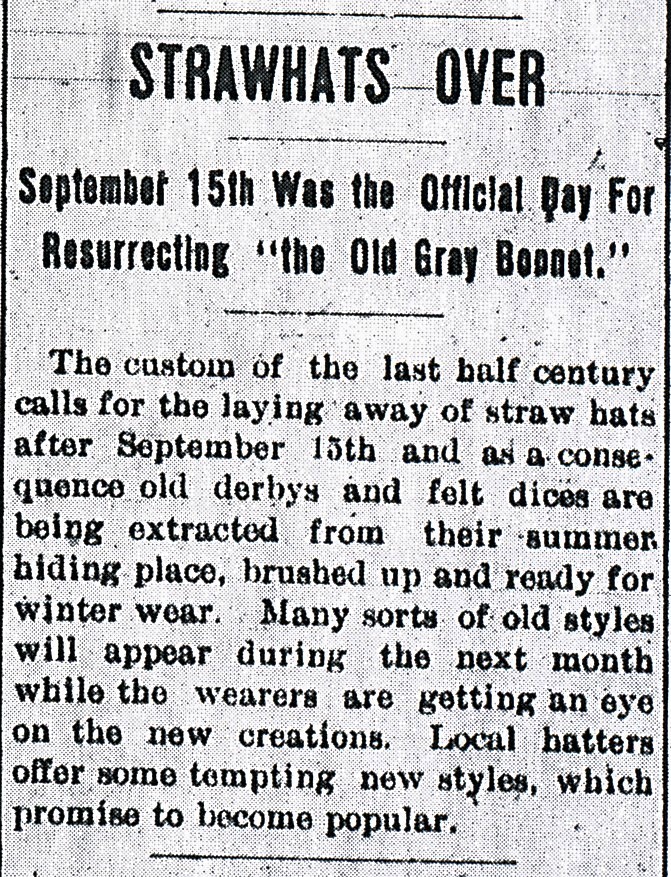
It’ sounds like a boring afternoon. . . I wonder if Grandma felt down because fall was fast approaching and straw hat season was over:
16-year-old Helena Muffly wrote exactly 100 years ago today:
Friday, September 15, 1911: Had visitors at school today, but fortunately they didn’t stay very long. I’m so nervous on such occasions for fear I’ll make a break in reciting at class. More so if the visitor is an important one.
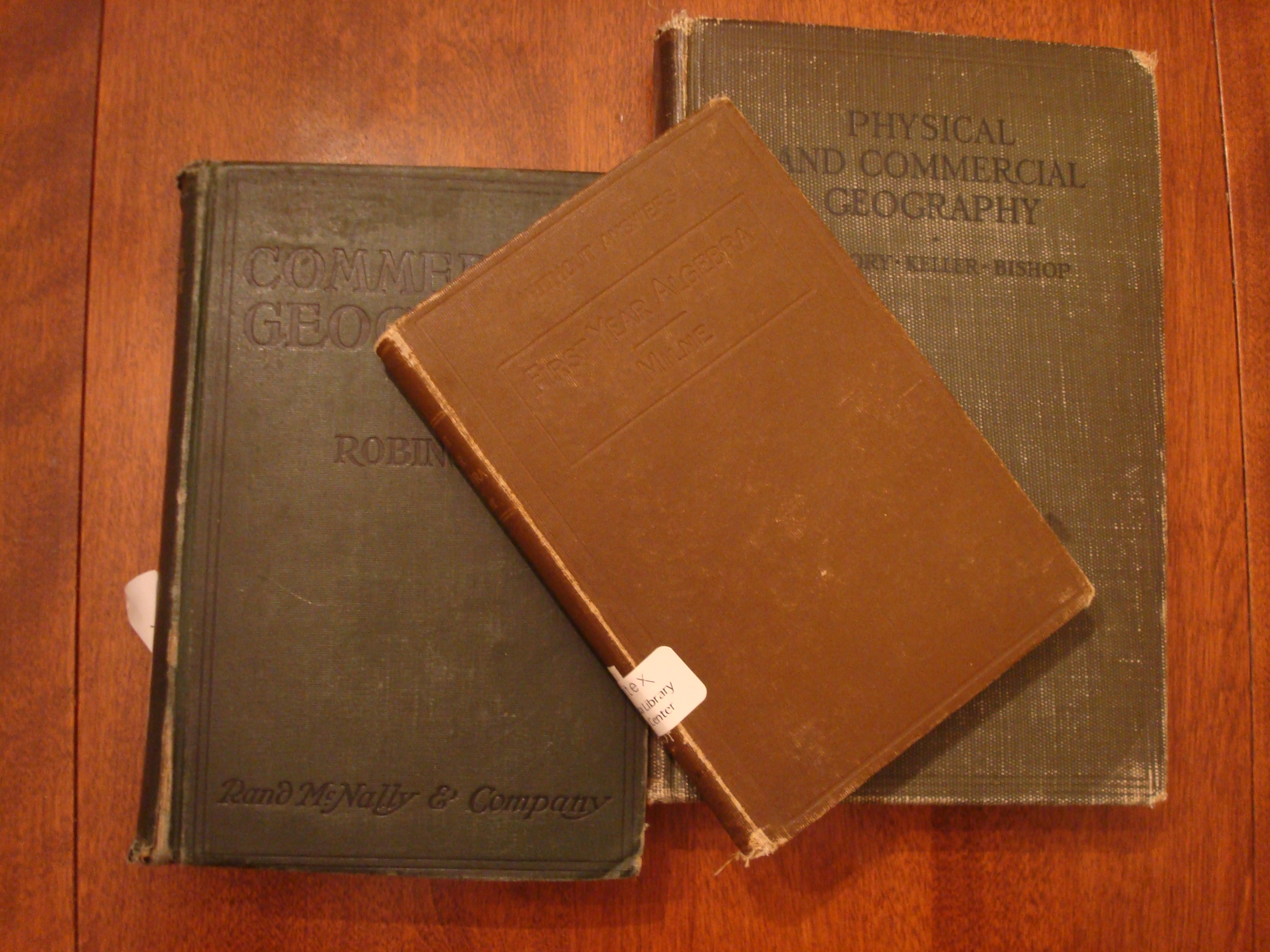
Textbooks published in 1910 and 1911.
Her middle-aged granddaughter’s comments 100 years later:
Since the high school had had a substitute teacher since the beginning of the school year, I’m guessing that school board members or the county superintendent of schools visited the school to see how things were going.
When I read this entry I wasn’t quite sure what reciting meant in this context—though it had a negative connotation and made me think about students’ memorizing poems.
I was surprised to discover that recitation referred not only to orally presenting memorized text, but also to orally responding to questions by the teacher. And that it was commonly used with small groups of students in multi-grade classes. Some students would be working with the teacher while others were working independently.
The one-teacher country school regularly faces the challenge of a wide range of grade levels and academic growth. One response to the multi-age conditions of this naturally small institution is a teacher’s regular use of “recitation” lessons with individual and small groups of students. This pedagogical device is a common legacy of the one-teacher country school. . .
. . . This instruction involved little more than the teacher lecturing and students reciting memorized passages or orally answering a series of questions as directed by the teacher’s textbook guide. Student learning was determined through the accuracy of the recitation and appropriateness of responses to teacher questions. Students were then introduced to the next topic and their assignment in the textbook. They were expected to work quietly and individually on their preparations for recitations.
It requires a good deal of self-discipline on the part of the student. “Doing school” for the students means continually keeping up with one’s work, knowing that you will face the teacher regularly, and understanding that neither is a choice. It is traditional in the sense that is presents itself as common sense, or just the way things are done.
While very few would advocate this as an acceptable model of instruction in public schools today, the form of the country school recitation, with its predictable student-teacher interaction and emphasis on independent work, nonetheless appears today as a sensible practice for curriculum and student management.
“Notes on a Country School Tradition; Recitation as an Individual Strategy,” by Stephen Swidler (Journal of Research in Rural Education, Spring 2000)
This description brings back memories of my mother. She taught in a one-room school-house for a year or two when she was in her early twenties. She used to say that she thought that multi-grade classrooms were the best place for learning. Students who excelled could listen to the lessons directed at an upper grade class and accelerate their learning.–and the student who was behind could discretely listen to the material being taught to a lower grade. It gave the child the opportunity to relearn the material that he or she hadn’t grasped the previous year without embarrassment.
16-year-old Helena Muffly wrote exactly 100 years ago today:
Thursday, September 14, 1911: Besse was out today again and to school I went with a rejoicing heart. I may not have felt just exactly that way, but was glad I didn’t have to miss school.
Her middle-aged granddaughter’s comments 100 years later:
Things were very hectic at the Muffly’s because many men were there helping them thresh the grain (see the yesterday’s entry). Grandma was concerned that she’d need to skip school to help her mother prepare and serve meals; fortunately her married sister Besse came home to help.
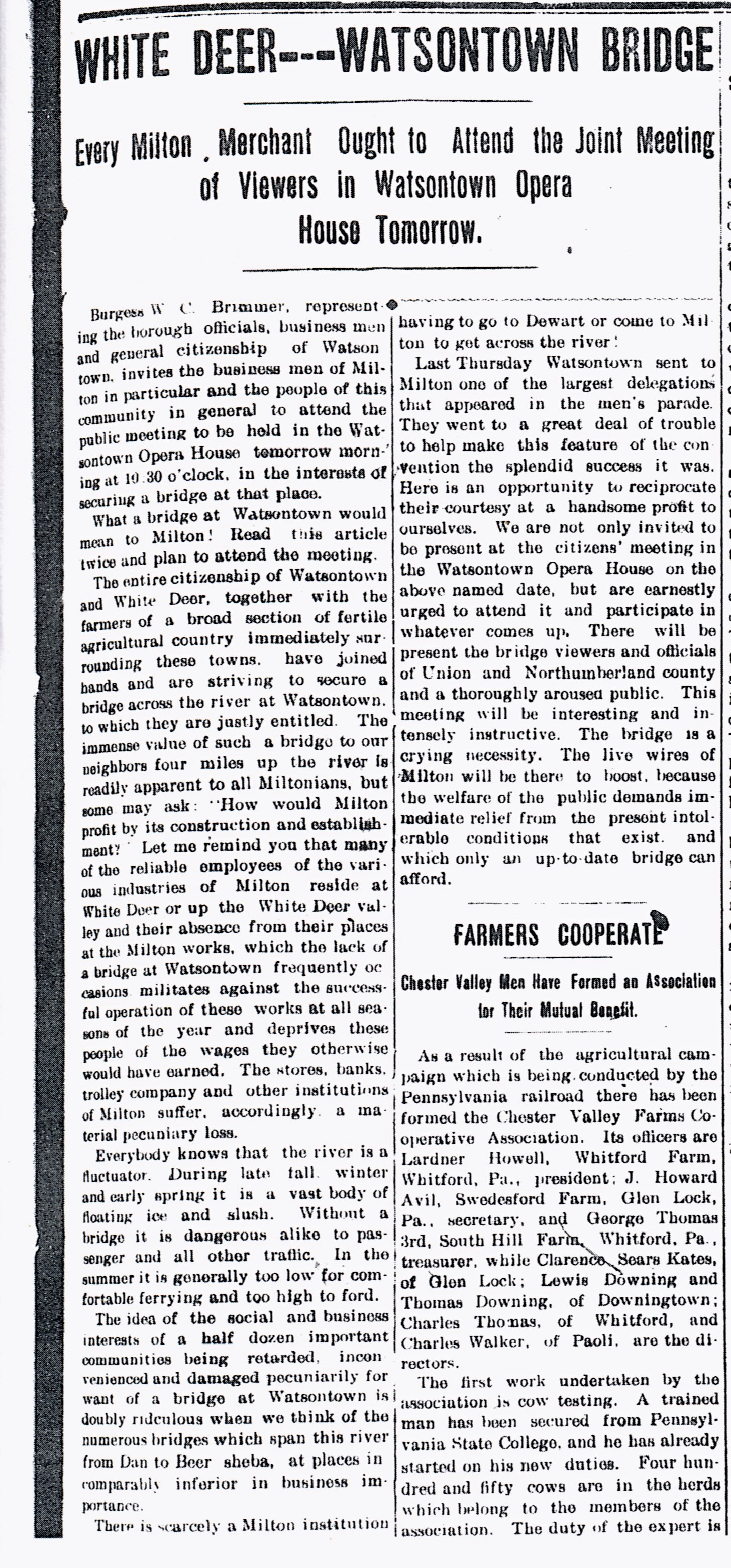
I’m going to share an article that was published in the Milton Evening Standard a hundred years ago today. It discussed the pros and cons of building a bridge across the river at Watsontown.
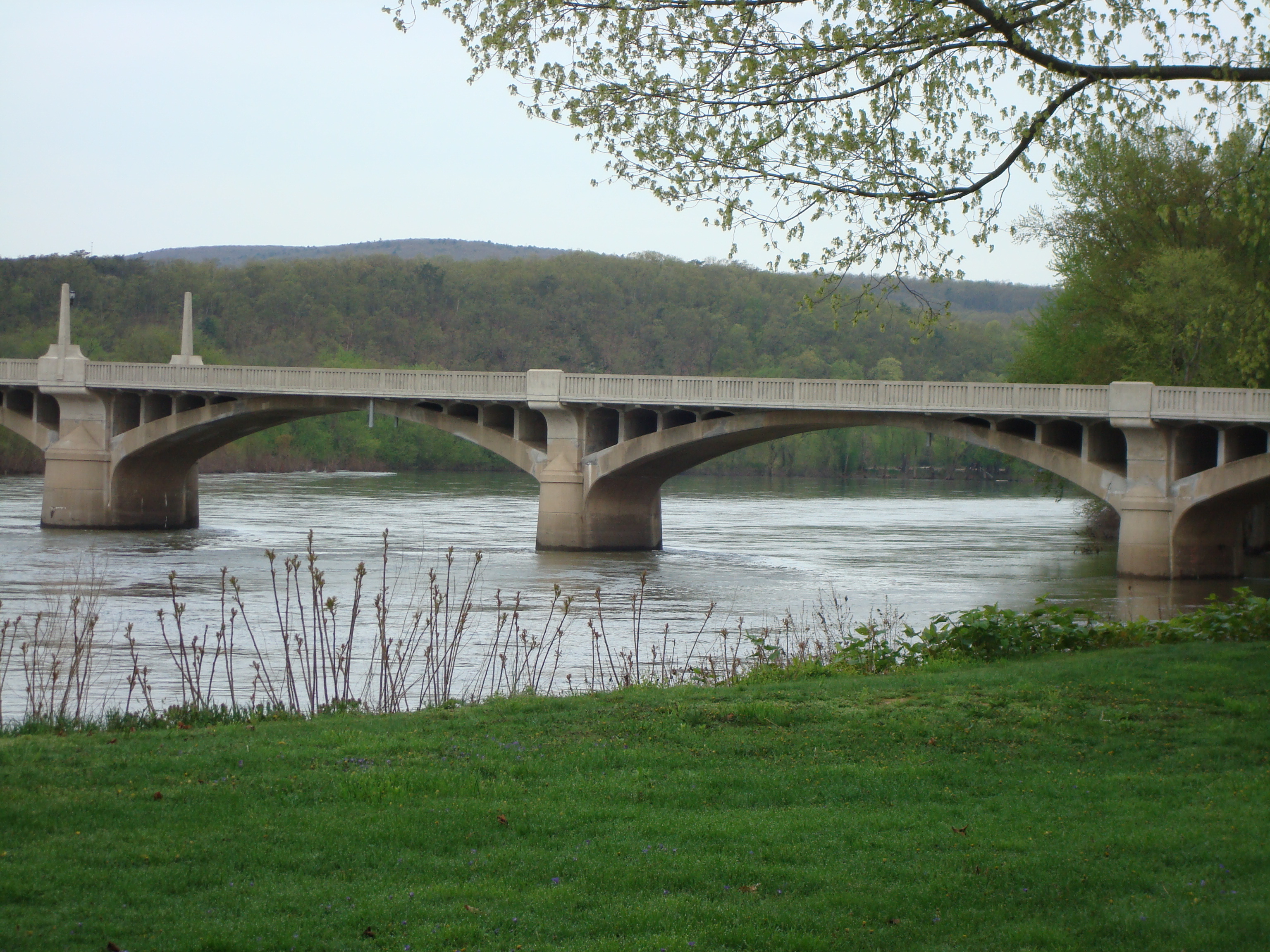
Source: Milton Evening Standard (September 14, 1911)Recent photo of the bridge at Watsontown. This is the second bridge that was built at this site. It's hard to believe that a hundred years ago the first bridge had not yet been built.
Grandma often walked about two miles to Watsontown—but she hasn’t written about ever crossing the Susquehanna River to White Deer.
It’s hard to imagine, but a hundred years ago the only way across the river was via ferry or other boat.
According to the paper, a bridge was needed because:
Everybody knows that the river is a fluctuator. During late fall, winter, and early spring it is a vast body of floating ice and slush. Without a bridge it is dangerous alike to passenger and all other traffic. In the summer it is generally too low for comfortable ferrying and too high to ford.
Milton Evening Standard (September, 14, 1911)
(An aside—after last week’s floods I think we’d all agree that the paper got it right when it said that the Susquehanna is a “fluctuator.”)
However, the paper indicated that a bridge at Watsontown might hurt commerce in Milton (which already had a bridge across the river):
Some may ask: “How would Milton profit by its construction and establishment?”
Milton Evening Standard (September 14, 1911)
A hundred years ago White Deer, the town across the river from Watsontown, was much livelier than it is today.
White Deer is at the foot of the mountains—and for much of the 1800’s huge volumes of lumber moved through White Deer—some went out via the river and some was loaded on trains.
Lumber was transported across the Susquehanna River to several factories in Watsontown—including a table factory and a door factory.
The lumbering industry was in decline by 1911. According to Union County Pennsylvania: A Celebration of History by Charles M. Snyder
What appears to have been the last stand of virgin forest in White Deer Township was removed by the Watsontown Door and Sash Company in 1917.
16-year-old Helena Muffly wrote exactly 100 years ago today:
Wednesday, September 13 , 1911: Was in such terrible trepidation this morning, lest I would have to miss school and help Ma with the work, but Besse came to my relief. So glad I was. I missed those stacks and stacks of dishes for dinner, but have to confront them tonight.
Her middle-aged granddaughter’s comments 100 years later:
Besse was Grandma’s married sister who lived nearby. The previous day Grandma wrote that the threshers were at the farm. All the farmers in the community probably were at the Muffly farm helping with the threshing. And, I bet that all the hard work made them very hungry.
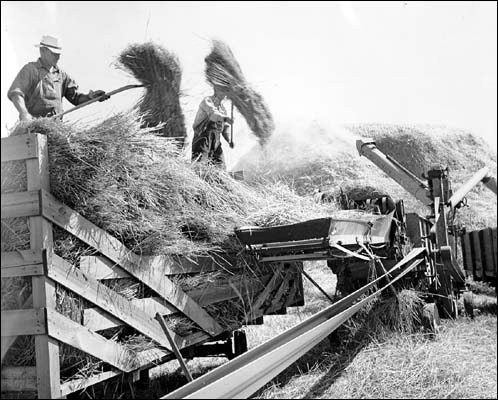
Early 20th century photos of steam-operated threshing machine. Photo was taken in the midwest, so the machine in the photo was probably a little larger than what would have been used in central Pennsylvania. (Photo source: Library of Congress, Fred Hultstrand and F.A. Pazandak Collections)
I’m on a roll remembering traditional Pennsylvania sweet and sour foods that might have been served to the threshers. Yesterday I wrote about spiced crab apples. Another fall sweet and sour food is pickled cabbage (pepper hash).
Pickled Cabbage (Pepper Hash)
1 medium head cabbage, shredded (approximately 4 cups)
1 green bell pepper (green mango), coarsely chopped
1 red bell pepper (red mango), coarsely chopped
1/2 cup vinegar
1/2 cup sugar
1/2 teaspoon salt (optional)
Mix all ingredients together and let stand at least 1 hour. This salad may be kept covered and refrigerated for several weeks. Drain before serving.
I got this recipe from my sister-in-law, Linda— and she says that she got it from her mother. It is a very typical old-fashioned central Pennsylvania dish.
This recipe is very adaptable and can easily be made in larger or smaller quantities. Just use equal proportions of vinegar and sugar to make as much dressing as needed.
Linda says that the original recipe called for green and red mangos rather than green and red bell peppers. Traditionally people in central Pennsylvania and other parts of Appalachia referred to bell peppers as mangos. Of course, the mango fruit doesn’t grow in Pennsylvania, and until recent improvements in transportation the tropical fruit wasn’t sold there, so there never was any confusion.
16-year-old Helena Muffly wrote exactly 100 years ago today:
Tuesday, September 12, 1911: Had to run around town this morning and accomplished some errands. Have to sleep with Rufus tonight as the threshers are here.
Her middle-aged granddaughter’s comments 100 years later:
Rufus refers to Grandma’s sister Ruth. The wheat and oats would have been harvested in last July. It would have been tied into shocks and left to dry in the field. Now a threshing machine would separate the grain from the straw.
The threshing machine would have been a huge steam operated contraption –and lots of labor was required. The owner of the machine would take it from farm to farm —and all of the farmers in the neighborhood would help.
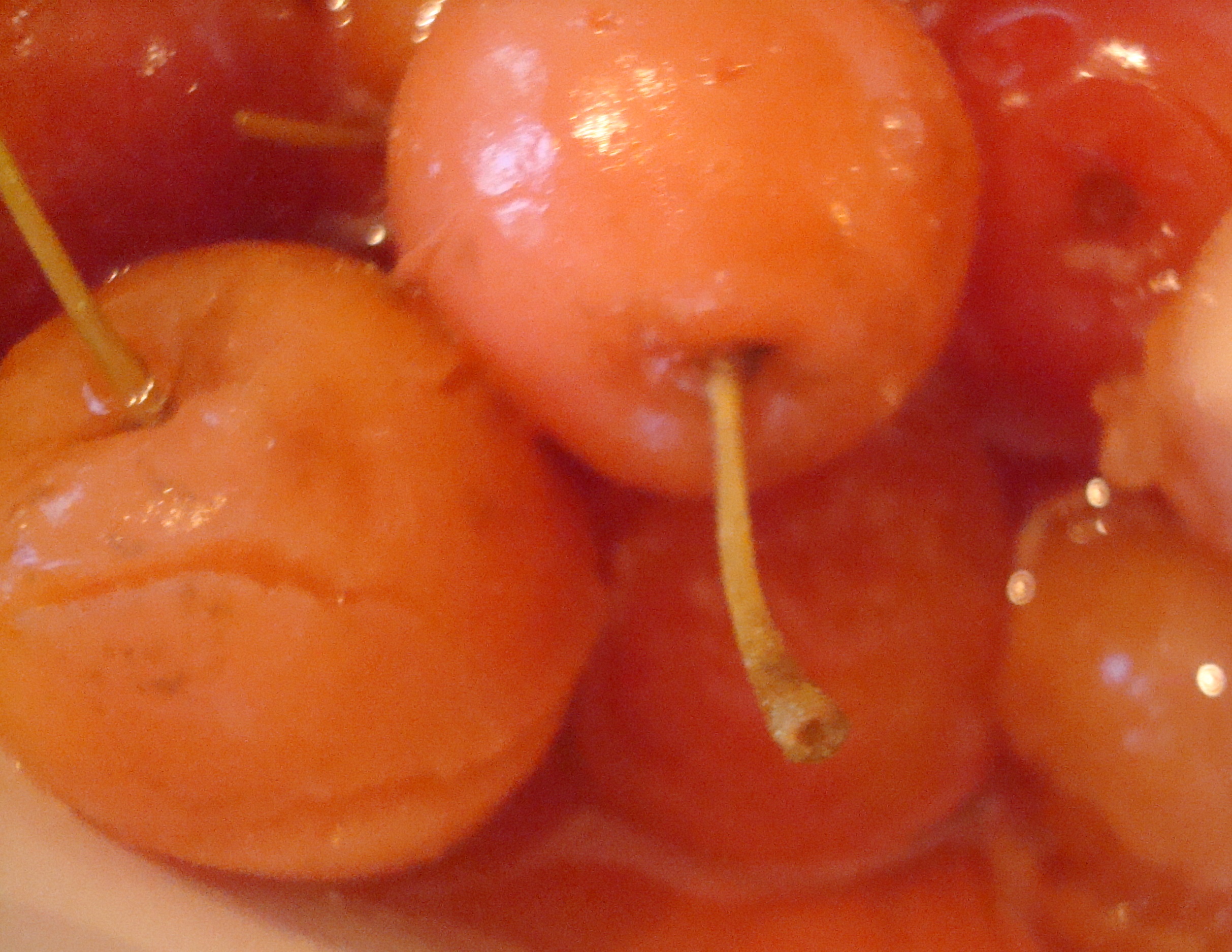
Lots of food would have been needed to feed the men. People in central Pennsylvania used to say that a meal should have seven sweets and seven sours. I wonder if the Muffly women made Spiced Crab Apples for one of the sours to feed the threshers.
Here’s the old recipe that I use to make spiced crab apples. In the old days a large amount of spiced crab apples would have been prepared—and some would have been canned. I’ve adapted the recipe to make a smaller amount—and just store them in the refrigerator rather than canning them.
Spiced Crab Apples (Pickled Crab Apples)
2 pounds crab apples
1 3/4 cup apple cider vinegar
1 1/2 cup water
3 cups sugar
1 1/2 teaspoons whole cloves
2 sticks cinnamon
1 piece fresh or dried ginger (approximately 1/2 inch cube)
Wash crab apples, and remove blossom ends; do not remove stems. Prick each crab apple with a fork several to prevent apple from breaking apart while cooking.
Stir vinegar, water, sugar, and spices together in a large saucepan. Bring to a slow boil. Add prepared crab apples and simmer for 15 minutes. Remove from heat and put the mixture into a large glass bowl. Refrigerate overnight. Remove spices from syrup.
The crab apples will keep in the refrigerator for several weeks.
My husband really likes this recipe. He says that it tastes just like Spiced Crab Apples that his Aunt Gertrude made when he was a child–and that they bring back wonderful memories of sitting in her kitchen eating them.
16-year-old Helena Muffly wrote exactly 100 years ago today:
Monday, September 11, 1911: Got hit by a stick this afternoon at recess in the region of my left eye. It did hurt a little bit for awhile. It is a little bit sore now.
If I use my imagination I can almost see 16-year-old Grandma, her 6-year brother Jimmie, and the other students playing on the grass outside the old McEwensville School building.
Her middle-aged granddaughter’s comments 100 years later:
I’m amazed that high school students had recess in 1911. The high school and elementary school at McEwensville shared the same building. Apparently the entire building had recess.
Some things are better now than a 100 years ago—but I’d argue that recess for high school students is an example of something at was better a hundred years ago.
Today high school students don’t have recess. And, obesity is an issue. At the high school my children attended I think that they only have two semesters of physical education during the entire four-year program.
16-year-old Helena Muffly wrote exactly 100 years ago today:
Sunday, September 10, 1911: Went to Sunday School this afternoon. I was the only one in my class today. It has happened that way for the past three Sundays. It is simply provoking the way the other girls attend Sunday School.
Her middle-aged granddaughter’s comments 100 years later:
I think Grandma attended the McEwensville Baptist Church and that the church closed sometime before 1920. Based on these diary entries it’s easy to understand why the church was shuttered a few years later.
Since Grandma didn’t write much a hundred years ago today, I’m going to tell you about a historic event that occurred in 1911–
Mona Lisa (Photo source: Wikepedia)
On August 21, 1911 the Mona Lisa was stolen from the Louvre in Paris. I’ve seen several articles recently about the hundredth anniversary of the robbery. For example, the Los Angeles Times had an article about the theft. The picture was eventually recovered in Florence, Italy in 1913.
I tend to think of McEwensville as a very isolated spot in 1911–and that Grandma would have known nothing of events happening half a world away–but actually she may have known about the robbery.
I was amazed to discover that at least one paper in rural central Pennsylvania, the Milton Evening Standard, was covering the story. The September 9 paper discussed the robbery—and that the U.S. secret service was trying to find it.
Source: Milton Evening Standard (September 9, 1911) An aside: I'm not sure why the article says that the painting was stolen on August 22. Modern sources all say that was taken on August 21.
Who would have thought that a hundred years ago today people thought that Mona Lisa was in the U.S.?