Old-fashioned Oatmeal Fruit Muffins (Oatmeal Raisin Muffins)

Oatmeal Fruit Muffins

I recently made a hundred-year-old recipe for Oatmeal Fruit Muffins (Oatmeal Raisin Muffins). These classic muffins were delightful with the robust, warm, sweet flavor of molasses and a hint of nutmeg.

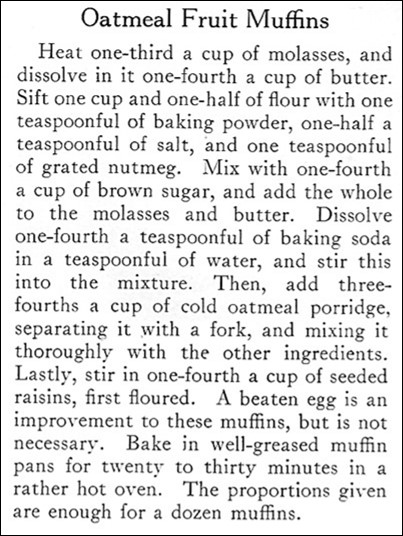
Here’s the original recipe:

Recipe of Oatmeal Fruit Muffins
Source: American Cookery (June/July, 1923)

When I made this recipe, I went with the option of adding an egg. The batter would be very dry if the egg was not added. I’m not sure why the recipe called for dissolving the baking soda in a little water, but modern baking soda is not typically dissolved before combining with other ingredients, so I skipped that step.

Here’s the recipe updated for modern cooks:

Oatmeal Fruit Muffins (Oatmeal Raisin Muffins)

  • Servings: approximately 12 muffins
  • Difficulty: moderate
  • Print

1/3 cup molasses

1/4 butter

1/4 cup brown sugar

1 1/2 cups flour

1 teaspoon baking powder

1/4 baking soda

1/2 teaspoon salt

1 teaspoon nutmeg

3/4 cup cooked oatmeal (left-over oatmeal)

1 egg, beaten

1/4 cup raisins

Preheat oven to 400° F. Put molasses and butter in a saucepan. Heat, using low heat until the butter melts. Remove from heat. Stir in the brown sugar.

In a mixing bowl, combine the flour, baking powder, baking soda, salt, and nutmeg. Stir in the egg and molasses mixture. Add the raisins, and stir to combine.

Grease muffin pans (or use paper liners). Spoon batter into muffin  cups; fill each cup about 3/4ths full. Place in oven. Bake 20-30 minutes or until lightly browned and the muffins spring back when lightly touched.

http://www.ahundredyearsago.com

Old Fashioned Fried Chicken (with Milk Gravy)

Fried Chicken

I hadn’t made old-fashioned fried chicken in years, so was intrigued when I saw a recipe for Fried Chicken with milk gravy in a hundred-year-old cookbook and decided to give it a try. The chicken pieces are coated with flour then fried. The recipe called for frying the chicken pieces in a covered skillet. The coating on the chicken is not nearly as thick and crispy as many modern fried chicken recipes, but it is like the coating on fried chicken that I remember from my childhood. The milk gravy was lovely.

Here’s the original recipe:

Fried Chicken Recipe
Source: The Calorie Cook Book by Mary Dickerson Donahey (1923)

In the U.S. today, we generally refer to “skim milk.” The old recipe calls for “skimmed milk” rather than “skim milk.” Most milk was not homogenized a hundred years ago (and often it was not pasteurized), so the cream floated to the top. When using the milk, it could either be shaken to get “whole” milk or the cream on the top could be “skimmed” off to get the equivalent of skim milk. I don’t think that it matters whether skim, 2%, or whole milk is used in this recipe, so when I updated the recipe, I just called for using “milk.”

Here’s the recipe updated for modern cooks:

Fried Chicken

  • Servings: 4 - 6
  • Difficulty: moderate
  • Print

1 whole chicken, cut into pieces

1/2 cup flour

1/2 teaspoon salt

1/8 teaspoon pepper

fat (lard, shortening) or cooking oil

3 tablespoons flour

2 cups milk

Combine the flour, salt, and pepper; then roll the chicken pieces in the flour mixture.

In the meantime, heat 1/2 inch of fat or oil in a large skillet (that has a lid) using medium heat. When hot, carefully place the floured chicken pieces in the pan.  Cover skillet, and cook for approximately 5 minutes or until the bottom side of each piece is lightly browned, then gently turn, cover skillet, and fry until the other side is browned. The chicken pieces will need to be turned several times. Continue cooking until a meat thermometer indicates that the temperature is at least 165° F. (Put large pieces of chicken in the skillet and cook for a few minutes before adding smaller ones, if there is wide variation in the size of the pieces.)

Remove chicken from skillet, and pour most of the fat or oil out of the skillet. Put back on the stove at medium heat. Stir the 3 tablespoons flour into the remaining fat/oil and browned bits. Slowing stir in the milk. Continue stirring and cooking until the gravy thickens.  Remove from heat and serve.

http://www.ahundredyearsago.com

Tomato Surprise (Stuffed Tomatoes with Scrambled Eggs and Celery)


Tomato Surprise on plate

Sometimes recipe titles in hundred-year-old cook books aren’t very descriptive. For example, a recipe for Tomato Surprise left me scratching my head until I read the recipe directions. Tomato Surprise actually was a recipe for tomatoes stuffed with scrambled eggs and celery.

Tomato Surprise was tasty and made a nice presentation. I made it for a light dinner, but it  would work well for breakfast, brunch, or lunch.

Here’s the original recipe:

Recipe for Tomato Surprise
Source: Larkin Housewives’ Cook Book (1923)

When I made this recipe, I had a lot the scrambled egg mixture left over after I stuffed the tomatoes. The recipe author must have used larger tomatoes than what I used. I revised the recipe to indicate that 3-6 tomatoes should be used, depending upon the size of the tomatoes.

Four stalks of celery seemed like a lot (maybe the stalks were smaller a hundred years ago), so I used 2 stalks.

A hundred-years-ago tomatoes were often peeled. The original recipe called for peeling tomatoes, but I couldn’t bring myself to peel the tomatoes, so I left the skin on.

I didn’t have onion juice, so I substituted 1/8 teaspoon of onion powder.

And, I decided that the tomatoes didn’t need to be served with lettuce or salad dressing.

Here’s the recipe updated for modern cooks:

Tomato Surprise (Stuffed Tomatoes with Scrambled Eggs and Celery)

  • Servings: 3 - 6
  • Difficulty: moderate
  • Print

3 – 6 tomatoes (depending upon tomato size)

2 stalks celery, chopped

6 eggs

1/2 teaspoon salt

dash cayenne (red) pepper

1/8 teaspoon onion juice

4 tablespoons milk

1 tablespoon butter

lettuce leaves, optional

salad dressing, optional

Here’s the recipe updated for modern cooks:

Using a knife remove the stem end and the firm core from the tomato and discard. Scoop out the tomato pulp, place in a strainer and drain off any excess liquid.  Chop the pulp.  Set aside. Turn the tomato shells upside down on a plate to drain any liquid out of them.

In the meantime, break the eggs into a bowl. Beat eggs until smooth, then add the salt, cayenne pepper, onion powder, and milk. Beat until combined.

Using medium heat, melt butter in skillet, add egg mixture and cook the eggs until set. Periodically stir and fold the eggs until they are completely cooked.  Removed from heat and stir in the chopped tomato pulp and celery. Stuff the tomato shells with the mixture.

If desired, serve on lettuce leaves with salad dressing.

http://www.ahundredyearsago.com

Old-fashioned Fried Eggplant

Fried Eggplant on plate

Eggplant is one of those vegetables that I seldom use. I’m often not quite sure how to prepare it, and will pass over it when selecting vegetables to purchase. But I recently saw a really basic Fried Eggplant recipe in a hundred-year-old cookbook and decided to give it a try. Slices of eggplant were breaded with bread crumbs, then fried. It turned out well. The Fried Eggplant slices were crispy and delicious.

Here’s the original recipe:

Recipe for Fried Eggplant
Larkin Housewives’ Cook Book (1923)

I dried the eggplant slices using paper towels. The recipe makes it sound like cloth towels would have been used a hundred years ago.

I breaded the eggplant slices with bread crumbs rather than dipping in flour. I made my own bread crumbs. Starting with 2 slices of bread, I used a blender to make fine bread crumbs. A food processor would also work, or purchased bread crumbs could be used.

The old recipe called for soaking the eggplant slices in salted water for several hours before cooking. I think that modern eggplants are less bitter than the eggplants of days gone by, so I’m not sure if soaking is needed, but I did it. I’ve seen other recipes that call for just sprinkling eggplant with salt, letting sit for awhile, and then drying with paper towels. That might be another option.

Here’s the recipe updated for modern cooks:

Fried Eggplant

  • Servings: 4 - 6
  • Difficulty: moderate
  • Print

1 medium eggplant

2 tablespoons salt

water

2 eggs, beaten

1 cup fine bread crumbs

fat (lard, shortening, etc.) or oil

Peel eggplant, then slice into 1/4 inch thick slices. Put in a bowl and cover with water that contains the salt. Let sit for 2 – 4 hours, then drain, and dry the eggplant slices with paper towels.

Put the beaten egg in a shallow bowl, and put the bread crumbs in another shallow bowl. Dip each eggplant slice in the egg, and then roll in the breadcrumbs to coat.

Heat 1/4 inch of fat or oil in a large frying pan. Carefully place the breaded eggplant slices in the pan in a single layer. Depending upon pan size, the slices may need to be cooked in several batches. Fry for approximately 3-5 minutes or until the bottom side of each slice is lightly browned, then gently turn and fry until the other side is browned. Remove from pan and drain on paper towels. Serve immediately.

http://www.ahundredyearsago.com

Old-fashioned Combination Cabbage Salad (Cabbage and Celery Gelatin)

Combination Cabbage Salad in bowl

I can remember eating gelatin salads that contained vegetables when I was a child, so was intrigued when I came across a hundred-year-old recipe for Combination Cabbage Salad. The salad actually is a gelatin salad that contains shredded cabbage, chopped celery, and chipped pimento. It is made using unflavored gelatin. The recipe only called for 1/2 cup of sugar, while calling for 1 cup vinegar and the juice of a lemon. The result was a salad that was very tart and tangy.

The recipe suggests serving the salad with whipped cream that has a little salad dressing stirred into it. I used Ceasar dressing. This added to the overall tartness of the salad.Combination Cabbage Salad on plate

This salad is very old-fashioned–and definitely very different from modern sweet, fruit-flavored, gelatin salads, but I enjoyed it. The salad was refreshingly tart on a hot summer day – though if I made it again I think that I’d skip the whipped cream topping. The whipped cream and salad dressing mixture amplified the sourness of this dish, and overwhelmed the other ingredients.

Here’s the original recipe:

Recipe for Combination Cabbage Salad
Source: Larkin Housewives’ Cook Book (1923)

I skipped the suggestion to mold this gelatin salad in teacups, and went right to the suggestion to put it in a pan – though I actually used a square, flat baking dish.

This recipe required lots of interpretation on my part. I have no idea how much  one-half package of Larkin Gelatin would be, so I added up all the liquids and estimated that this recipe calls for approximately 5 2/3 cups of liquid. My rule of thumb is to use one packet of unflavored gelatin for each 2 cups of liquid, so I used 3 packets. That worked well.

I don’t know how much 1/4 can of pimientos would be. I used 2 tablespoons of chopped pimento.

I put a little salad dressing in the whipped cream. I’m curious about what type of dressing the recipe author used. I used Ceasar dressing because I had it on hand – though that’s probably not very authentic when making a hundred-year-old recipe.  If I made this recipe again, I skip the salad dressing (and probably would also skip the whipped cream).

Here’s the recipe updated for modern cooks:

Combination Cabbage Salad (Cabbage and Celery Gelatin)

  • Servings: 7 - 9
  • Difficulty: moderate
  • Print

3  packets (0.25 ounce) unflavored gelatin

1/2 cup water + 4 cups water

1/2 cup sugar

1 teaspoon salt

1 cup vinegar

juice of 1 lemon

2 cups cabbage, shredded

1 1/2 cups celery, chopped

2 tablespoons pimento, chopped

1/2 cup heavy whipping cream (if desired)

2 teaspoons salad dressing (if desired) – I used Ceasar salad dressing, though think that a sweeter dressing might be better.)

Put 1/2 cup cold water in a bowl. Sprinkle the gelatin on top of the water, and let soak for 5 minutes.

Put 4 cups water, the sugar, and salt in a saucepan. Bring to a boil.  Add the gelatin that has been soaked in water. Bring back to a boil while stirring constantly until the gelatin is dissolved. Remove from heat and stir in the vinegar and  lemon juice. If needed, strain. Cool slightly, then stir in the cabbage, celery, and pimento. Mold or pour into a dish or bowl. (Use a fairly flat dish, if you plan to cut the gelatin into squares to serve. A 9″ X 9″ baking dish would work well.)  Refrigerate until firm.

If desired, serve with whipped cream. Whip the cream until peaks form, then stir the salad dressing into the whipped cream. Put a dollop of the whipped cream on top of each serving.

http://www.ahundredyearsago.com

Hundred-Year-Old String Bean Recipe


string beans

Sometimes the most basic ways of preparing a simple food changes over the course of a hundred years. String beans are a good example. Here’s what it says in a hundred-year-old cookbook:

Recipe for string beans
Source: Boston Cooking-School Cook Book (1923)

The old recipe calls for boiling the string beans 1-3 hours!! And, for breaking or cutting them into 1-inch pieces. Today, many people leave them whole. (I normally break string beans into 2 -3 inch pieces, but if preparing a meal for my children or grandchildren I would definitely leave them whole.) The old recipe also calls for removing the strings from the beans – which many string beans no longer have. (I guess that technically they may not be string beans.)

When I made the recipe I did cut the string beans into 1-inch pieces, but I couldn’t bring myself to cook the beans for 1-3 hours, and in the updated recipe say to boil them for 10-15 minutes – though I did provide information about cooking longer, if desired.

Here’s the recipe updated for modern cooks:

String Beans

  • Servings: 2 - 3
  • Difficulty: easy
  • Print

1 pound string beans

water

1 teaspoon salt

1 tablespoon butter

Trim the ends of the beans, and then cut or break the beans into one-inch pieces. Wash and put in a saucepan. Cover with water; add salt.  Bring to a boil using high heat; then reduce heat and cook 10-15 minutes. Drain, then add butter. Let the butter melt, stir gently, then serve. (If desired, cook longer for a softer consistency.  This will result in string beans that are prepared more similarly to how it was done a hundred years ago. A 1923 cookbook calls for cooking the beans 1-3 hours.)

http://www.ahundredyearsago.com

Old-fashioned Pineapple and Lemonade

2 glasses Pineapple & Lemonade

Old-fashioned lemonade is refreshing on a hot summer day, but it can get a little boring, so when I saw a recipe in a hundred-year-old cookbook for Pineapple and Lemonade, I decided to give it a try. The Pineapple and Lemonade was a little sweeter than the typical lemonade, and the pineapple flavor predominated over the lemon, but it was tasty.

Here’s the original recipe:

Recipe for Pineapple and Lemonade
Source: Order of the Eastern Star Relief Fund Cook Book compiled by the Michigan Grand Chapter (1923)

This recipe was in an Order of the Eastern Star organizational cookbook. The Order of the Eastern Star is affiliated with the masons. The recipe author was John Hamill. I think this is the first male recipe author that I’ve seen in a hundred-year-old cookbook. The initials after his name (R.W.G.T.) mean that he was the Right Worthy Grand Templar or Right Worthy Grand Treasurer.

Here’s the recipe updated for modern cooks:

Pineapple and Lemonade

  • Servings: 3-4
  • Difficulty: easy
  • Print

2 cups water

1 cup sugar

1 20-ounce can of crushed pineapple

juice of 3 lemons

4 cups mixture of ice and water

Put water and sugar in a saucepan; bring to a boil using medium heat while stirring occasionally. Remove from heat. Stir in the contents of the can of pineapple and the lemon juice, then strain. Add the ice and water mixture, and serve.

http://www.ahundredyearsago.com