Feeding Calves a Hundred Years Ago

16-year-old Helena Muffly wrote exactly 100 years ago today: 

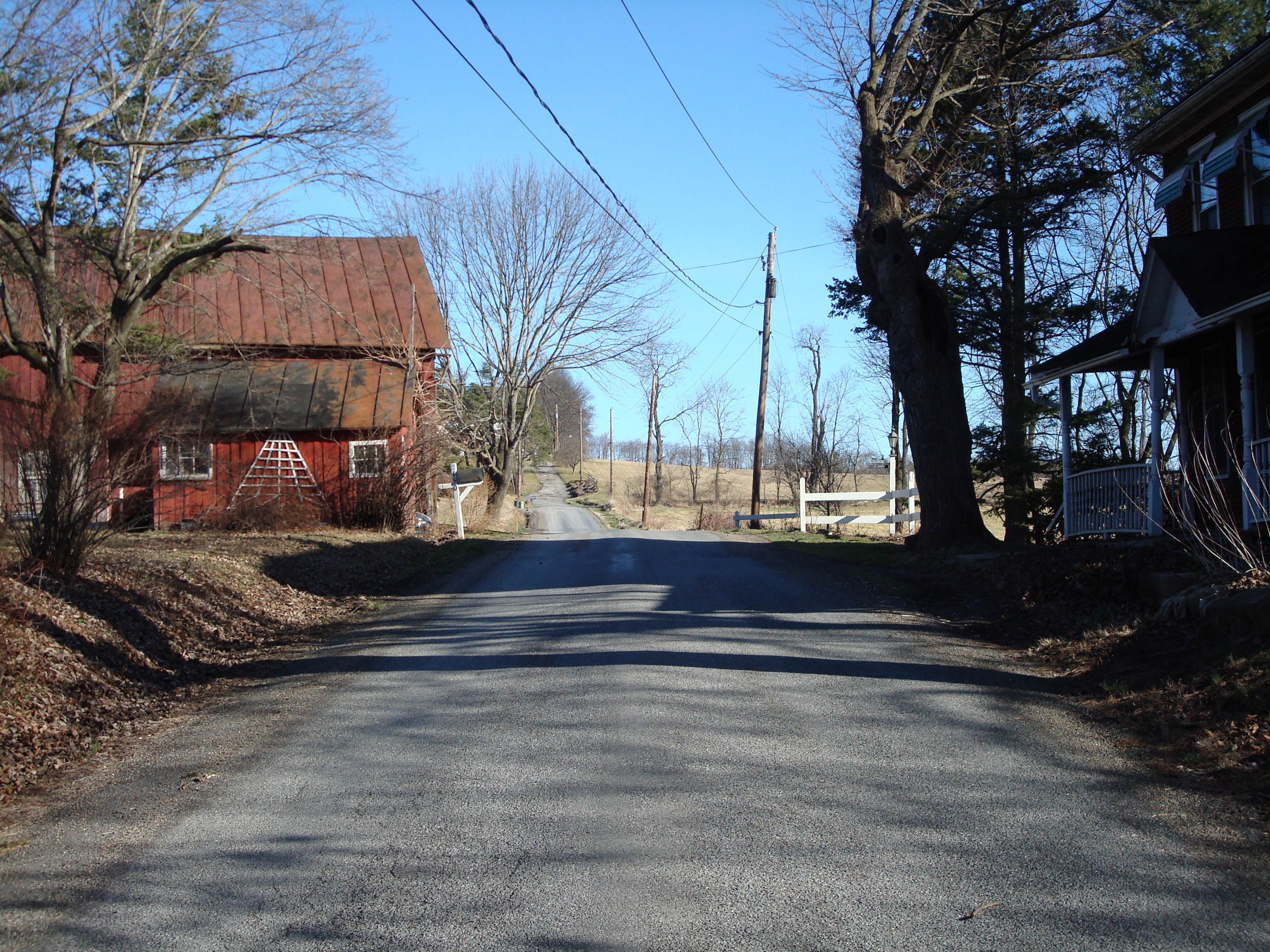
Saturday, September 9, 1911: Today was rather a blue Saturday. It was so rainy this morning. Henry the nosey one upset almost a whole bucket full of milk. I felt rather sorrowful, but there was no use of crying over spilt milk.

Her middle-aged granddaughter’s comments 100 years later:

Who was Henry?—a dog?, . . a cat? . . . a calf? I’m guessing that he was a calf that Grandma was trying to feed. He probably was really hungry, and in his enthusiasm managed to tip over the bucket of skim milk.

A hundred years ago cream separators were commonly used. The cream was sold or used to make butter—and calves (and pigs) were fed the skim milk.
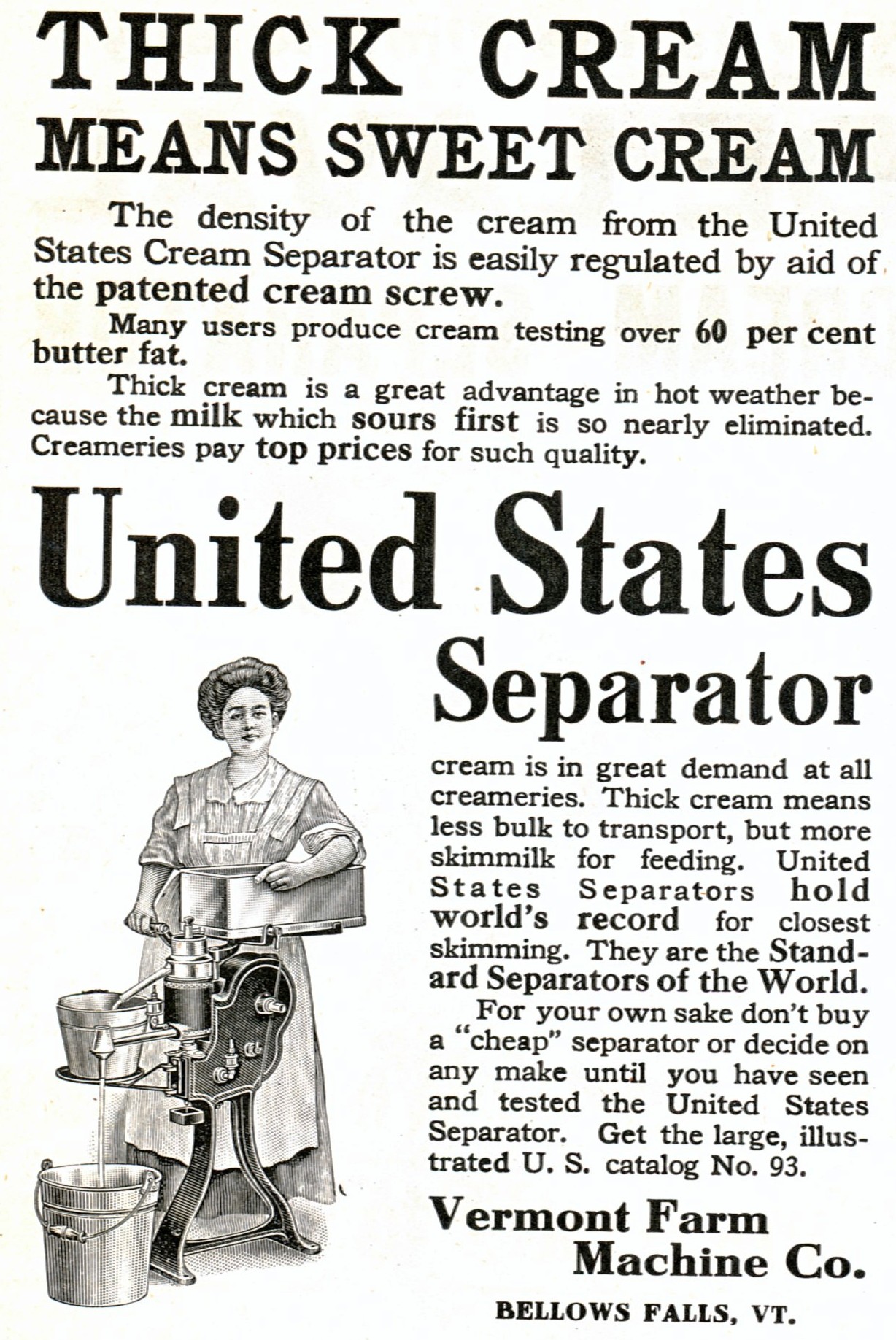
Ad in July 1, 1911 issue of Kimball's Dairy Farmer Magazine

According to a book published in 1911 called The Farm Dairy by H.B. Gurler:

The calf should be allowed to take the first milk from its dam as nature requires this and if her rules are violated there will surely be trouble. After the calf has once nursed, it should be removed from its mother but fed its mother’s milk for a few days, depending on the vigor of the calf. Commence to add skim-milk after a week or ten days, adding a small amount at first and increasing it daily until the calf is on an entire skim milk diet.

There are a few simple rules to follow in growing calves on skim-milk. The milk must be sweet; it must be as warm as the mother’s milk and care must be exercised not to feed too much of it. There are many more calves injured by being fed too much skim milk than there are by not having enough of it. Four quarts at a feed twice a day is sufficient for the average-sized calf for the first month.

Add a spoonful of ground flax seed to each feed and teach the calf to eat a little corn-meal as soon as possible. Corn is the most economical food to balance a ration containing so much skim milk. Feed shelled corn as soon as the young calf will digest it well.
The Spice Islands

16-year-old Helena Muffly wrote exactly 100 years ago today: 

Friday, September 8, 1911: Had to laugh at the mistake a certain pupil made in school today. It seemed so comical. Something about sailing to the Spice Islands, wherever they are, and that said person had to remain after school this evening in order to recite her history properly.

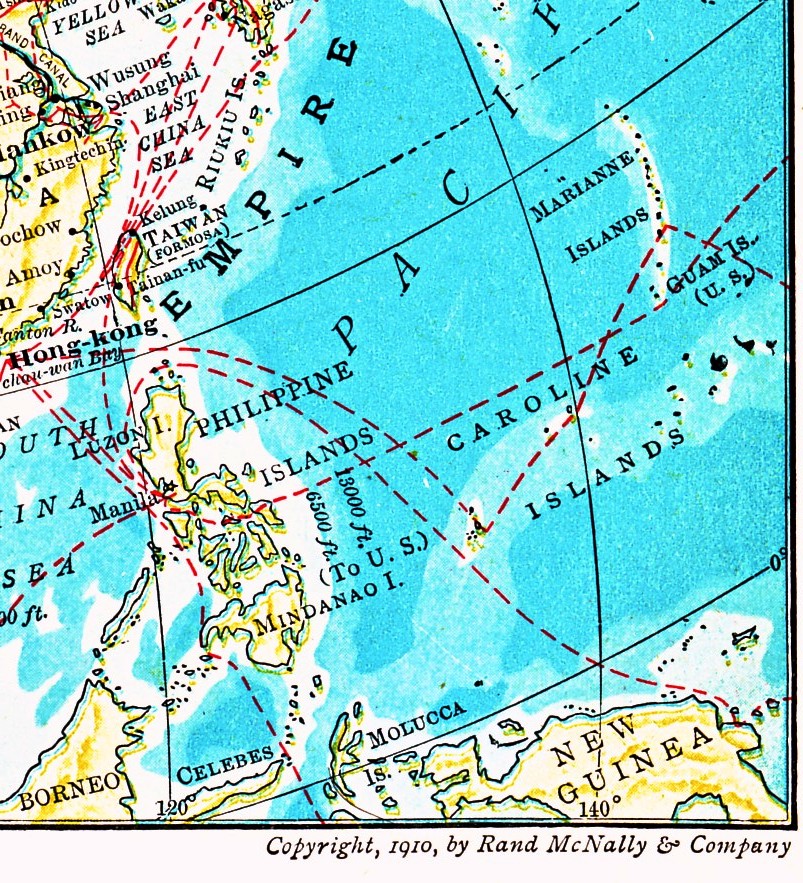
1910 map of Molucca Islands (just west of New Guinea). They were sometimes called the Spice Islands. (Source; Commercial Geography, 1911)

Her middle-aged granddaughter’s comments 100 years later:

This was the fourth day of the school year.  I bet that the history text used at McEwensville High School began with Columbus discovering American—and that the question that the student missed was something about Columbus searching for the Spice Islands but instead finding America.

Years ago the Molucca Islands were often called the Spice Islands. They are now part of Indonesia. In 1911 they were part of the Dutch East Indies. According to a 1911 textbook:

The Moluccas are still, as they were when Columbus set sail in search of them, and chanced upon America, the spice islands; thought the spice trade has relatively declined in modern times, owing to the use of fresh meat and green vegetables.

Commercial Geography (1911) by Edward Van Dyke Robinson

A footnote indicated that the chief spices from the East Indies were: black pepper, cloves, nutmegs and cinnamon.

Old-time Chocolate and Fruit Ice Cream Recipes

15-year-old Helena Muffly wrote exactly 100 years ago today: 

Sunday, February 26, 1911: I went to Sunday school this afternoon and staid for church and catechize. The walking was extremely bad, but still I went. We had chocolate ice cream for supper. We all rather like it, so we have it occasionally which is about once in a week.

Her middle-aged granddaughter’s comments 100 years later:

I’m amazing how often the Muffly family had ice cream. This is the fifth time they’ve made it since the diary began on January 1–ice cream was previously mentioned on January 22, February 8 (and it was banana ice cream on the 8th! I’m amazed that bananas were available in rural Pennsylvania), February 12, and  February 23.

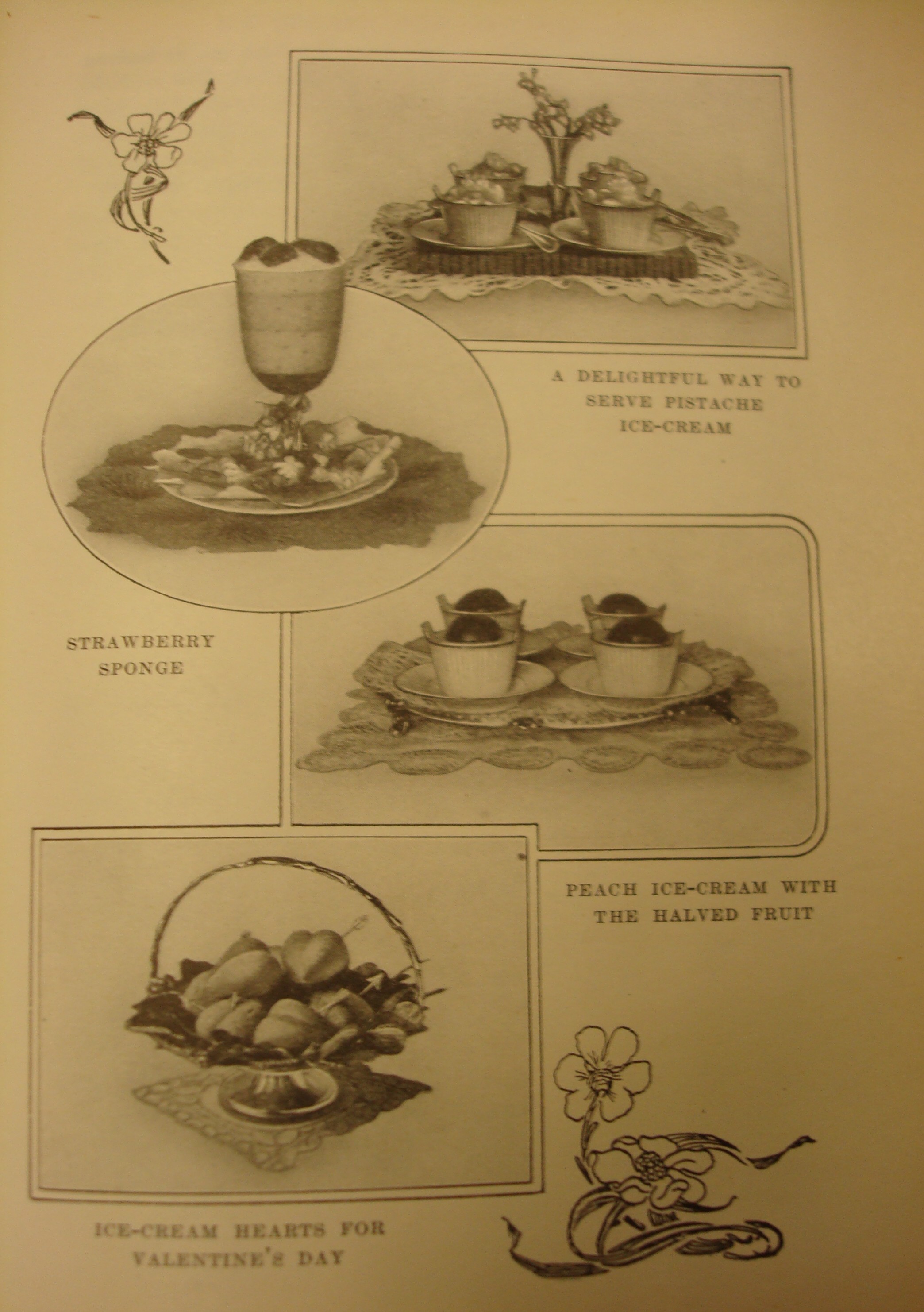
A century ago ice cream freezers were the new-fangled thing—and with the ready availability of ice during the winter months, ice cream made the perfect dainty winter dessert. (A hundred years ago, young people preferred lighter foods which they called dainty foods.)

I found directions for making ice cream in an old cookbook that was published in 1911.

Chocolate Ice Cream—Use the vanilla recipe, adding four ounces of grated chocolate to the milk before scalding and using a couple ounces more sugar than for the vanilla cream.

Vanilla Ice Cream—Add to one egg slightly beaten one sup of sugar, one tablespoon of flour, and a speck of salt. Pour on one pint of scalding milk and cook for twenty-five minutes in a double boiler. When cool, add vanilla and one pint of thin cream.

Fresh Fruit Ice Creams—Prepare fruit by sprinkling sugar. Let it stand one hour, press through a sieve, and stir into ice cream when the cream is frozen to a mush. All fruit ice creams are made in substantially the same way, but where seed fruits, such as currants, are used, the carefully strained juice only must be added. This can be put in the freezer with the cream and not reserved until later, as in the case of the mashed fruits. Grated pineapple, with the addition of a little lemon juice, makes a particularly fine fruit cream.

The Butterick Cook Book (1911)

For detailed directions from the 1911 cookbook see the Vanilla Ice Cream posting.

Old-time Vanilla Ice Cream Recipes

15-year-old Helena wrote a hundred years ago today:

Sunday, February 12, 1911. Pa and Ma went away today and we had the house to ourselves while they were gone. Of course we had a fine dinner for my sister is an excellent cook, or rather she thinks she is. Any way we had dinner. Ice cream consisted of part of it. I had to turn the freezer, which I soon tired of. (I usually tire of anything I don’t like.) Any how I froze that cream so hard that it all crumbled up in big chunks. That surely was a result of labor. Rachel Oakes was a guest for dinner. I went to Sunday school church and catechize this afternoon. By the time I got home, the afternoon was almost over.

 Her middle-aged granddaughter’s comments 100 years later:

 I found directions for making ice cream in an old cookbook that was published in 1911.

 Vanilla Ice Cream, No. 1—Sweeten one quart of thin cream with three-fourths cup of sugar, flavor with one and one-half tablespoons of vanilla extract and freeze.

Vanilla Ice Cream, No. 2—Add to one egg slightly beaten, one cup of sugar, one tablespoon of flour, and a speck of salt. Pour on one pint of scalding milk and cook for twenty-five minutes in a double boiler. When cool, add vanilla and one pint of thin cream.

In freezing cream and ices, good general rules to be observed are: Be lavish with the salt and have the ice pounded quite fine, thereby involving less labor in turning the freezer and securing a smooth velvety cream. The quickest and best way to pound the ice is to put it in a stout burlap bag, tie up the mouth, and pound it vigorously with a flat-headed hammer or mallet. Snow may be used instead of ice; if this does not freeze steadily, add one cup of water to it. Have the ice and salt already packed around the can before the mixture is put in. Be sure that the latter is quite cold before it is placed in the can and do not begin freezing by turning rapidly and lagging toward the end of the process. Instead turn slowly at the beginning and increase the speed as the mixture thickens. Be very careful that there is no possible chance of the salt or water getting into the can, but do not pour off the water unless it gets too high; when a little may be turned off.

Allow three measures of ice to one measure of salt; if a larger proportionate quantity of salt be used the freezing will take place in a shorter time, but the mixture will have a granular texture.

Never fill a freezer more than three-fourths full, as the mixture gains in bulk as it freezes.

When it is desired to have the cream in blocks or cakes a special mold will be needed. The mold should be set in ice and salt while the cream is being frozen, and when the beater or mixer is removed, the cream should be packed into the mold as quickly as possible. It should be pressed down firmly and smoothly and a piece of stout muslin or buttered paper laid over it before the mold cover is put on. The mold is then packed in ice and salt and kept for a few hours until the cream is ready for use.

The Butterick Cook Book (1911)

Based upon the directions above, it appears that Grandma probably started turning the handle quickly at the beginning and then much slower as it thickened—which is exactly the opposite from what she should have done.

(An old-fashioned ice cream freezer is shown in the January 22 posting.)

No Smallpox–Just Reading, Moping, and Doing Nothing

15-year-old Helena wrote a hundred years ago today:

Saturday, January 21, 1911. Spent most of the day in reading and moping around doing nothing. Mother is reading tonight, while I make my entry, but she doesn’t know what I’m writing, for she has her back turned.

Local Front Page News Exactly 100 Years Ago Today:

More Smallpox: Three More Cases Have Broken Out In Montour County

Two at Mausdale and One at Washingtonville: All Are Traced to Lumber Camp

Milton Evening Standard, January 21, 1911 

 Her middle-aged granddaughter’s comments 100 years later:

When I dug into the old 1911 Milton Evening Standard  microfilms at the Milton Public Library, I was shocked to discover that smallpox still occurred in central Pennsylvania a  hundred years ago. This means that there was smallpox less than fifty years before my birth. I had thought that the smallpox vaccine had wiped the disease out much earlier.  But, even though the victims lived only 15-20 miles from Grandma’s home, it  apparently was a world away from Grandma’s concerns when she wrote this diary entry. (Sometimes the slower pace of 1911 sounds wonderful, but there have been some very positive changes in the last 100 years!!)

Grandma probably wrote this entry sitting in a house illuminated with at least two gas lanterns—since it appears that she and her mother weren’t sitting close together. Maybe Grandma was huddled over the table in the kitchen but could see her mother sitting in the living room through a doorway.  Why did she mention that she won’t want her mother to know what she is writing? There’s nothing very earth-shaking here—except maybe yesterday’s spelling fiasco.

How Do You Spell ‘Man’?

15-year-old Helena wrote a hundred years ago today:

Friday, January 20, 1911: Brought home some maps I drew at school last year. They were very excellent specimen’s of drawing, so I thought it would be worthwhile to save them and exhibit them to my friends if I ever have an reason to. Perhaps I shall not. Missed the word (man) in spelling. Now looked surprised, anyone else might have missed it too under the same circumstances.

Her middle-aged grand-daughter’s comments 100 years later:

Recent Photo of McEwensville High School

It was just one of those days with a high point and a low spot. Today’s five sentence diary entry gives lots of hints about Grandma:

  • She’s proud of her drawing ability (or at least her map-making skills).
  • She wants to share her successes with friends, but seems to hold back and feel uncertain about how they’ll react. Grandma so wants affirmation that the maps are good but fears that maybe her friends wouldn’t think the maps were as cool as she thinks they are—and then she’d feel bad.
  •  And, I guess she wasn’t much of a speller. (That trait seems to have carried down to my generation–though I can definitely spell man.)  Was there a spelling bee?—Maybe it was supposed to be a fun way to end the week on Friday afternoon.  Did Grandma really mean that she misspelled the word “man”? What were the circumstances? Was she horsing around with friends instead of paying attention? . . . Daydreaming? Did she feel humiliated when the class laughed? . . . or did she enjoy the attention? 

Cold, Dark, January Nights

15-year-old Helena Muffly wrote exactly 100 years ago today:

Sunday, January 15, 1911: Hardly remember what I did today. This evening I accompanied my lofty sister up to Oakes.

Her middle-aged granddaughter’s comments 100 years later: 

Grandma had two sisters. Besse  and Ruth.  Besse was the oldest and already married by the time Grandma began keeping this diary. Ruth was 3 years older than Grandma and still lived at home—so this entry must be referring to Ruth. I wonder why Grandma refers to Ruth as lofty?

Grandma would have walked down this road past another neighbor's farm to get to Oakes--except imagine that it is dark and very cold.

The Oakes family lived on a farm that was located about a mile from where Grandma lived.  Grandma and Ruth would have gone down the road that went past their farm in the opposite direction from the way they headed when going to McEwensville.

I don’t like to go out after dark on cold, dark January nights.  Grandma and Ruth would have gone up a hill and then turned into a lane to get to the Oakes home.  Did they walk to Oakes—or did they ride in a carriage or wagon? Was there a full moon? Did they take a lantern?