Good Grade in Algebra!

16-year-old Helena Muffly wrote exactly 100 years ago today: 

Tuesday, November 28, 1911: Exams are over thank goodness. I made ninety in Algebra, instead of the one I made last month. I must make some good resolutions and study better next month for I have much need to study. Came near missing a day at school.

Recent photo of the building that once housed McEwensville High School.

Her middle-aged granddaughter’s comments 100 years later:

Yeah!! Grandma got 90% in algebra!! In October she’d only gotten 68%.  Her studying over the previous couple days apparently paid off.

It’s silly to vicariously celebrate a minor success that occurred a hundred years ago, yet I get so involved in the diary story that it somehow seems appropriate to feel pleased when Grandma had a good day.

“I don’t know what I know”

16-year-old Helena Muffly wrote exactly 100 years ago today: 

Wednesday, November 22, 1911: Am trying to recover what I do not know that I missed during the month. I am pretty far behind and it is going to take some studying.

Her middle-aged granddaughter’s comments 100 years later:

I love the line Grandma used in this entry—“Am trying to recover what I do not know that I missed during the month.”

It reminds me of the mastery matrix.

The worst quadrant to be in is the one where you don’t know what you don’t know—but at least you are comfortable there in your ignorance.

I think that Grandma was in the most frustrating quadrant. She knew that she didn’t know something—but she couldn’t quite get a handle on what it was.

100 Year Old Ad for Quaker Oatmeal

16-year-old Helena Muffly wrote exactly 100 years ago today: 

Tuesday, November 21, 1911: Nothing doing.

Her middle-aged granddaughter’s comments 100 years later:

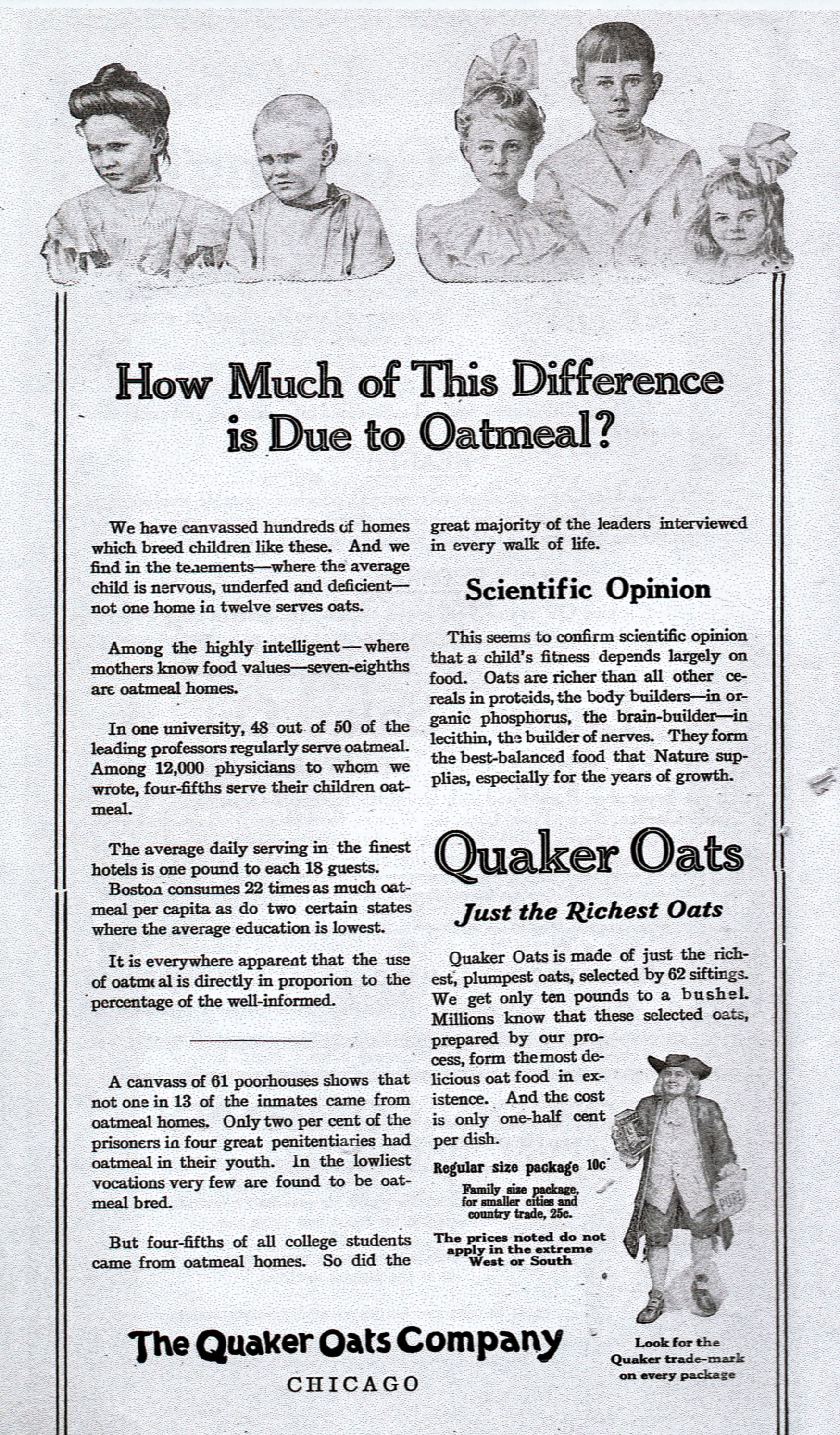
Since Grandma didn’t write much a hundred years ago today, I’ll share an old advertisement for Quaker Oatmeal.

It has lots of mind-boggling “statistics.” I wonder if there were any truth in advertising requirements regarding what types of research was needed to back up the numbers a hundred years ago.

How Much of This Difference is Due to Oatmeal?

We have canvassed hundreds of homes which breed children like these. And we find in the tenements—where the average child is nervous, underfed and deficient—not one home in twelve serves oats.

Among the highly intelligent—where mothers know food values—seven-eighths are oatmeal homes.

In one university, 48 out of 50 of the leading professors regularly serve oatmeal. Among 12, 000 physicians to whom we wrote, fourth-fifths serve their children oatmeal.

The average daily serving in the finest hotels is one pound to each 28 guests.

Boston consumes 22 times as much oatmeal per capita as do two certain states where the average education is lowest.

It is everywhere apparent that the use of oatmeal is directly in proportion to the percentage of the well-informed.

A canvass of 61 poorhouses shows that not one in 13 of the inmates came from oatmeal homes. Only two per cent of the prisons in four great penitentiaries had oatmeal in their youth. In the lowliest vocations very few are found to be oatmeal bred.

But four-fifths of all college students came from oatmeal homes. So did the great majority of the leaders interviewed in every walk of Life.

Scientific Opinion

This seems to confirm scientific opinion that a child’s fitness depends largely on food. Oats are richer than all other cereals in proteids, the body builders—in organic phosphorous, the brain –builder—in lecithin, the builder of nerves. They form the best-balanced food that Nature supplies, especially for the years of growth.

Quaker Oats

Just the Richest Oats

Quaker Oats is made of just the richest, plumpest oats, selected by 62 siftings. We get only ten pounds to a bushel. Millions know that these selected oats, prepared by our process, form the most delicious oat food in existences. And the cost is only one-half cent per dish.

Regular size package 10 cents.

Family size package, for smaller cities and country trade, 25 cents.

The prices noted do not apply in the extreme West or South.

Look for the Quaker trade-mark on every package.

The Quaker Oats Company

Chicago

National Foods Magazine (December 1910)

An Outlandish Fib

16-year-old Helena Muffly wrote exactly 100 years ago today: 

Monday, November 20, 1911:We got a good joke off on Carrie at school today. It was a most outlandish fib she told, and oh so shocking.

Recent photo of the school that Grandma and Carrie attended.

Her middle-aged granddaughter’s comments 100 years later:

Hmm. . . what was the story behind this entry? Carrie Stout was a friend of Grandma’s. I can’t quite figure out a probable relationship between a fib and the others (the class?) somehow playing a joke on Carrie.

Maybe Carrrie lied about homework? . . .but what would be the follow-up joke?

Or maybe she lied about why she was late getting to school? . . . and then the class . . .did what??

I might as well quit guessing. Some things are just impossible to figure out a hundred years later.

1911 Thanksgiving Vegetable Centerpieces

16-year-old Helena Muffly wrote exactly 100 years ago today: 

Saturday, November 18, 1911: Didn’t so much of anything today, except to be exceedingly lazy.

Her middle-aged granddaughter’s comments 100 years later:

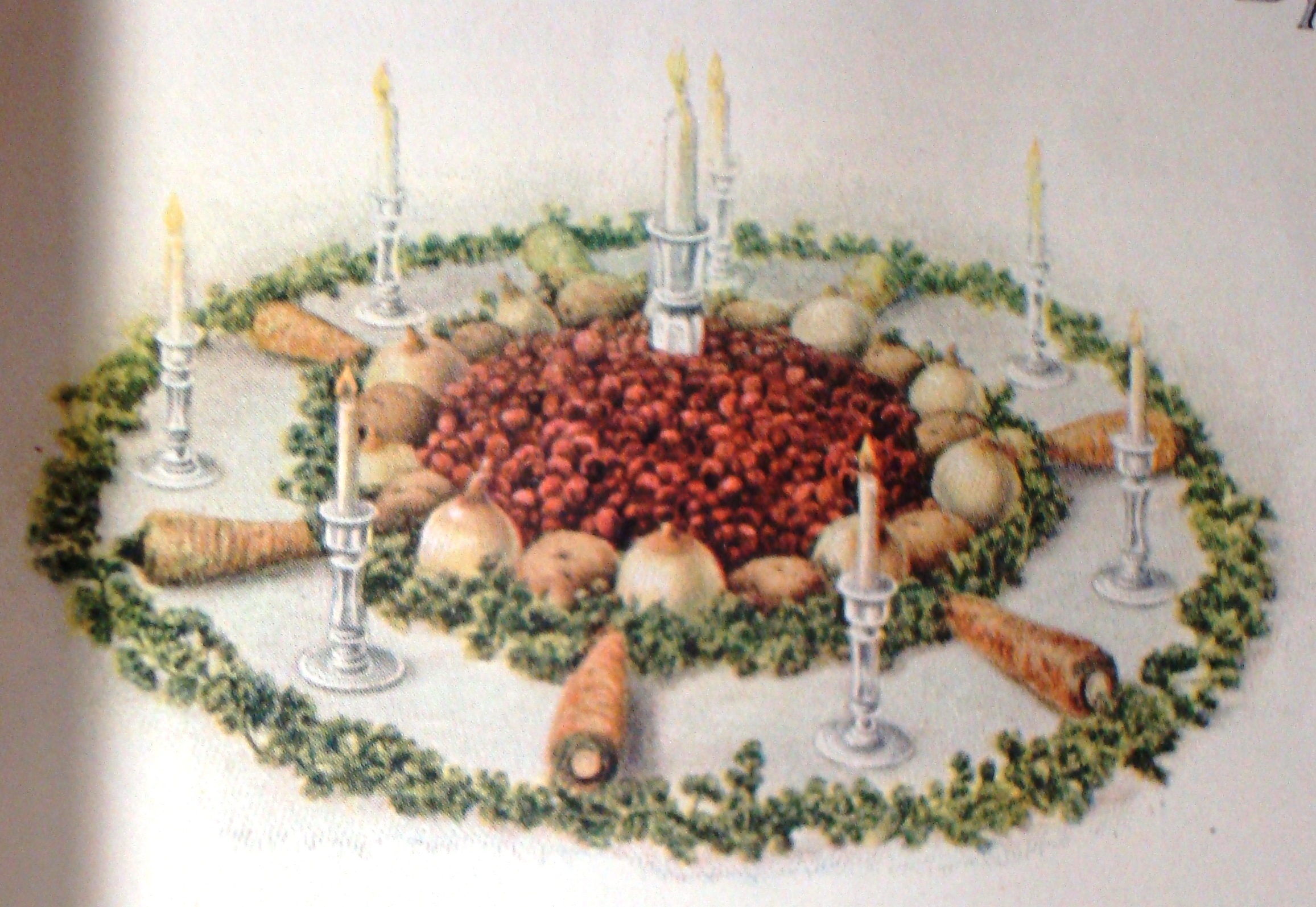
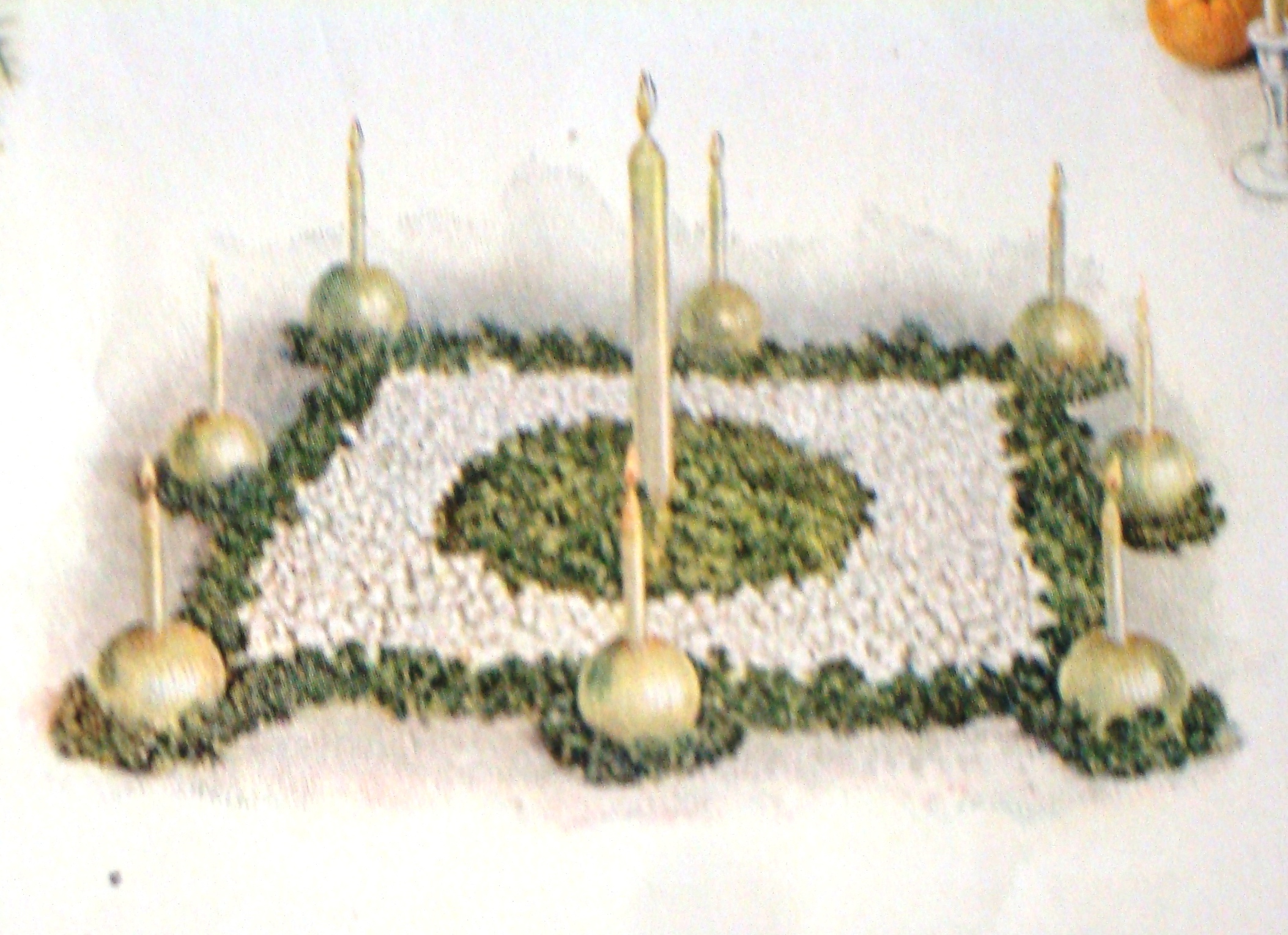
Maybe Grandma spent a quiet Saturday reading magazines. The November 1911 issue of Ladies Home Journal had some great pictures of Thanksgiving vegetable centerpieces.

Centerpiece made with squash, carrots, celery with leaves, tomatoes, parsley, cranberries, and evergreen cuttings
Centerpiece made with carrots, cranberries, potatoes, onions with brown skin partially removed, and candles
Centerpiece made with onions with brown skin removed, popcorn, parsley, and candles
Centerpiece made with pumpkin, carrots, tomatoes, evergreen cuttings, and candles

Snooping at the Teacher’s Desk

16-year-old Helena Muffly wrote exactly 100 years ago today: 

Friday, November 17, 1911:Another girl and I made our teacher feel cross for awhile this afternoon.  He had drawn a picture of a ring and beneath it we wrote “my diamond.”  Now he gives some of us credit for snooping at everything he has on his desk.

Did the paper look like this?

Her middle-aged granddaughter’s comments 100 years later:

This is one of my favorite diary entries. Grandma must have been a hoot when she was young.

This entry also makes me wish that I knew more about her teacher. I know that the teacher’s name was Howard Northrop—but little else.  In most diary entries he seems like the stereotypical teacher—gives hard tests, puts Grandma on the spot sometimes when she isn’t paying attention, etc.

In this post her teacher seems really human—How old was he? Was he cute? Did he have a girlfriend? Was he thinking of asking her to marry him? If so, how did it all work out?

Sharing Hopes and Fears with Bosom Friends

16-year-old Helena Muffly wrote exactly 100 years ago today: 

Sunday, November 12, 1911: Went to Sunday School this morning. Our Sunday School teacher is sick. This afternoon I gave Caroline a visit. But such a day to go calling. It rained and blew and hailed.

Photo source: Wikimedia Commons

Her middle-aged granddaughter’s comments 100 years later:

Brrr. . . . the weather sounds dreadful.

Caroline refers to Grandma’s friend Carrie Stout. She lived on a farm midway between the Muffly farm and McEwensville.

Friends, then as now, played an important role in adolescents’ lives.  Here’s what a book published in 1911 had to say:

The boy seeks his chum and the girl her bosom friend into whose sympathetic ears hopes, fears, dreams, ambitions, and secrets are poured.

Boy and Girl (1911) by Emma Virginia Fish

I wonder what dreams, hopes, and ambitions Grandma shared with Carrie.  And, if—as the years passed– Grandma fulfilled her dreams, or if they were dashed or forgotten.