16-year-old Helena Muffly wrote exactly 100 years ago today:
Tuesday, October 10, 1911: Wound up with our examinations today. Don’t think I made a good mark in algebra. I have such a sore thumb! Mighty.
Grandma may have used a wood pencil to take written exams. Wood pencils with erasers have been around since the late 1800s. (Photo source: Wikimedia Commons)
Her middle-aged granddaughter’s comments 100 years later:
The previous day’s entry also indicated that Grandma was taking exams. And, diary entries the preceding winter and spring mentioned exams on consecutive days.
These entries imply that students at McEwensville High School took periodic exams in all subject areas on successive days. The school only had one teacher—so it seems as if the multiple exams spread over two days were by design.
Whew, I’m glad that I wasn’t a student a hundred years ago. I remember when I was a high school student how much I hated it when several teachers gave tests close together. (I did learn how to successfully take multiple exams one after the other for college finals—but never liked it.)
16-year-old Helena Muffly wrote exactly 100 years ago today:
Monday, October 9, 1911: Had examinations today. Weren’t as hard as I expected they would be.
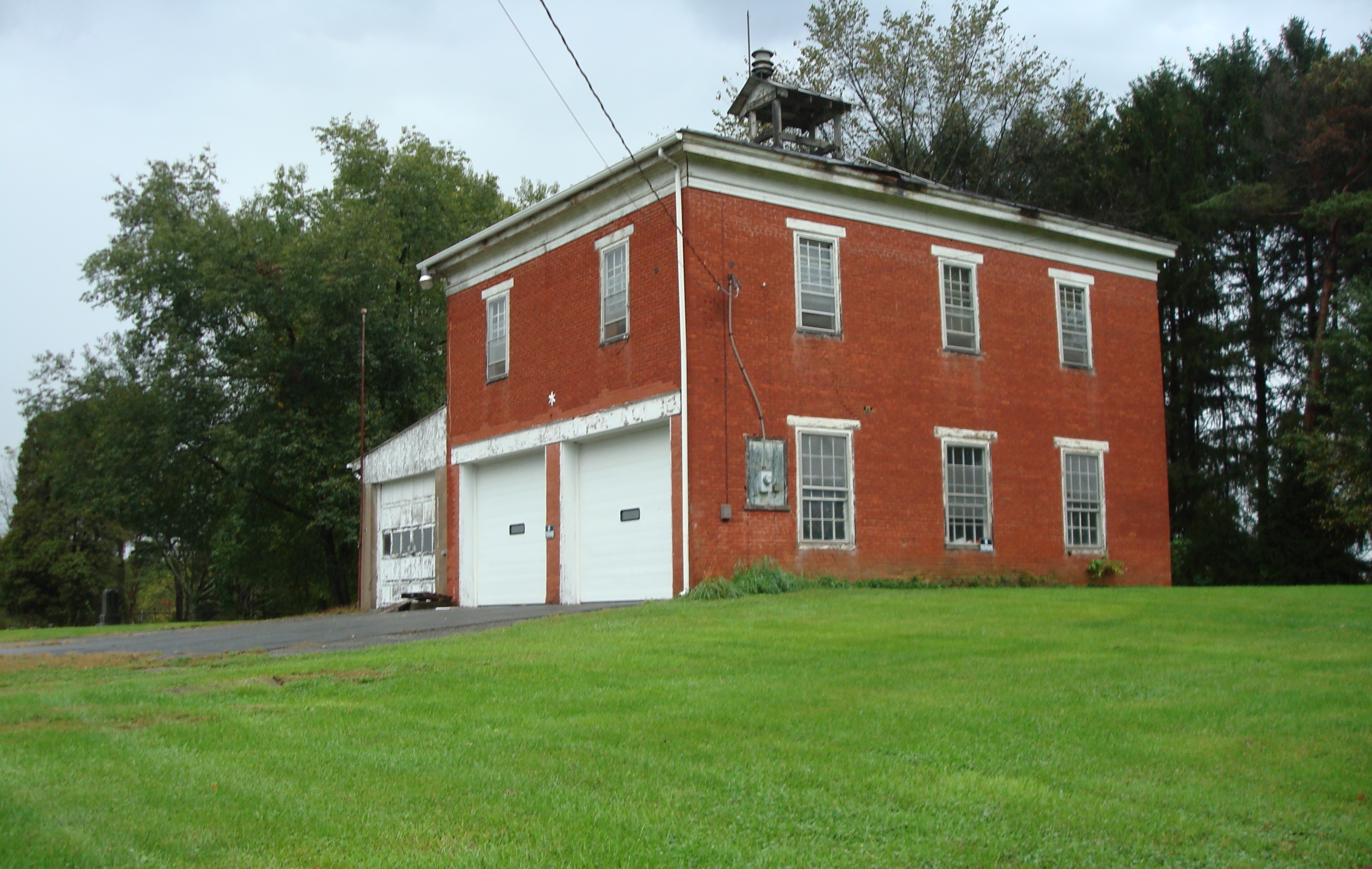
Building that once housed McEwensville High School
Her middle-aged granddaughter’s comments 100 years later:
It’s always a good sign when you feel good after an exam. It sounds like Grandma probably learned what her teacher wanted her to know. Today we worry so much about student performance—and whether they’ve learned what they were supposed to learn.
A hundred years ago people believed that schools had several purposes. According to a 1911 book:
The public school performs one of its greatest functions in developing common knowledge, habits, and ideals in its future citizens, a function that it could not perform if all school teaching and regulation of conduct were individual. A common standard of knowledge, power, and achievement, to which everyone is expected to conform, helps to mould the life of an individual in a normal way and to fix in his mind and character standards by means of which his achievements and ideals may be guided.
The Making of the Individual (1911) by E.A. Kirkpatrick
16-year-old Helena Muffly wrote exactly 100 years ago today:
Sunday, October 8, 1911: Ruth and I went down to Aunt Lizzie’s near Montandon. Such a time as we had this afternoon a hunting chestnuts and walking around. We went down on the train and came home that way. Tuu (??) took us to the depot on the return trip. Such a pain as I had a coming home. I guess I ate too much dinner.
Her middle-aged granddaughter’s comments 100 years later:
Sounds like a fun Sunday. Montandon is about 10 miles south of the Muffly farm. Grandma and her sister Ruth would have taken the train that ran from Watsontown to Milton and then on to Montandon.
I’m not sure whether Aunt Lizzie (Elizabeth) was a good cook or a poor one since Grandma ended up with a stomach ache—though the entry seems to indicate that Grandma must have enjoyed the food.
Aunt Lizzie was a sister of Grandma’s father, Albert Muffly. I’m not sure who she married—and can’t quite read Grandma’s handwriting in the diary to figure out who took them to the train station.
Albert Muffly was the fourth child of Samuel K. and Charlotte Muffly. He was born in 1857. Lizzie was born in 1862 and was the seventh child in the family. Samuel K. and Charlotte had eleven children.
For more on the Muffly family genealogy see these previous postings:
16-year-old Helena Muffly wrote exactly 100 years ago today:
Saturday, October 7, 1911: Hulled some walnuts this afternoon. Tried to be careful of my hands, but they got stained somewhat.
Black Walnuts
Her middle-aged granddaughter’s comments 100 years later:
Black walnuts grow semi-wild in Pennsylvania–and across much of the US.
The hull is the outer husk. It must be removed to prevent spoilage. The nuts are then dried. After they are dried they can be cracked.
Crack hulls with feet. Then use hands to remove.
Last week-end my husband and I gathered some black walnuts at a park. We took them home and hulled them. We put the nuts in an old net onion bag and hung them in the garage to dry. They’ll be ready to crack and eat by December.
Walnut stains on my hands. This is one powerful stain. Three days later my hands are still brown, and everyone at work is teasing me about being an auto mechanic. (Bottom line: Wear gloves when hulling walnuts.)
Oct. 15 Addendum: I mentioned putting the walnuts in a net onion bag to my father. He was horrified and said that they would mold. He said they should be spread out on newspapers in a cool dry place (an attic is ideal). So I checked my walnuts and noticed that two of them had a spot of mold of them. I discarded those walnuts–and spread the rest out on newspapers to dry. Stay tuned . . .
Nov. 9 Addendum: I’ve now successfully cracked some black walnuts. Click here for today’s post on How to Crack Black Walnuts.
16-year-old Helena Muffly wrote exactly 100 years ago today:
Friday, October 6, 1911: Went over some of my studies tonight in order to learn what I don’t know. Exams are approaching. Dear me.Her middle-aged granddaughter’s comments 100 years later:
Grandma sounds really worried about the exams. Maybe she did some exercises to relieve stress. Here’s one from a 1911 book:
Shoulder and Back Exercise
First Position (Fig. 40)—Stand erect, with the feet together, and both arms extended on a plane with the should, so that in the first position the left arm is extended directly in front of the body and the right arm on the same plane directly behind the body. The arms must be held rigidly on the same plane.
Second Position (Fig. 41)—by a circular movement, the position of the left arm is assumed by the right, and vice versa. During the entire movement the feet must be kept firmly planted on the floor, pivoting at the hips only, while making the continuous circular movement of the arms.
Personal Hygiene and Physical Training for Women (1911) by Anna Galbraith
16-year-old Helena Muffly wrote exactly 100 years ago today:
Thursday, October 5, 1911: Besse was out a little while this afternoon. Brought some chestnuts. Didn’t have any before. Such an extraordinary occurrence. Ruth’s cow had twin calves. Both are white, rather good lookers. Ruth and I carried one down out of the field and out to the barn. Then we put him in the express wagon and he tumbled out.
Chestnuts (Source: Wikimedia)
Her middle-aged granddaughter’s comments 100 years later:
This entry befuddles me. I’m surprised that Grandma considered chestnuts a treat when her married sister Besse brought them, and that she’d never previously eaten any.
I would have guessed that chestnut trees were very common in central Pennsylvania in 1911—and my research supports that impression. Here’s what I found:
Chestnut trees were once more popular in the US than they are today—but many died due to a chestnut blight.
According t o Wikipedia, the blight was first identified on Long Island, New York in 1904—and chestnut trees largely died out in the US over the next 40 years. Wikipedia also says:
In some places, such as the Appalachian Mountains and others, one quarter of hardwoods were chestnuts. Mature trees often grew straight and branch-free for 50 feet (15 m), up to 100 feet, averaging up to 5 feet in diameter. For three centuries, most barns and homes east of the Mississippi River were made from it.
Bottom line—I still think that chestnut trees were common in 1911, so I’m still confused by this entry.
Twin Calves
It’s relatively rare for a cow to have twins. When I was growing up on a farm in the 1960’s we had a herd of 40 cows—and about one set of twins was born per year. I’m not sure how many cows the Muffly’s had, but it probably was in the range of 5 to 10 cows—so years probably went by between the birth of twins.
I can almost picture Grandma and her sister Ruth chatting and laughing as they collaboratively worked to bring one of the calves down to the barn.
For a discussion of how the Muffly children owned their own cows see the previous post on this topic.
16-year-old Helena Muffly wrote exactly 100 years ago today:
Wednesday, October 4, 1911: Had a clash with Ma this morning. I guess she thinks I am one terrible kid! I must bring about a reform if possible.
Her middle-aged granddaughter’s comments 100 years later:
I wonder what Grandma did. This entry seems to indicate that Grandma believed that she was in the wrong—and that if she will had enough willpower that she might be able to “reform” herself.
In 1911 willpower was considered an important precursor of good behavior:
The Power of the Will or Inhibition
The conduct of mankind is chiefly governed by the emotions, instincts, and impulses. . . .
“I am, I ought, I can, I will” are the only firm foundation-stones upon which we can base our attempts to climb into a higher sphere of existence. The first impulse a faculty of introspection, the second a moral judgment, the third a consciousness of the freedom to act, the fourth a determination to exercise that power.
Physical Hygiene and Physical Training for Women (1911) by Anna Galbraith