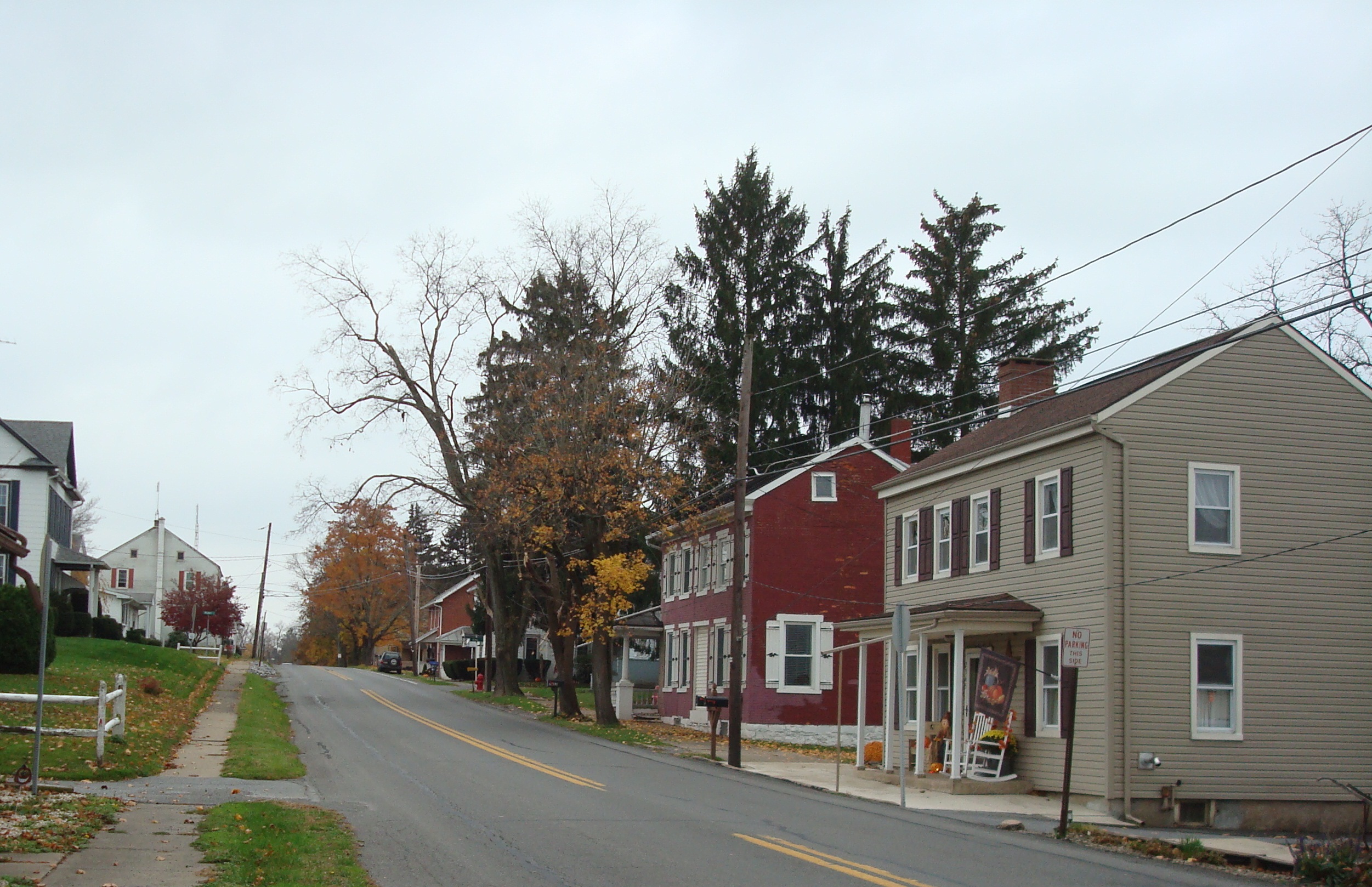
17-year-old Helena Muffly wrote exactly 100 years ago today:
Sunday, February 9, 1913: Went to Sunday School this afternoon. I forget to study my catechize lesson, so I didn’t know it very well.
The McEwensville Baptist Church was torn down many years ago, but Grandma would have walked down this road to go to church.
Her middle-aged granddaughter’s comments 100 years later:
Grandma occasionally mentioned catechism classes in the diary. The first time she mentioned it was on the very first day of the diary—January 1, 1911:
. . . This afternoon I went to Sunday school and attended catechize after church. On my way home I received a charming new year’s gift. (Thanks to the donor.) The first day of the new year is almost spent and I feel rather sad.
Went to S.S. this afternoon and attended Catechize.
Whew, Grandma’s been taking catechism classes for more than two years. That seems like a really long time. And, she also seems really old to be taking them. She’s 17—almost 18 years old. I believe that Grandma attended the McEwensville Baptist Church.
I wonder:
How many years did young people need to attend catechism classes before they could join the church a hundred years ago?
What was the typical age when people joined the church back then?
17-year-old Helena Muffly wrote exactly 100 years ago today:
Saturday, February 8, 1913: Went to Watsontown this morning to get some stuff for a box social. Ruth and I went up to McEwensville this evening. I did not spend a very enjoyable evening since the person I wanted to get my box didn’t get it and the person I didn’t want to get it got it. Rode home with Ruth and her friend. He’s one of the bald-headed types.
Ruth Muffly
Her middle-aged granddaughter’s comments 100 years later:
I think this is the first box social that Grandma’s gone to since she began the diary—though her sister Ruth went to one in February, 1912.
Box socials always seem like something out of story books. The girls prepared beautiful box lunches with enough food for two that were then auctioned off to raise funds for the school or some charity.
The winning bidder would eat the food with the girl who made the box.
It sounds like the box social turned into a disaster for Grandma.
Ruth was 21—the guy she was with sounds older. How old was he?. . . 30??. . . older??
17-year-old Helena Muffly wrote exactly 100 years ago today:
Wednesday, February 5, 1913: Nothing very much for today. Went up to practice this evening.
Her middle-aged granddaughter’s comments 100 years later:
Grandma was going to be in her class play, and went back into McEwenville in the evening for play practice. (She probably had to come home after school to help milk the cows.)
Grandma obviously appreciated whatever culture was available in her small rural community. I recently found this advertisement for Victor Victrola’s in the March 15, 1913 issue of a farm magazine called Kimball’s Dairy Farmer.
If there is any place where a Victor-Victrola is needed and sure to be appreciated, it is in the homes of the farmers—in your house.
You haven’t the opportunities city people have for attending the theatre, opera, and musical concerts—and yet you have real need of such entertainment to rest body and mind after your day of toil.
And you can have it with a Victor-Victrola in your home. You can enjoy the world’s best music, sung and played by the same great artists who entertain the large city audiences.
You can hear whatever kind of music you like right now.
You don’t have to wait until you feel you can afford a $100 or $200 instrument—any Victor-Victrola you choose as the instrument for your home will play every record in the Victor catalog, and will give you almost as perfect music as the Victor- Victrola XVI, the instrument by which the value of all musical instruments in measured.
Any Victor dealer in any city in the world will gladly demonstrate the Victor-Victrola to you and play any music you wish to hear.
Write us for the handsome illustrated Victor catalogs.
Victor Talking Machine Co., Camden, N.J.
Berliner Gramophone Co., Montreal, Canadian Distributors
Victor-Victrola XVI, $200, Mahogany or quartered oak
17-year-old Helena Muffly wrote exactly 100 years ago today:
Tuesday, February 4, 1913: We had an exam in General History this morning. It was a review of all we had gone over this year. I was so afraid I’d make a sorry mark, so I began to review but I didn’t get over it all. I got some things wrong, but then I know I got more right. At least I think so.
Roman Fleet (Source: Outlines of General History by V.A. Renouf)
Her middle-aged granddaughter’s comments 100 years later:
Did Grandma need to memorize dates for the exam?
Here’s what the Suggestions for Teachers section of a hundred-year-old text-book had to say about memorizing dates:
In conclusion, I will touch on the question of learning dates. These should be memorized by all students. It is well to bring as many events as possible into relation with a memorized date. The few students who have a ready memory for dates can be encouraged to remember most or all of them; but the majority of the class should not be burdened with more than are necessary for a correct general perspective of the centuries.
Outlines of General History (1909) by V.A Renouf
Would a history teacher today agree or disagree with this suggestion?
The book also included some sample questions that teachers might use. I did a previous post that included a few of the sample questions:
17-year-old Helena Muffly wrote exactly 100 years ago today:
Monday, February 3, 1913: It was simply enchanting this morning. The snow came down in fluffy flakes. It was an unusual sight. Had a pain this morning. Guess four dishes of ice cream was most too much for my capacity.
Caption: Vanilla Ice Cream with Chocolate Sauce Plate XX. For Receipt see pages 247 and 299. Source: Lowney’s Cook Book (1912)
Her middle-aged granddaughter’s comments 100 years later:
The previous day the Muffly’s made ice cream. It must have tasted really, really good if Grandma ate four dishes (even if she’s paying for her indulgence). Maybe she ate it with warm chocolate sauce.
Here is a hundred-year-old recipe for vanilla ice cream and chocolate sauce:
Vanilla Ice Cream
4 cups milk
1 cup sugar
3 eggs
1 tablespoon vanilla
1/3 teaspoon salt
This is the simplest and cheapest ice cream made. One pint of cream added is an improvement.
Scald the milk in double boiler. Mix eggs, sugar and salt; added scalded milk to them; return to double boiler and cook until mixture thickens and is of a smooth and creamy consistency.
Strain into a cold dish. Add vanilla and cool before putting mixture in ice cream freezer.
Chocolate Sauce
2 ounces Lowney’s Premium Chocolate
1 cup sugar
1/4 teaspoon salt
1 teaspoon vanilla
Cook all the ingredients except vanilla twelve minutes; add vanilla, and serve hot. This sauce is especially good served with Vanilla Ice Cream.
Lowney’s Cook Book (1912)
Lowney’s Cook Book was published by a company that made baking chocolate. I assume that any brand of unsweetened chocolate could be substituted for the Lowney’s Premium Chocolate in the chocolate sauce recipe.
For more old ice cream recipes and related information see:
Old-time Vanilla Ice Cream Recipes (These recipes are different than the one above. It’s interesting to see the variation in the old recipes.)
17-year-old Helena Muffly wrote exactly 100 years ago today:
Sunday, February 2, 1913: It was a very tight fit. The girls slept with me. It was very nice, especially where one must cling to the very edge for fear
Went to Sunday School this morning. Besse was out. We had ice cream today. Second time. Rufus took Helen home this evening, that is they both went to Christian Endeavor, but I stayed to studying General History. It’s awfully cold here, so I’m going to be. Good-night.
Picture source: National Food Magazine (June, 1910)
Her middle-aged granddaughter’s comments 100 years later:
Based on the diary, I think that Grandma and her sister Ruth (called Rufus in this entry) shared a double bed during the winter months since the second floor of homes were cold back in the days of wood and coal stoves.
The previous day Grandma wrote that a friend, Tweet (Helen) Wesner, came to visit. Probably the three girls squeezed into the double bed.
A hundred years ago making homemade ice cream was often winter activity rather than a summer one. The Muffly’s did not have electricity and lived on a farm. Ice was more readily available in the winter—and it would be easier to store the ice cream.
Here are the directions in a hundred-year-old cookbook for making ice cream:
Directions for Freezing
Select a reliable freezer and one which runs easily. Keep the gearing well oiled.
Adjust the freezing can in the freezer, making sure that all parts fit and that the crank turns readily. Place ice in bag made of ticking or strong sacking, and with a wooden mallet, pound until very fine. Surround the freezing can with ice and rock salt, using three measures of ice and one of salt, for ice cream and sherbets; two measures of ice and one of salt for sorbets, frappes, etc.; equal measures of ice and of salt for molding and for freezing mousses, bombes, and parfaits.
For freezing ice cream, when the freezing can is cold, pour in mixture to be frozen, let stand five minutes, then turn the crank slowly for eight or ten minutes, then more rapidly until mixture is frozen. Remove dasher, scrape cream from sides of freezing can to the middle and press down so as to have the cream one solid mass; let stand to season, or if to be molded, pack in the mold.