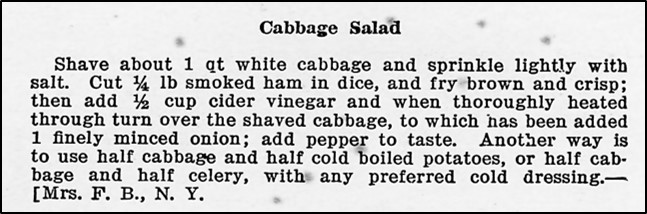
Sometimes coleslaw with its typical sugary, mayonnaise-based dressing can seem like a bit much. I recently came a hundred-year-old dressing for Cabbage Salad with Ham that calls for simply dressing it with warm vinegar. The simplicity of the dressing really brings out the flavor of this salad.
Here is the original recipe:
Source: The Old Reliable Farm and Home Cook Book (1919)
1 quart (4 cups) cabbage, grated (about 1 medium cabbage)
1 medium onion, finely minced
1/4 cup ham, diced
1/2 cup apple cider vinegar
1/4 teaspoon salt
1/4 teaspoon pepper
Combine grated cabbage and minced onion in a bowl. Set aside
Sauté diced ham in a skillet using medium heat until lightly browned. Stir in vinegar, salt, and pepper; heat until hot. Pour heated vinegar over cabbage and onion; stir to combine. Serve.
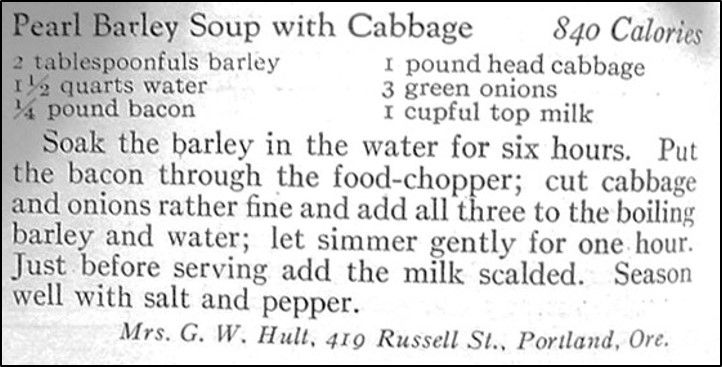
Soup is the perfect comfort food on these cold winter days. I recently found a wonderful hundred-year-old recipe for Pearl Barley Soup with Cabbage. The soup was delightful – but the recipe name is misleading. The recipe only calls for two tablespoons of barley – and it is not a predominate ingredient in the soup. This soup is really a hearty, rustic Cabbage and Bacon soup.
Here’s the original recipe:
Source: Good Housekeeping (October, 1917)
Since modern pearled barley does not need pre-soaking, I skipped that step. Also, I didn’t think that three green onions were very many, so I used all the green onions in the bunch that I purchased. Here’s the recipe updated for modern cooks:
Pearl Barley Soup with Cabbage (Cabbage and Bacon Soup)
Put water in a dutch oven; bring to a boil using high heat, then add barley, bacon, cabbage, and green onions. Return to a boil, then reduce heat and gently simmer for 1 hour. Add half and half, salt, and pepper. Heat until steamy hot, then serve.
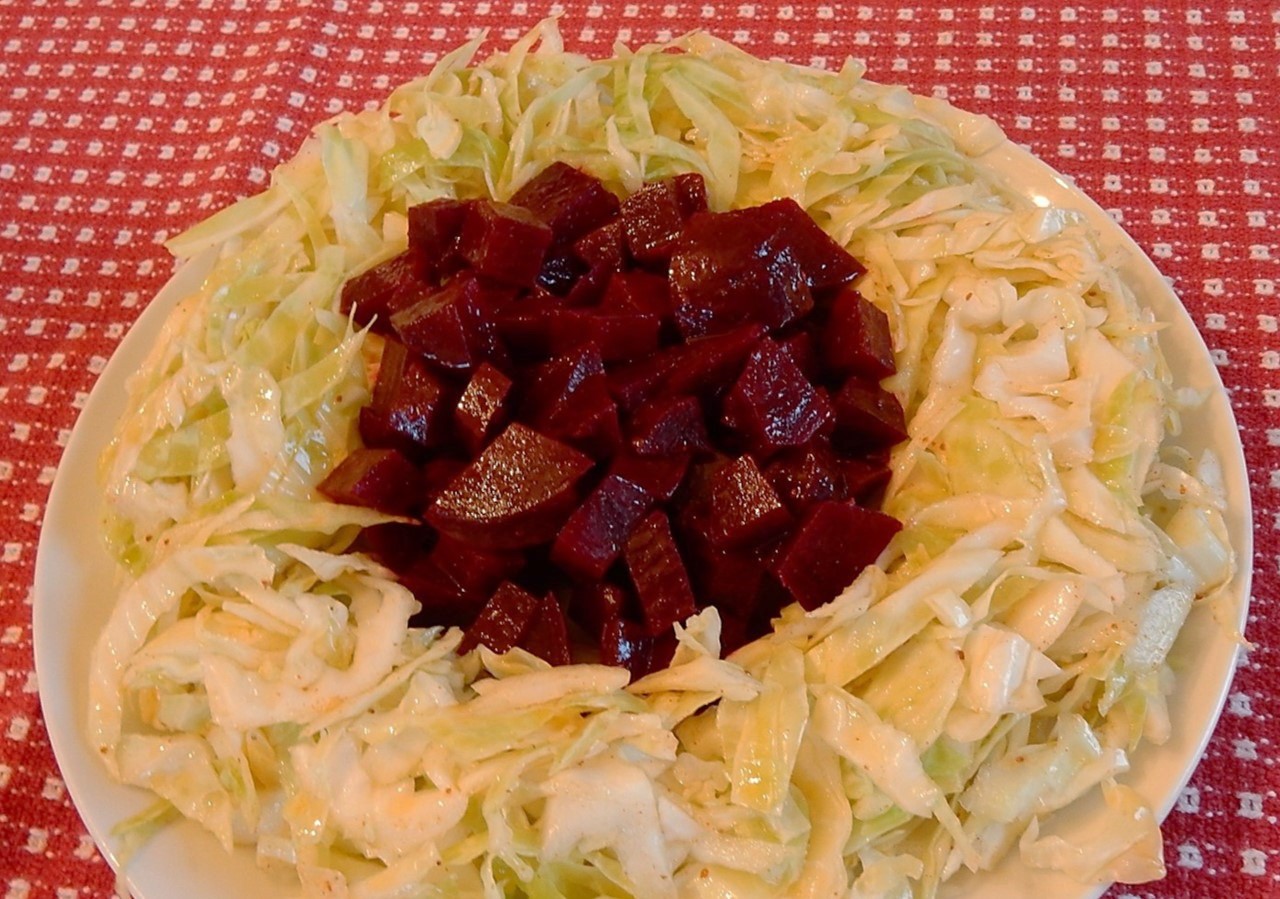
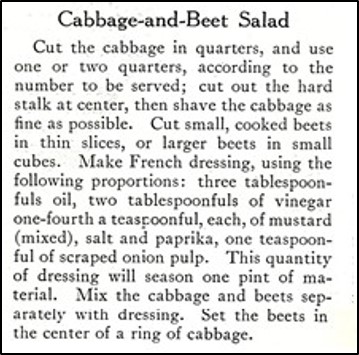
Sometimes salads can seem a bit boring, so I was delighted to find a hundred-year-old recipe for Cabbage and Beet Salad. This salad makes a lovely presentation that is just a tad dramatic. And, a subtle homemade French dressing adds just the right amount of flavor to the salad.
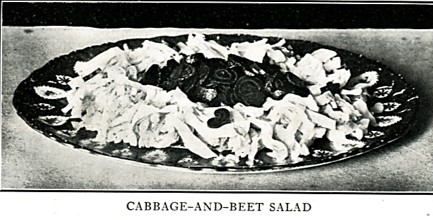
Here’s the photo and recipe for Cabbage and Beet Salad in the hundred-year-old magazine:
Source: American Cookery (August – September, 1918)
1 small cabbage, shredded (about 5 cups shredded cabbage)
2 medium beets, cooked and diced into 1/2 inch cubes (about 1 cup diced, cooked beets)
French Dressing
6 tablespoons olive oil
4 tablespoons vinegar
1/2 teaspoon salt
1/2 teaspoon mustard
1/2 teaspoon paprika
2 teaspoons onion, finely minced
Put shredded cabbage in a bowl; gently stir in 2/3 of the French dressing. Put in refrigerator, and chill for at least 2 hours.
Put diced beets in another bowl; gently stir in 1/3 of the French dressing. Put in refrigerator, and chill for at least 2 hours.
To serve: Drain any excess dressing from the shredded cabbage, then arrange the cabbage in a ring with a hole in the center. (I pressed the cabbage into a circular mold, covered with the serving plate, and then quickly flipped and removed mold – but a mold is not necessary.)
Drain any excess liquid from the beets. Place beets in the center of the ring. Serve immediately.
To make French Dressing: Put olive oil, vinegar, salt, mustard, and paprika in a small bowl; stir to combine. Stir in minced onion.
I found a delightful Bavarian Cabbage recipe in a hundred-year-old magazine. This traditional German dish was refreshingly sweet-sour (more sour than sweet), and would be lovely served with sausages, roast beef, or pork. It tasted very authentic; and if I closed my eyes and listened hard enough, I could almost see myself sitting at an outdoor cafe on the banks of the Rhine on a cool October day while listening to merry Octoberfest music.
1 tablespoon bacon drippings or butter (I used bacon drippings.)
1 tablespoon onion, finely chopped
1/2 cup vinegar
1 tablespoon sugar
1 teaspoon salt
1/4 teaspoon white pepper
Using medium heat, melt the bacon drippings (or butter) in a frying pan; add onions and cook until tender (but not browned). Add the vinegar, sugar, salt, and pepper, and stir to combine. Then add the shredded cabbage and stir; cover the pan and gently simmer for 20 minutes. Remove pan cover once or twice during cooking to make sure there is enough liquid; if too dry add enough water to keep from burning. (I did not need to add any water.)
I used less salt than the original recipe called for. One tablespoon of salt seemed like a lot – so I decided that it probably was a typo and instead used 1 teaspoon of salt. I also didn’t quite understand the last part of the old recipe about cold water (though I’m guessing that it was directing the cook to wash the cabbage prior to cooking).
16-year-old Helena Muffly wrote exactly 100 years ago today:
Wednesday, September 13 , 1911: Was in such terrible trepidation this morning, lest I would have to miss school and help Ma with the work, but Besse came to my relief. So glad I was. I missed those stacks and stacks of dishes for dinner, but have to confront them tonight.
Her middle-aged granddaughter’s comments 100 years later:
Besse was Grandma’s married sister who lived nearby. The previous day Grandma wrote that the threshers were at the farm. All the farmers in the community probably were at the Muffly farm helping with the threshing. And, I bet that all the hard work made them very hungry.
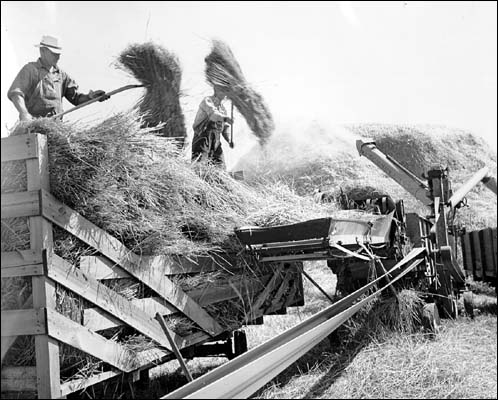
Early 20th century photos of steam-operated threshing machine. Photo was taken in the midwest, so the machine in the photo was probably a little larger than what would have been used in central Pennsylvania. (Photo source: Library of Congress, Fred Hultstrand and F.A. Pazandak Collections)
I’m on a roll remembering traditional Pennsylvania sweet and sour foods that might have been served to the threshers. Yesterday I wrote about spiced crab apples. Another fall sweet and sour food is pickled cabbage (pepper hash).
Pickled Cabbage (Pepper Hash)
1 medium head cabbage, shredded (approximately 4 cups)
1 green bell pepper (green mango), coarsely chopped
1 red bell pepper (red mango), coarsely chopped
1/2 cup vinegar
1/2 cup sugar
1/2 teaspoon salt (optional)
Mix all ingredients together and let stand at least 1 hour. This salad may be kept covered and refrigerated for several weeks. Drain before serving.
I got this recipe from my sister-in-law, Linda— and she says that she got it from her mother. It is a very typical old-fashioned central Pennsylvania dish.
This recipe is very adaptable and can easily be made in larger or smaller quantities. Just use equal proportions of vinegar and sugar to make as much dressing as needed.
Linda says that the original recipe called for green and red mangos rather than green and red bell peppers. Traditionally people in central Pennsylvania and other parts of Appalachia referred to bell peppers as mangos. Of course, the mango fruit doesn’t grow in Pennsylvania, and until recent improvements in transportation the tropical fruit wasn’t sold there, so there never was any confusion.