16-year-old Helena Muffly wrote exactly 100 years ago today:
Sunday, October 29, 1911: Went to Sunday School this morning. Tweet came along with Ruth from church. So you see she was here all afternoon. Ruth and I went up to Oakes’ this evening.
Recent photo of the road Ruth and Tweet would have walked down as they approached the Muffly farm.
Her middle-aged granddaughter’s comments 100 years later:
Grandma’s monthly exams were scheduled to begin the next day. It seems odd that Grandma doesn’t mention studying for them in this diary entry. The previous Thursday she had mentioned that she was struggling in algebra and worried about upcoming exams. And on Friday, she’d written that she “must begin to get ready for upcoming examinations which come around again next Monday and Tuesday.”
Yet she never mentioned studying on Saturday or Sunday—and apparently spent most of Sunday with friends. The Oakes lived on a farm near the Muffly’s. Several of the Oakes children were close in age to Grandma and Ruth.And, earlier in the day another friend, Helen Wesner (who went by the nickname of Tweet), visited them.
16-year-old Helena Muffly wrote exactly 100 years ago today:
Tuesday, October 24, 1911: Had a fly around this morning with Ma. I as usual was the cause of it. She says I’m incorrigible, but I don’t quite agree with her. Do you?
Her middle-aged granddaughter’s comments 100 years later:
I wonder what Grandma did that led her mother to say that she was incorrigible. It’s interesting that Grandma included a rhetorical question in this post. It almost seems like she had a premonition that someone else might someday be reading the diary.
I’ll answer the question a hundred years later. I do not think that Grandma was incorrigible. She married and lived a long, productive life until she died in 1980 at the age of 85.
Grandma raised four wonderful children, and had many awesome grandchildren and great-grandchildren. (Well, maybe I shouldn’t say that since I’m one of the grandchildren, but my relatives are obviously really cool.)
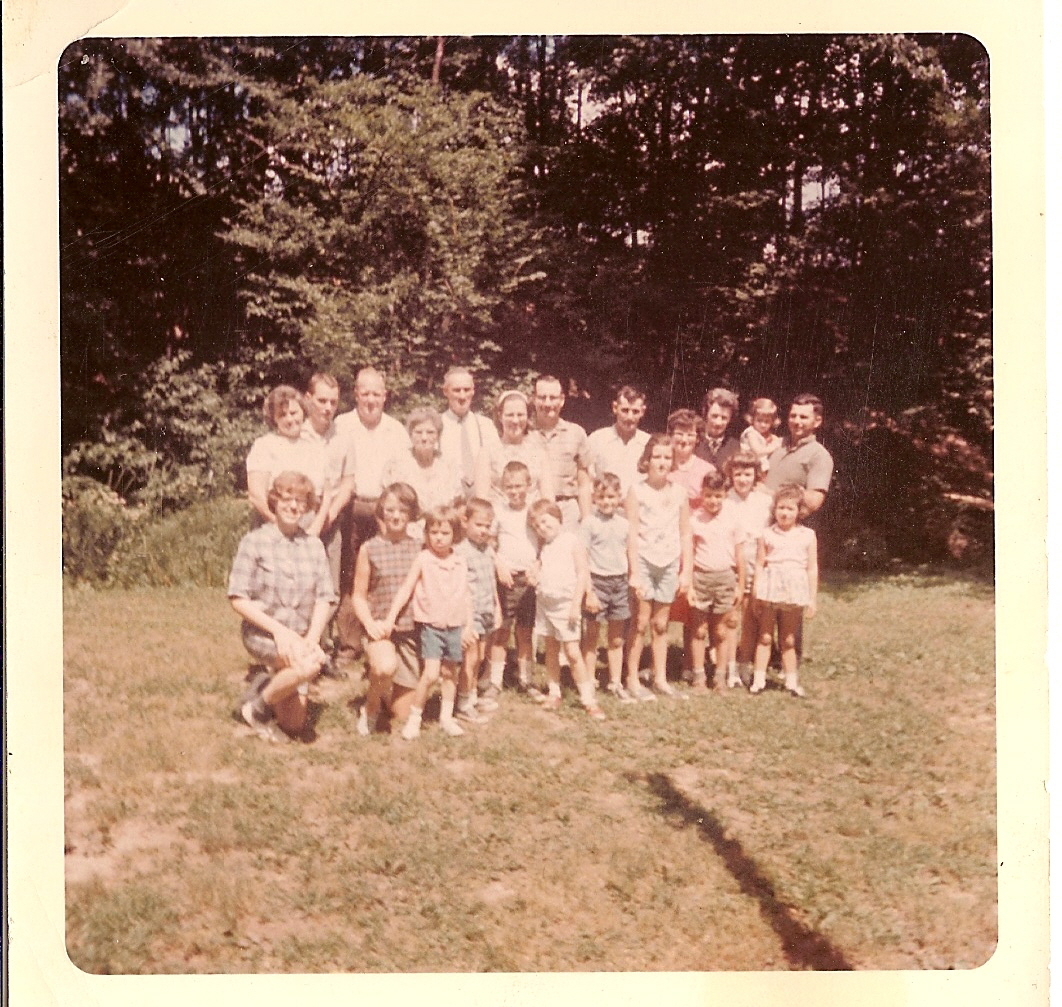
Helen(a) (Muffly) and Raymond Swartz and their descedants at the Swartz Reunion, White Deer Park, circa 1964
Grandma’s mother was obviously wrong– she was not incorrigible!
16-year-old Helena Muffly wrote exactly 100 years ago today:
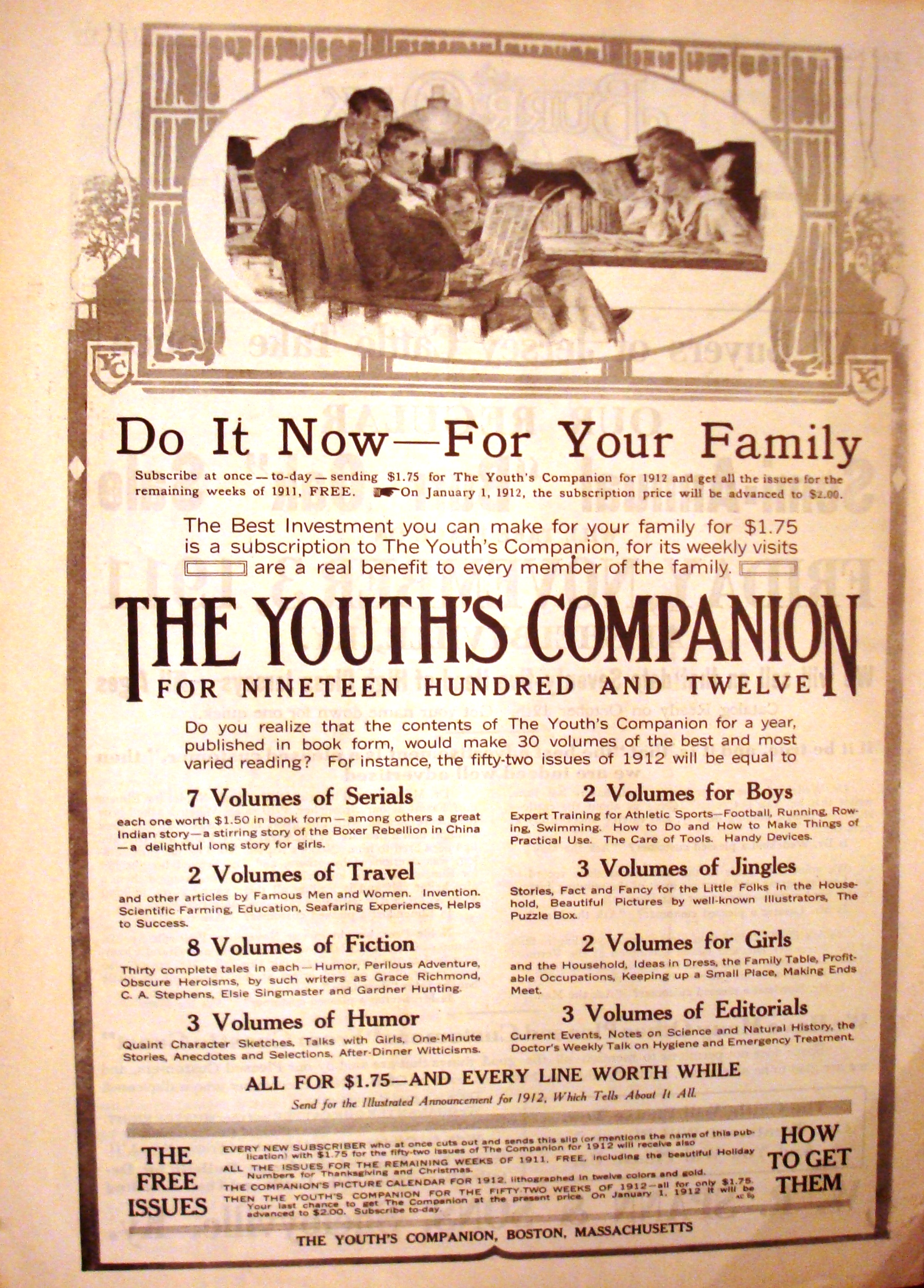
Monday, October 23, 1911: Subscribed for the Youth’s Companion today. Beginning to get cold. I mean the weather not me.
Advertisement for The Youth’s Companion on the back cover of Kimball’s Dairy Farmer Magazine (November 1, 1911)
Her middle-aged granddaughter’s comments 100 years later:
The Youth’s Companion was a popular magazine in the late 1800s and early 1900s.
According to the Collecting Old Magazines website the magazine began as a children magazine, but was aimed at the entire family by the time that Grandma wrote this diary entry:
. . . an audience limited to children only gave The Youth’s Companion only so many years in the life of a subscriber. The magazine expanded its offerings to include the entire family, and by doing so expanded its own lifetime to the lifetime of the subscriber. . . The typical issue would include “outdoor adventure stories, historical articles, anecdotes, contests, travel articles, and editorials.
“The Children’s Page” was there for the youth in its title, but by 1897 The Youths Companion also touted itself as “An Illustrated Family Paper,” which throughout that decade and into the new century would publish work from notables such as Grover Cleveland, Theodore Roosevelt, Booker T. Washington, Helen Keller, as well as literary notables such as Kate Chopin, Edith Wharton, Jack London and Emily Dickinson.
Magazine History and Collecting Tips, Collecting Old Magazines
16-year-old Helena Muffly wrote exactly 100 years ago today:
Sunday, October 22, 1911: While walking to Sunday School this afternoon, I saw three men taking a man and n_____ woman to jail. Anyway that’s very likely where they’ll land before long. It’s raining tonight real hard.
Her middle-aged granddaughter’s comments 100 years later:
Whew, this diary entry upsets me. Grandma spelled out n___ in her handwritten entry in the diary, and her attitude bothers me a lot.
Grandma would have walked a mile or so on country roads to get to Sunday School in McEwensville.
Central Pennsylvania was not very diverse a hundred years ago, but a few Blacks lived in the area. C.V. Clark, in a presentation to the Northumberland County Historical Society, mentioned that in the late 1800’s a freed slave named Eliza lived in McEwensville–and her descendents probably were still living in the area in 1911.
I know that times were different back then, but the bottom line is that Blacks were often treated terribly a hundred years ago. To help better understand what things were like in 1911 I’d like to share some disturbing information that I recently discovered.
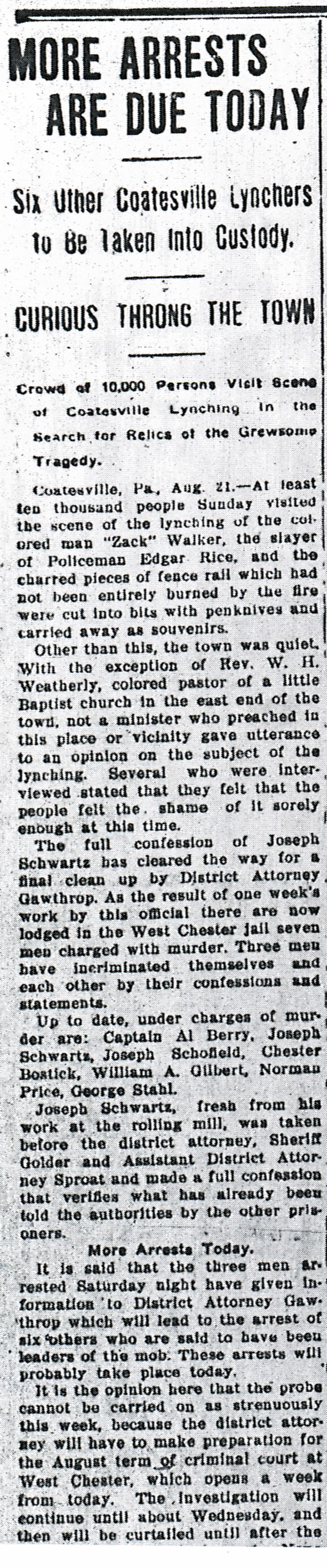
The last lynching in Pennsylvania occurred on August 13, 1911. Zachariah Walker was lynched in Coatesville which is near Philadelphia.
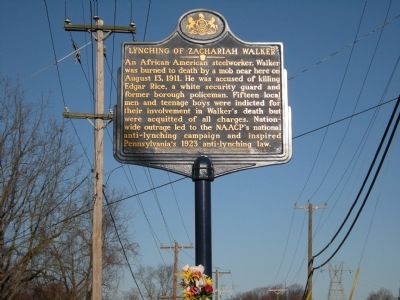
Historic marker in Coatesville. Used with Permission: HMdb.org (Historic Marker Data Base); photographer: Kevin W. of Stafford VA
The inscription on the historic maker about the lynching says:
LYNCHING OF ZACHARIAH WALKER
An African American steelworker, Walker was burned to death by a mob near here on August 13, 1911. He was accused of killing Edgar Rice, a white security guard and a former borough policeman. Fifteen local men and teenage boys were indicted for their involvement in Walker’s death but were acquitted of all charges. Nationwide outrage led to the NAACP’s national anti-lynching campaign and inspired Pennsylvania’s 1923 anti-lynching law.
Even though Grandma lived more than a hundred miles from Coatesville, she probably was aware of the lynching. The local paper, The Milton Evening Standard periodically ran stories about it.
16-year-old Helena Muffly wrote exactly 100 years ago today:
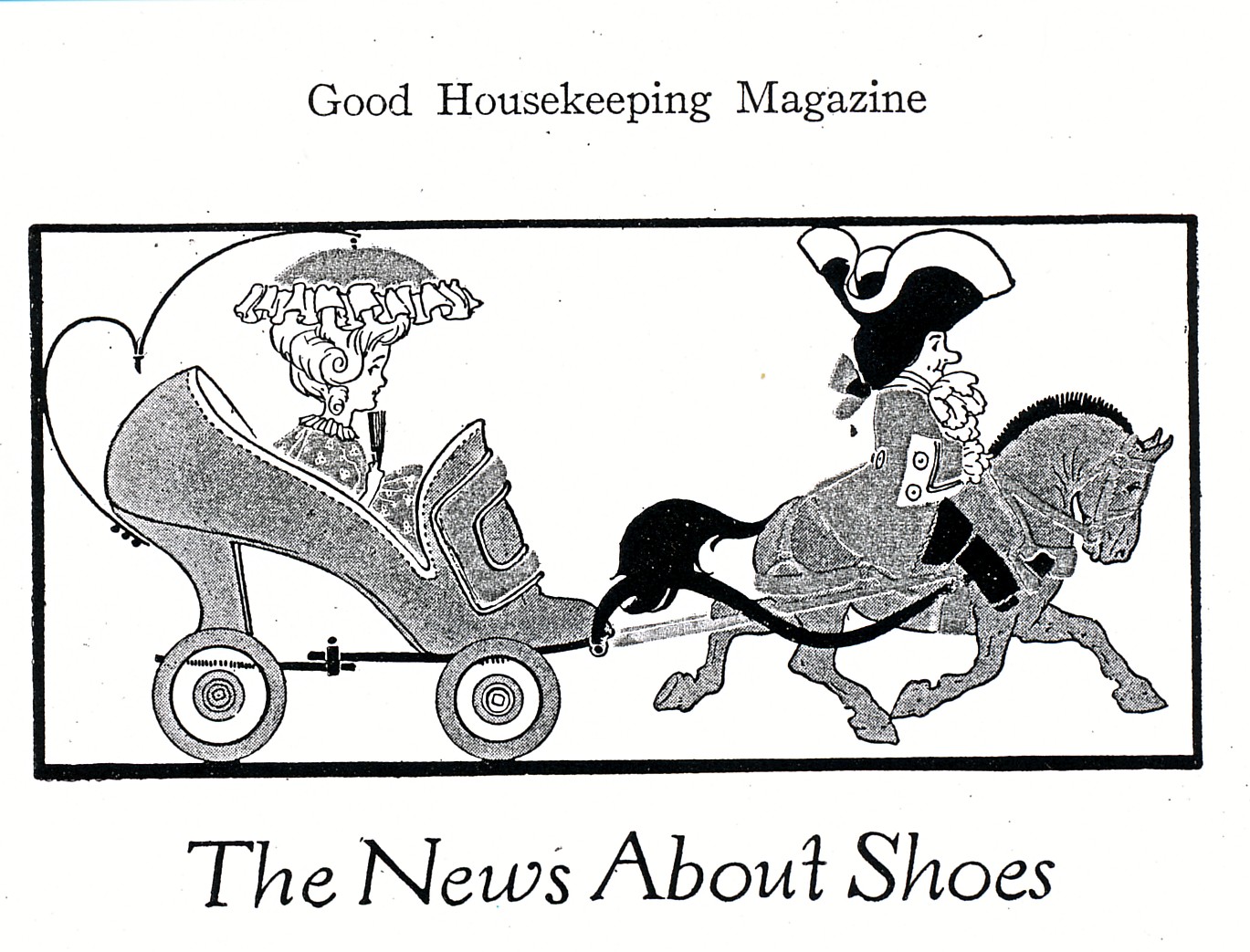
Saturday, October 21, 1911: Rufus and Ma went to Milton today. Ruth got a jacket suit and Ma bought me a pair of shoes. They’re for school so you see I didn’t care so much if I wasn’t there to try them on.
It’s the style, not shoe, that costs.
Quote from The News About Shoes (Good Housekeeping Magazine, October, 1911)
Her middle-aged granddaughter’s comments 100 years later:
To clarify this entry—Grandma’s sister Ruth and her mother went shopping. Sometimes in the diary Grandma referred to Ruth as Rufus—and in this entry she co-mingled two names for the same person.
I’m surprised that Grandma’s mother didn’t take her along to buy shoes, and that Grandma was only slightly annoyed. . . Or . . . [another scenario, based on my second read through of this diary entry] maybe Grandma was really angry when she wrote it and was trying to convince herself that it really was okay.
Shoe sizes must have been very standardized way back then if someone could buy shoes for another person; or maybe Grandma wore the same size shoe as her mother or sister.
16-year-old Helena Muffly wrote exactly 100 years ago today:
Thursday, October 20, 1911:Got out of school early this afternoon. I gathered some walnuts after I got home. Mollie gave me a kick in the back while milking another cow this evening. I’ve named Ruth’s twin calves, one Brutus and the other Caesar, but I can’t tell which is which.
1911: Probability of being kicked = high (photo source: Kimball's Dairy Farmer Magazine, December 15, 1911)2011: Robot milker--Probability of being kicked = almost zero
Her middle-aged granddaughter’s comments 100 years later:
Ouch! It sounds like the kick hurt. Grandma’s cow Mollie had her first calf in August. And, Grandma had been pleased with how well Mollie adjusted to being milked, For example on September 27 she wrote:
“Was in doubts and fears as to how Mollie would act when I commenced to milk her. Pop milked her last night, but I had to do it after that, so I got up early this morning, resolving to come off conquering and I did. Hurrah. She didn’t kick.”
But apparently something upset Mollie while Grandma was milking the next cow—and she gave Grandma a kick.
There have been huge changes in how cows are milked over the last hundred years. In 1911 most farmers had just a few cows that were milked by hand. Today most cows are milked by machines in milking parlors (and some are even milked by robots.)
16-year-old Helena Muffly wrote exactly 100 years ago today:
Wednesday, October 18, 1911: Grandma and Aunt Alice were here today, but I didn’t get to see them because they had gone when I got home from school. We had a review in Latin today. An easy examination it was.
John and Sarah Derr Family. Taken about 1900. L to R. Front Row: John, Annie (Derr) Van Sant, Sarah. Back Row: Miles, Fuller, Alice (Derr) Krumm, Elmer, Phoebe (Derr) Muffly, Judson, Homer.
Her middle-aged granddaughter’s comments 100 years later:
Grandma’s Aunt Alice was her mother’s (Phoebe Derr Muffly) sister. She was married to John Krumm and lived in Turbotville.
Alice is referred to as Mary Alice in official records, so she apparently went by her middle name. Based on information in the 1910 census on the Family Search website, she would have been 54-years-old in 1911 and was 5 years older than Phoebe.
Alice’s and Phoebe’s mother –and Grandma’s grandmother– was Sarah Derr. Sarah also lived in Turbotville, and was 70-years-old in 1911.
Turbotville is located about 4 miles northeast of the Muffly farm. The women may have come by horse and buggy—or may have taken the train. The Susquehanna, Bloomsburg, and Berwick Railroad provided passenger service to Turbotville—and there was a flag stop at a feed mill near the Muffly’s.