16-year-old Helena Muffly wrote exactly 100 years ago today:
Tuesday, November 28, 1911: Exams are over thank goodness. I made ninety in Algebra, instead of the one I made last month. I must make some good resolutions and study better next month for I have much need to study. Came near missing a day at school.
Recent photo of the building that once housed McEwensville High School.
Her middle-aged granddaughter’s comments 100 years later:
Yeah!! Grandma got 90% in algebra!! In October she’d only gotten 68%. Her studying over the previous couple days apparently paid off.
It’s silly to vicariously celebrate a minor success that occurred a hundred years ago, yet I get so involved in the diary story that it somehow seems appropriate to feel pleased when Grandma had a good day.
16-year-old Helena Muffly wrote exactly 100 years ago today:
Monday, November 26, 1911:Had exams today. Wonder what some of my marks are. Rufus and I had a squabble tonight over such a trifle. She pummeled me so hard on the head that I had a headache for a while. I guess school marms can lay it on sometimes.
Ruth Muffly
Her middle-aged granddaughter’s comments 100 years later:
Whew . . . it sounds the two sisters had a terrible fight. In the diary Grandma sometimes–—especially when she was annoyed or angry– referred to her sister Ruth as Rufus.
In November 1911, Grandma was 16 years old and Ruth as 19. Ruth was a teacher (i.e., school marm) at one of the one-room schools near McEwensville. What could have possibly angered them so much?
16-year-old Helena Muffly wrote exactly 100 years ago today:
Wednesday, November 22, 1911: Am trying to recover what I do not know that I missed during the month. I am pretty far behind and it is going to take some studying.
Her middle-aged granddaughter’s comments 100 years later:
I love the line Grandma used in this entry—“Am trying to recover what I do not know that I missed during the month.”
It reminds me of the mastery matrix.
The worst quadrant to be in is the one where you don’t know what you don’t know—but at least you are comfortable there in your ignorance.
I think that Grandma was in the most frustrating quadrant. She knew that she didn’t know something—but she couldn’t quite get a handle on what it was.
16-year-old Helena Muffly wrote exactly 100 years ago today:
Tuesday, November 21, 1911: Nothing doing.
Her middle-aged granddaughter’s comments 100 years later:
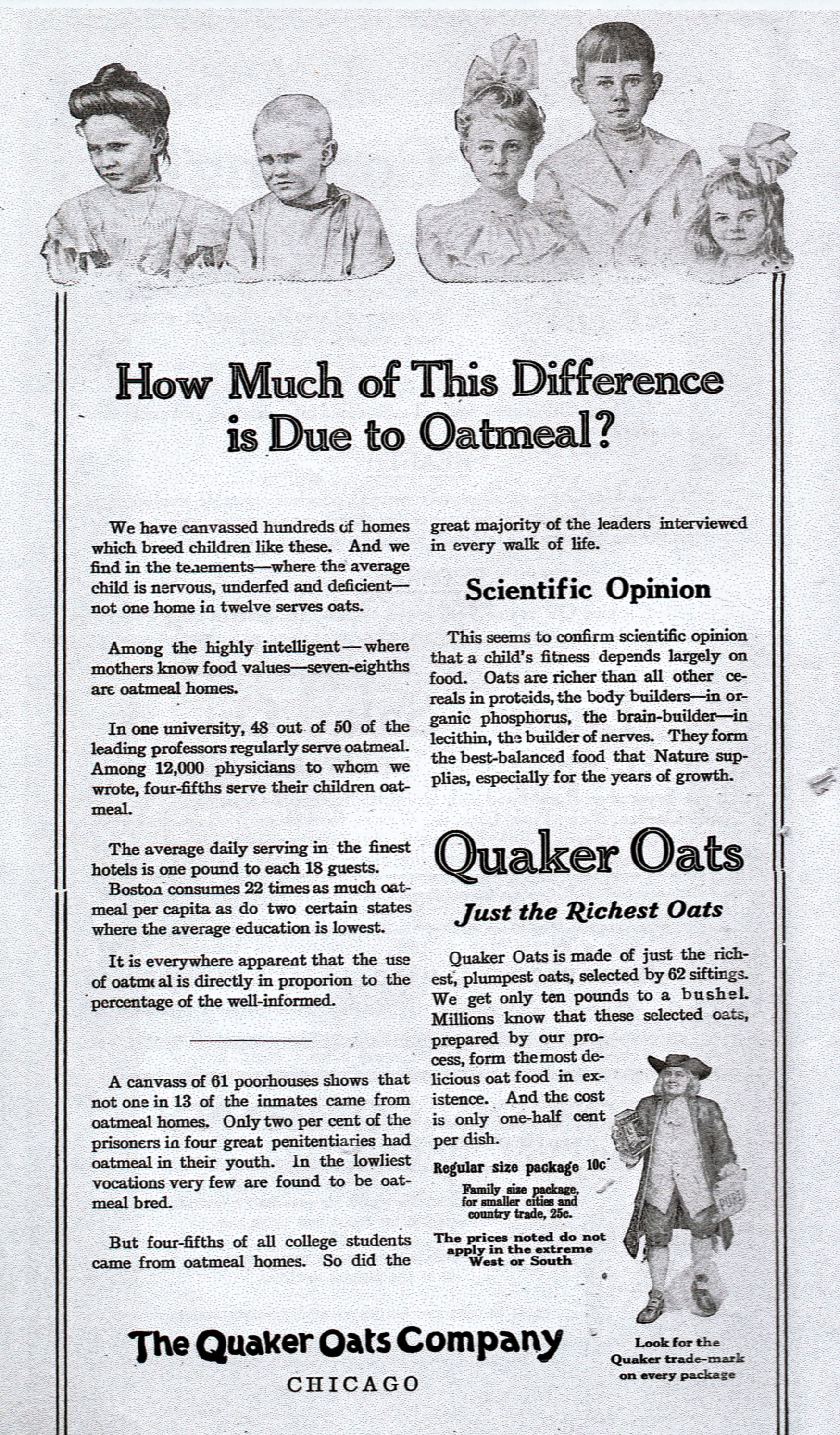
Since Grandma didn’t write much a hundred years ago today, I’ll share an old advertisement for Quaker Oatmeal.
It has lots of mind-boggling “statistics.” I wonder if there were any truth in advertising requirements regarding what types of research was needed to back up the numbers a hundred years ago.
How Much of This Difference is Due to Oatmeal?
We have canvassed hundreds of homes which breed children like these. And we find in the tenements—where the average child is nervous, underfed and deficient—not one home in twelve serves oats.
Among the highly intelligent—where mothers know food values—seven-eighths are oatmeal homes.
In one university, 48 out of 50 of the leading professors regularly serve oatmeal. Among 12, 000 physicians to whom we wrote, fourth-fifths serve their children oatmeal.
The average daily serving in the finest hotels is one pound to each 28 guests.
Boston consumes 22 times as much oatmeal per capita as do two certain states where the average education is lowest.
It is everywhere apparent that the use of oatmeal is directly in proportion to the percentage of the well-informed.
A canvass of 61 poorhouses shows that not one in 13 of the inmates came from oatmeal homes. Only two per cent of the prisons in four great penitentiaries had oatmeal in their youth. In the lowliest vocations very few are found to be oatmeal bred.
But four-fifths of all college students came from oatmeal homes. So did the great majority of the leaders interviewed in every walk of Life.
Scientific Opinion
This seems to confirm scientific opinion that a child’s fitness depends largely on food. Oats are richer than all other cereals in proteids, the body builders—in organic phosphorous, the brain –builder—in lecithin, the builder of nerves. They form the best-balanced food that Nature supplies, especially for the years of growth.
Quaker Oats
Just the Richest Oats
Quaker Oats is made of just the richest, plumpest oats, selected by 62 siftings. We get only ten pounds to a bushel. Millions know that these selected oats, prepared by our process, form the most delicious oat food in existences. And the cost is only one-half cent per dish.
Regular size package 10 cents.
Family size package, for smaller cities and country trade, 25 cents.
The prices noted do not apply in the extreme West or South.
16-year-old Helena Muffly wrote exactly 100 years ago today:
Saturday, November 18, 1911: Didn’t so much of anything today, except to be exceedingly lazy.
Her middle-aged granddaughter’s comments 100 years later:
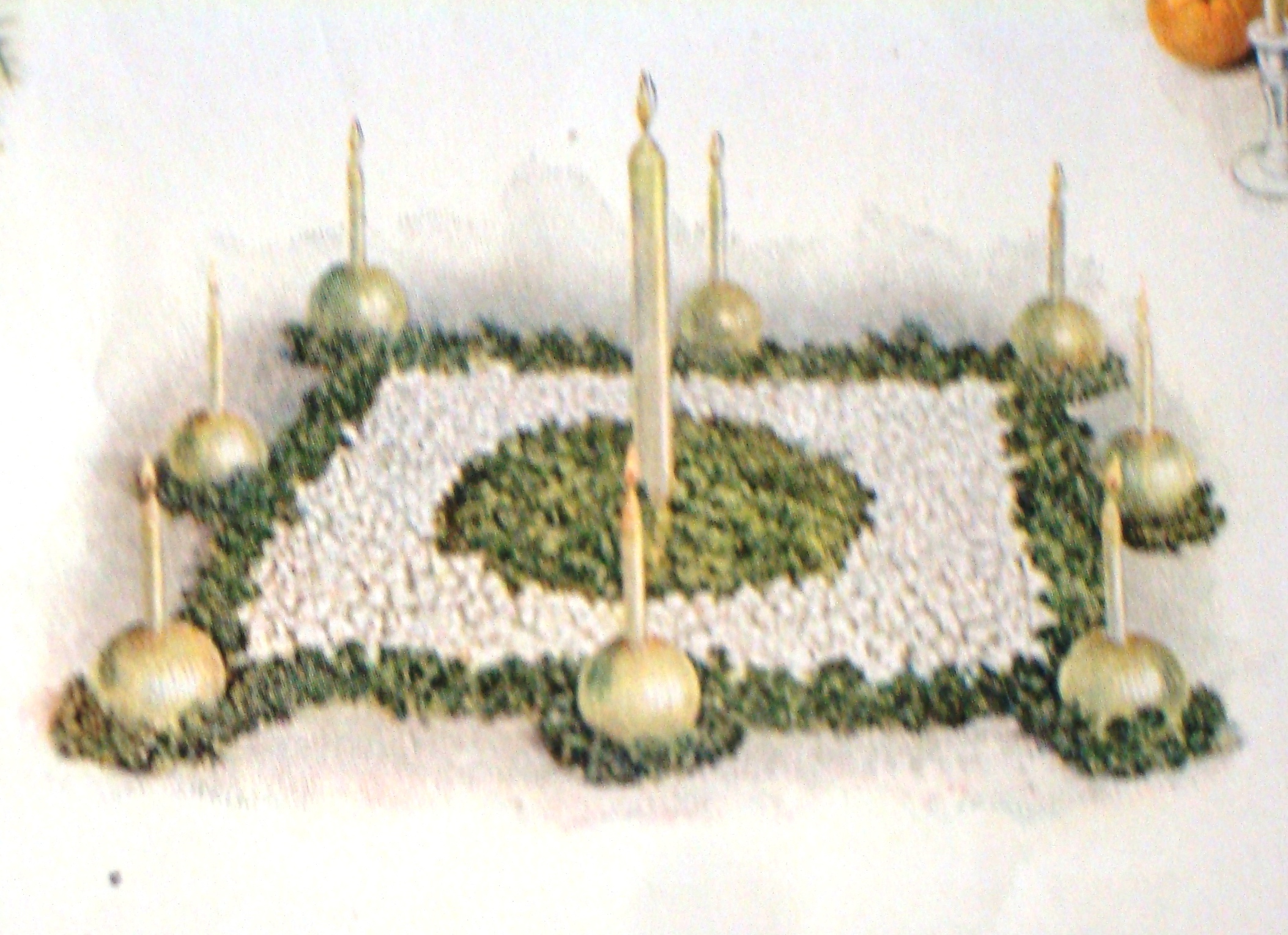
Maybe Grandma spent a quiet Saturday reading magazines. The November 1911 issue of Ladies Home Journal had some great pictures of Thanksgiving vegetable centerpieces.
Centerpiece made with squash, carrots, celery with leaves, tomatoes, parsley, cranberries, and evergreen cuttingsCenterpiece made with carrots, cranberries, potatoes, onions with brown skin partially removed, and candlesCenterpiece made with onions with brown skin removed, popcorn, parsley, and candlesCenterpiece made with pumpkin, carrots, tomatoes, evergreen cuttings, and candles
16-year-old Helena Muffly wrote exactly 100 years ago today:
Friday, November 17, 1911:Another girl and I made our teacher feel cross for awhile this afternoon. He had drawn a picture of a ring and beneath it we wrote “my diamond.” Now he gives some of us credit for snooping at everything he has on his desk.
Did the paper look like this?
Her middle-aged granddaughter’s comments 100 years later:
This is one of my favorite diary entries. Grandma must have been a hoot when she was young.
This entry also makes me wish that I knew more about her teacher. I know that the teacher’s name was Howard Northrop—but little else. In most diary entries he seems like the stereotypical teacher—gives hard tests, puts Grandma on the spot sometimes when she isn’t paying attention, etc.
In this post her teacher seems really human—How old was he? Was he cute? Did he have a girlfriend? Was he thinking of asking her to marry him? If so, how did it all work out?
16-year-old Helena Muffly wrote exactly 100 years ago today:
Wednesday, November 15, 1911: There was a fire near Watsontown about noon or a little afterwards. Four of the boys took the afternoon off and hurried away to find out the happenings. Tomorrow they have some work to do. I wouldn’t like to be they, for part of what they have to do is rather difficult.
Her middle-aged granddaughter’s comments 100 years later:
A hundred years ago devastating fires occurred much more frequently than they do today. Fire codes often were non-existent—and when they did exist they were less stringent than today.
Many homes and businesses were heated with wood or coal stoves, and if the chimneys weren’t cleaned properly, creosote could build up and catch fire. And, when a fire occurred, it took longer for firefighters to arrive on the scene—and the firefighting equipment they used had many limitations.
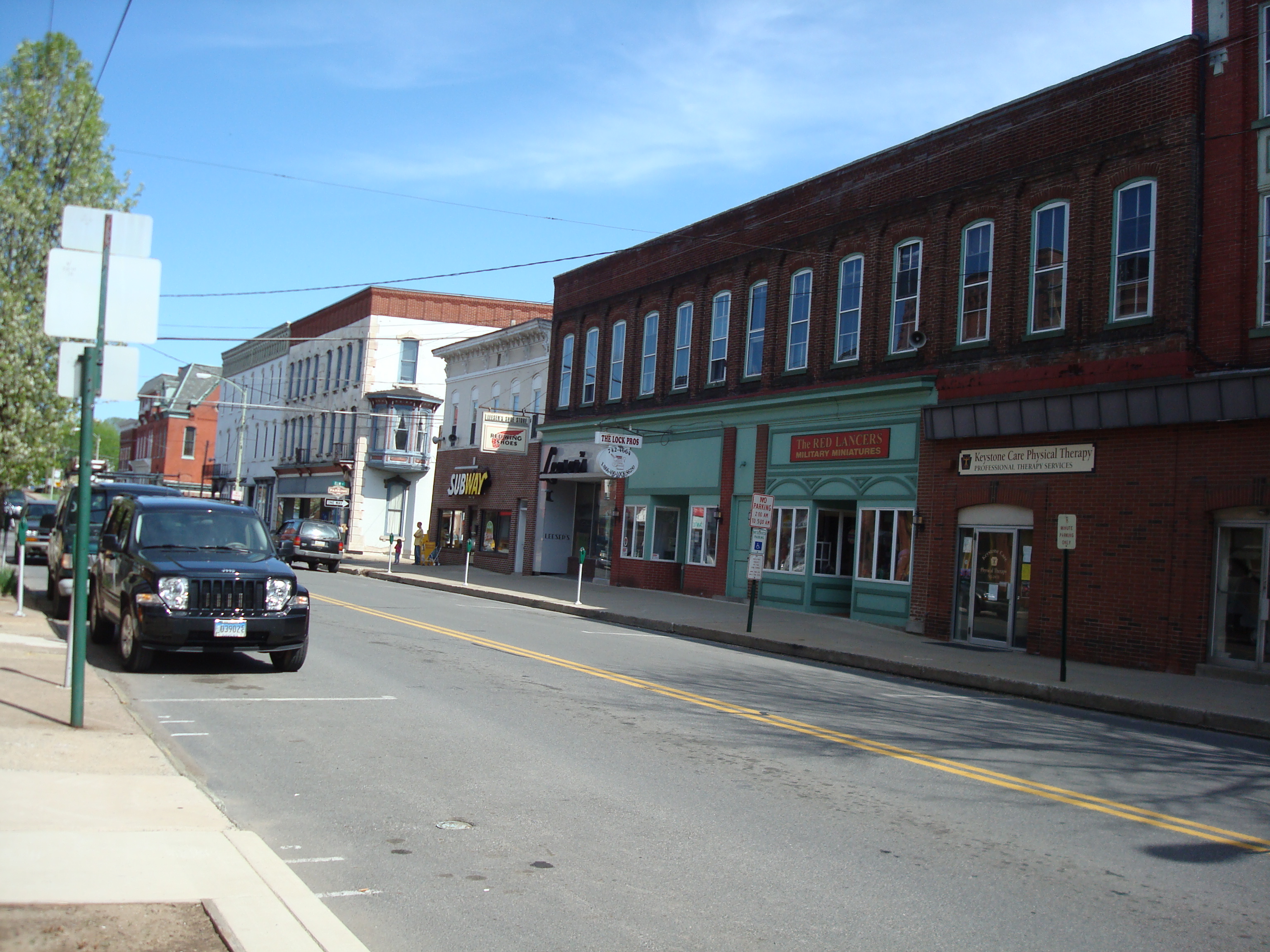
"New" buildings in downtown Milton. These buildings were built after the Great Milton Fire of 1880.
People in towns and cities across the US had memories of “Great Fires.” For example, in the diary Grandma often mentioned shopping in nearby Milton. There had been a horrible fire that burned most of Milton on May 14, 1880, so when Grandma went shopping she would have been going into “modern” buildings that were only about 30 years old. Her parents and other adults would have remembered the fire–and probably told stories about its devastation.
George Venios in Chronicles and Legends of Milton described the Great Milton Fire:
At fifteen minutes before twelve o’clock the steam whistles at the Milton Car Works began to sound frantically but since it was so near to the noon lunch hour, few noticed the importance of the distress signal. A man on horseback charged down Broadway screaming over and over from the top of his lungs for all to hear–“FIRE! — FIRE AT THE CAR WORKS!” . . .
The fire spread rapidly . . . Buildings were crashing and burning like kindling. . .
In less than four hours, almost all of Milton was decimated. Nearly 125 acres burned, consuming 625 buildings . . . Over 3,000 people were left homeless.
So many disastrous fires occurred across the U.S. a hundred years ago, that there was even discussion of creating another holiday called Fire Prevention Day. According to the November 11, 1911 issue of The Youth’s Companion magazine:
Fire-Prevention Day
Shall we give ourselves another holiday? The suggestion is made that we take October 9th, the date of the great Chicago fire, and, in spite of its nearness to Columbus day, observe it as Fire-Prevention Day.
That course is urged by Governor Hadley of Missouri, prompted, perhaps, by the burning last winter of the Capitol at Jefferson City with many priceless records. It was urged also by the National Fire Marshals’ Association in convention in Albany, New York, where also the state Capitol was recently damaged by fire. . .
If a day could be given to cleaning up waste places, to inspecting danger spots, to punishing those who violate the building laws, to having fire-drills in schools and factories, to installing and testing fire-fighting devices, and in general, to stimulating a keener sense of the waste of fire, it would be so valuable a holiday that it might well be made monthly, rather than yearly.
But would another holiday, whatever its name, be so usefully employed?
It’s awesome that there was interest in creating a holiday that would be dedicated to the public good a hundred years ago.
Fire Prevention Day never became a national holiday, but the idea eventually later morphed into Fire Prevention Week. In 1925, President Calvin Coolidge proclaimed the first Fire Prevention Week.
Now the National Fire Protection Association sponsors National Protection Week each year. It is held during the week that contains October 9 (the date of the Great Chicago Fire). During that week schools often have activities about fire prevention, the media publishes safety tips, fire stations hold open houses, and so on.