Calories Used Per Hour by Weight and Activity Level

Table
Source: Household Engineering: Scientific Management in the Home (1919)

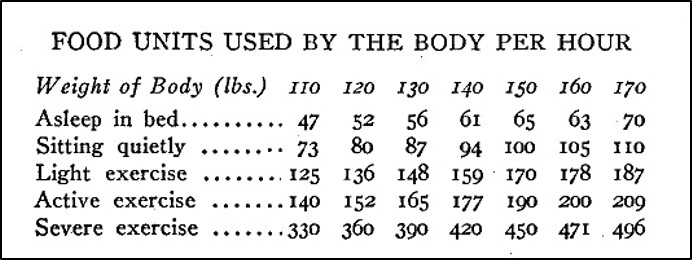
People have wondered for a long time how exercise and other activities affect the number of calories needed. A 1919 home economics textbook contained this table with U.S. Department of Agriculture data on the “average calorific requirements of the body under different conditions.” The book contained examples of how the table could be used to calculate the number of calories needed by an individual:

A woman of about 130 pounds, sleeping for 8 hours, doing light housework 10 hours, reading, etc. 6 hours, would require (8 X 56) + (10 X 148) + (6 X 87) = 2,450 calories.  A boy of about the same weight with 8 hours sleep, 8 hours active exercise, 6 hours playing tennis (severe exercise) and 2 hours quiet would require (8 X 56) + (8 X 165) + (6 X 390) + (2 X 87) = 4,282 calories.   

Household Engineering: Scientific Management in the Home by Christine Frederick (1919)

hmm. . . I wonder if the information in the 1919 table is still considered correct.

Old-fashioned Ginger Ale Gelatin Salad

Molded Gelatin Salad with PearsWhen I was a child, there was always lots of food at Labor Day picnics – including multiple gelatin salads. So I was thrilled when I came across a recipe in a 1919 American Cookery magazine for Ginger Ale Gelatin Salad just in time for this long holiday week-end.

The sparkling Ginger Ale Gelatin Salad was sweet and tangy, with a mild lemony undertone. The gelatin can be made with or without fruit.  A hundred years ago canned fruit was often added to gelatin, so I added canned pear halves – though other fruits could be used (or none at all).

The old magazine included a section where readers could ask questions, and this recipe was provided as a response to a request for a Ginger Ale Salad recipe. The reader making the request indicated that the desired recipe should be for a gelatin salad that could be made with or without fruit.

Recipe for Ginger Ale Salad
Source: American Cookery (October, 1919)

When I made the gelatin, I used an entire packet of gelatin since this recipe called for a total of 2 cups of liquid – and the gelatin box indicated that each individual packet should be used with 2 cups of liquid. Since the old recipe called for using 1/4 packet, I assume that gelatin packets were larger back then. I ignored the serving suggestion, and passed on the French or mayonnaise dressing with cocktail sauce. I also did not use small molds – and instead put all the gelatin into one mold. (I used a 1-quart bowl as the mold).

Here’s the recipe updated for modern cooks:

Ginger Ale Gelatin Salad

  • Servings: 3-4
  • Difficulty: moderate
  • Print

1 packet gelatin (0.25 ounce)

1/4 cup cold water

1 3/4 cups ginger ale

grated lemon peel from 1 lemon

fruit (optional) – I used 4 canned pear halves.

Put the water in a bowl; sprinkle the gelatin on the water. Set the bowl in hot water; let sit for 2 minutes, then stir until the gelatin is completely dissolved. Stir in ginger ale. Put in refrigerator until the gelatin just begins to thicken (about an hour), then remove from refrigerator and stir in grated lemon peel and, if desired, add the fruit.  Pour into bowl or mold, and return to refrigerator. Chill until set.

Poem in Hundred-year-old Cookbook

poem titled, "Bread, Rolls, Buns and Toast"
Source: The Old Reliable Farm and Home Cook Book (1919)

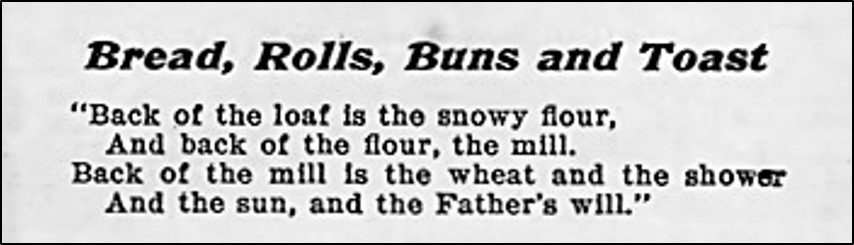
Old cookbooks sometimes have poems, such as this one in a 1919 cookbook. It was at the beginning of a chapter containing bread recipes. The poem lays out the path involved in creating a bread ingredient (flour). People were so much closer to agrarian life back then, and had a clear understanding of relationship between the weather, wheat production, the milling process, and flour. Would a similar poem resonate with cookbook users today?

Old-fashioned Fried Corn

fried corn in bowl with spoon

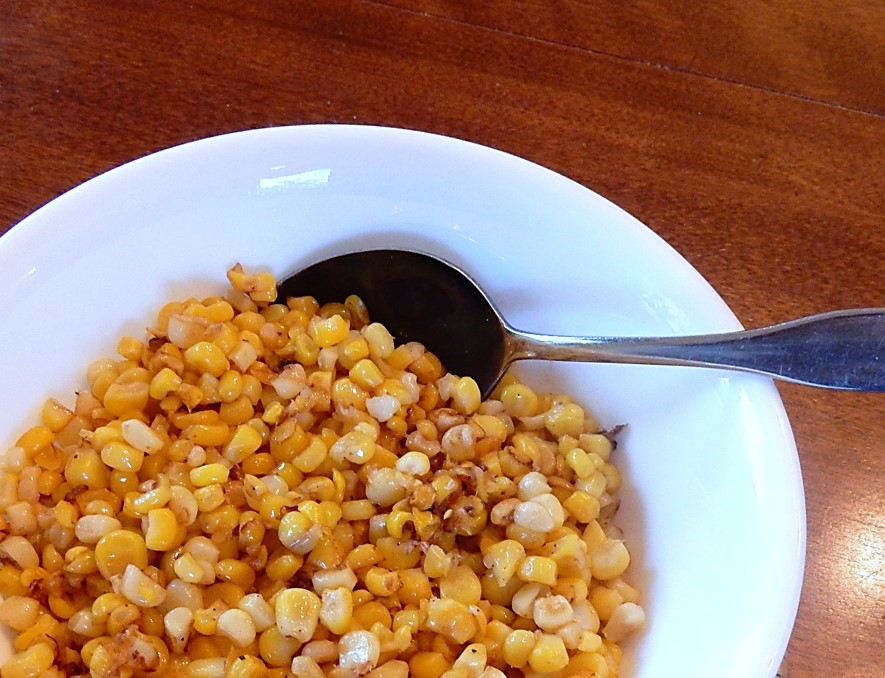
August is my favorite month when it comes to cooking and eating. Gardens and farmers markets are filled with a bounty of fresh vegetables and fruits at their prime – and, to me, corn on the cob is the quintessential August vegetable.  But, I also am always looking for different ways to serve corn. So I was pleased to find a classic, very easy, hundred-year-old recipe for Fried Corn.

The corn is fried in a little butter, then seasoned with just a bit of cream, salt and pepper. Frying the corn, removes some of the liquid and brings out its natural sweetness Sometimes simple is best.

Here’s the original recipe:

fried corn in bowl
Source: The Old Reliable Farm and Home Cook Book (1919)

And, here’s the recipe updated for modern cooks:

Fried Corn

  • Servings: 3-4
  • Difficulty: easy
  • Print

1 tablespoon butter

4 ears of corn (about 2 cups after cut off cobs)

1 tablespoon cream

salt and pepper

Cut corn off the cob. Melt butter in a skillet. Add corn then, using medium heat, fry the corn until browned, while stirring frequently (approximately 8-10 minutes). Add cream, and sprinkle with salt and pepper to season; stir. Remove from heat and serve.

Hundred-Year-Old Recommendation to Eat Bread Crusts

two bread crusts on a cutting boardSome people eat bread crusts and consider them the best part of a loaf of bread; others toss them in the trash. Apparently, the value of bread crusts is a long-standing question. Here are some excerpts from a 1919 magazine article:

“Eat the Crusts”

“Eat the crusts, dear,” grandfather used to say to me when on those delightful never-to-be forgotten childhood visits to grandpa’s house.

Whether it was because of the dear old man’s admonition and the love I bore I don’t know, but I do know that I have always eaten crusts and do yet.

In childhood I ate crusts because my elders said it was right to eat them, and as I grew up and went to high school and college, I took a more than passing interest in chemistry, and then I discovered the real reason why one should eat bread crusts. The heat of the oven has a particular effect on the starch and sugar contained in the flour of the wheat and changes it into dextrine, and the greatest amount of dextrine is found in the crusts, so that the crusts of bread are the most easily taken care of by the stomach.

American Cookery (October, 1919)

Old-fashioned Deviled Tomatoes

Fried tomato slices with deviled egg topping

I recently found a delightful hundred-year-old recipe for Deviled Tomatoes. Tomato slices sautéed in butter are topped with a lively deviled egg mixture.

Here is the original recipe:

recipe for deviled tomatoes
Source: American Cookery (November, 1919)

Here’s the recipe updated for modern cooks:

Deviled Tomatoes

  • Servings: 5 - 7
  • Difficulty: moderate
  • Print

4 medium tomatoes, sliced

1/3 cup flour

3 tablespoons butter + 1 tablespoon butter, softened

1 teaspoon powdered sugar

2 teaspoons dried mustard

dash salt

dash cayenne pepper

yolk of 1 hard-boiled egg, mashed

1 tablespoon vinegar

2 tablespoons green pepper, finely chopped

2 tablespoons onion, finely chopped

2 tablespoons parsley, finely chopped

Coat the tomato slices with flour. Then, melt 3 tablespoons butter in a large skillet, and sauté the flour-coated tomato slices for two minutes on each slide or until lightly browned. Drain on paper towels.

In the meantime, in a small bowl cream together 1 tablespoon butter, powdered sugar, dried mustard, salt, cayenne pepper, and mashed hard-boiled egg yolk. Add vinegar and stir to combine. Stir in green pepper, onion, and parsley. Heat until warm (on stove or in microwave).

To serve, put a heaping teaspoonful of the egg mixture on top of each tomato slice.

1919 Swans Down Cake Flour Advertisement

image of box of cake flour in an advertisement
Source: American Bakery (August/September, 1919)

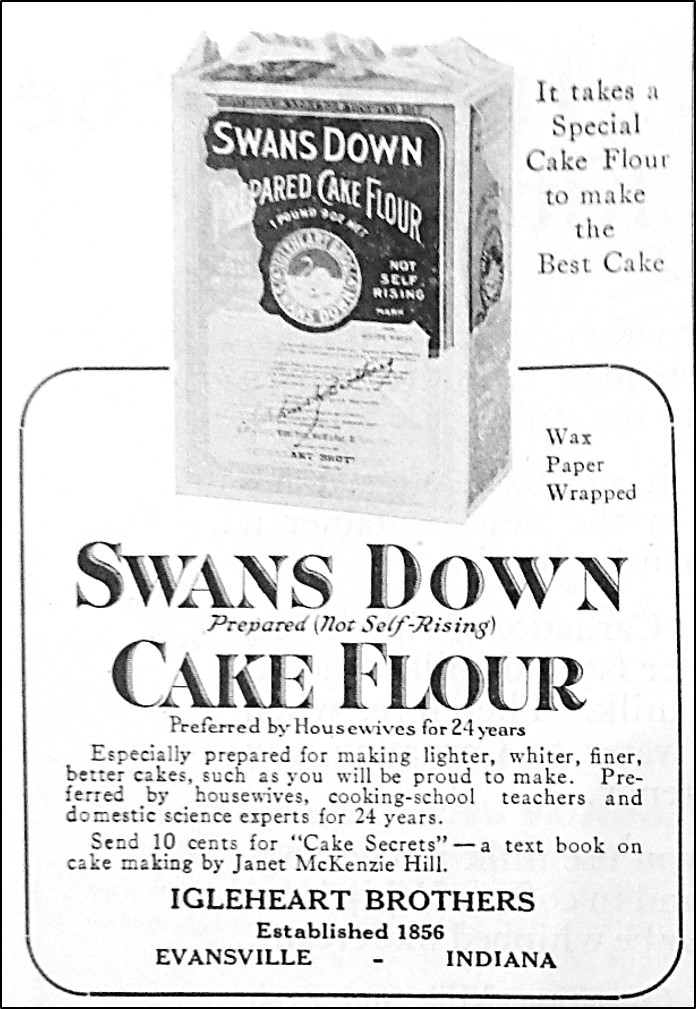
Old advertisements provide lots of information about which cooking ingredients were available at different periods of time – and they also sometimes provide information about how those goods were packaged. The waxed paper wrapper surrounding the Swans Down Cake Flour package was obviously seen as a key selling point in this 1919 advertisement.