Does anyone like school lunches? I hear both parents and their children complain about them. According to my local school district’s website, today’s high school menu is:
Menu – October 24, 2019
Main: Italian Entree Choice Grill: Grilled Chicken Sandwich Salad: Italian Entree Choice
Smart Sides: Caesar Salad, Celery Sticks
But, is it worse than school lunches a hundred years? Somehow I just can’t imagine students today getting excited about Jellied Salmon.
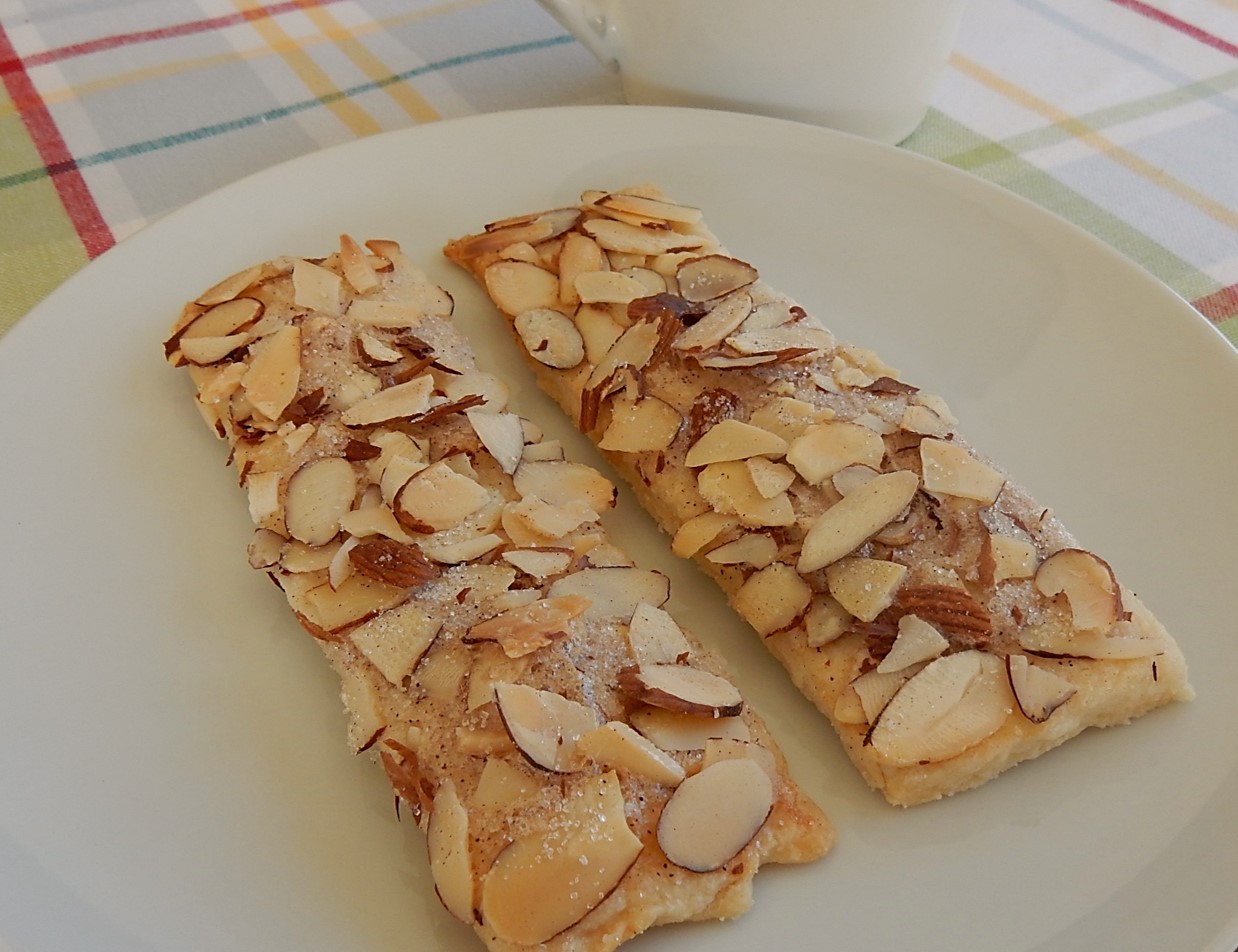
When I make a pie, I sprinkle any remaining pastry scraps with cinnamon and sugar, and then bake until light browned. These scraps are good, but I found a hundred-year-old recipe for Almond Strips that takes it to the next level.
Almond Strips are bars of baked pastry dough topped with cinnamon, sugar, and almond slices. These bars are a great way to use those pastry scraps – yet are so pretty and tasty that they can be served without apology.
Here is the original recipe:
Source: Recipes for Everyday by Janet McKenzie Hill (1919)
pie pastry for a 1-shell pie (or use scraps of pastry dough left-over after making a pie crust)
1 egg white
Put sugar and cinnamon in a small bowl; stir to combine. Then add almond slices; stir. Set aside.
Preheat oven to 425° F. Roll pie pastry into a rectangle 1/4-inch thick. Cut into strips 2 inches X 4 inches. Place strips on a greased cookie sheet. Brush with egg white and sprinkle with sugar/cinnamon/almond mixture. Make sure the sugar and almonds are distributed evenly across the bars. Press lightly. Bake for approximately 10 -15 minutes (or until lightly browned).
Source: Source: Stickney & Poor advertisement, American Cookery (November, 1919)
Making a toast can be nerve-racking. And, it’s always especially stressful to decide what to say. It may be a little out of date, but here is some hundred-year-old advice:
Toasts for Dinner Occasions
Since much of the enjoyment of good toasts comes from clever local allusions, it would be difficult to make specific suggestions for dinners in general. Almost any subject, if well handled, will stimulate a good response. Such topics of current interest as the coal strike and the “wet” and “dry” issues, treated with humor and without political bias, furnish unfailing springs of interest.
Local practices and happenings, covert and complimentary allusions to the guest of honor, or to the business or profession of other prominent guests will be in order.
Each Fall I buy a Delicata squash and roast it, but until I came across a hundred-year-old Delicata squash recipe, I never gave any thought to other ways that it might be prepared. It was fun to try a “new” way of serving this old-time squash.
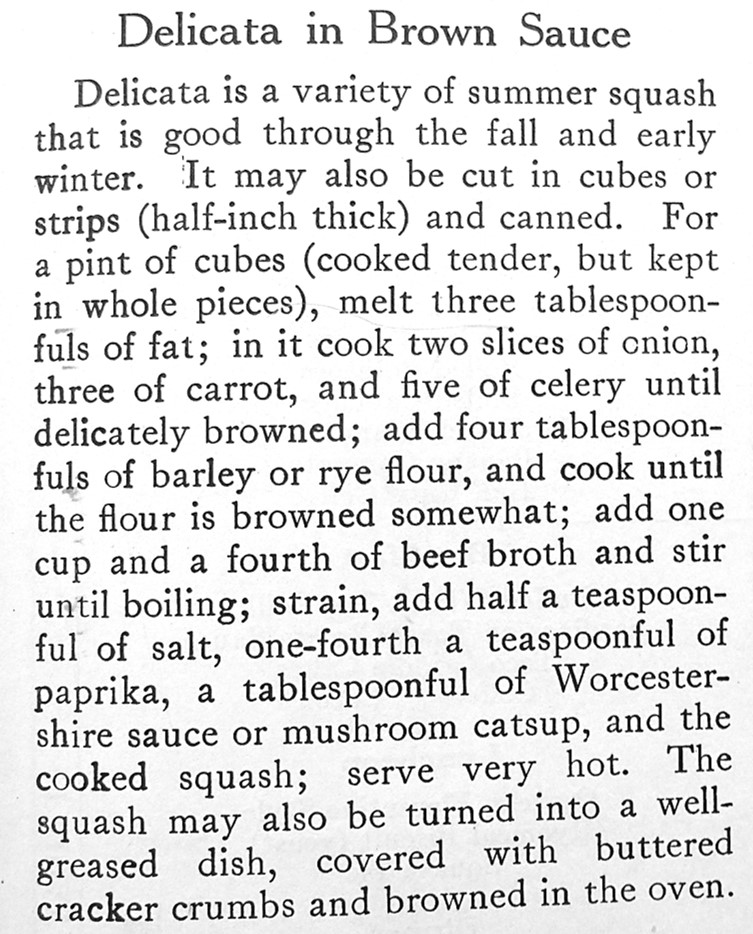
The century-old recipe was for Delicata Squash in Brown Sauce. The recipe called for cubed squash that is served in a delightful classic brown sauce.
Here is the original recipe:
Source: American Cookery (January, 1919)
I made several adaptions and assumptions when making this recipe. I used fresh Delicata squash rather than canned. And, I used butter rather than “fat.”
I was a bit foggy about what was meant by three slices of carrot and five of celery. Does the recipe really mean just a few small pieces of sliced carrot and celery – or was it referring to larger chunks? I made the assumption that the recipe was calling for one carrot and two stalks of celery – but this may not be what the recipe writer intended.
And, have you ever heard of mushroom ketchup? Since I didn’t have any idea what it was, I went with the Worcestershire sauce option.
4 tablespoons rye or barley flour (I used rye flour.)
1 1/4 cups beef broth
1/2 teaspoon salt
1/4 teaspoon paprika
1 tablespoon Worcestershire sauce
Peel squash, halve and remove seeds and membranes; then cut into 1-inch cubes. Place in a saucepan and cover with water. Put on the stove and bring to a boil using high heat; then reduce heat and simmer until tender (about 15 minutes). Remove from heat and drain.
In the meantime, melt butter in a skillet. Add onion, carrot and celery; sauté until tender using medium heat. Stir in the flour, and continue stirring until the flour just begins to brown. Gradually add beef broth while stirring constantly; continue stirring until the mixture comes to a boil. Remove from heat and strain; reserve the strained sauce. (If desired, the cooked vegetables may be served separately; otherwise discard.) Return the strained sauce to the saucepan; stir in salt, paprika, and Worcestershire sauce. Reheat until hot.
To serve, place cooked squash in serving dish. Pour brown sauce over the squash.
Advertising is supposed to convince people that they should buy a product. Sometimes an ad that apparently worked well a hundred years ago doesn’t work quite as well today.
If I wanted to promote salt, I won’t say “white as hoar-frost on pumpkins.” Is it just me, or do others not know what “hoar-frost” is? Of course, I could google the term – but by then I’ve lost all interest in buying the product.
And, would an ad today promote the “sanitary package”?
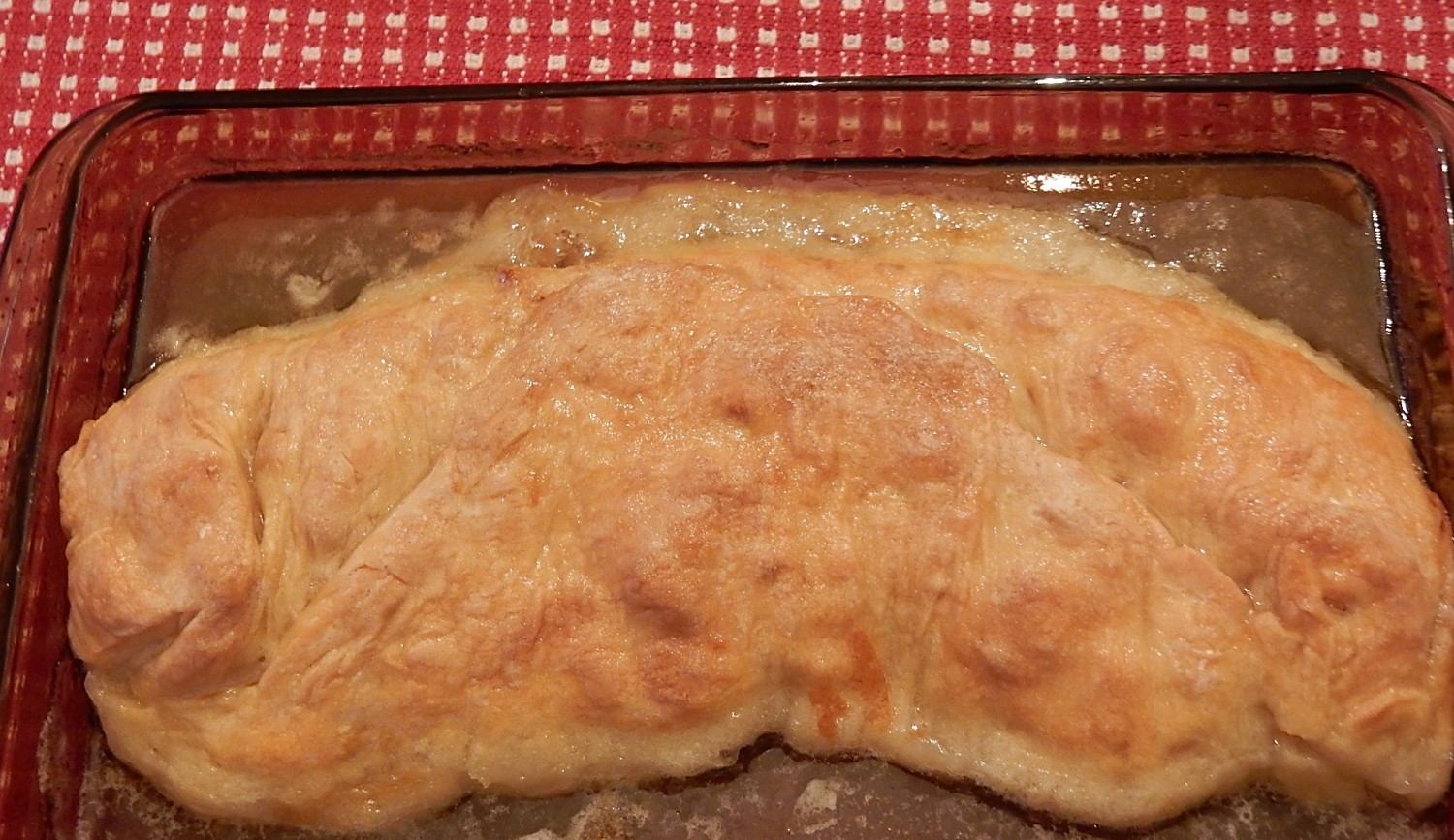
Fall is the season for apples, and the perfect time to make apple desserts. I recently found a lovely hundred-year-old recipe for Baked Apple Roll; however, it has one quirky characteristic. The recipe does not call for any cinnamon.
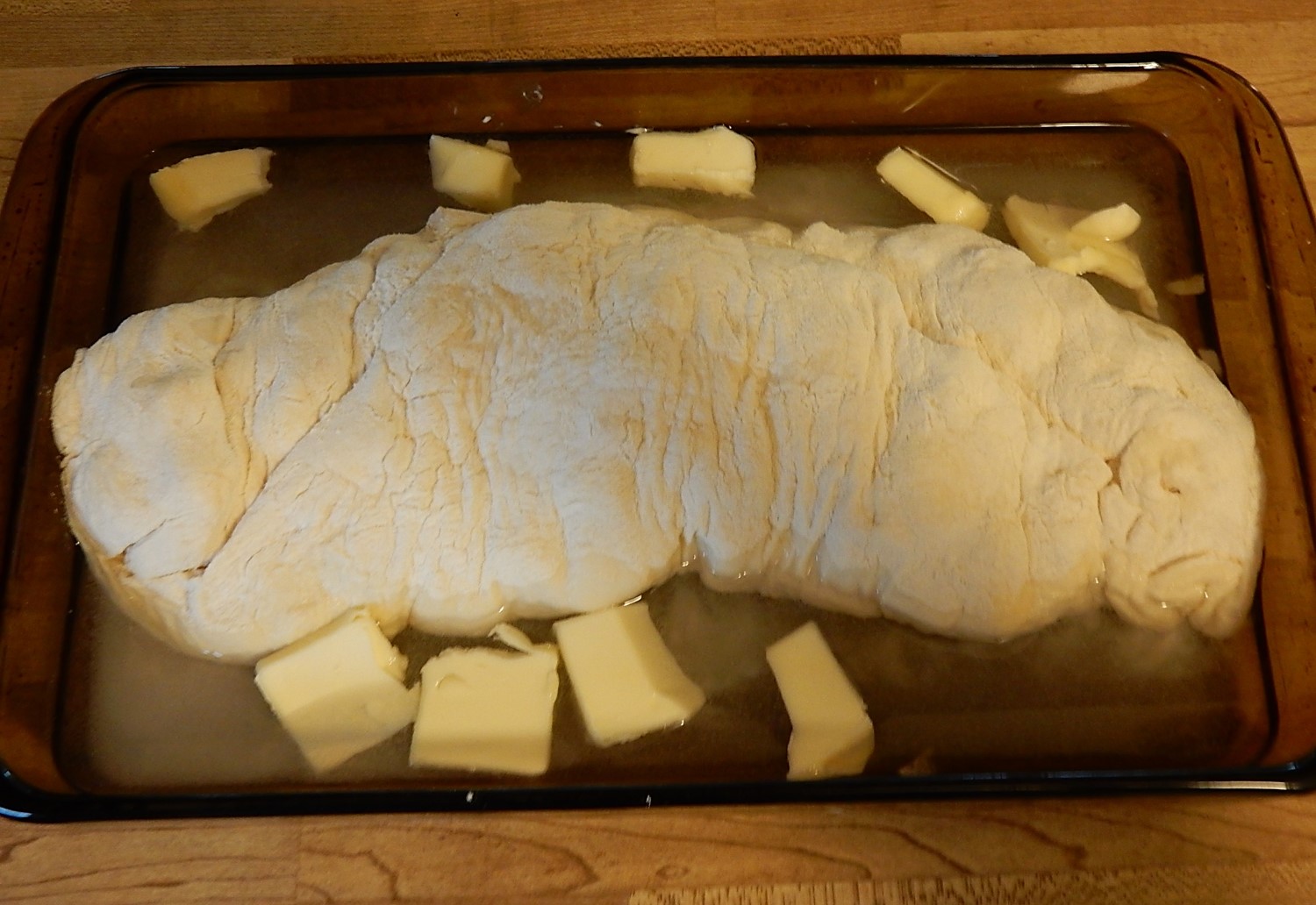
The Baked Apple Roll is smothered in a very simple sugar, water, and butter sauce. The roll looked beautiful, but (since I’m so used to apple dishes being spiced with cinnamon), the roll tasted bland to me. If I made this recipe again, I might add some cinnamon – though I recognize that wouldn’t hold true to the old recipe.
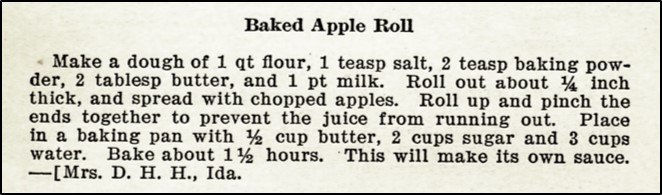
Here’s the original recipe:
Source: The Old Reliable Farm and Home Cook Book (1919)
When I made the recipe, I halved it, and still had a large roll that made 4-5 servings. Here is the recipe updated for modern cooks.
3 cups chopped apples (about 2-3 large apples) (peel and core before chopping)
1 cup sugar
1 1/2 cups water
Preheat oven to 325° F. In a bowl, combine flour, salt, baking powder, and 1 tablespoon butter. Add milk, and mix using a fork until dough starts to cling together. If it is excessively sticky, add additional flour. Turn onto a well-floured prepared surface, and roll dough into an approximate 11-inch square that is 1/4 inch thick. Evenly spread chopped apples on the rolled dough to within 1/2 inch of the edges. Start at one side and roll. Seal edges by pressing together to help prevent the juice from running out. Place in an oblong baking dish (approximately 7 inches by 12 inches or larger) with the “seam” at the top.
In a bowl, combine the sugar and water. Carefully pour the sugar mixture into the edge of the baking dish. Do not pour it over the top of the roll. Cut the 1/4 cup butter into small pieces, then “dot” the sugar/water mixture with the butter pieces. This will turn into a syrup as it cooks. Bake for 1 hour and 15 minutes. Remove from oven and baste the roll with the hot sugar syrup. Return to oven and bake an additional 15 minutes or until lightly browned. Remove from oven. The roll can be cut into slices, and served hot or cold with the syrup drizzled around the slices.
According to the October, 1919 issue of Good Housekeeping, October is the last fresh vegetable month:
The Last Fresh Vegetable Month
In October vegetables may still hold the post of honor on the table which is planned on a truly economical and sensible basis. By using freely and consistently what is in season, and by utilizing especially the delicious vegetable overflow, it is possible to lessen the meat bill appreciably. If we do use the abundant fresh vegetables lavishly when in season, it will make us feel more comfortable about the increased meat consumption, which the cold weather later makes necessary. The savings on meat and grocery bills when we effect by living largely on vegetables during the summer and fall will help us to balance the budget satisfactorily.
A hundred-years-ago people apparently ate more meat in the winter than during the warmer months. I don’t think that my meat consumption varies much across the year, though I have vague childhood memories of having strawberry shortcake as the main course sometimes in June, and being told that, “We eat lighter in the summer because it’s hot.”