Is drinking coffee a good or bad habit? People have been asking this question for more than a hundred years. A 1920 promotional advertisement by a coffee trade association called the Coffee Trade Publicity Committee of the United States claimed that the debate was over – and that coffee is good for us.
However, a quick online search suggest that the trade association was over-optimistic, and, that the debate continues. According to the Mayo Clinic there are both benefits and risks related to drinking coffee:
Coffee may offer some protection against:
Parkinson’s disease
Type 2 diabetes
Liver disease, including liver cancer
Heart attack and stroke
Coffee still has potential risks, mostly due to its high caffeine content. For example, it can temporarily raise blood pressure. Women who are pregnant, trying to become pregnant or breastfeeding need to be cautious about caffeine. High intake of boiled, unfiltered coffee has been associated with mild increase in cholesterol levels.
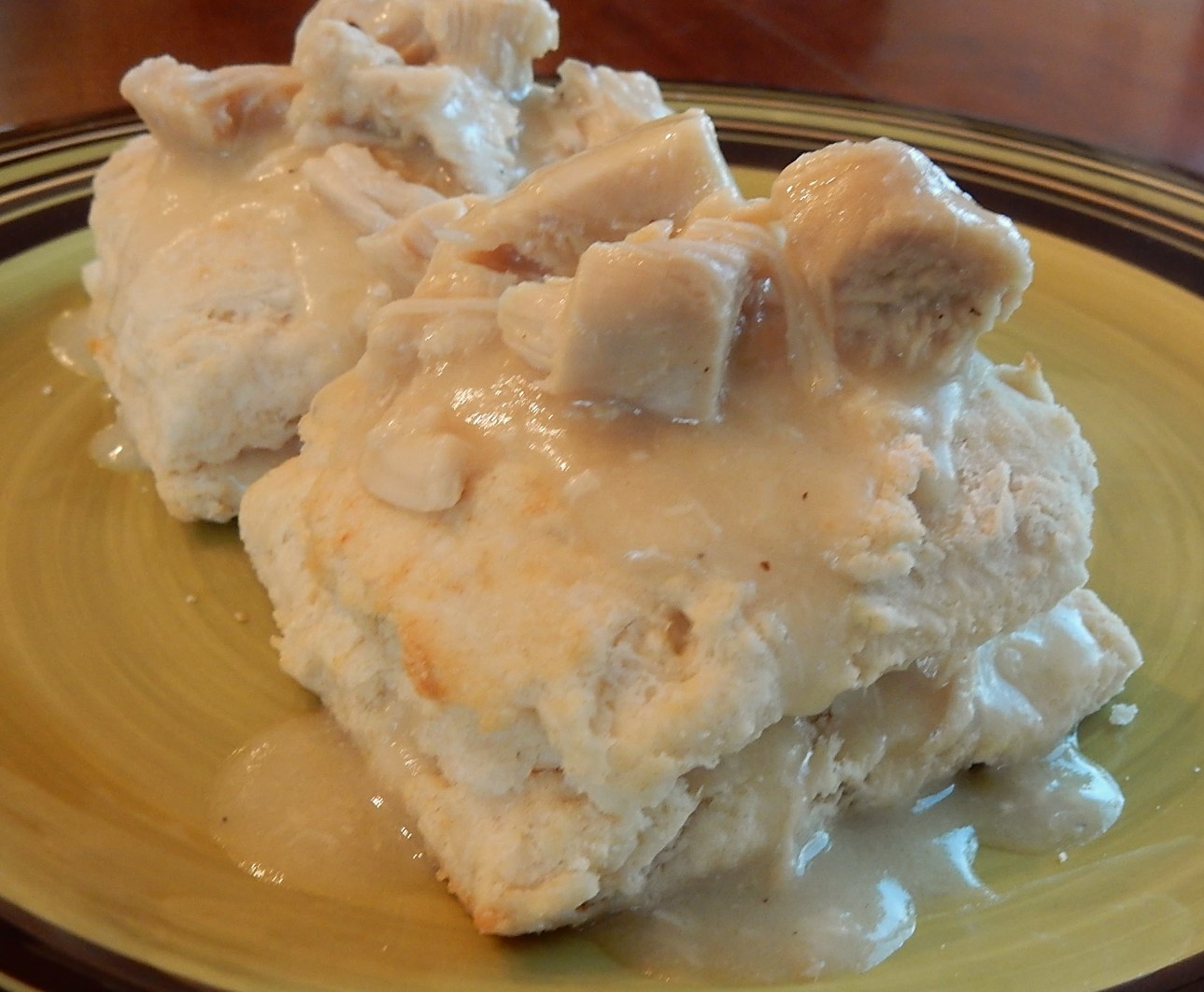
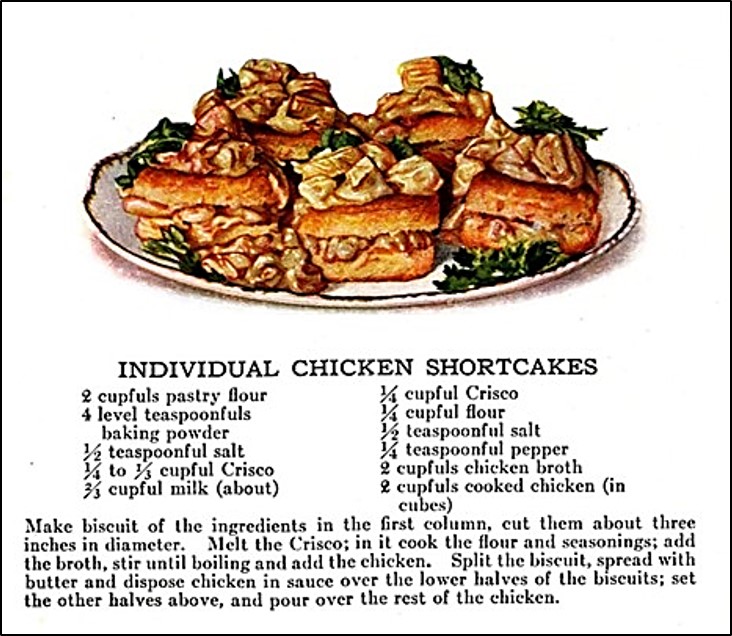
With all that is happening in the world, I’m in the mood for homey and comforting foods. So when I came across a hundred-year-old recipe for Individual Chicken Shortcakes, I had to give it a try. This is really a recipe for old-fashioned Chicken and Biscuits. Whatever it is called, this dish hit the spot. The biscuits were flaky, and the chunky chicken gravy was warm and hearty.
Here is the original recipe:
Source: Balanced Daily Diet by Janet McKenzie HIll (1920)
When I updated the recipe, I used butter instead of shortening when making the chicken gravy.
2 cups pastry flour (all-purpose flour also works if pastry flour is not available)
4 teaspoons baking powder
1/2 teaspoon salt
1/4 cup shortening
approximately 2/3 cup milk
butter, if desired (use when assembling)
Chicken Gravy
1/4 cup butter
1/4 cup all-purpose flour
1/2 teaspoon salt
1/4 teaspoon pepper
2 cups chicken broth
2 cups cooked chicken (coarsely chopped into approximately 1/2-inch cubes)
To Make Biscuits: Preheat oven to 450° F. Combine flour, baking powder, and salt in a mixing bowl. Cut in shortening. Add most of the milk and mix using a fork until dough starts to cling together. Add more milk if needed. Roll dough on a prepared floured surface into a rectangle 1/2-inch thick. Cut into 3-inch squares. Place squares on a baking sheet. Bake for approximately 10 -15 minutes (or until lightly browned).
To Make Chicken Mixture: Using medium heat, melt butter; then stir in the flour, salt, and pepper. Gradually, add chicken broth while stirring constantly. Continue stirring until it thickens. Add the chicken, and stir to combine.
To Assemble: Split the biscuits, and butter, if desired. Put 1-2 heaping tablespoons of the chicken mixture on the bottom half of each biscuit. Put other half on top, and spoon another 1-2 heaping tablespoons of the chicken mixture on top. Serve.
Source: School and Home Cooking (Carlotta C. Greer, 1920)
Today when people talk about how each dollar that is spent on food is distributed across categories, they are often referring to how much farmers get compared to processors, retailers, and others. For example, according to the United States Department of Agriculture, in 2017 farm producers got 7.8 cents of each dollar spent on food, while the retail trade received 12.6 cents, and 36.7 cents went to food services (restaurants).
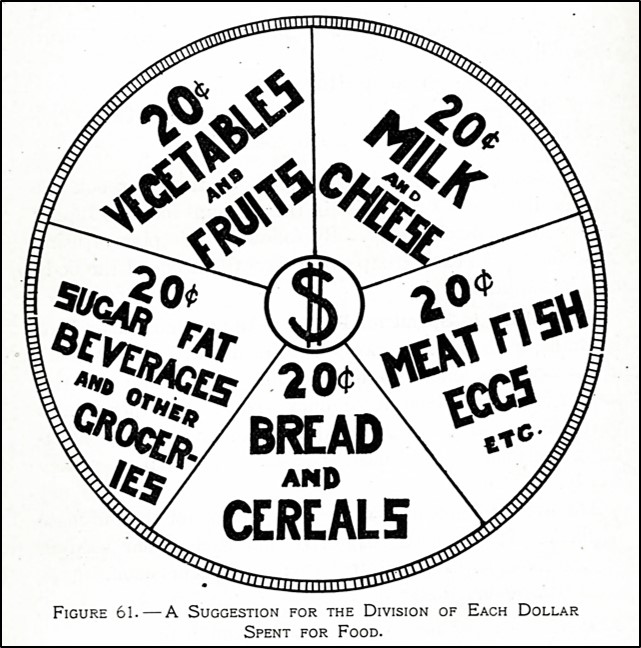
A hundred-years-ago, the division of each dollar spent for food often referred to how the cost of foods purchased by consumers should be distributed across food categories. A 1920 home economics textbook said:
How Much to Spend for Food
Anyone, no matter how ignorant or thoughtless, can get rid of money. But it takes a wise person, one who understands values and quality to get value received for money spent. Whether one is purchasing for all the meals of a family or is only selecting a luncheon or one meal, it is desirable to spend money wisely.
The five food groups may serve as a basis for the purchase of foods. It has been suggested that each dollar used in buying foods be divided into 5 parts of 20 cents each.
Out of every dollar spent use:
20 cents, more or less, for vegetables and fruits
20 cents, or more, for milk and cheese
20 cents, or less, for meat, fish, eggs, etc.
20 cents, or more, for bread and cereals
20 cents, or less, for sugar, fat, tea, coffee, chocolate, flavoring
When I recently was browsing through a hundred-year-old cookbook, and came across a recipe for Cinnamon Toast, memories came flooding back. I have warm, fuzzy memories of eating Cinnamon Toast, as well as fun memories of making Cinnamon Toast that bring to mind people I hadn’t thought of in years.
When I was a child, Cinnamon Toast was the perfect after-school snack. Open the door, take off coat, put a couple slices of bread in the toaster, and toast. Then spread with butter, sprinkle with cinnamon and sugar, and voila – a delightful, sweet treat.
I also remember how my mother always made Cinnamon Toast when I didn’t feel well, and how it always made a miserable day seem a just little bit better. Similarly, I always made it for my children when they were ill, and not hungry for the usual foods. And, I’ve noticed that, as adults, they make Cinnamon Toast for themselves when they are sick.
When I make Cinnamon Toast, no recipe is needed. It is so simple to make. But seeing the hundred-year-old recipe for Cinnamon Toast reminded of another day, many years ago when I did make Cinnamon Toast using a recipe.
It was my first day in junior high, and I was feeling very grown up going from one class to another. Then I was brought back to earth when I got to home economics, and the teacher said, “Today we are going to learn how to make Cinnamon Toast.” And, she actually gave us a recipe. My friends and I tried to suppress giggles. A few of the more daring girls (only girls took home economics back then; the boys took shop) whispered, “This is stupid. Doesn’t everyone know how to make Cinnamon Toast? Does she think we’re little kids?”
But the bottom line is – recipe or no recipe – Cinnamon Toast is the ultimate comfort food.
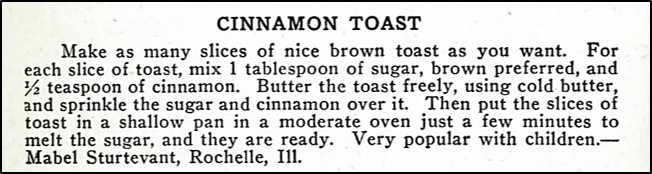
Here’s the original recipe:
Source; The Cook Book of Left-Overs (1920) compiled by the More Nurses in Training Movement
The hundred-year-old recipe calls for brown sugar, while I typically use white. Either type of sugar works. When brown sugar is used, the Cinnamon Toast has a slight hint of caramel.
Put the brown sugar and cinnamon in a small bowl; stir until mixed. Set aside.
Toast bread then spread with butter. Sprinkle with the sugar and cinnamon mixture. (Save any extra of the sugar and cinnamon mixture to use on another piece of toast.)
If desired, melt the sugar mixture on the toast – Preheat oven to 350° F. Place the toast on a baking sheet or in a shallow baking dish, and put in the oven for 1-3 minutes or until the sugar is melted; remove from oven and serve immediately.
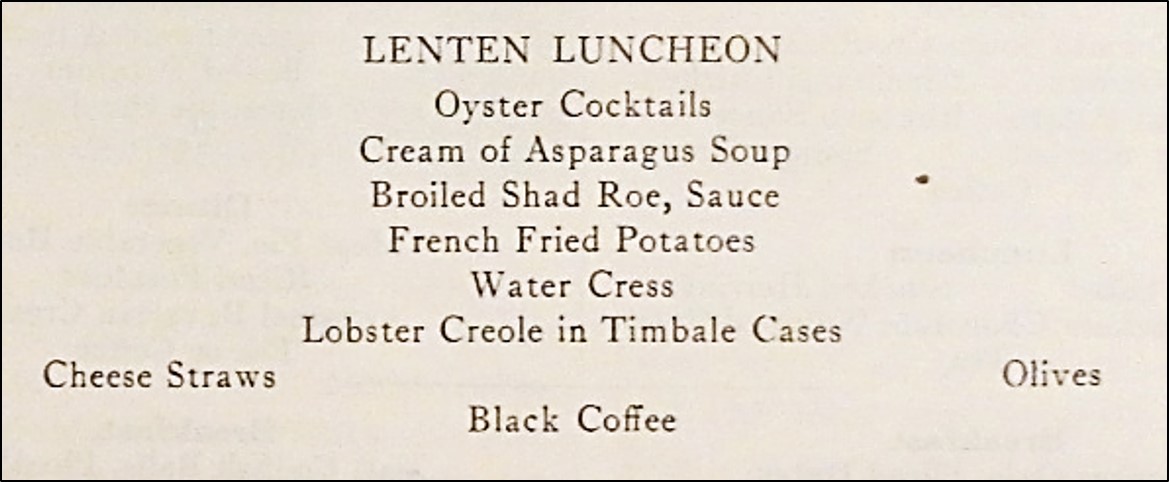
There’s been a history of giving up meat during Lent for a long time. I’m not sure exactly what was allowed a hundred years ago – and it probably varied depending upon someone’s religious and ethnic background – but this 1920 Lenten menu clearly suggests that it was common to eat fish instead of meat during this time of year.
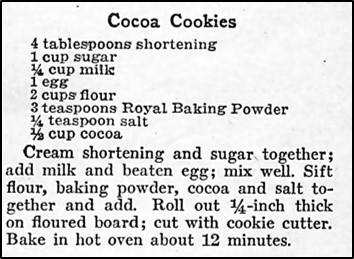
I recently came across a hundred-year-old recipe for Cocoa Cookies that I just had to try. This recipe was actually a cut-out cookie recipe. The cookies had a crispy exterior with a softer, cake-like interior, and just the right amount of sweetness. They are lovely with coffee (or milk).
Here is the original recipe:
Source: New Royal Cook Book (1920), published by Royal Baking Powder Co.
When I followed the recipe, the cookie dough was extremely dry and crumbly, so I added a second egg to make the dough a better consistency for rolling.
Preheat oven to 400° F. Cream butter (or shortening) and sugar; then stir in milk and eggs. Add the baking powder, salt, and cocoa; stir until combined. Add the flour and stir until well mixed. Roll out to 1/4 inch thick; then cut into shapes. Place on greased baking sheets. Bake 9-12 minutes or until lightly browned.
Source: New Royal Cookbook (1920) published by Royal Baking Powder Co.
When I cook vegetables in water, I usually add a little salt to the water. Apparently people a hundred-years-ago wondered whether it was a good idea to add baking soda when cooking vegetables.
Baking Soda in Cooking Vegetables and Fruits
The baking soda will soften the water in cooking beans or cabbage, and the vegetables will cook quicker and more thoroughly, but the alkali has a destructive effect on the vitamins present in these vegetables, and in all fresh foods. Scientists tell us that these vitamins are more important to nutrition than the foods themselves are when deprived of them, and that we lose the good of the food if the vitamins are destroyed. Try adding a little vinegar to the water for beans or cabbage; this will soften them quite as well, and our friends, the vitamins, are not injured by acids, only by alkalis.