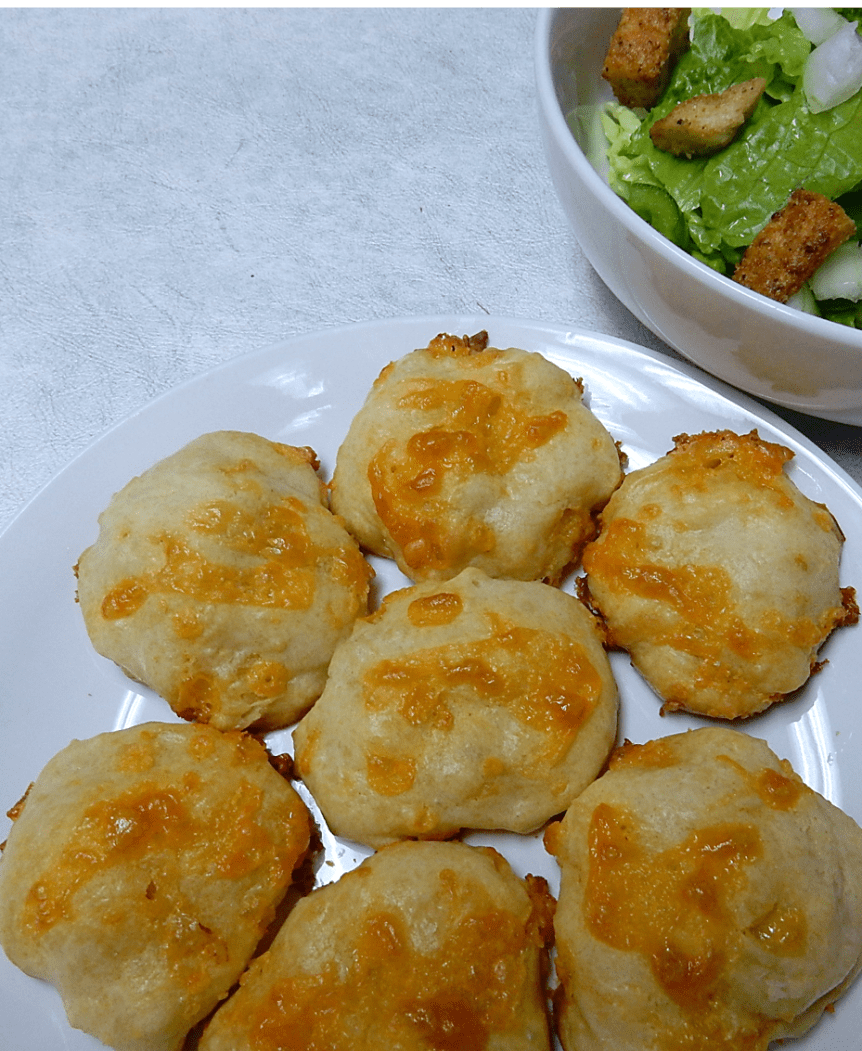
When I think of Cheese Puffs, I think of a cheesy snack that’s in the snack aisle at the supermarket, so I was surprised to see a hundred-year-old recipe for cheese puffs. These Cheese Puffs are a delightful cheesy tidbit that can be eaten as a snack or a part of a meal.
The old recipe recommends serving the Cheese Puffs with a salad, which is what I did. Cheese Puffs and a salad are just right for a light lunch.
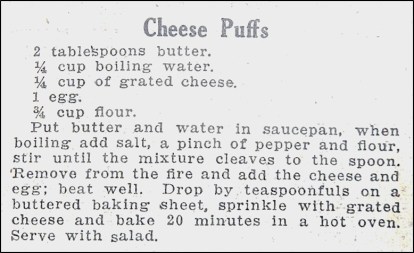
Here’s the original recipe:
Source: Mrs. Scott’s Seasonal Cook Books (The North American Newspaper, Philadelphia, Winter, 1921)
1/4 cup grated cheese (I used cheddar cheese.) + additional grated cheese to garnish
1 egg
Preheat oven to 400° F. Put butter and water in a large sauce pan; bring to a boil. Stir in salt, pepper, and flour. Remove from heat, and add 1/4 cup grated cheese and egg; stir until thoroughly mixed.
Place on a greased baking sheet. Sprinkle with addiitonal grated cheese. Put in oven and bake 20 minutes or until lightly browned. If desired, serve with a salad.
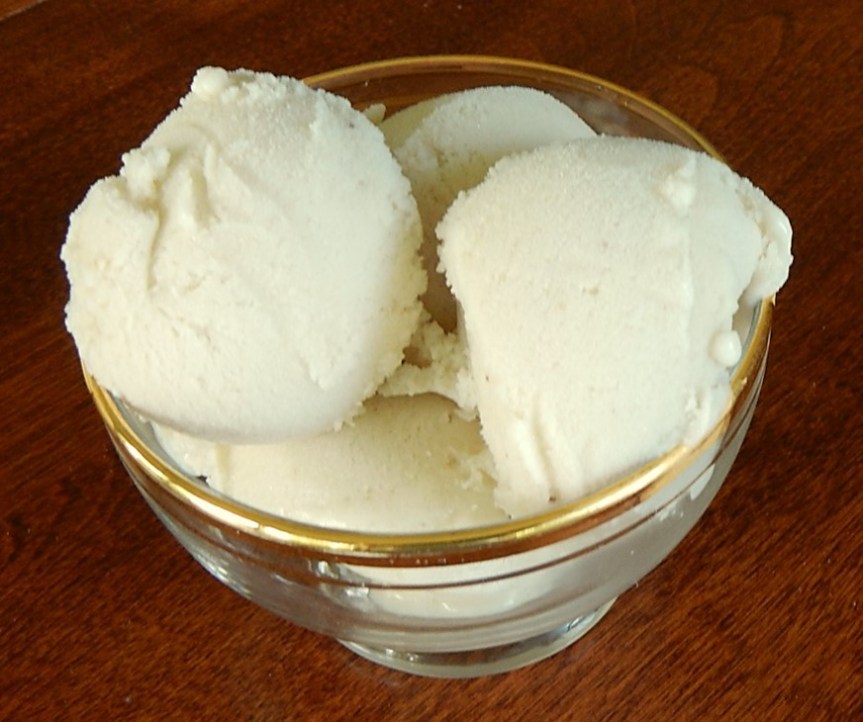
Here’s how a 1921 magazine article described the different types of ice cream:
Classes of Ice Cream
There are three distinct classes of Ice Cream: The Philadelphia, which is supposed to be made of heavy cream; the French, which is made with eggs on a soft custard foundation; and the so-called American, which is made on the foundation of a thin white sauce. All three classes are made in New York, and in every other large city, but we have never heard that any special recipe for ice cream is peculiar to New York. The less expensive form of cream, in that and every other city, are those based on a thin white sauce, sweetened sauce, sweetened, flavored, and frozen.
Marguerites are something of a culinary Marie Celeste, if you ask me. You’ll find them in recipe books from the teens, the 20s, the 30s, even the early 40s–and then they’re gone. They vanish without a trace . . . But The Joy of Cooking doesn’t mention them. Neither does Betty Crocker. By 1960, the day of the Marguerite had passed.
I can see why they’ve vanished from modern recipe books. The Marguerites had a nondescript taste and aren’t nearly as sweet as many modern snacks; yet at the same time, I liked them and they were a surprisingly satisfying snack.
Marguerites are fun to make and made a nice presentation. The salt on the crackers was noticeable in the finished product, which was both salty and sweet.
Will I make Marguerites again? I’m not sure – yet a piece of me thinks that I might. They’re an easy snack to whip up, and eating just a couple really did take the edge off my late afternoon hunger.
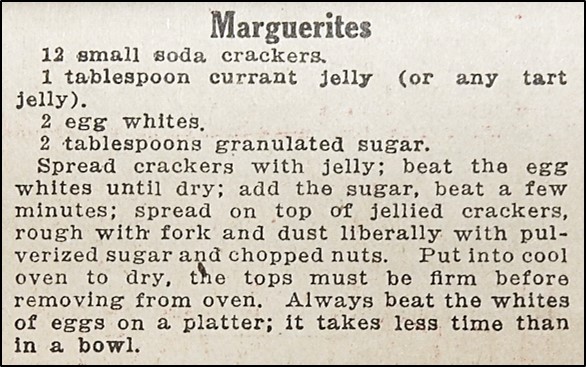
Here’s the original recipe:
Source: Mrs. Scott’s Seasonal Cook Books (The North American Newspaper, Philadelphia, Winter, 1921)
The 1 tablespoon of jelly called for in this recipe was not nearly enough since each cracker needed to be spread with the jelly, When I updated the recipe, I didn’t list an amount, I just indicated that currant (or other tart) jelly was needed to make this recipe.
Pulverized sugar is an old term for powdered sugar.
Preheat oven to 325° F. Put egg whites in bowl and beat until stiff. Add granulated sugar, and beat a little more to get the sugar evenly distributed in the egg whites. Set aside.
Put crackers on a baking sheet. Spread currant (or other tart) jelly on each cracker. Put approximately a tablespoonful of the beaten egg white on top of each jellied cracker; gently spread using a fork, and then sprinkle with powdered sugar and chopped nuts.
Place in oven and bake until the beaten egg whites are lightly browned (about 15 minutes).
A hundred-year-old home economics textbook included a 9-step guide for washing dishes:
The steps for washing dishes correctly are:
Remove the dishes from the table. Remove the bits of food from the plates with the rubber plate-scraper or a piece of paper. Rinse off very dirty dishes. Pile together dishes that are alike.
Put to soak all cooking utensils. Hot water should be put in those which have contained sugar or syrup, and cold water in those which have been used with milk, eggs, cereal, starch or flour.
Pour hot water in the dishpan, make a good suds with the soap, use a clean dishcloth (not a “rag”) or mop, and wash every dish carefully. Do not have the dishpan full of dirty dishes while washing. Always wash the cleanest dishes first.
Place the washed dishes in a drain-pan or dish-drier, being careful not to crowd them. Crowding dishes in a pan is apt to chip them and makes it hard to scald them thoroughly. This pan or drier should be placed at the left of the pan in which the dishes are washed because this will save unnecessary motions in putting the dishes from one into the other.
Rinse dishes thoroughly with boiling water, being sure that each dish has been rinsed inside and out. If the dishes have been scalded in a dish-drier, it may be set on the drain-board and the dishes allowed to dry without wiping. The silver and glass should be washed first. They will look best when wiped and polished dry with a towel. Some persons like to dry all the dishes with a towel. This is a good method, but it takes more time than drying them in a rack or drier.
Scape out and rinse off the cooking utensils. Use plenty of hot soapy water for washing them; wash thoroughly, both inside and out, scouring if necessary. Rinse with boiling water and wipe dry. Steel knives may be scoured with scouring-powder applied with a cork.
Wash off the drain-boards and tables, and scour them with the powder and a brush if necessary. Use clean water for this. Wash out the sink and sour it with a brush and scouring-powder when the soapy water will not remove the stains.
Wash the dish-towels in clean soapy water, removing all spots. Rinse in clean water, shake out and pull into shape. Hang to dry on a rack for this purpose in the kitchen, or better still, hang outdoors in the sun. Wash and rinse the dishcloth or dish-mop.
Clean out the dishpan thoroughly, wipe it dry and put it away.
Elementary Home Economics (1921) by Mary Lockwook Matthews
Cut the eggs in half length-wise and remove the yolks. Cut the whites into narrow strips; and, mash the yolks. (I mashed them with a fork. Another way to mash them would be to force them through a strainer.) Put a teaspoon of the yolk in the center of each plate, and arrange the strips of egg white around the mashed yolk to make it look like a daisy. (When I made this recipe, it took a little more than one egg for each daisy. I had left-over yolk.) Put shredded lettuce around the daisy. Serve with French salad dressing. If desired add a little grated onion to the French dressing before serving.
Our family calls the noon meal “lunch” and the evening meal “supper” – but I often feel out-of-step with my friends and neighbors who all eat “dinner” in the evening. So I was fascinated to read what it said in a 1921 home economics textbook about which meal was which:
In some families the meal served at noon is called luncheon and is followed by dinner in the evening; in others, dinner is the meal served at noon, followed by supper in the evening. Luncheon and supper are simpler meals than dinner.
Elementary Home Economics (1921) by Mary Lockwood Matthews
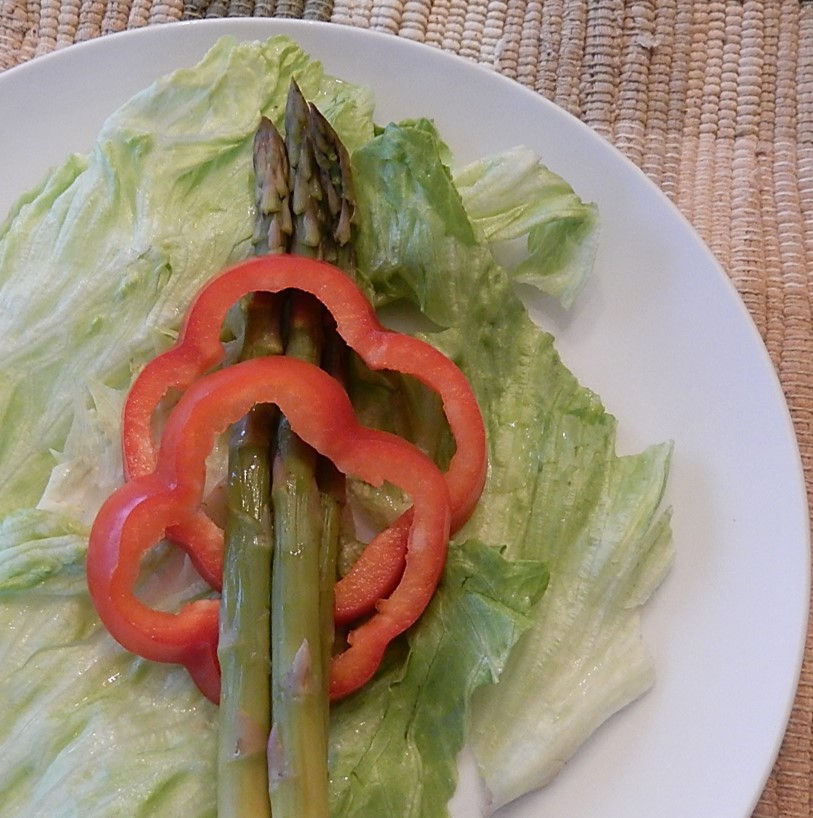
Spring has sprung – and I’m enjoying spring foods like asparagus. I found a hundred-old-recipe for Asparagus Salad, and decided to give it a try. Chilled asparagus stalks and red pepper rings are arranged on a bed of lettuce. The salad was tasty, and made a lovely presentation in an old-fashioned way.
Here’s the original recipe:
Source: The Boston Cooking-School Cook Book
In order to authentically replicate the original recipe, I suppose that I could have used canned asparagus, but somehow fresh asparagus just seemed like it would taste better, so that I what is used.
And, I skipped the French dressing that was enhanced with ketchup. It probably would be wonderful, but somehow it didn’t sound good to me.
Steam asparagus for 3-5 minutes or until tender. Remove from heat and chill.
To assemble salad, arrange lettuce leaves on plate. Place the chilled asparagus in the rings, and place on the lettuce leaves. If desired, serve with French salad dressing.

 Here’s how a 1921 magazine article described the different types of ice cream: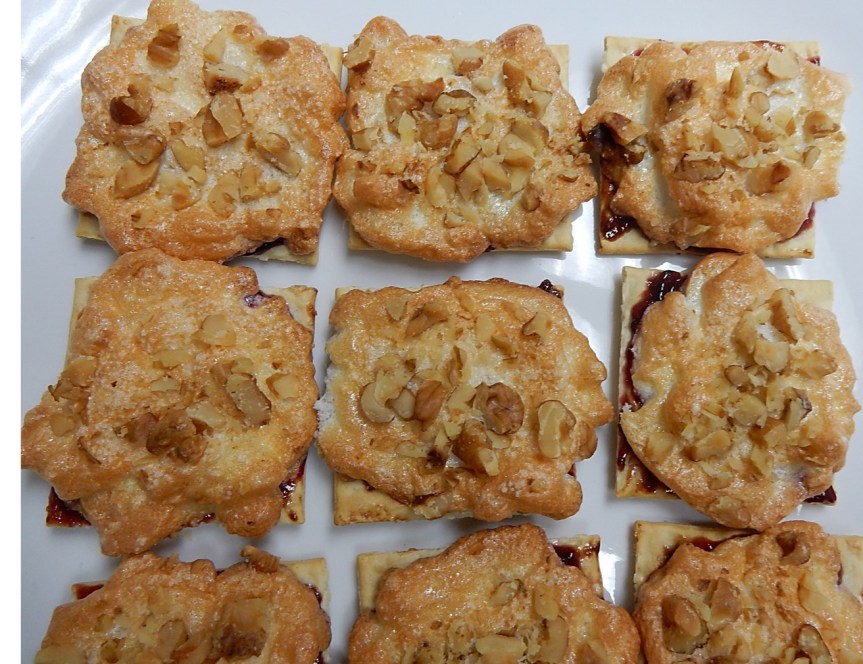
 Happy Easter