Good Cooks Are Composers

Quote by Henry Finck
Source: The New Cookery (1921) by Lenna Frances Cooper

The foreword to a 1921 cookbook begins with this quote. Nice quote – but I was curious about who Henry T. Finck was and why I should care about what he thought.

A quick google search turned up information about Henry Finck. He was both the music editor and the epicurean editor at the New York Evening Post. According to Oregon Encyclopedia:

Music critic Henry T. Finck spent his childhood on an apple orchard near the Christian agricultural colony of Aurora in the lower Willamette Valley. The first Oregonian to graduate from Harvard, Finck was a prolific writer and critic of contemporary music. He also wrote about horticulture, romantic love, travel, food, and his Oregon boyhood.

Old-fashioned Coffee Cake

piece of coffee cake on plate

Coffee cake is a wonderful sweet treat to have with coffee (or without), so I was pleased to find a hundred-year-old recipe for Coffee Cake. The cake turned out well. It was moist and tender with a nice cinnamon and sugar topping.

Here’s the original recipe:

Coffee Cake Recipe
Source: The New Dr. Price Cook Book (1921)

And, there’s the recipe updated for modern cooks:

Coffee Cake

  • Servings: 7 - 9
  • Difficulty: moderate
  • Print

Cake

2 cups flour

1/2 teaspoon salt

3 tablespoons sugar

4 teaspoons baking powder

2 tablespoons shortening, melted

1 cup milk

Topping Mixture

3 teaspoons flour + additional, if needed

1 tablespoon cinnamon

3 tablespoons sugar + additional, if needed

3 tablespoons shortening

Preheat oven to 375° F. Put all of the cake ingredients in a mixing bowl. Beat to combine. Put batter in a greased and floured 9-inch square cake pan.

In a separate bowl, place the flour cinnamon, and sugar. Stir to combine. Add the shortening, and mix together until the texture is crumbly. It may helpful to use your hands to get the shortening mixed in.  (When I made the recipe I added more flour and sugar than called for in the original recipe, to make it more crumbly).

Spread the topping mixture over the top of the cake. Bake for 30 – 35 minutes, or until a wooden pick comes out clean.

http://www.ahundredyearsago.com

1921 Table Etiquette

set table on porch or patioPhoto source: Ladies Home Journal (July, 1911)

Here’s a few table etiquette rules that appeared in a 1921 home economics textbook: 

Table Manners

  • Never go to the table unless hands and face are clean and hair is in order. 
  • Stand behind your chair until the hostess takes her seat. 
  • The napkins should be laid across the lap without being entirely opened out. Never stick the corner inside the collar. If the napkin is to be used again, fold it neatly before leaving the table. 
  • Always sit erect in the chair while eating. Keep the arms and elbows off the table. 
  • Never eat hurriedly. 
  • Do not talk when the mouth is full of food. 
  • Ask politely for dishes to be passed, rather than reach across the table. 
  • Never complain about the food. If it is not the kind desired, it need not be eaten. 
  • If it is necessary to leave the table before the others are ready, ask to be excused by the hostess. 
  • Do not talk about disagreeable things during the meal. 

Source: Elementary Home Economics (1921) by Mary Lockwood Matthews

Old-fashioned Nut Squares


Nut Squares on Plate

Warm weather is finally here, and I’m ready to sit on the porch with tea and a snack. So when I saw a hundred-year-old recipe for Nut Squares that said, “Very nice for afternoon tea,” I knew that I needed to try the recipe.

The Nut Squares were tasty and chock-full of nuts with a crispy crust and a chewy middle.  The one downside is that the crust had a tendency to crack and break when I cut the cookies into bars.

Here’s the original recipe:

Nut Squares on plate
Source: Ladies’ Union Cook Book (Concord Junction, MA, 1921)

I was surprised that the recipe did not call for any butter or shortening – though the cookies still had a nice texture. Perhaps the top crust may have had less tendency to break and crumble off the bars if the recipe had inclued butter or shortening.

Here’s the recipe updated for modern cooks:

Nut Squares

  • Servings: about 24 bars
  • Difficulty: easy
  • Print

3 eggs

1 1/2 cups sugar

3/4 cup flour

1/2 teaspoon baking powder

2 cups chopped nuts (I used chopped walnuts.)

Preheat oven to 375° F. Put eggs in mixing bowl and beat. Add sugar, flour, and baking powder; beat until smooth. Pour mixture into a greased 9 X 13 inch baking pan. Bake until set and the top is light brown (about 25 – 30 minutes). Remove from oven. When partially cool cut into squares or 1 X 2 inch bars.

http://www.ahundredyearsago.com

Scrambled Eggs, Country Style

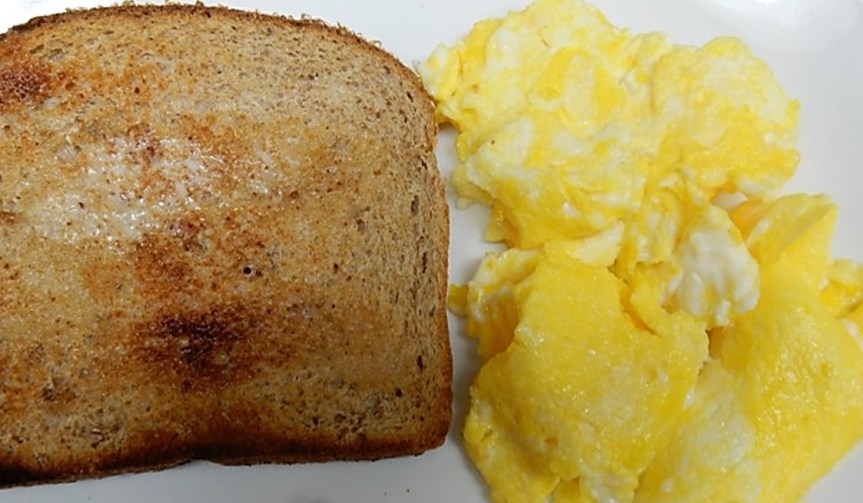
Scrambled Eggs, Country Style on PlastWhen I make scrambled eggs I typically break the eggs into a bowl, add a little milk, salt, and pepper, and then beat the eggs until they are smooth and frothy, but I was intrigued by a hundred-year-old recipe for Scrambled Eggs, Country Style, and decided to give it a try. The recipe was extremely easy, and similar to how I make scrambled eggs when camping.
I broke the eggs directly into the skillet and let the egg whites begin to turn white; then I broke the yolks and began mixing the eggs while they cooked. This resulted in bigger chunks of the egg white in the scrambled eggs – but they were tasty.

Here’s the original recipe:

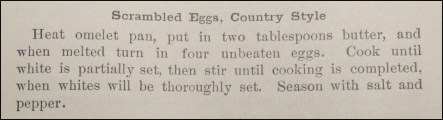
Recipe for Scrambled Eggs, Country Style
Source: Boston-Cooking School Cook Book (1921)

And, here’s the recipe updated for modern cooks:

Here’s the recipe updated for modern cooks:

Scrambled Eggs, Country Style

  • Servings: 2 - 3
  • Difficulty: easy
  • Print

2 tablespoons butter

4 eggs

salt and pepper

Using medium heat, melt butter in skillet. Break the eggs into the skillet, and cook until the eggs are partially set with the egg whites beginning to coagulate;  then break the yolks and stir and fold the eggs until they are completely cooked. Sprinkle with salt and pepper to season.

http://www.ahundredyearsago.com

1921 Description of Vegetables

drawing of farmer with vegetablesA hundred years ago people thought about the nutritional value of vegetables differently than they do today.

Vegetables

Vegetables may be divided into two great classes:

  1. Coarse or fibrous vegetables, comprising roots, tubers, stems, bulbs, and leaves.
  2. The finer or fruity vegetables, as tomato, squash, pumpkin, green peas, corn, immature beans (shelled), cucumbers, melons, etc.

Vegetables are characterized by their large amount of cellulose; and as water enters largely into their composition, they are by no means the most nutritious diet. Food, however, in order to supply perfectly the needs of the vital economy, must contain water, and indigestible as well as nutritive elements. vegetables are therefore dietetically of great value, as they furnish large quantities of organic fluids, and are rich in those mineral elements which are necessary for maintaining the alkalinity of the blood, and for the repair of the bony structures.

Perhaps no food is more generally used by rich and poor alike in making up their daily fill of fare; yet how often the vegetable is spoiled in cooking! In the first place, the portion of the vegetable next to the skin contains the greater quantity of mineral matter and flavoring substances. Hence all thin-skinned vegetables such as carrots, oyster plant, etc. should be scraped. Others should be pared as thinly as possible.

Vegetables, like all starchy foods, should be put to cook in boiling water, as by the application of hot water, the starch grains are caused to swell and burst, and this give the starch an opportunity to escape through the cellulose.

Whenever possible, vegetables should be cooked the same day they are gathered. If necessary to keep green vegetables for any length of time, do not put them in water, as that will dissolve and destroy some of their juices. Lay them in a cool, dark place. A stone floor is best. Old vegetables should be immersed in cold water for an hour or more just before cooking, to make them more tender.

Young, tender vegetables, as lettuce, tomatoes, water cress, etc., served in the uncooked state, are valuable for the water and the potash salts they contain also for the stimulating effect they have on the appetite.

The Science of Food and Cookery (1921) by H.S. Anderson