Daisy Salad

Daisy salad on plateHappy Easter

Extra hard-boiled eggs in the refrigerator? Here’s a fun way to use them.

Here’s the original recipe:

Daisy Salad on Plate
Source: Mrs. Scott’s Seasonal Cook Books (The North American Newspaper, Philadelphia, Winter, 1921)

Here’s the recipe updated for modern cooks:

Daisy Salad

  • Servings: 3-4
  • Difficulty: moderate
  • Print

4 hard-boiled eggs

2 cups shredded lettuce

French salad dressing

Grated onion, if desired

Cut the eggs in half length-wise and remove the yolks. Cut the whites into narrow strips; and, mash the yolks. (I mashed them with a fork. Another way to mash them would be to force them through a strainer.) Put a teaspoon of the yolk in the center of each plate, and arrange the strips of egg white around the mashed yolk to make it look like a daisy. (When I made this recipe, it took a little more than one egg for each daisy. I had left-over yolk.) Put shredded lettuce around the daisy. Serve with French salad dressing. If desired add a little grated onion to the French dressing before serving.

http://www.ahundredyears ago

Was Dinner at Noon or in the Evening a Hundred Years Ago?

Eating at a Table
Source: A Text-book of Cooking

Our family calls the noon meal “lunch” and the evening meal “supper” – but I often feel out-of-step with my friends and neighbors who all eat “dinner” in the evening. So I was fascinated to read what it said in a 1921 home economics textbook about which meal was which:

In some families the meal served at noon is called luncheon and is followed by dinner in the evening; in others, dinner is the meal served at noon, followed by supper in the evening. Luncheon and supper are simpler meals than dinner.

Elementary Home Economics (1921)  by Mary Lockwood Matthews

Old-fashioned Asparagus Salad

Asparagus Salad on Plate

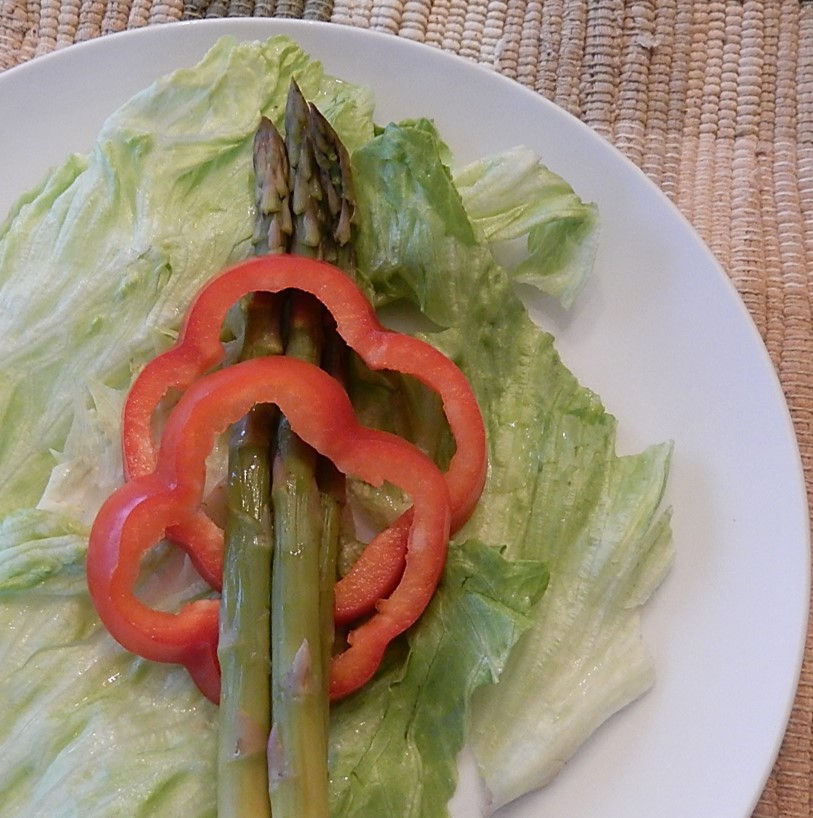
Spring has sprung – and I’m enjoying spring foods like asparagus. I found a hundred-old-recipe for Asparagus Salad, and decided to give it a try. Chilled asparagus stalks and red pepper rings are arranged on a bed of lettuce. The salad was tasty, and made a lovely presentation in an old-fashioned way.

Here’s the original recipe:

Recipe for Asparagus Salad
Source: The Boston Cooking-School Cook Book

In order to authentically replicate the original recipe, I suppose that I could have used canned asparagus, but somehow fresh asparagus just seemed like it would taste better, so that I what is used.

And, I skipped the French dressing that was enhanced with ketchup. It probably would be wonderful, but somehow it didn’t sound good to me.

Here’s the recipe updated for modern cooks:

Asparagus Salad

  • Servings: 1 serving
  • Difficulty: easy
  • Print

For each serving:

3 – 4 stalks asparagus

2 1/3-inch wide rings of red pepper

lettuce leaves

French salad dressing, if desired

Steam asparagus for 3-5 minutes or until tender. Remove from heat and chill.

To assemble salad, arrange lettuce leaves on plate. Place the chilled asparagus in the rings, and place on the lettuce leaves. If desired, serve with French salad dressing.

http://www.ahundredyearsago.com

1921 Hebe Advertisement

Advertisement for Hebe
Source: The Boston Cooking-School Cook Book (Revised Edition, 1921)

Hebe sounds wonderful in the advertisement, but it actually was very controversial. Hebe was similar to evaporated milk – but was a mixture of skim evaporated milk and coconut fat. It was less expensive than regular evaporated milk. Hebe was a “filled milk” which means that the milk was reconstituted with fats other than dairy fats.

A hundred years ago Hebe was seen as a threat to the dairy industry. According to MySA:

Congress passed a law in 1923 (H.R. 8086 or 67 P.L. 513) banning its shipment: “It is hereby declared that filled milk, as herein defined, is an adulterated article of food, injurious to the public health, and its sale constitutes a fraud upon the public. It shall be unlawful for any person to manufacture within any Territory or possession, or within the District of Columbia, or to ship or deliver for shipment in interstate or foreign commerce, any filled milk.”  Infant formula — under certain rules — was allowed.

Any violation of the law was punishable by “a fine of not more than $1,000 or imprisonment of not more than one year, or both…”.

And that was the end of Hebe.


Old-fashioned Spinach Soup

bowl of spinach soup

I have warm memories of Popeye the Sailor Man eating spinach to grow strong. Spinach is chockful of nutrients, and is an excellent source of potassium, magnesium, vitamin K, vitamin A, manganese, folate, copper, vitamin B2, vitamin B6, vitamin E, and vitamin C, as well as being one of the best sources of plant-based iron. What’s not to like?

As a result, I’m always on the lookout for good spinach recipes. So when I came across a hundred-year-old for Spinach Soup, I decided to give it a try.

The creamy Spinach Soup was delicious with a slight peppery undertone which added interest.

Here’s the original recipe:

Spinach Soup Recipe
Source: Lowney’s Cook Book (Revised Edition, 1921)

Here’s the recipe updated for modern cooks:

Spinach Soup

  • Servings: 4 - 5
  • Difficulty: moderate
  • Print

2 quarts spinach (I used a 10 ounce package of spinach.)

6 cups water

1/2 bay leaf

1 teaspoon salt

3 tablespoons butter

3 tablespoons flour

2 cups milk

1 clove garlic or 2 tablespoons chopped onion (I used the chopped onion.)

1/4 teaspoon cayenne (red) pepper

1/4 teaspoon celery salt

1/2 cup cream, if desired

Put spinach and water into a large pan, and bring to a boil using high heat; reduce heat and simmer for 30 minutes. Remove from heat, and puree or press through a sieve. (I used a Foley mill.)

In the meantime, put milk, garlic or onion, and bay leaf in a saucepan. Using medium heat, scald the milk, while stirring occasionally. Remove from heat, and strain. (Discard the garlic or onion and bay leaf.)

Put butter in large pan or dutch oven. Melt using low heat; then stir in the flour. Slowly add scalded milk while stirring constantly. Then stir in the spinach mixture, salt, cayenne pepper, and celery salt. Heat until steamy, then serve.

If desired whip the cream, and put a dollop of the whipped cream on top of each bowl of soup.

http://www.ahundredyearsago.com


Hundred-year-old Serving Suggestions for Oranges

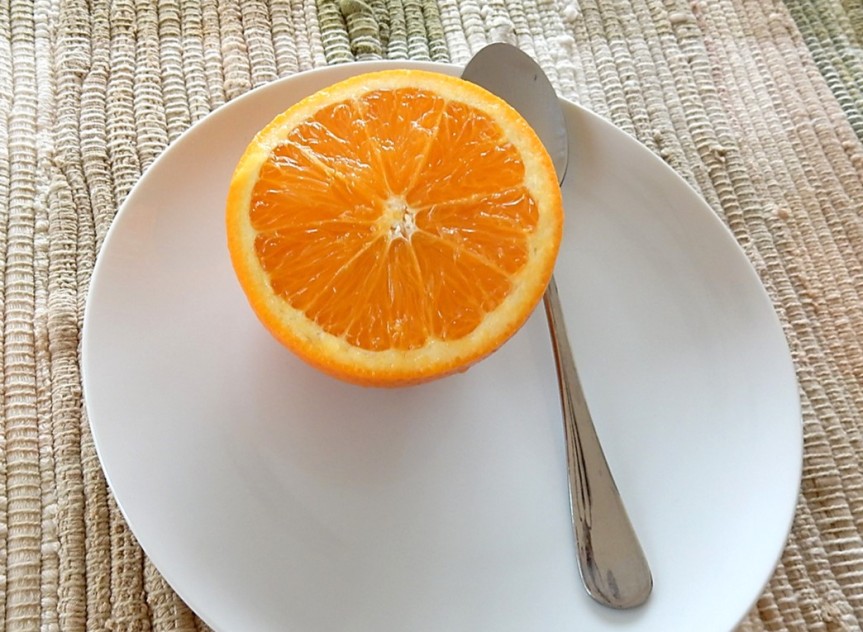
orange half on plateDid you ever eat an orange with a spoon? I never did until I prepared this post and needed a photo to illustrate it.

Here are several suggestions for preparing oranges in a hundred-year-old cookbook:

Ways of Preparing Oranges for Serving

  1. Wipe orange and cut in halves crosswise. Place one-half on a fruit plate, having an orange spoon or teaspoon on plate at the right of fruit. 
  2. Peel an orange and remove as much of the white portion as possible. Remove pulp by sections, which may be accomplished by using a sharp knife and cutting pulp from tough portion first on one side of section, then on the other. Should there be any white portion of skin remaining on pulp it should be cut off. Arrange sections on glass dish or fruit plate. If the orange is a seeded one, remove seeds. 
  3. Remove peel from an orange in such a way that there remains a one-half inch band of peel equal distance from stem and blossom end. Cut band, separate sections, and arrange around a mound of sugar. 

The Boston Cooking-School Cook Book (1921 Edition)

Is it just me, or are the second and third descriptions not very clearly written?

For the second one – Is the author just providing a very detailed description of how to separate an orange into sections? . . . or is the author telling the reader to remove the outer membrane from each section?

And, for the third one – Why is a one-half inch band of peel left around the middle of the orange, only to then cut the band?

“A Good Dish for the Meatless Meal” Recipe

A Good Dish for a Meatless Meal

Sometimes the names of dishes in old cookbooks make me smile. The recipe I made for today is called “A Good Dish for the Meatless Meal.” It was one of several recipes in a section on Lenten recipes in an old newspaper recipe supplement.

The recipe made a delightful rice, tomato, and onion casserole topped with creamy melted cheese, and garnished with parsley and paprika. The recipe author was right. It was a good dish. The recipe is a keeper.

Here’s the recipe updated for modern cooks:

Recipe for "A Good Dish for a Meatless Meal"
Source: Source: Mrs. Scott’s Seasonal Cook Books (The North American Newspaper, Philadelphia, Winter, 1921)

I assume that “drippings” refer to the fat created when cooking beef or pork – though I am a bit foggy why meat drippings would be called for in a recipe for a meatless dish. Maybe a hundred years ago “meatless” just meant that there were no chunks of meat. In any case I substituted olive oil for the drippings, but any oil or fat could be used.

A Good Dish for a Meatless Meal

  • Servings: 3 - 4
  • Difficulty: easy
  • Print

1 cup rice

2 tablespoons olive oil

1/2 cup onion, finely chopped

2 cups stewed tomatoes (1 14.5 ounce can)

1 teaspoon salt

1 cup grated American cheese

parsley, chopped

paprika

Preheat oven to 375° F. Cook the rice according to package directions.

In the meantime, heat the olive oil in a skillet and then add the chopped onion. Using medium heat, sauté until the onion is transparent. Stir in the tomatoes and salt, then add the rice. Cook until hot and bubbly then transfer to a casserole dish. Top with the grated cheese. Place in oven and heat until the cheese is melted. Remove from oven and sprinkle with the chopped parsley and paprika.

http://www.ahundredyearsago.com