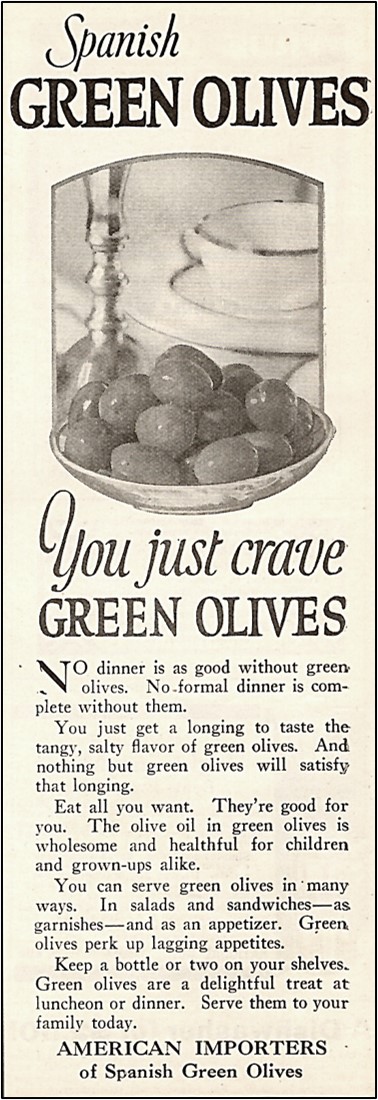
Who would have guessed that Spanish green olives have been imported into the United States for at least a hundred year? And, who would have guessed that there was a trade association promoting those imported olives?
Who would have guessed that Spanish green olives have been imported into the United States for at least a hundred year? And, who would have guessed that there was a trade association promoting those imported olives?

I seldom buy canned salmon, yet when I recently flipped through a hundred-year-old cookbook, a recipe for Salmon Croquettes caught my eye. It brought back warm memories of eating various canned salmon dishes when I was a child. Long story short, I bought a can of salmon the next time I went to the store, and soon was making Salmon Coquettes. The crispy croquettes only took a few minutes to make and were a tasty comfort food.
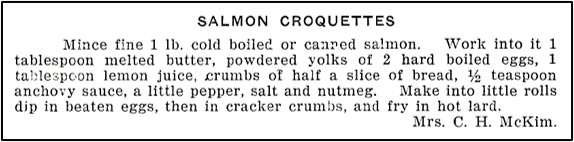
Here’s the recipe updated for modern cooks:
1 can salmon (14.75 oz.), flaked
1 tablespoon, butter, melted
2 hard-boiled egg yolks, mashed
1 tablespoon lemon juice
1/2 slice bread, torn into small pieces to make crumbs
1/2 teaspoon anchovy sauce
dashes of salt, pepper, and nutmeg
1 egg, beaten
approximately 3/4 cup cracker crumbs (I put saltine crackers in a Ziplock bag and rolled with a rolling pin to make crumbs.)
lard, shortening, or cooking oil
Put salmon into a mixing bowl. Add melted butter, mashed hard-boiled egg yolks, lemon juice, bread crumbs, anchovy sauce, salt, pepper, and nutmeg. Shape into small balls about 1 1/2 inches in diameter. (If the mixture is too juicy to make balls, add additional bread crumbs.)
Put the beaten egg in a bowl. In another bowl put the cracker crumbs. Roll the salmon balls in the egg and then in the cracker crumbs.
Put lard, shortening, or cooking oil in skillet and heat until hot using medium heat. (It should be about 1/2 inch deep.) Add salmon balls. When the bottom of the balls have lightly browned (about 1 1/2 – 2 minutes), gently roll to brown the other sides. Remove from skillet and drain on paper towels, then serve.

How come recipes are sometimes a success, and other times a failure? Here’s what it said in a hundred-year-old magazine.
Ten percent of every culinary success is common sense and a good recipe. The other ninety — ah, there is the mystery!
American Cookery (March, 1922)

Canapes made using bread as the base were a popular appetizer a hundred years ago. I was intrigued by a recipe for Grated Cheese Canapes in a 1922 cookbook. Rounds of thin-sliced bread were spread with mustard then topped with grated cheese and chopped olives. The tangy mustard combined nicely with the slight saltiness of the cheese and olives to make a lovely hors d’oeuvre.
Here’s the original recipe:
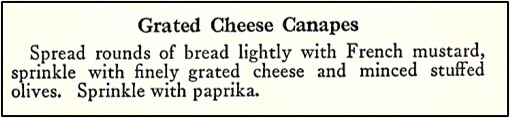
A hundred years ago did the term “French mustard” refer to a yellow mustard or a dijon-style mustard? I googled it discovered that French’s Mustard was introduced at the 1904 St. Louis World’s Fair – but that is a brand and not exactly a type of mustard. In the end, I decided to use a dijon-style mustard, but am not sure that was commonly available in the United States in 1922.
Here’s the updated recipe for modern cooks:
6 slices of thinly sliced bread (assumes 2 rounds per slice) (I used white bread.)
approximately 2 tablespoons French mustard (I used a Dijon mustard.)
approximately 3/4 cup finely grated cheese (I used cheddar cheese.)
approximately 1/2 cup stuffed olives, finely chopped
paprika
Cut the bread into rounds that are 2 – 2 1/2 inches in diameter. Thinly spread French mustard on the rounds. Top with grated cheese and chopped olives; sprinkle with paprika.

Who were “New Women” a hundred years ago? — flappers,?
A hundred-year-old church cookbook from Alpena, Michigan had a different definltion. This fun poem was at the beginning of the Desserts and Puddings chapter. Alpena is on Lake Huron in northeastern Michigan.
I recently found a hundred-year-old recipe for Cabbage with Caraway Seeds. It has an old-fashioned goodness, and makes a lovely side dish.
Here’s the original recipe:
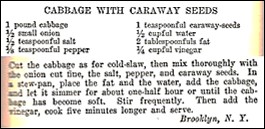
Here’s the recipe updated for modern cooks:
1 pound cabbage (about 1/2 of a medium cabbage), shredded
1/2 small onion, finely chopped
1/2 teaspoon salt
1/8 teaspoon pepper
1 teaspoon caraway seeds
1/2 cup water
2 tablespoons fat (I used butter.)
1/4 cup vinegar
Put cabbage, onion, salt, pepper, caraway seeds, butter and water in a large saucepan. Bring to a boil using medium heat, then reduce heat and simmer until the cabbage is tender; stir frequently. If needed, add additional water. After the cabbage is soft (about 30 minutes), add the vinegar and cook an additional 5 minutes.
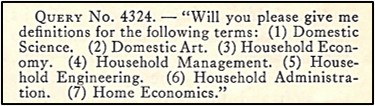
You might enjoy this 1922 article that gave definitions for several terms associated with the day-to-day operation of a home. The article was written in response to a reader’s request for definitions.
Definitions Wanted
We find that these terms are variously defined, sometimes they are all taken to mean pretty much the same thing, sometimes the distinctions are quite arbitrary and neither included nor connoted in the common significance of the word. We are glad to define them as they appear to us to be distinguished one from another:.
Domestic Science. The application of scientific methods of thought and work to the problems of the house, or to household problems.
Domestic Art. The application to the house, in its exterior and interior, of the artistic principles of form and color, also of materials used. Building, decorating, tinting, and furnishing are included also – but properly by no means chiefly – artistic clothing. The term is very much a misnomer when applied to work in plain sewing.
Household Economy. Following the Greek word from which “economy” is derived, this means the “running” of the entire household, with regard to division of labor, expenditure of incomes, provision of food, care in sickness, and provision of amusement and recreation. In our modern use of the term, a careful thrift is connoted.
Household Management. The direction and care of the household, as in the foregoing, but not necessarily, with any implication of thrift. The house of a millionaire can be “managed” without thought of the cost.
Household Engineering. Here we have a more mechanical ordering of the house. Both “economy” and “management” seem to us to include the human element in all its phases, as co-dwellers in the house. “Engineering” appears to consider the human element only as a means to an end, the end of the mechanical ordering of the dwelling.
Household Administration. This includes both the economy, and also the management and engineering – but, as though it were done by a ruler who sits aloft and directs the activities without either sharing them, or giving his heart to them. He does it all with brains like the administrator of an estate. At least, it sounds like that to us.
Home Economics. The new word, “home,” in this term, introduces an ethical and even spiritual element which all the others lack. It signifies economics as under definition (3), but with one whole eye on higher, rather than material values. It means running the house with common sense, but also with uncommon sense, and always subordinating the common and the uncommon. This means that the spirit of the home will be the first and chiefest, and most important thing to be considered, and will always come before the mere care of the house.
American Cookery (December, 1922)

