HHere’s some information in a hundred-year-old cookbook about making cocoa and chocolate. Not quite sure how cocoa differs from chocolate.
Cocoa and Chocolate
Theobromine is the stimulating element in cocoa beans, and is much less pronounced in its effect than the corresponding principles in tea and coffee. The high percentage of fat, together with other food principles, places this bevarage in the class with foods. As a rule, when making cocoa or chocolate, follow the recipes found on the package. It will be well to bear in mind, however, that boiling will greatly improve it. Beating constantly with an egg beater while cooking will thoroughly mix the ingredients and prevent a thin skin from rising to the surface.
Cooks are always looking for tasty recipes that use left-overs. A hundred-years-ago croquettes were a popular way to use left-over vegetables, meats, and other foods. Often the croquettes were shaped into balls or small cylinders, and then fried.
I don’t make croquette recipes very often because I worry about whether fried foods are healthy. But I recently came across a recipe for Rice and Celery Croquettes that called for baking the croquettes rather than frying them, so I decided to give the recipe a try. The croquettes had a nice breaded coating, and a delicate onion and celery flavor.
Here’s the original recipe:
Source: Good Housekeeping’s Book of Menus, Recipes, and Household Discoveries (1922)
500° F. seemed like a very high temperature and I was concerned that the top of the croquettes would burn before the centers got hot, so I baked the croquettes at 425° F.
The ingredient list called for strained tomatoes, but the directions referred to tomato juice, so I used tomato juice. Rather than grating the onion, I finely chopped it.
Preheat oven to 425° F. Put the beef extract powder or bouillon powder and tomato juice in a small bowl. Stir to dissolve the extract/bouillon powder Set aside.
Mix together rice, celery, onions, 1 egg, salt, and tomato juice with beef extract/bouillon. Shape into croquettes. I made round croquettes that were about 1-inch in diameter.
Put bread crumbs on a plate, then roll the croquettes in the breadcrumbs. Dip the coated croquettes in a beaten egg that has been mixed with two tablespoons water, then roll again in the bread crumbs.
Put the croquettes in a ovenproof baking dish or skillet. (I used a cast iron skillet). Dot top of croquettes with small pieces of butter. Place in oven and bake until the croquettes are lightly browned (about 35 minutes). If they are not sufficiently browned, increase oven temperature to 500° F. and bake for several additional minutes. Remove from oven and serve.
Sunsweet Prunes have been around for at least a hundred years. I’m always surprised when I see hundred-year-old advertisements for brands that still exist.
Yesterday my husband and I made our annual trip to a farm where the farmer sells pumpkins and squash from a farm wagon. We’ve purchased pumpkins and squash from the same farmer for more than ten years, and always look forward to a conversation about the weather, how young people don’t know that Hubbard squash is a squash, and tend to think of it as a decorative gourd, and so on.
We weren’t disapointed. The farmer had three farm wagons filled with orange, yellow, green, and white pumpkins, and butternut, acorn, Hubbard, and other types of squash.
When I got home, I flipped through my hundred-year-old cookbooks and found a recipe for Steamed (Winter) Squash. The recipe is very simple. Sometimes simple is best. Chunks of squash are steamed, then mashed. Butter, salt, pepper, and a small amount of sugar are then stirred into the squash. The mashed Steamed Squash was delightful. It’s a perfect comfort food, and brings warm memories of eating a similar vegetable dish when I was a child.
Here’s the original recipe:
Source: Mrs. DeGraf’s Cook Book (1922)
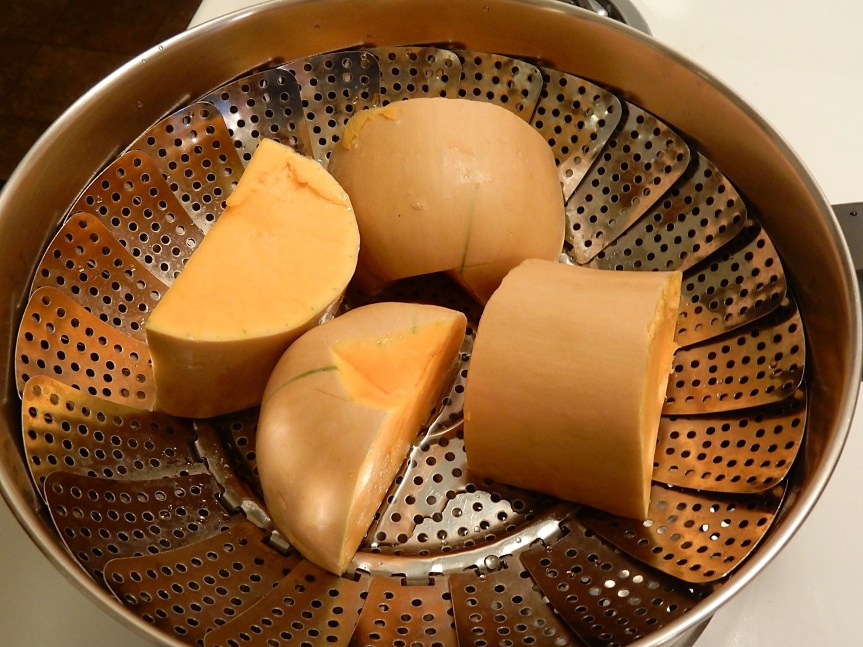
I found this recipe a little difficult to follow, but I interpreted it to mean that fairly large chunks of winter squash that have not been peeled should be put into the steamer. After steaming, the pulp is removed from the squash shell, then mashed.
Since there are no amounts listed in this recipe, I made a judgement about how much of each ingredient to use to make 3-4 servings of the Steamed Squash.
About 1 pound winter squash (I used 1/2 of a butternut squash)
1 tablespoon butter
1/3 teaspoon salt
1/8 teamspoon pepper
1 teaspoon sugar
Cut squash into large chunks (if necessary remove seeds), each about 4 inches across, Do not peel. Put the chunks of squash in a large pan that contains a steamer. Add water to the pan, so that it comes to just below the steamer. Cover pan. Using high heat, bring water to a boil, then reduce heat so the water continues gently boiling. Keep pan covered and steam until the squash is tender (about 20-30 minutes). Remove from heat. Using a spoon scrape the squash pulp from the shell. Put into a mixing bowl and mash. Stir in butter, salt, pepper, and sugar. Put in serving bowl and serve immediately.
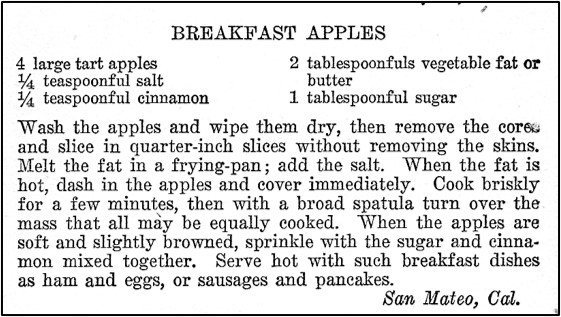
I’m always looking for new recipes for simple, yet tasty ways to serve apples – and I recently found an excellent new (old) recipe. The hundred-year-old recipe was for Breakfast Apples, though they are work equally well at lunch or dinner.
The Breakfast Apples were delightful. Apple slices were sautéed in butter then sprinkled with cinnamon and sugar.
Here’s the original recipe:
Source: Good Housekeeping’s Book of Menus, Recipes, and Household Discoveries (1922)
4 large tart apples (Braeburn, McIntosh, Granny Smith, etc.)
2 tablespoons butter
1/4 teaspoon salt
1/4 teaspoon cinnamon
1 tablespoons sugar
Core and slice the apples (do not peel them). Melt butter in a skillet using medium heat; add salt and stir to combine. Add sliced apples, then put lid on pan. Cook for 5 minutes, then remove lid and use a spatula to turn over the apple slices so they evenly cook on both slides. Put lid back on the pan and cook for another 5 minutes. Remove lid and check to see if the apples are soft. (If they are not soft, cook for several additonal minutes.)
In the meantime, put the cinnamon and sugar in a small bowl, and mix together.
Sprinkle the cooked apples with the cinnamon and sugar mixture. Serve hot.
Some hundred-year-old advertisements are for foods that apparently haven’t stood the test of time. This ad for Ambassador Luncheon Haddies is for canned haddock. I’ve never seen canned haddock at the store – though maybe it was similar to canned tuna.

 Here’s some information in a hundred-year-old cookbook about making cocoa and chocolate. Not quite sure how cocoa differs from chocolate.


 Here’s advice on a “Helpful Hints” page in a hundred-year-old church cookbook for how to cure a nervous headache:
 I’m always looking for new recipes for simple, yet tasty ways to serve apples – and I recently found an excellent new (old) recipe. The hundred-year-old recipe was for Breakfast Apples, though they are work equally well at lunch or dinner.