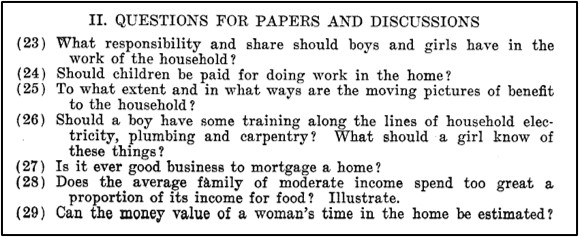
Source: Economics of the Family (1023) by C. W. Taber and Ruth A. Wardall
I’ve been reading a 1923 home economics textbook. It’s fascinating to see the questions for papers and discussion in the book. Some of the questions we still ponder today. (Should children be paid for doing work in the home?) Others are too gender-based for comfort. (Should a boy have some training along the lines of household electricity, plumbing, and carpentry? What should a girl know of these things?)
I hadn’t had Tuna Salad in years, but I was immediately drawn to a Tuna Salad recipe in a hundred-year-old cookbook. The old recipe brought back warm memories of lunches with friends and family where Tuna Salad was a prominent part of the meal.
The recipe did not disappoint. The recipe made a classic tuna salad, and was very quick and easy to make.
Here’s the original recipe:
General Welfare Guild Cook Book (Compiled by the General Welfare Guild, Beaver Valley General Hospital, New Brighton, PA; 1923)
The recipe called for “one small cup chopped celery or cucumber.” When I made the recipe, I assumed that a “small cup” was the equivalent of a 6-ounce tea cup – or about 3/4 cup. I used enough mayonnaise to bind the other ingredients together – about 1/4 cup. And, I skipped the extra mayonnaise garnish.
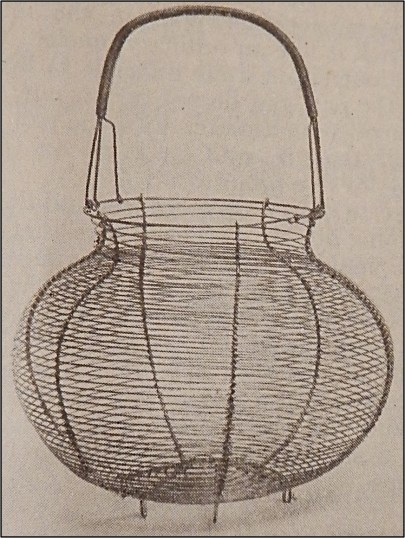
It’s fun to see old-time kitchen gadgets. Here’s what a hundred-year-old magazine said about a lettuce washer featured in an article titled, The Newest Kitchen Utensils:
Lettuce Washer
There are few things more distasteful than a plate of lettuce or romaine or chicory which, no matter how carefully it has been selected, examined or washed, has been so imperfectly dried that the dressing is weakened almost to tastelessness by the water still remaining on the leaves. Yet this happens even in the most carefully administered households, for it is a difficult thing to dry salad plants well without breaking their delicate, tender leaves. This implement, which is a familiar object in all French kitchens, is a salad washer and dryer. The green leaves are rinsed and placed in it, then it is dipped several times in a pan of cold water, and finally it is hung in a cool place where it may drip uninterruptedly. If time presses it may be swung back and forth a few times and all superfluous water will be expelled. Place the basket close to the ice to crisp the salad until serving time.
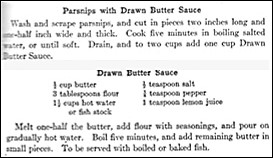
I seem to get into ruts when making vegetables, so am always on the lookout for recipes for some of the less common vegetables. When I saw a recipe for Parsnips with Drawn Butter Sauce in a hundred-year-old cookbook, I decided to give it a try.
The recipe turned out well. The sweet, nutty, earthly parsnips were cut into strips about 2-inches long and cooked, and then embedded in a rich, buttery sauce.
Source: Boston Cooking School Cook Book (1923)
I was surprised that the old recipe for the Drawn Butter Sauce called for water and flour. Today, Drawn Butter is generally just a clarified butter – but apparently it was a thickened butter and water sauce a hundred years ago.
When I made this recipe, I made half a recipe for the drawn butter sauce. I used hot water rather than fish stock. I peeled the parsnips rather than scraping them. (Does anyone scrape parsnips – or carrots for that matter – anymore?)
Peel parsnips and cut into pieces two inches long and 1/2 inch wide. Put in a saucepan, cover with water; add 1 teaspoon salt. Bring to a boil using high heat, then reduce heat and simmer for 5 minutes or until tender.
Melt half of the butter in a saucepan using medium heat; stir in the flour, 1/4 teaspoon salt, and pepper. Gradually add the hot water while stirring constantly. Bring to a boil while continuing to stir, reduce heat and continue to stir while the mixture slowly boils for 5 minutes. Stir in remaining butter and the lemon juice. Immediately remove from heat and pour the sauce over the cooked parsnips. Gently stir to combine.
When I boil potatoes, beans, or other vegetables, I often have issues with the water boiling over. Here’s a household hint in a hundred-year-old cookbook about how to prevent a pan from boiling over:
To Keep the Lid on a Boiling Pot – A teaspoonful of butter dropped into the water in which you are boiling dry beans, or other starchy vegetables will stop the annoyance of having the lid on the pot jump off, as it will otherwise do. The butter acts the same as oil on troubled waters and keeps it calm and manageable.
Cook Book (Published by Bethany Shrine Patrol No. 1, Rochester N.Y., 1923)
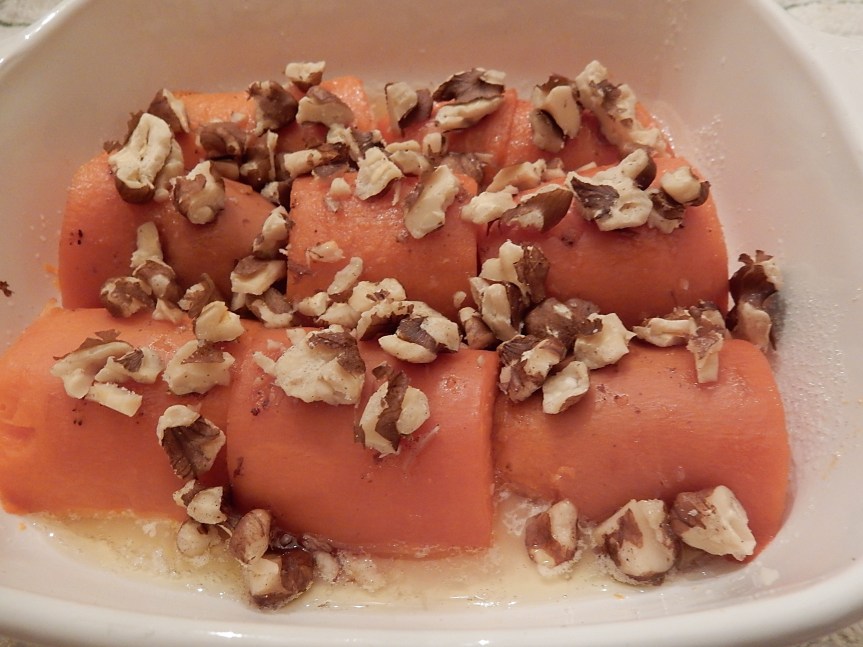
I love the bold, earthy taste of black walnuts – but seldom see them in stores, so I often forage for them. One of my favorite autumn activities is gathering black walnuts, hulling them (oh, what mess!), and then on a cold winter day cracking them to get the nut meats out. I now have a jar of black walnuts in my refrigerator so was excited to see a recipe for Walnuts and Sweet Potatoes that called for black walnuts in a hundred-year-old cookbook.
The recipe was delightful. It called for sugar instead of the usual brown sugar used in sweet potato recipes which allowed the robust taste of the black walnuts to shine.
Here’s the original recipe:
Source: Larkin Housewives’ Cook Book (1923)
This recipe calls for a lot of sweet potatoes (12), so when I updated the recipe I reduced it to 4 sweet potatoes (2 pounds). After all the specificity about the number of sweet potatoes, the recipe was oddly unspecific about the amounts for the other ingredients. So when I updated, the recipe I also added amounts for the other ingredients. And, I changed the name from Walnuts and Sweet Potatoes to Black Walnuts and Sweet Potatoes to better describe the recipe.
2 pounds sweet potatoes (about 4 medium sweet potatoes)
3 tablespoons butter
1/4 cup sugar
1/2 cup black walnuts, coarsely chopped
Wash sweet potatoes and then place in a Dutch oven or other large pan. Cover with water and bring to a boil using high heat. Reduce heat and simmer for 25 minutes or until the sweet potatoes are tender. Remove from heat and let cool enough to handle. Remove skins from the sweet potatoes. They should slip off easily. Then cut the sweet potatoes in quarters and arrange in a shallow baking dish.
In the meantime, preheat oven to 375° F. Dot the sweet potatoes pieces with small pieces of butter, then generously sprinkle with sugar. Top with the chopped black walnuts. Put in oven, and bake until the sweet potatoes are hot, and the sugar is melted and bubbly.
Sometimes hundred-year-old advertisements work for me; other times they don’t. I’m still trying to decide whether the phrase “Costs more – Worth it!” makes me want to buy Occident Flour.




 When I boil potatoes, beans, or other vegetables, I often have issues with the water boiling over. Here’s a household hint in a hundred-year-old cookbook about how to prevent a pan from boiling over: