Lingering in Cool, Shady Nooks

16-year-old Helena Muffly wrote exactly 100 years ago today: 

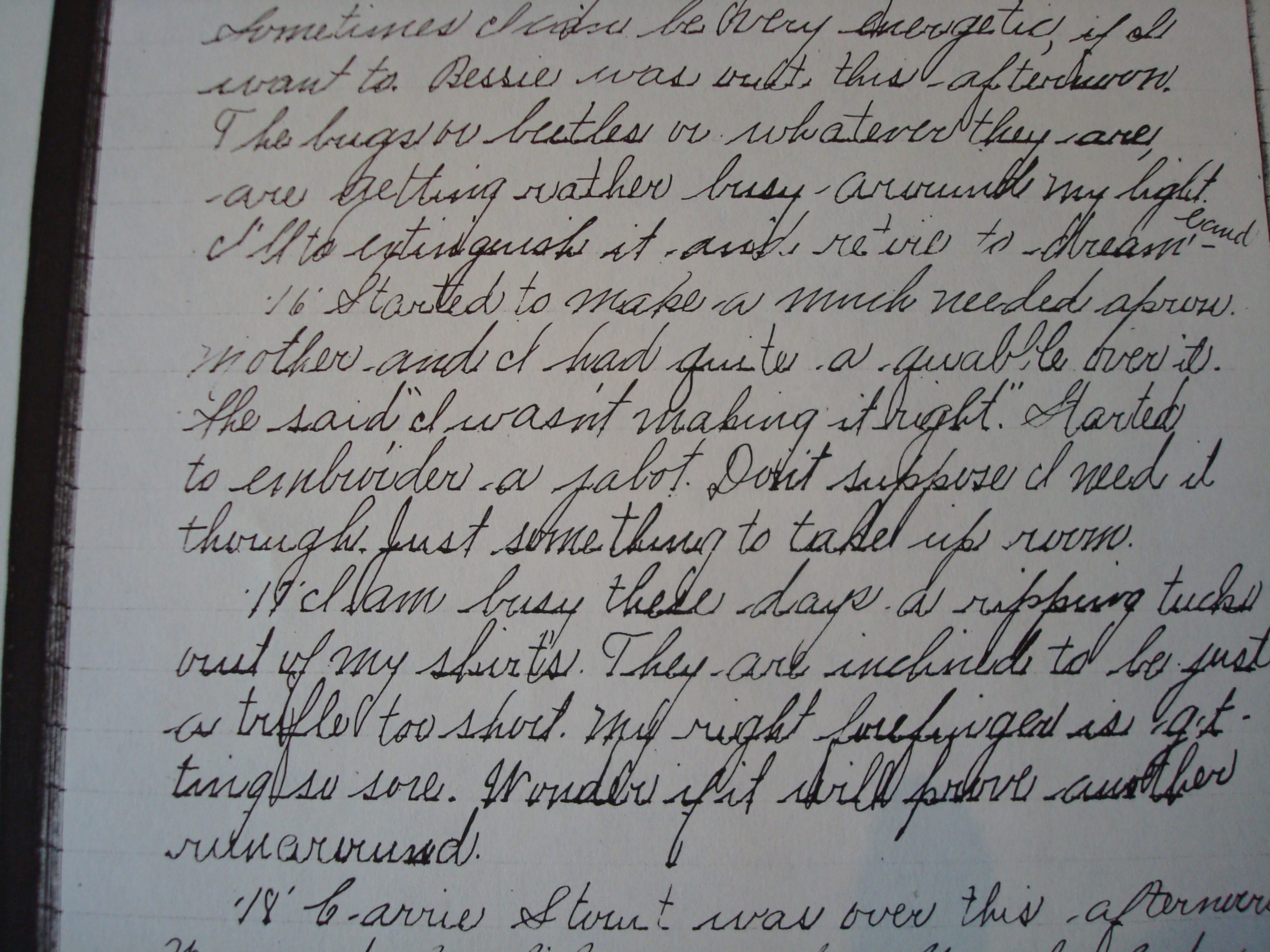
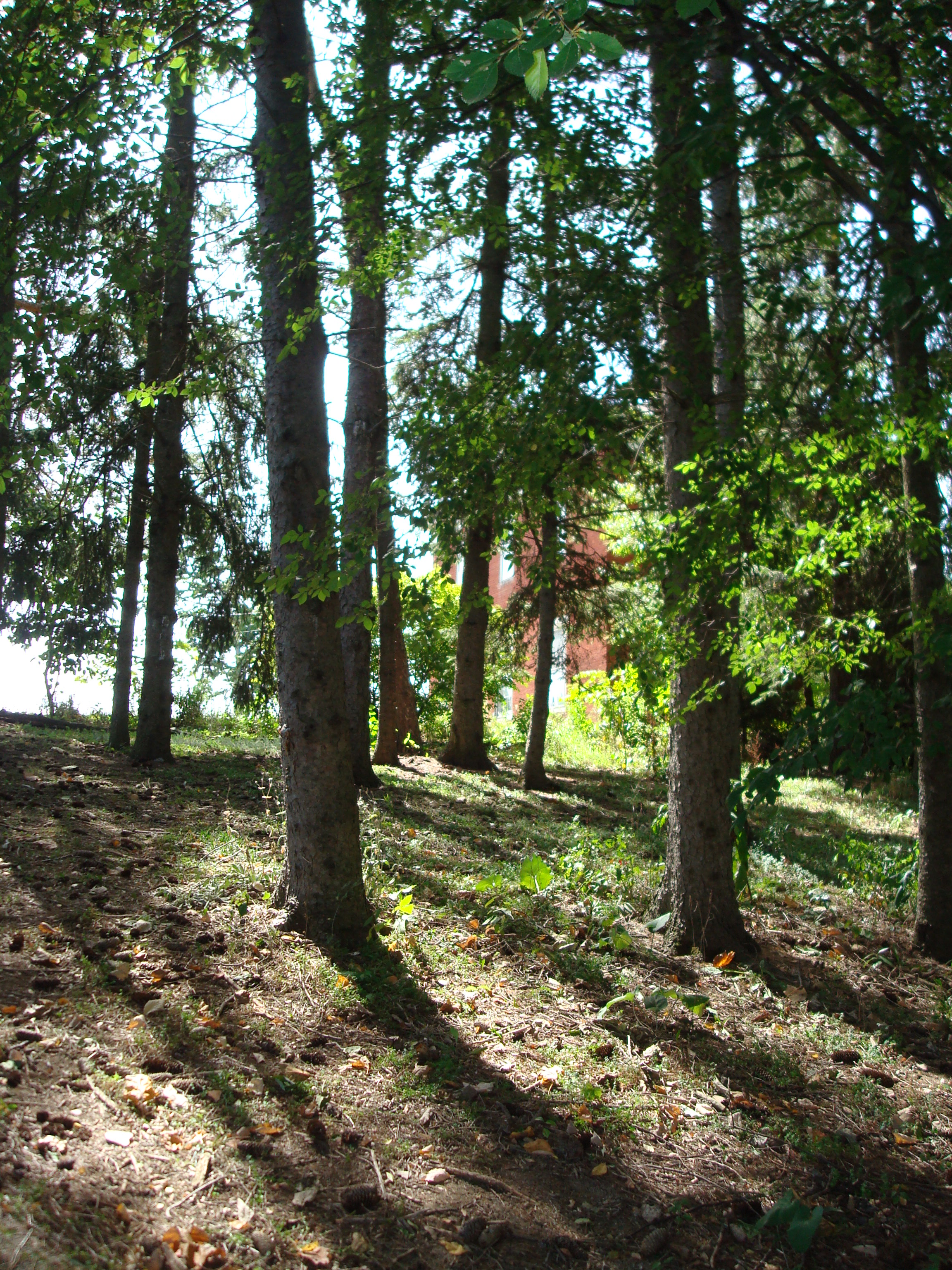
Tuesday, May 23, 1911: It was most too hot today any work today, so I lingered around in cool shady nooks so that I might not become overheated.
Her middle-aged granddaughter’s comments 100 years later:

It probably was hotter on May 23, 1911 in McEwensville than it is today. Weather Underground’s forecast for today (May 23, 2011) for McEwensville is for a high of 76 degrees with a 50% chance of thunderstorms.

The May 23, 1911 issue of the New York Times contained an article about the unseasonably hot weather in Pittsburgh, Pennsylvania on the previous day. Since Pittsburgh is about 150 miles west of McEwensville—similar weather patterns were probably seen on the 23rd in central Pennsylvania.

The New York Times article said:

PITTSBURG, May 22.—The stretch of two weeks of torrid heat was broken in Pittsburg at 6 o’clock tonight, when an electrical storm brought relief after the official thermometer had registered 92 degrees late this afternoon for the third successive day.

The record of continuous maximum temperature for all months for five years was broken, and all records known, extending forty years back for May heat are shattered.

The thirtieth death from heat in four days was reported this afternoon when Gustave Yenney, a jeweler, dropped dead in the Criminal Court room, the third person to topple over in the same court since last Friday, though the other two courtroom victims are recovering. Following the fatality, two branches of court adjourned to await cooler weather. Business offices all over the city closed for the afternoon.

It’s interesting how offices closed due to hot weather before the advent of air conditioning. I guess that back in those slower times there were both “snow days” and “heat days”.

An aside—Note that prior to World War I Pittsburgh was spelled without an h at the end—i.e., Pittsburg. During the War the h was added to make the name look less German.

The Location of the Old McEwensville Baptist Church

16-year-old Helena Muffly wrote exactly 100 years ago today: 

Monday, May 22, 1911: Never have I felt less inclined to write in this diary than I do tonight.

The old McEwensville Baptist Church probably was located somewhere on the lot that currently contains this yard and white house.

Her middle-aged granddaughter’s comments 100 years later:

Since Grandma didn’t have much to say a hundred years ago today, I’m going to partially resolve one of the mysteries that I’ve been grappling with.  Many of these mysteries are about minor things (and I keep telling myself they don’t really matter in the bigger scheme of things)—yet it’s always fun to resolve one of them.

The mystery that I’ve resolved (with Uncle Carl’s help) is the location of the old Baptist Church in McEwensville.

I think that Grandma attended the Baptist Church (see February 5 entry), but since the building was torn down many years ago I wasn’t even sure where in McEwensville the church had been located.

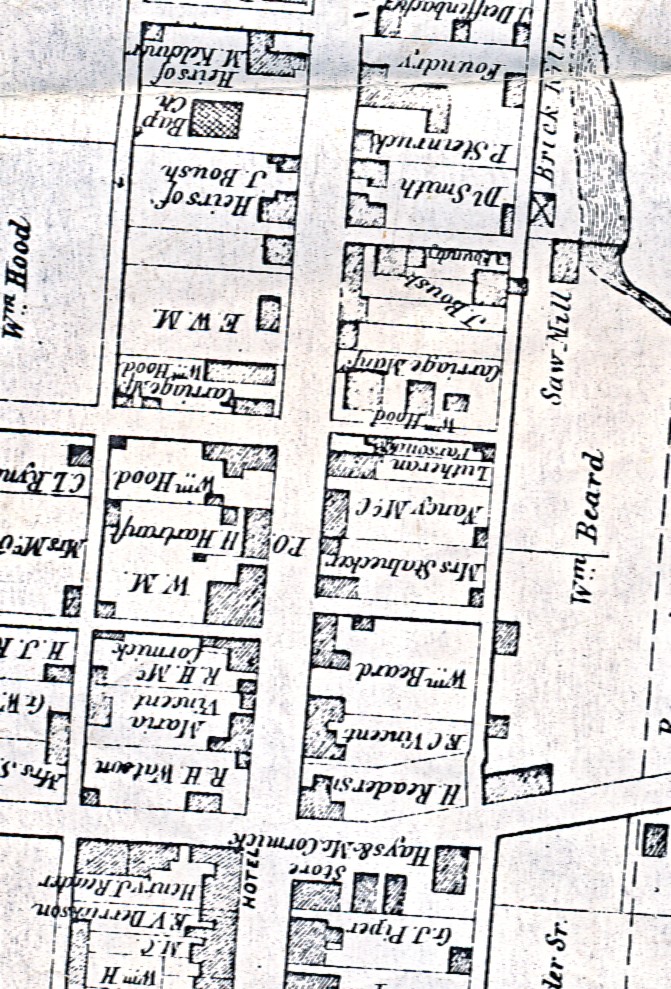
The Baptist Church is located near the top of the map on the lefthand side.

Uncle Carl recently loaned me a copy of an 1858 map of McEwensville that had the Baptist Church on it. The church was located on the east side of Main Street a little to the north of where the old road from Watsontown entered town. We assume that the building location on the map probably was the same in 1911.

I’ve updated the map on the Setting page to reflect the correct location.

An aside—It’s really cool how the old map lists all of the property owner’s names. Also, note how in the mid-1800s the very small streamlet that runs along the west side of the northern part of McEwensville had been dammed to provide water for a saw mill.

Old-fashioned Chocolate Almond Drop Cookies

16-year-old Helena Muffly wrote exactly 100 years ago today: 

Sunday, May 21, 1911: Went to Sunday school this afternoon. The whole Stout family was over this evening. Wormed the results of that letter out of Carrie.

Her middle-aged granddaughter’s comments 100 years later:

This entry describes one of the really nice characteristics of rural life—neighbors just dropping by to visit.  One hundred years ago, on warm spring evenings neighbors probably often gathered to chat about the weather, share the local news, or talk about …. well, just whatever. Long-term friendships were formed over the years—and people would discuss anything and everything.

The adults may have sat around the kitchen table —while the young folks wandered off for their own discussions.  Cookies or other refreshments may have been served. A small cookbook published in 1911 to advertise KC Baking Powder contained this recipe for chocolate almond drop cookies:

K C Almond Drop Cookies

2 eggs, beaten light

1 cup sugar

2 ounces chocolate melted

1 ½ cups blanched almonds, chopped

1 teaspoonful vanilla extract

1 cup flour

1 level teaspoonful K C Baking Powder

½ teaspoonful each, salt and cinnamon

Sift together, three times, the flour, salt, cinnamon, and baking powder. To the eggs add the sugar, chocolate, almonds, extract, and lastly the flour mixture. Drop by teaspoonfuls upon a buttered baking pan. Bake in a moderate oven. This recipe makes about three dozen little cakes.

The Cook’s Book (KC Baking Powder,1911)

When I tried this recipe, I heated the oven to 375 degrees and baked the cookies for about 12-14 minutes. I didn’t sift the flour—and I used unsweetened chocolate, sliced almonds, and a different brand of baking powder. I was surprised that the recipe didn’t call for any butter or other shortening.

The cookies are tasty with a slight hint of cinnamon, and the recipe is definitely a keeper.

Planting Popcorn

16-year-old Helena Muffly wrote exactly 100 years ago today: 

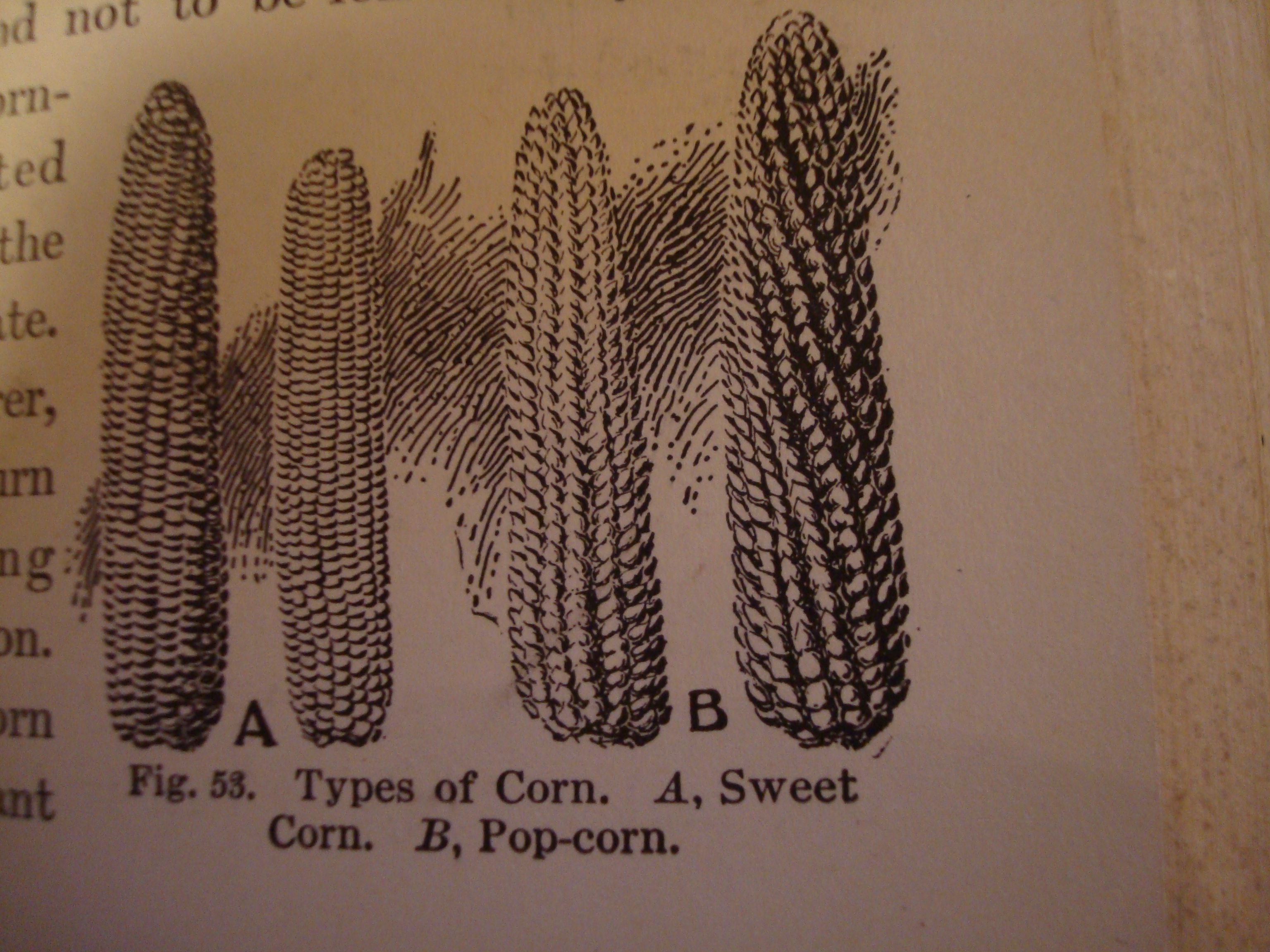
Saturday, May 20, 1911: Oh psh aw, this is hardly worth writing. I planted some popcorn this morning, and was kept busy nearly all afternoon.

Photo source: How to Grow Vegetables (1911)

Her middle-aged granddaughter’s comments 100 years later:

A 1911  book called How to Grow Vegetables by Allen French describes how popcorn (and sweetcorn) were grown a hundred years ago.  The book says that the same methods were used for both types of corn. According to the book :

Being very tender it is not planted till all danger of frost is over. The warmest and “quickest” of all soils should be chosen. The ground should be rich, and well supplied with quickly available fertilizers.

 Sow— If the ground is cold or wet, sow thickly in the rows.

 Thin—Twelve to eighteen inches apart, according to height of variety.

Culture—Preserve the surface mulch, and keep down the weeds.

Fertilizer—Any good general fertilizer, liberally applied, as corn is an exhaustive crop; should be rich in nitrogen for a sandy soil. Dress once with nitrate of soda or liquid manure when the plants are up.

Planting Potatoes

16-year-old Helena Muffly wrote exactly 100 years ago today: 

Friday, May 19, 1911:  I had to drop potatoes this afternoon. I’m so glad it only comes once in a year. I got so fatigued, but that isn’t rare.

Her middle-aged granddaughter’s comments 100 years later:

A hundred years ago potatoes were a winter staple, so the family probably planted lots of potatoes. Also, many families raised more potatoes than they needed so they could sell the excess to people living in nearby towns. No wonder Grandma was tired after dropping (planting) seed potato pieces in the furrows.

A 1911 book by Allen French called How to Grow Vegetables explains how potatoes were planted when Grandma was young:

The seed piece—It has been proven that the size of the piece rather than the number of eyes on it, is of importance in giving good results.  . . . All pieces should be chunky and not thin; pieces the size of hens’ eggs are proper, weighing about three ounces. If they have to be stored after cutting, keep them in a cool place with wet clothes laid over the box to keep them from wilting.

Cutting Potato Seed Pieces

Distances—Rows apart, for hand culture, twenty-four to thirty inches; for horse culture, three feet or more. Plant in the row, twelve to eighteen inches apart; the richer the soil and the better prepared the closer they may stand. . . Distances are also a matter of variety: plant strong-growing or large-yielding kinds farther apart.

Depth—In heavy clayey soils three inches may be allowed. But generally speaking, it is not wise to plant less than four inches deep; if planted shallower the tubers may be sunburnt.

Culture–Cultivate once or twice before the potatoes break ground, to kill the weeds and preserve the mulch. . . The early cultivations may be deep, but once the plants are growing well, cultivation should be shallow on account of the surface-feeding roots.

Fertilizer—The soil should be rich. Humus, if supplied in the year the potatoes are grown, may come from good compost or very well-rotted manure. If fresh, the manure may cause scab. For safety, the manure is best supplied in the fall, and ploughed in; or it could be heavily fed to the previous crop. Or in farm operations green manure (leguminous crops), ploughed in, will both give humus and help to open up the subsoil. Chemical fertilizers may previously be applied at the rate of about fifteen hundred pounds per acre.

Gathering Lilacs

16-year-old Helena Muffly wrote exactly 100 years ago today: 

Thursday, May 18, 1911:  Carrie Stout was over this afternoon. We went for lilacs and after she had a big bouquet, she became afraid of the bumble bees.

Her middle-aged granddaughter’s comments 100 years later:

Sounds like two friends having fun on a pleasant spring day while doing simple things together—gathering lilacs while goofing around as they worried about bumble bees. Ah, the joys of being young and carefree.

Remodeling Clothes

16-year-old Helena Muffly wrote exactly 100 years ago today: 

Wednesday, May 17, 1911: I am busy these days ripping tucks out of my skirts. They are inclined to be just a trifle too short. My right forefinger is getting so sore. Wonder if it will prove another runaround. 

Her middle-aged granddaughter’s comments 100 years later:

I wonder why the skirts didn’t fit right. Had Grandma gained a little weight?—or maybe styles were a little longer than they’d been the previous spring? A hundred years ago clothes were worn until they wore out, yet they remained stylish because they were regularly remade.

Today we buy new clothes each season in the latest colors and styles. Our closets are stuffed to the gills with seldom worn clothes from last year and the year before.

I’m annoyed with myself when I buy a new brown pencil skirt because my navy pleated skirt is hopelessly out of style—yet I won’t be caught dead wearing the pleated skirt. Sometimes I long for the good old days when clothes were regularly remodeled (though I’m all thumbs when it comes to sewing).

A book published by the Butterick Company in 1911 called The Dressmaker: A Complete Book on All Matters Connected with Sewing and Dressmaking from the Simplest Stitches to the Cutting, Making, Altering, Mending and Caring for the Clothes has a chapter on remodeling clothes:

Nothing accumulates so fast in every household as half-worn clothing, and the dead capital that it represents is apt to make the thoughtful ones draw a deep breath.  . .

One ought, at the very beginning of each season, to set to work to take a critical survey of last year’s wardrobe. It is the easiest way to find out exactly what new clothes are needed and exactly how far one can go with the old ones. Coats, suits, and dresses that are still in sound physical condition, but which have grown out of style, should be remade. The remodeling of a pair of sleeves, the recutting of a skirt, will almost always give a new lease of life to a suit.

Decide first what clothes are worth remaking. When the materials are badly worn it is hardly worth while going to any amount of trouble in the way of renovations. But when the material is sound and whole it is little short of criminal not to take advantage of the possibilities. . . .