
A Jabot

16-year-old Helena Muffly wrote exactly 100 years ago today: 

Tuesday, May 16, 1911: Started to make a much needed apron. Mother and I had quite a squabble over it. She said I wasn’t making it right. Started to embroider a jabot. Don’t suppose I need it though. Just something to take up room.

Jabot

Her middle-aged granddaughter’s comments 100 years later:

A jabot is a decorative ruffle on the front of a shirt or dress. A hundred years ago they were considered a stylish accessory.  Currently female supreme court judges often wear them.

And, today I learned how to pronounce a new word. Jabot is pronounced zhab-oh or jab-oh  I was telling my son that I needed to write an entry about  jabots–and we ended up discussing how to pronounce it. I had pronounced it “ja-bot.” But according to the dictionary the “t”  is silent.

I wonder what Grandma was doing incorrectly when she was making the apron. Old-time apron directions are in a previous post.
The Break-up of Standard Oil

16-year-old Helena Muffly wrote exactly 100 years ago today: 

Monday, May 15, 1911:  I was so very busy this forenoon. Sometimes I can be very energetic, if I want to. Bessie was out this afternoon.

Her middle-aged granddaughter’s comments 100 years later:

Grandma probably was unaware of a major event that occurred on this date a hundred years ago.  If you look in a history book, there generally are two events mentioned that occurred in 1911—one was the Triangle Shirtwaist Factory fire and the other was the U.S. Supreme Court decision that broke up Standard Oil.

The Court ruled a hundred years ago today that Standard Oil was a monopoly and that it must be broken up because it violated the Sherman Anti-trust Act.

John Rockefeller founded—and then led Standard Oil as it grew into one of the largest firms in the nation. According to Wikipedia, in 1904 Standard Oil controlled 91% of oil production and 85% of final sales in the US.

Investigative journalists called muckrakers highlighted the problems and inequities caused by monopolies, corporate greed, and the robber barons.

Rockefeller and his associates did not build the Standard Oil Co. in the board rooms of Wall Street banks. They fought their way to control by rebate and drawback, bribe and blackmail, espionage and price cutting.

Ida Turnball

The Supreme Court decision symbolized the end of the robber baron era in the US.

Mothers Day

16-year-old Helena Muffly wrote exactly 100 years ago today: 

Sunday, May 14, 1911:   Went to Sunday school this morning. I went over to Stout’s this afternoon. Carrie and I were going to take a walk and visit some other girls. Just as I expected we didn’t do. What a shame.

 Her middle-aged granddaughter’s comments 100 years later:

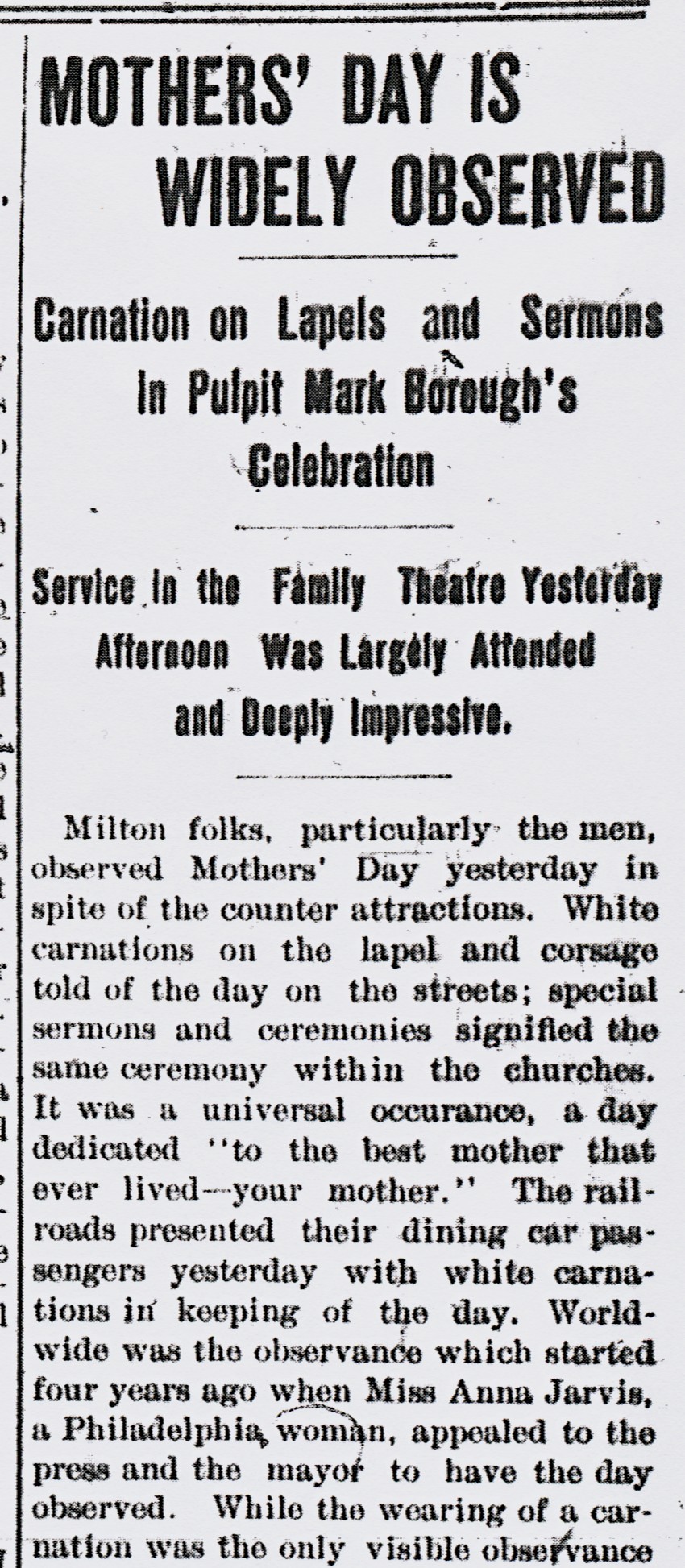
Article in Milton Evening Standard, May 15, 1911

This date was Mothers Day a hundred years ago. I wonder if the Muffly family celebrated it. The holiday had been founded only four years previously—yet people in central Pennsylvania apparently were aware of Mothers Day since there was an article about it in the May 13, 1911 issue of the Milton Evening Standard.

The article discussed how people should wear a white flower if their mother was deceased; and a colored flower if their mother was living. I wonder if anyone still does that. I know that the white and colored flower tradition lasted at least until the 1960s.

When I was a child I can remember going out into the garden before church on Mothers Day to pick a colored flower that I’d pin on my dress.

When I’d get to church most of the other women and girls would be wearing flowers (as well as a few men wearing boutonnieres). I can remember sitting in the pew during the church service and being surprised how many of the adults wore white flowers.

No Dentist (Again), So Onward to the Bijou Dream Theater

16-year-old Helena Muffly wrote exactly 100 years ago today: 

Saturday, May 13, 1911: I went to Milton this afternoon to get my teeth filled, but it happened to be a wild goose chase, for he wasn’t there. I walked around town until I was tired, then went into Bijou Dream. I’m so very tired now. Oh, dear.

Advertising Ruler from Bijou Dream Theater (Source: Milton Historical Society)

Her middle-aged granddaughter’s comments 100 years later:

Grandma’s not having much luck getting her tooth filled. This is the second time that she went to Milton to see the dentist, but he wasn’t there (see the May 6 entry); and she’s been complaining on and off about a toothache since mid-April (see April 11, April 15, and April 18 entries). I can’t imagine this kind of delay in treating a toothache today—I guess some things are definitely better now.

But at least Grandma got to go to the movies at the Bijou Dream two Saturday’s in a row.  The  previous week when she tried unsuccessfully to go to the dentist was also a Saturday—and that time she also ended up going to the Bijou Dream. Now that I think about it, I wonder if the fact that she kept trying to go to the dentist on a Saturday was at least part of the reason that she had difficulty finding him in his office.

Photo of Bijou Dream Theater in book called Milton 1909 that was published by the Milton Evening Standard (Source: Milton Historical Society).

George Venios has the photo of the Bijou Dream Theater in his book, Milton Chronicles and Legends. His caption says:

 The entrance to the Bijou Dream Theater, which was located on Broadway at the same site as the Capitol. It was a converted livery stable. On hot summer days, the unmistakable smell of the stable would return.

Turbotville High School Commencement

16-year-old Helena Muffly wrote exactly 100 years ago today: 

Friday, May 12, 1911: Just about the same things which I did yesterday. Ruth went up to Turbotville this evening to attend the commencement. I’ll surely have some peace tonight because she won’t be here to disturb it.

Recent photo of Turbotville Community Hall. The commencement probably was held here.

Her middle-aged granddaughter’s comments 100 years later:

I’m surprised that the school year apparently was more than a month longer in the neighboring town of Turbotville than it was in McEwensville.

McEwensville High School  had held it’s commencement on April 6. That day was also the last school day. In general the school year was very short a hundred years ago since children were needed at home during the spring planting season—but it sure seems like the school year was exceptionally short in McEwensville.  I wonder what the community thought about this—Did they worry that their children might be learning less than students in neighboring communities? Or were they glad school ended early so their kids could help with the farm chores?

Despised and Disagreeable

16-year-old Helena Muffly wrote exactly 100 years ago today: 

Thursday, May 11, 1911:  It is quite unnecessary to state what I did today, nor would it prove a bit interesting for it is just the same hum-drum duties that we pass through every day. Ruth told me this evening that it was no wonder that everybody despised me, I was so disagreeable.

Her middle-aged granddaughter’s comments 100 years later:

What caused Grandma’s sister Ruth to tell her that she was disagreeable and that everyone despised her? I’m sure Grandma said something very annoying or maybe even nasty—but from the entry it’s also obvious that Ruth’s retort hurt and that Grandma worried about what others thought of her.

Carrying Water for Mortar

16-year-old Helena Muffly wrote exactly 100 years ago today: 

Wednesday, May 10, 1911: I did about half of the ironing this morning. I don’t call that very much of a suit do you? This afternoon I had to carry water to be used in making mortar and spilt waters on my skirts.

Summer 2010 photo of the farm where Grandma lived when she was writing this diary.

 Her middle-aged granddaughter’s comments 100 years later:

Why was the family making mortar? Does Grandma mean they were making cement—or mortar to be used when bricks were laid?

I think she probably was referring to cement. I picture that the path between the house and barn was just a dirt path and that it probably was sometimes muddy. Maybe they were laying a sidewalk.

Or, maybe they were making a cement floor for the barnyard. Until I saw this entry I never thought about the barnyard—now I’m wondering whether the floor was dirt or cement. . . . Or. . . .