Hundred-Year-Old Alarm Clock Ad

16-year-old Helena Muffly wrote exactly 100 years ago today: 

Monday, December 4, 1911: Pa took us to school this morning. Such a time as I had waiting on him, but we got there in plenty of time. You see our old clock was the cause of it all, being over half an hr. fast.   

Her middle-aged granddaughter’s comments 100 years later:

Maybe the family needed to get a Big Ben clock for Christmas. The December 15, 1911 issue of Kimball’s’ Dairy Farmer magazine had an alarm clock advertisement.

The ad text says:

Big Ben

Merry Christmas! Here is Big Ben.

May he wish you many of them!

Don’t waste a minute of this merry day. Have the presents ready Christmas eve. Hang each stocking up. Arrange the presents that won’t go inside in little piles around each stocking.

Then when all have gone to sleep, sneak into each bedroom a joy-faced Big Ben.

He’ll ring the merriest Christmas bell you have ever heard and get the family down to see the presents bright and early so the whole day will be yours to fully enjoy.

Big Ben is a gift worth the giving, for he is a clock that lasts and serves you daily year after year.

He is not merely an alarm clock—he’s an efficient timepiece—to get you up or to tell you the time all day—a clock for bedroom, parlor, library or hall.

Big Ben stands seven inches tall. He’s massive, well poised, triple plated. His face is frank, open, easy to read—his keys large, strong, easy to wind.

He calls you every day at any time you say, steadily for ten minutes, or at repeated intervals for fifteen.

He is sold by jewelers only—the price is $2.50 anywhere.

If you cannot find him at your jeweler’s, a money order sent to his designers, Westclox, La Salle, Illinois, will bring him to you express charges paid.
Had to Walk Home in the Snow

16-year-old Helena Muffly wrote exactly 100 years ago today: 

Sunday, December 3, 1911: Went to Sunday School this afternoon. Coming home it was snowing and I was rather dubious as to whether my new hat would take it all right or not, but it did.

Source: National Climatic Data Center

Her middle-aged granddaughter’s comments 100 years later:

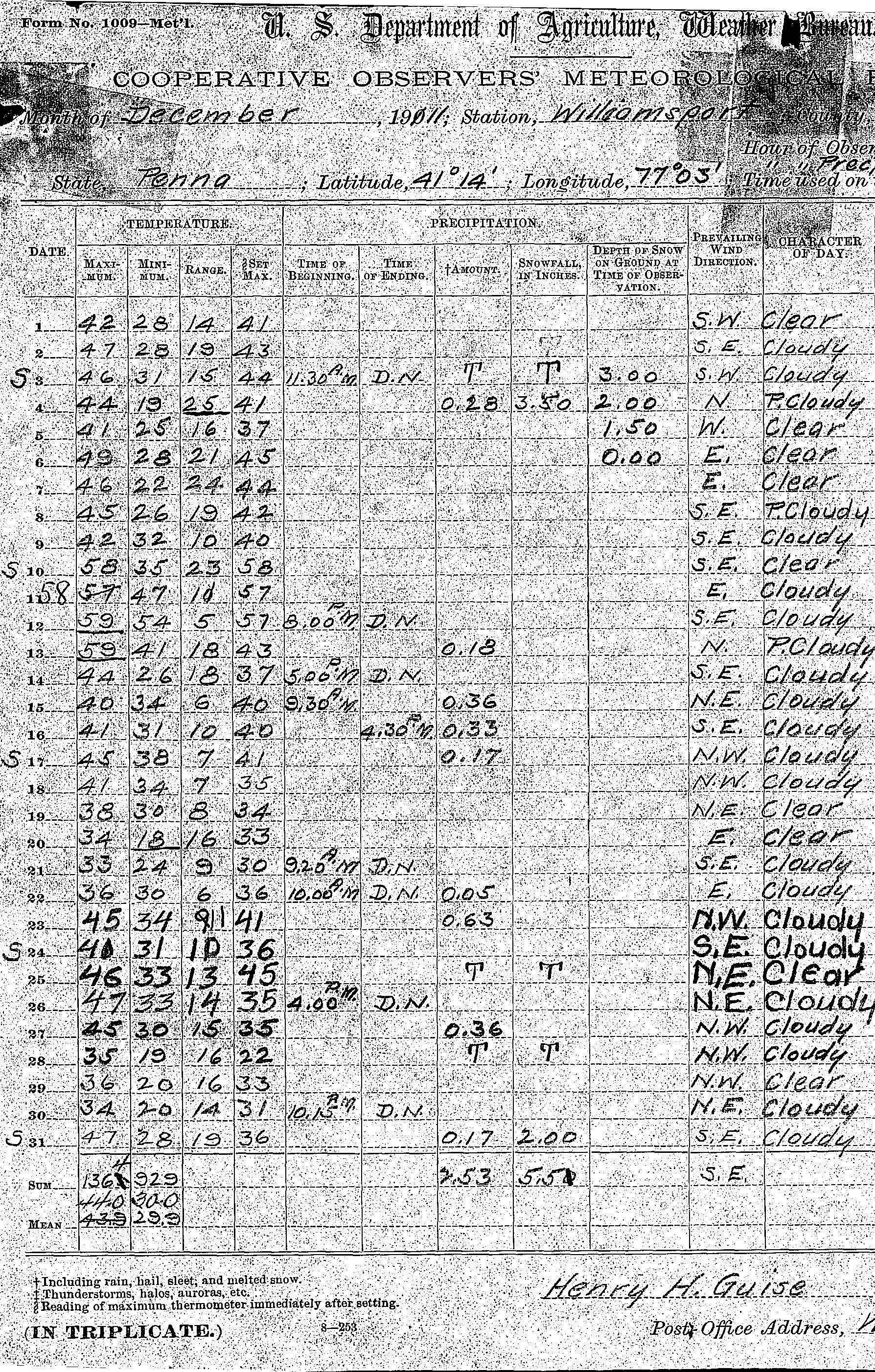
It sounds like a blustery winter day. I found the weather data for December, 1911 for Williamsport, Pennsylvania on the National Climatic Data Center website.

Williamsport is about 20 miles northwest of McEwensville. According to the observation sheet, on December 3, 1911 the high was 46 degrees and the low was 31. It also indicated that there was a trace of snow  and that the wind was coming from the southwest.

The sheet said that there was 3 inches of snow on the ground—which seems somewhat surprising because the previous day’s entry did not indicate any snow on the ground.

Williamsport is across a mountain from McEwensville—so maybe the weather wasn’t as bad there as it was where Grandma was walking. But I wouldn’t expect there to be major differences in the weather between the two towns (and in general I think that it would be a little warmer in McEwenville).

I suppose that it really was just a raw day with some snow flurries—but that the mile or so walk between the church in McEwensville and the Muffly farm was pretty miserable (especially if you were worried that your new hat might get ruined).

100-Year-Old Peanut Cookie Recipe

16-year-old Helena Muffly wrote exactly 100 years ago today: 

Saturday, December 2, 1911: Saturdays are so cut and dried, when no one comes to see you, especially when one is having a short vacation. I made some cookies this afternoon, the first time I really did it alone. They got rather hard on account of having too much flour in them. Anyway they proved to be eatable.

Peanut Cookies

Her middle-aged granddaughter’s comments 100 years later:

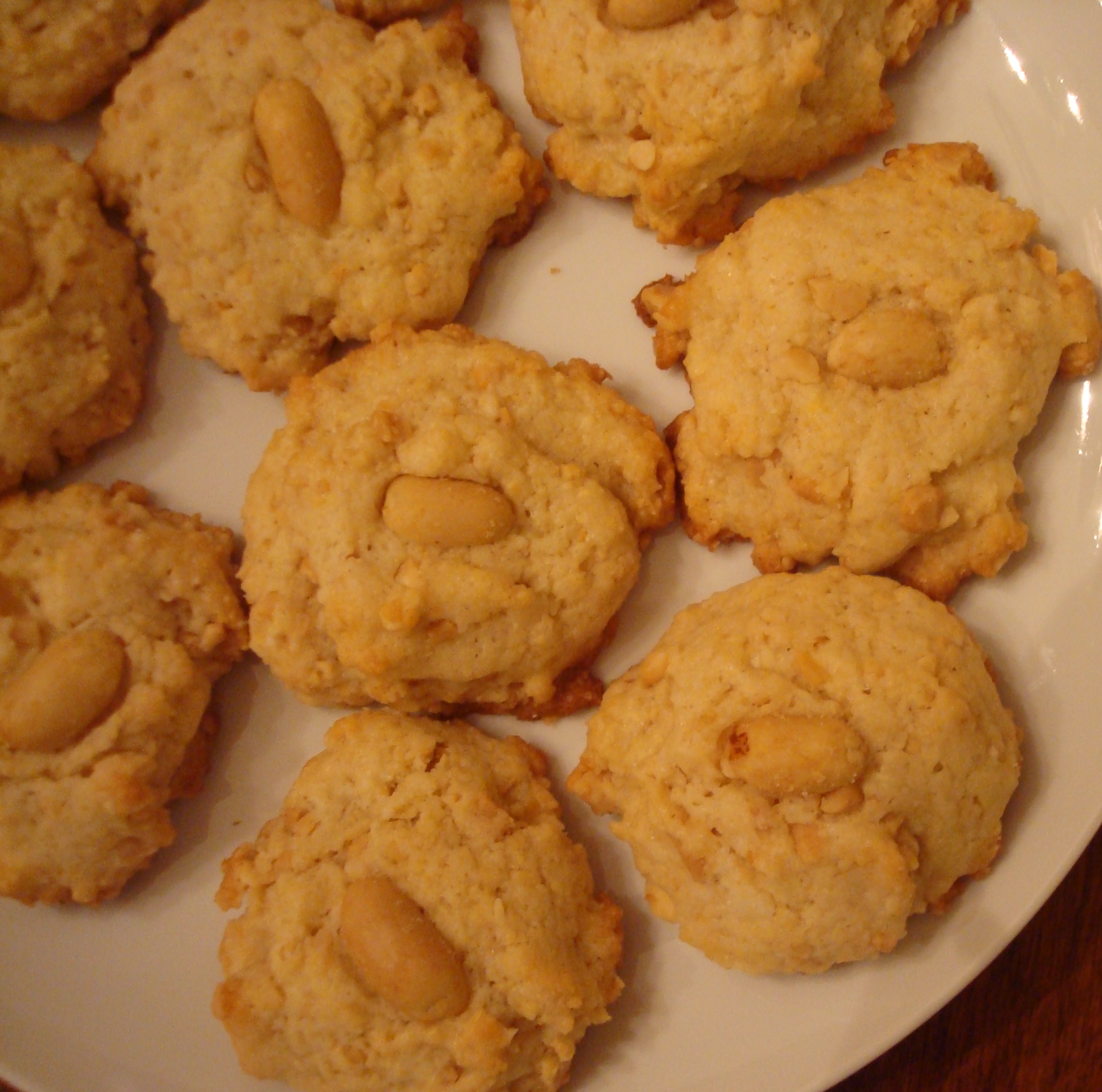
I wonder what kind of cookies Grandma made. A small cookbook published in 1911 to advertise KC Baking Powder contained this recipe for Peanut Cookies:

Peanut Cookies

1/4 cup butter

1/2  cup sugar

1 egg

2 tablespoonsful milk

1/4 teaspoonful salt

1 cup flour

1 level teaspoonful  KC Baking Powder [other brands work fine]

3/4 cup shelled peanuts

Sift together, three times, the flour, salt and baking powder. Cream the butter; add sugar, egg, milk, the flour mixture, and lastly, the peanuts, chopped and pounded fine in a mortar. Drop on a buttered tin, a teaspoonful in a place. Put half a nut meat on each bit of dough. Bake in a moderate oven.

These cookies are excellent with a delightful peanut taste. I plan to make them again when I do my holiday baking.

For this recipe I used a 375 degree oven. I dropped the batter on a greased cookie sheet, and baked the cookies until lightly browned (about 10 minutes).

I did not sift the flour and other dry ingredients. And, instead of using a mortar to pound the nuts–whew, cooking sounds like more work in the days before electric appliances–, I ground them in a blender.

Aprons a Hundred Years Ago

16-year-old Helena Muffly wrote exactly 100 years ago today: 

Friday, December 1, 1911:

The dying year around us a glory sheds

December with her pleasures breaks upon the scene,

Around our hearts a happy gladness lies

Christmas is coming with her laurels of green.

Didn’t have school today. Had a notion to go a visiting, but then didn’t, as I had some particular work, which I wanted done. Well, as Thanksgiving is over, I am looking forward to Christmas, hoping some pleasant surprises awaits me. Vice versa of Jan. 31.

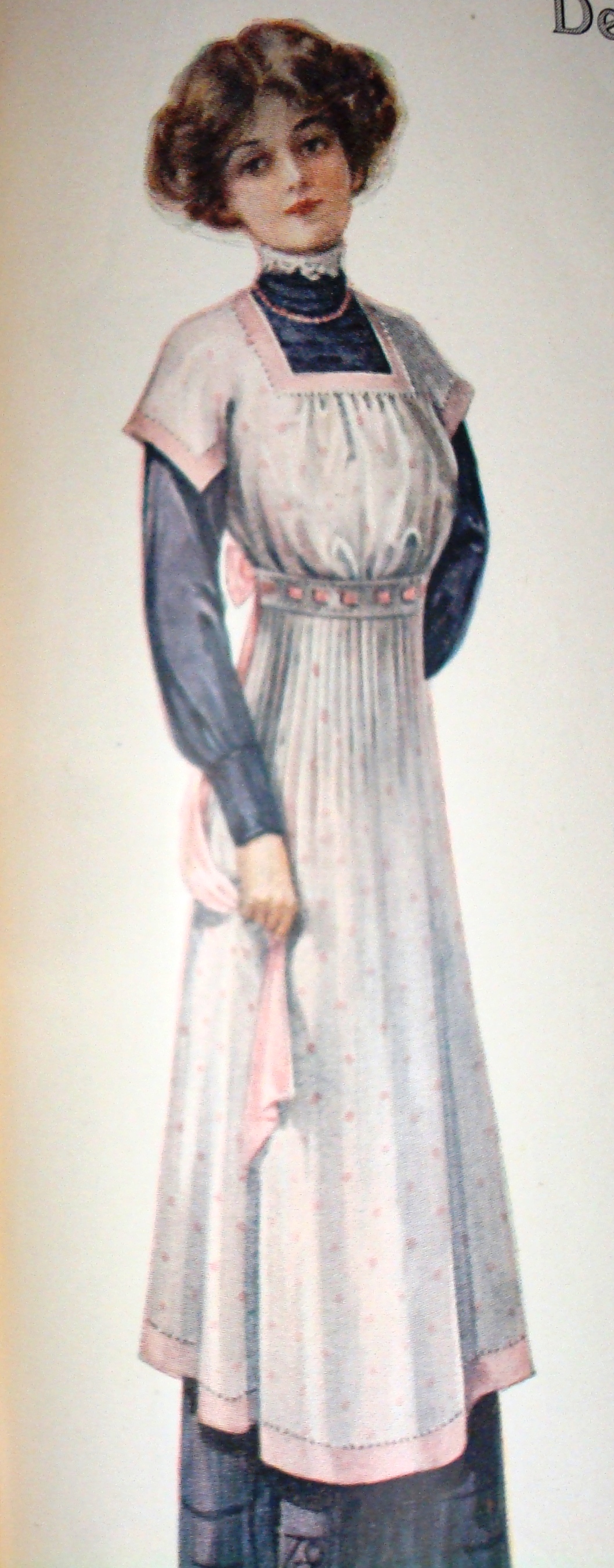
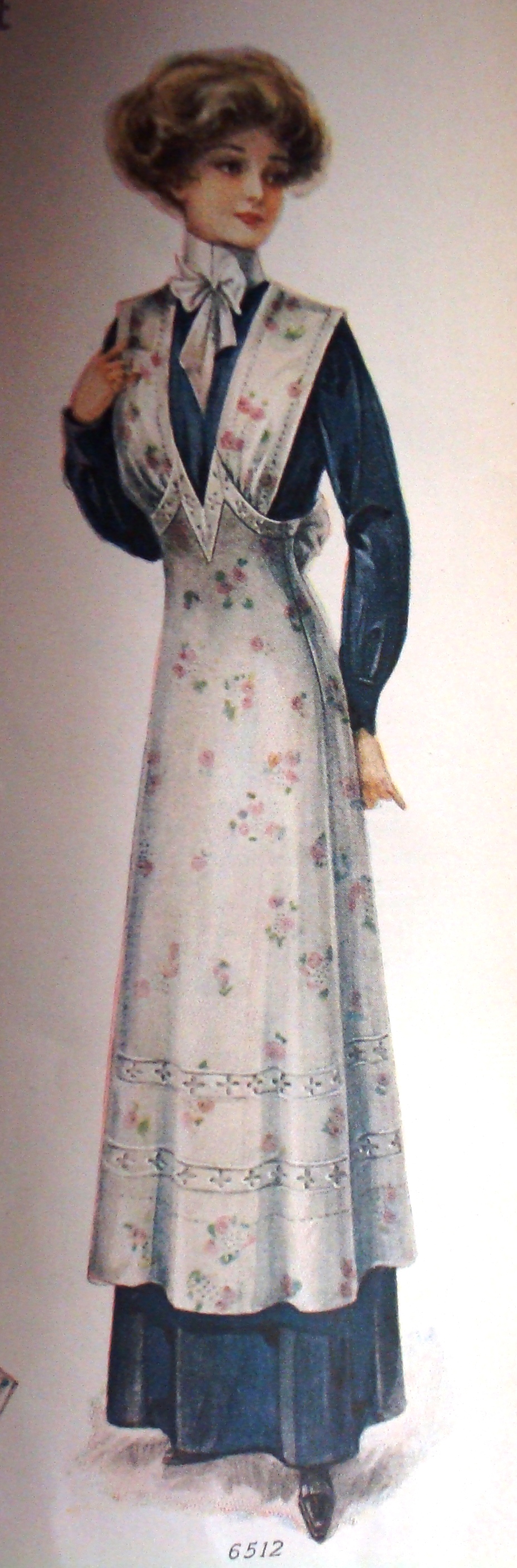
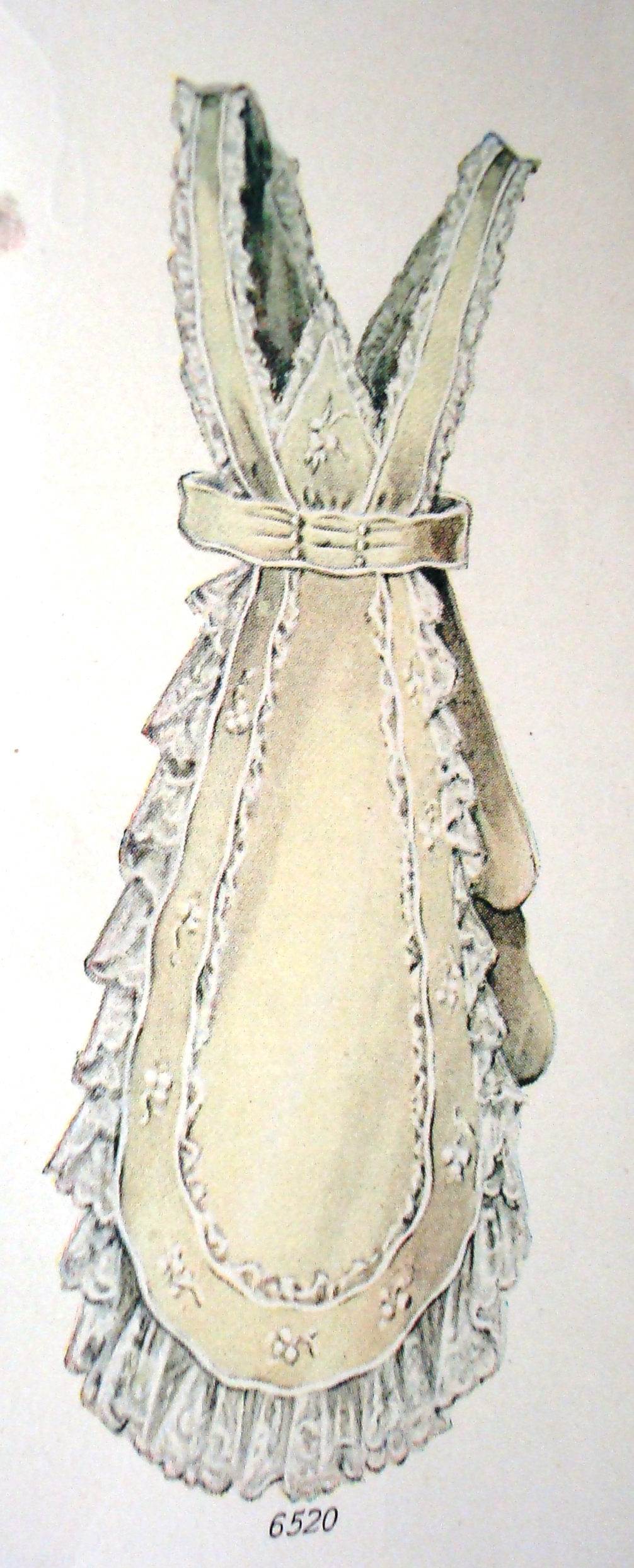
Source of Photos: Ladies Home Journal (December, 1911)

Her middle-aged granddaughter’s comments 100 years later:

I wonder if Grandma was planning to make any gifts for family or friends. If she wanted to make aprons, she could have ordered patterns from Ladies Home Journal.

According to a December, 1911 article called the “The Pretty Christmas Apron:”

Odds and ends of the piece-bag and remnants from the bargain counter may be utilized to make these pretty aprons.

Hundred-Year-Old Pictures of Embroidered Collars and Jabots

16-year-old Helena Muffly wrote exactly 100 years ago today: 

Thursday, November 30, 1911: Today is Thanksgiving. We didn’t have such a terrible sumptuous repast either. I would have liked to have had a piece of a turkey gobbler and a dish of ice cream, but we were far from that. I sat at home all day doing miscellaneous jobs which I didn’t relish any too well. Rufus went up to McEwensville this afternoon, to get some of her ever-increasing finery made which she is going to glow in at the institute. One is a piece of embroidery which I presented to her last Christmas but as she at that time was too poor to buy the material to finish it and most too indolent to make it even if she had it. It has lain unmolested till today. There! I’ve filled up the remainder of this page.

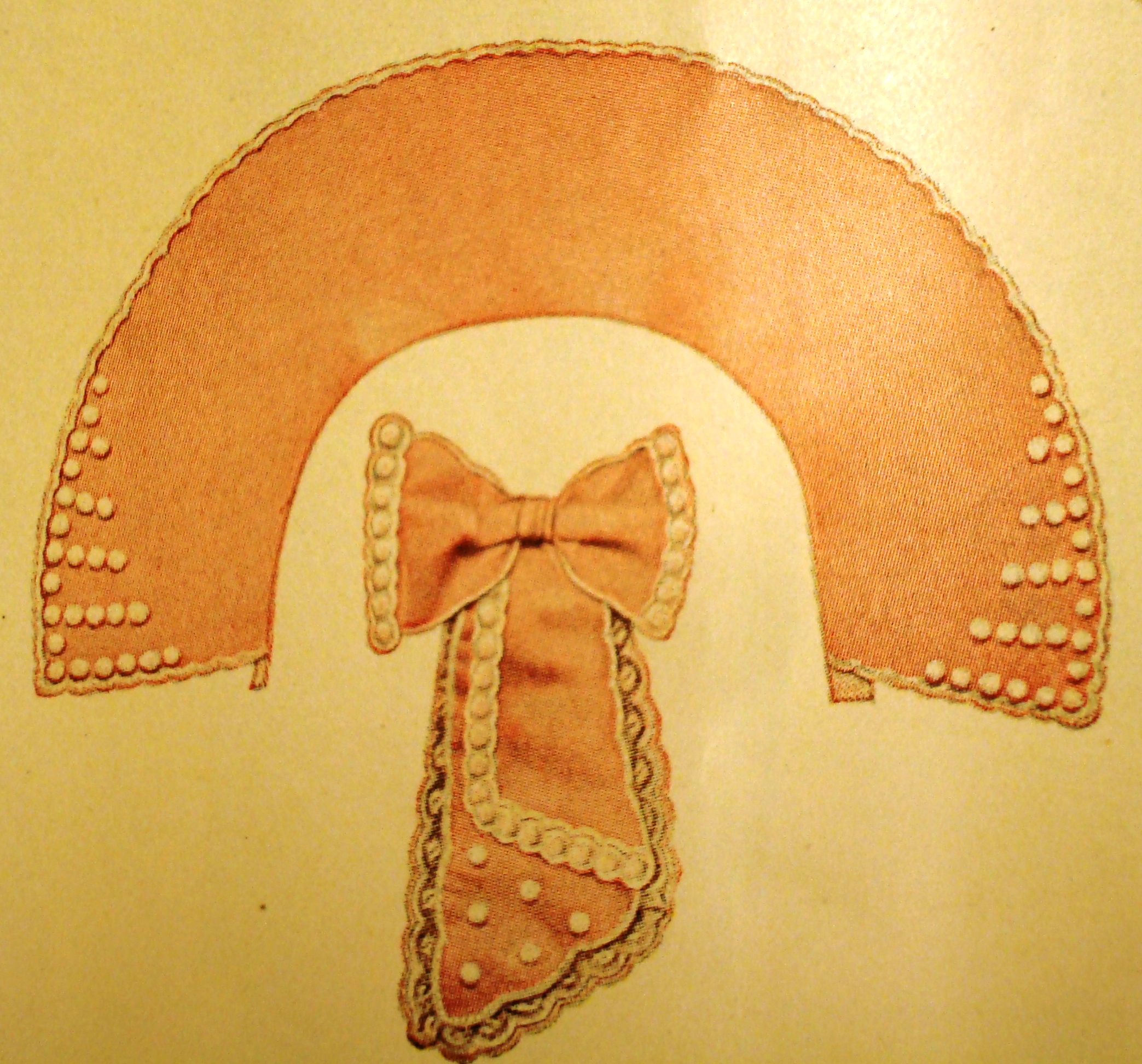
Embroidered collar and jobot. Source of photos: Ladies Home Journal (October, 1911)

Her middle-aged granddaughter’s comments 100 years later:

In this entry Grandma refers to her sister Ruth as Rufus. Ruth was a teacher at a nearby one-room school house and was probably preparing to attend a teachers’ institute (professional development meeting) in a nearby town.

Grandma may have given Ruth an embroidered collar and jabot.

Thanksgiving in 1911

Today Thanksgiving is never this late in November. A hundred years ago it was held on the last Thursday in the month. And, in 1911, the very last day of the month was a Thursday.

In 1939 President Franklin Roosevelt made Thanksgiving the fourth Thursday in the month by proclamation. Federal regulations enacted in 1941 made the change permanent. A very late Thanksgiving shortened the Christmas shopping season—and the change to the fourth Thursday was seen as a way to provide an economic boost to the economy.

Repast

Grandma used the term repast in her diary entry. It is an archaic word for a feast.

One Hundred Year Old December School Bulletin Board Ideas

16-year-old Helena Muffly wrote exactly 100 years ago today: 

Wednesday, November 29, 1911: Had sort of a little entertainment this afternoon. We got out of school early. Jake was going away so that was the whole reason. I can not give my myself up to a vacation of two days.


Bulletin Board Directions

Going Home. This takes three rolls of white crepe paper, one roll each of yellow, lavender and green, with ten sheets of gray matboard for the trees and fence, which are touched up with black tinting fluid. Orange tissue paper will furnish the hospitable glow seen through the windows. Pink tissue paper over yellow crepe paper is used to produce the flesh tint for the lad’s face. (Ladies Home Journal, December, 1911)

Her middle-aged granddaughter’s comments 100 years later:

In 1911, Thanksgiving was on November 30, and apparently the high school students were let out of school early on the day before the holiday.

I wonder if primary students on the first floor of the school building were also left out early.  Grandma’s friend Rachel Oakes was the primary teacher.  Might Rachel have stayed after school to prepare for the following week? Maybe she took down a Thanksgiving-themed bulletin board picture and put a winter one up.

The December, 1911 issue of Ladies Home Journal had an article titled “Christmas Scenes to be Made of Paper: A Suggestion for the Schoolroom Bulletin Board” that had some great examples.

Bulletin Board Directions

The Sleighride. This requires two rolls of gray crepe paper, three of white, and a roll each of red and green, together with four sheets of gray matboard, two bolts of narrow red ribbon for the sun’s rays, black tinting fluid and a little white cotton. The horse is cut from the matboard and tinted with color obtained by wetting a sheet of brown tissue paper.

Bulletin Board Directions

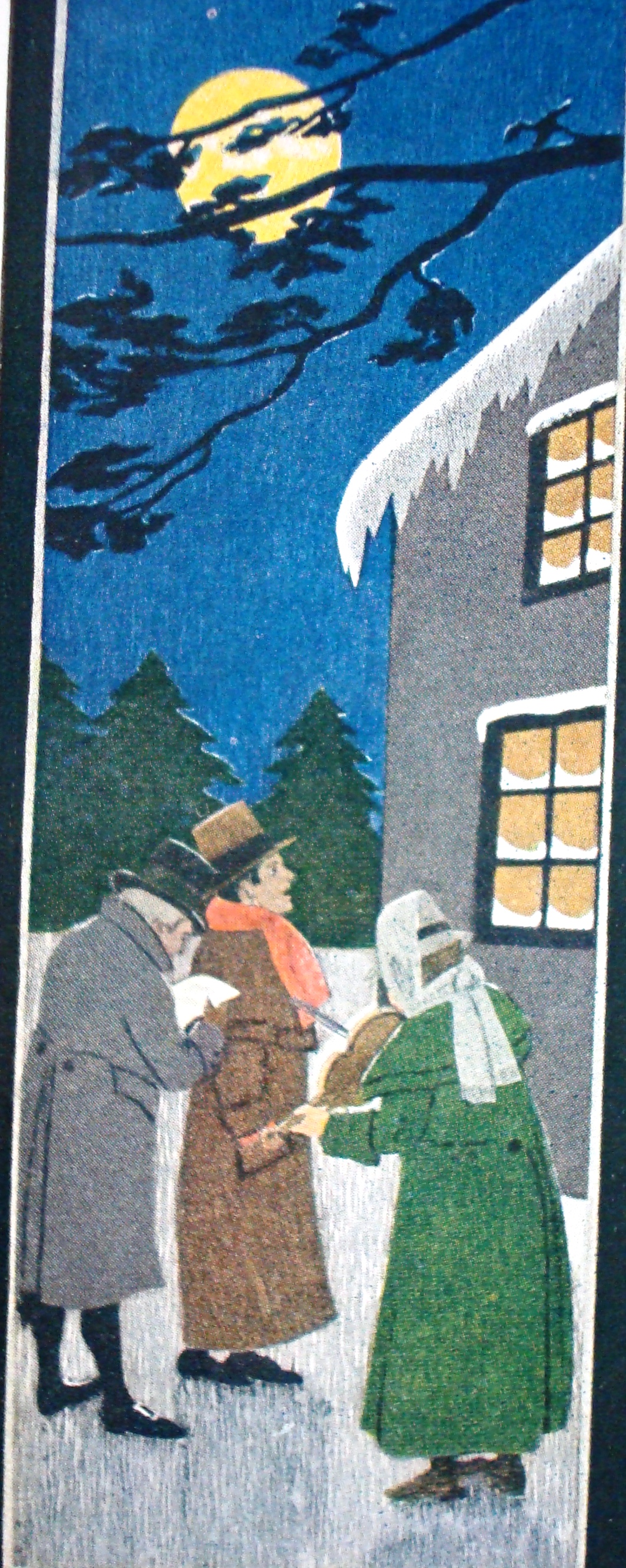
Christmas Carolers. Black and gray matboard, crepe paper, yellow, and orange tissue.

Good Grade in Algebra!

16-year-old Helena Muffly wrote exactly 100 years ago today: 

Tuesday, November 28, 1911: Exams are over thank goodness. I made ninety in Algebra, instead of the one I made last month. I must make some good resolutions and study better next month for I have much need to study. Came near missing a day at school.

Recent photo of the building that once housed McEwensville High School.

Her middle-aged granddaughter’s comments 100 years later:

Yeah!! Grandma got 90% in algebra!! In October she’d only gotten 68%.  Her studying over the previous couple days apparently paid off.

It’s silly to vicariously celebrate a minor success that occurred a hundred years ago, yet I get so involved in the diary story that it somehow seems appropriate to feel pleased when Grandma had a good day.