16-year-old Helena Muffly wrote exactly 100 years ago today:
Monday, March 11, 1912: I heave a sigh of relief when I think examinations are past for this month. I have my doubts about what I will get in geometry.
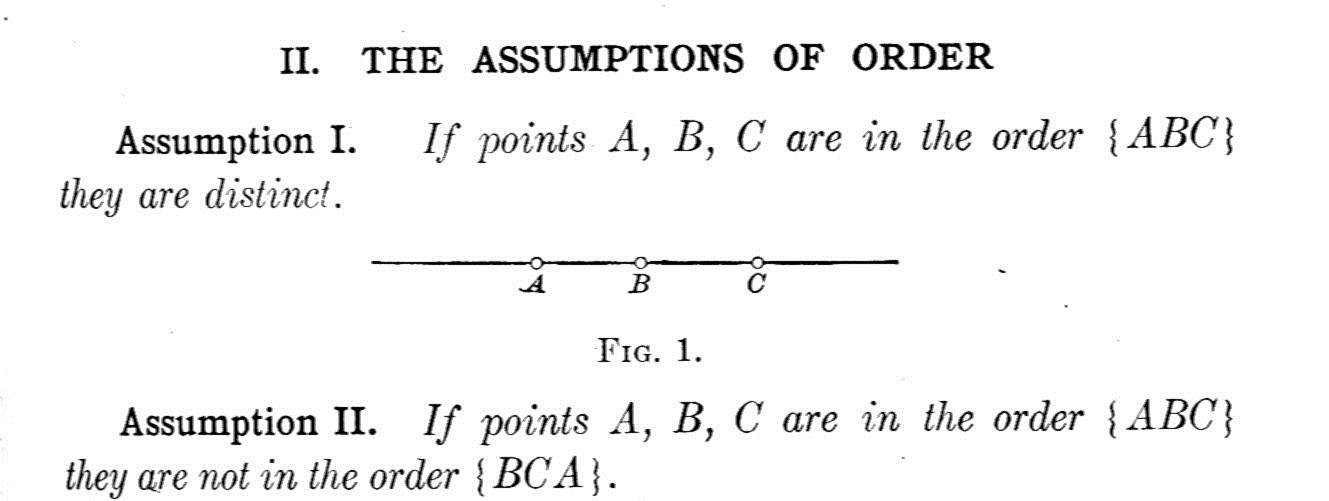
II. THE ASSUMPTIONS OF ORDER
Assumption I. If point A, B, C are in the order {ABD} they are distinct.
Assumption II. If points A, B, C are in the order {ABC} they are not in order {BCA}.
Modern Mathematics (1911), Edited by J.W.A. Young
Her middle-aged granddaughter’s comments 100 years later:
I suppose that Grandma had to do some proofs in geometry. Do students do proofs any more in high school? I get a head-ache just thinking about them.
Here’s the definition of a point in a hundred –year-old mathematics book. It was the first term defined in the book. (I assume that Grandma’s examination was on something more complicated—but I enjoyed reading this definition.)
In geometry a great many technical terms are defined, and each is defined in terms of others. Hence at the beginning of a book on geometry at least one term must be undefined; otherwise the book would have no beginning. We have to leave the undefined term point.
This implies that the reader is free to carry in his mind any image of a point which he can reconcile with what is said about it. We may try to import a notion of our image of a point by saying it has no length, breadth, or thickness, or by like phrases, but these are no part of our book on geometry; they have nothing to do with the logical steps by which the theorems are derived.
Modern Mathematics (1911), Edited by J.W.A. Young