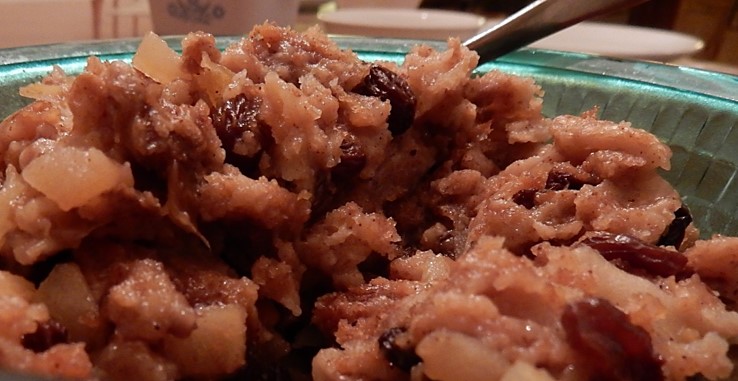
Old-fashioned Apple Raisin Stuffing

Apple Raisin Stuffing

Thanksgiving is rapidly approaching and I’m trying out old recipes to see which ones I want to serve on the big day. The stuffing I usually make contains celery, onions, and sage, and seems a bit boring, so I pulled out an old recipe for Apple Raisin Stuffing.

Apple Raisin Stuffing is wonderfully different from my old standby. It has a lovely, sweet cinnamon taste that reminds me of warm cinnamon bread. This recipe is a keeper. My children never have been fans of stuffing—but I actually think they might like this rendition, and plan to serve it over the holidays.

For my practice run, I divided the recipe in half and stuffed a chicken. I think that the full recipe would make about the right amount to stuff a small turkey.

Apple Raisin Stuffing

  • Servings: 4 - 5
  • Difficulty: easy
  • Print

Apple Raisin Stuffing

1 large apple, pared and diced (about 1 cup diced apple)

1 cup raisins

10 cups bread cubes

1 teaspoon cinnamon

1/8 teaspoon nutmeg

2 teaspoons salt

1/2 cup sugar

1 cup water

Combine diced apples, raisins, and bread cubes in a large bowl. In a separate bowl stir together the cinnamon, nutmeg, salt, sugar, and water; then pour over the bread mixture. Stir gently to combine. If too dry, add additional water. Use stuffing with poultry or pork.

When I wrote this post, I was uncertain whether to call this dish stuffing. . . or dressing. . . or filling. My family often calls it filling—but I think that might be a regional term.
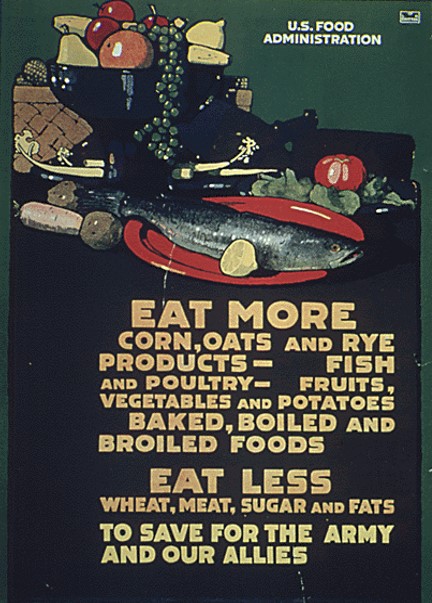
World War I: “With Meat at War Prices, Eat Cheese and Beans”

Source: National Archives

A hundred years ago meat was expensive, and in short supply, because much of it was needed to feed the soldiers fighting in World War I. Here’s what a magazine article said:

With meat at war prices, every housewife should learn to make tasty and nourishing meals with wholesome substitutes to be had at half the price of meat. One of the best substitutes for meat is cheese, and there are so many ways of preparing dishes of cheese that the housewife should learn to make use of this very wholesome food.

Another wholesome substitute is baked beans.

Roast beef— An average helping or portion, weighing 3 1/2 ounces, contains 360 food units, supplies 4/5 ounces protein, and costs 8 cents.

American pale cheese—An average helping weighing 2 3/4 ounces, contains 360 food units, supplies 4/5 ounce protein, and costs 4 cents.

Baked beans (as purchased in can)– An average portion, about 9 ounces, contains 360 food units, supplies 5/6 ounces protein, and costs 5 cents.

Other inexpensive foods rich in protein and therefore capable for building up the body are fish, eggs, oatmeal, lentils, dried peas and peanuts. Vary your diet and cut down your butcher bill!

National Food Magazine (November, 1914)

Old-fashioned Apple Custard Pie


apple custard pie 2

Custard pies were very popular a hundred years ago. One of the old-time fall favorites is Apple Custard Pie. The delicate custard taste mingles with the apples and a hint of cinnamon to create a truly special pie.

Old-Fashioned Apple Custard Pie

2 1/2 cups apples (cored, peeled and sliced)

1/2 teaspoon cinnamon

2 tablespoons water

4 eggs

1/2 cup sugar

1/2 teaspoon salt

2 cups milk

1 10-inch (large) pie shell

Combine apples, cinnamon, and water in a saucepan. Using medium heat, bring to a boil and then reduce heat; stir occasionally. If needed to prevent scorching on bottom of pan, add a small amount of additional water. Continue to simmer gently until the apples are soft (approximately 10-15 minutes). Cool slightly; then strain the apple mixture. Keep the cooked apples and discard the liquid. Set aside.

Heat oven to 425 degrees. In a bowl, beat eggs slightly. Add sugar, salt, and milk. Beat until blended. Stir in the cooked apples. If the apples are still hot, use care to stir while pouring them into the custard mixture to ensure that none of the egg coagulates from the heat. Pour into the pie shell, then bake at 425 degrees for 15 minutes. Reduce heat to 350 degrees, and bake an additional 1 – 1 1/2 hours or until knife inserted into center pie comes out clean.

This pie takes a long time to bake. If the top looks like it might start to burn before the center of the pie is solid, reduce heat to 325 degrees.

For this recipe, I used apples from a tree in my yard that, when cooked, get soft and do not hold their shape particularly well. I like how the cooked apples are widely dispersed in the custard; though, if preferred, firmer varieties may be used.

100-Year-Old Directions for Washing Dishes

washing dishes

Here are some hundred-year-old directions for how to wash dishes:

It is not difficult to wash dishes although many people make it a very disagreeable process. The necessary apparatus include a plentiful supply of hot water, a good soap, ammonia or borax to soften the water, a gritty soap or powder. Have a pan for washing and another for rinsing, and a tray for draining if there is no drainer attached to the sink.

Prepare the dishes by scraping and neatly piling articles of a kind together. Wash the cleanest dishes first, usually the glasses, next the cups and saucers, and the silver next.

Have the soiled dishes near the pan, and put in only one or two articles at a time. To pile in a number means the nicking of china, and scratching of silver.

Dip each dish in the rinsing water and then put in the drainer. Be careful not to use too hot water for delicate china and glass. Change the soapy water when it becomes in the least greasy.

Use dry towels to wipe the dishes dry.

Wash pots, pans, and utensils while they are still warm. Heavy pots and pans can be dried without wiping by placing on or near the stove. Do not put away until they are perfectly dry

When finished, wash out the towels and dish pan, and leave the sink and drain-board perfectly clean

Foods and Household Management: A Textbook of the Household Arts (1915)

Cranberries with Prunes

cranberries with prunes 2

Cranberries are beginning to appear in the produce section at my supermarket.  I remembered seeing a recipe for Cranberries with Prunes in a 1915 issue of Good Housekeeping, and just had to give it a try.

Cranberries with Prunes are a lovely taste treat with bright notes of both fruits.  The rich sweetness of the prunes mingles with the tart cranberries to create a vibrant mixture.  Like many hundred-old-recipes, this classic recipe is simple to make with only four ingredients.

This recipe combines two super foods. Both cranberries and prunes are noted for having lots of antioxidants, fiber, and other good things. Amazingly, even though terms like antioxidant were unknown to cooks a hundred years ago, people seemed to have an intuitive sense of healthy food combinations.

Cranberries with Prunes

3 cups cranberries
1/2 cup sugar
1 cup water
1 cup prunes

Combine cranberries, sugar, and water in a large saucepan. Bring to a boil using medium heat; then reduce heat and simmer until cranberries burst. Add prunes and remove from heat. Cool before serving.

Adapted from recipe in Good Housekeeping (November, 1915)

I’m often amazed how foods and cooking techniques have changed over the past hundred years. As with many old recipes, I needed to adapt this recipe. The original recipe provided detailed directions for preparing the prunes.

Cover the prunes with water and soak overnight. Simmer gently till thoroughly tender. Take up with a skimmer, and when perfectly cool slip out the stones. Add the cranberries to the water in which these were boiled, pouring in more water if necessary. . .

The prunes I used were already pitted and very moist, so there was no need to soak them overnight or to pit.

Farmers Say, “Let the Women Vote.”

Source: Ladies Home Journal (March, 1914)

In 1915, times were a-changing.  Farm Journal asked readers to send in post cards telling them whether they supported women’s suffrage. A sample of the responses were then printed in the magazine (and every single response that was published supported women’s suffrage). Here are a few of them:

Yes, indeed, let the women vote.

J.C. Switzer (Carterville, Mo.)

I am strongly in favor of women voting. Hope the time will soon come when women will have the vote; and good-bye booze.

Morton R. Woodard (Dunsville, N.Y.)

You wish to know what I think about woman suffrage. Being a woman who naturally objects to being classed along with the rest of the farm’s livestock, I certainly shall vote when I get a chance.

Mrs. C. J. Colony (Lodi, N.Y.)

Yes, I am in favor of woman suffrage. I am sorry to say that I used to be an “anti,” but as a widow and breadwinner I have had my eyes opened. So I say, speed the day when this unjust discrimination shall cease to be.

Mrs. Ida L. Newton (Lakeport, Fla.)

Farm Journal (October, 1915)

This is how the magazine summarized the responses:

The straw vote called for in recent numbers of the Farm Journal is a revelation to us, for it shows a far wider and more earnest interest in this cause than we thought existed.

Of course the fact that our paper has always stood for this reform, as well as for all others that deserved and needed support, may have had an influence in bringing our millions of readers to the side of Fair Play and a Square Deal for women. But apart from such influence, it is astonishing how the demand for suffrage is sweeping over the country, promising a great victory for the cause in some, if not all, of the states that are to vote on the measure this year.

Farm Journal (October, 1915)

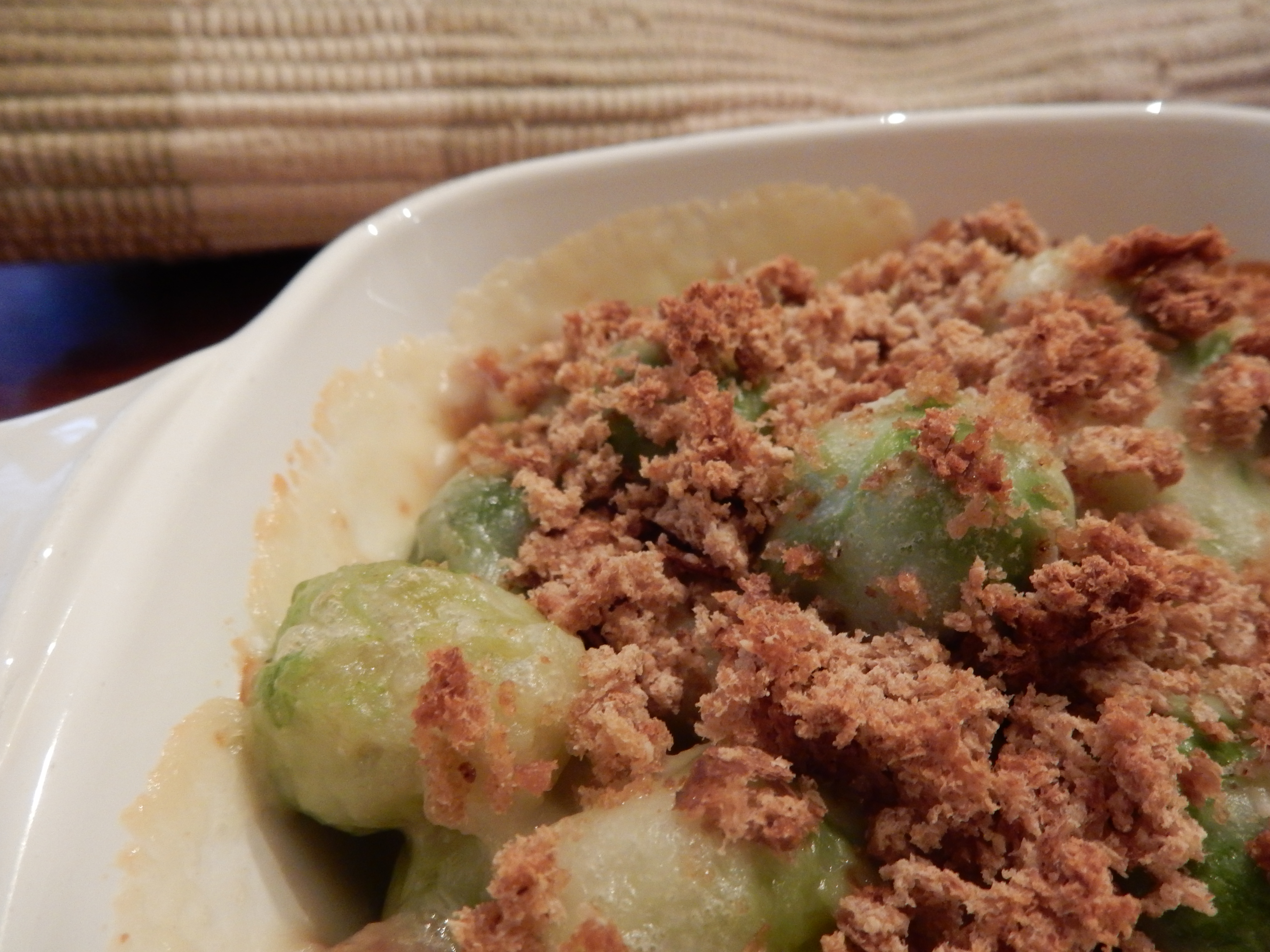
Old-fashioned Brussels Sprouts Au Gratin

Brussels Sprouts Au Gratin

Now that Fall is in full swing, I’m enjoying several seasonal vegetables. One of them is brussels sprouts.

Brussels Sprouts Au Gratin is an old-time way to serve them. The delicate essence of the cheese in the sauce nicely balances the slightly bitter taste of the brussels sprouts.

Brussels Sprouts Au Gratin

1 pint (2 cups) brussels sprouts

1 1/2 tablespoons butter

1 1/2 tablespoons flour

3/4 cup milk

2/3 cup shredded cheddar cheese

1/3 cup bread crumbs*

Preheat oven to 350° F. Wash the brussels sprouts and remove any wilted leaves; then put in a saucepan and cover with water. Bring to a boil using high heat, then reduce heat to medium and simmer until the brussels sprouts are tender (about 5 minutes). Drain well.

Meanwhile, in another pan, using medium heat, melt butter; then stir in the flour. Gradually, add the milk while stirring constantly; add the cheese. Continue stirring until cheese sauce thickens.

Add the brussels sprouts to the cheese sauce. Stir gently to combine. Put into a casserole dish, and sprinkle the bread crumbs on top of the mixture. Bake until hot and bubbly (about 15 minutes).

*Note: To make the bread crumbs, I took a bread crust, folded it into quarters, and then used a grater to grate the crumbs.

3 servings (Recipe can easily be doubled.)

An aside—I struggled when I wrote this post because I couldn’t decide whether to capitalize brussels. I googled it, and found that there was no consensus. I ended up using a lower case b –but don’t really like how it looks. What do you think? Should the b in brussels be capitalized?