Steamed Chocolate Nut Pudding with Hard Sauce Recipe

steamed chocolate nut pudding

Hundred-year-old cookbooks have oodles of steamed pudding recipes. These slow-cooking molded desserts were easy to make back in the days when people had a fire constantly burning in a wood stove. I have vague warm fuzzy memories of steamed puddings made by an elderly neighbor when I was a child, and I’ve wanted a pudding mold for some time–so I was thrilled to get one for Christmas.

A few day ago I flipped through my old cookbooks, and tried to decide which pudding recipe to make. I finally decided to try the recipe for Chocolate Nut Steamed Pudding because it sounded delicious – and didn’t require steaming for as long as many other puddings. (It only needed to be steamed for 1 1/2 hours.)

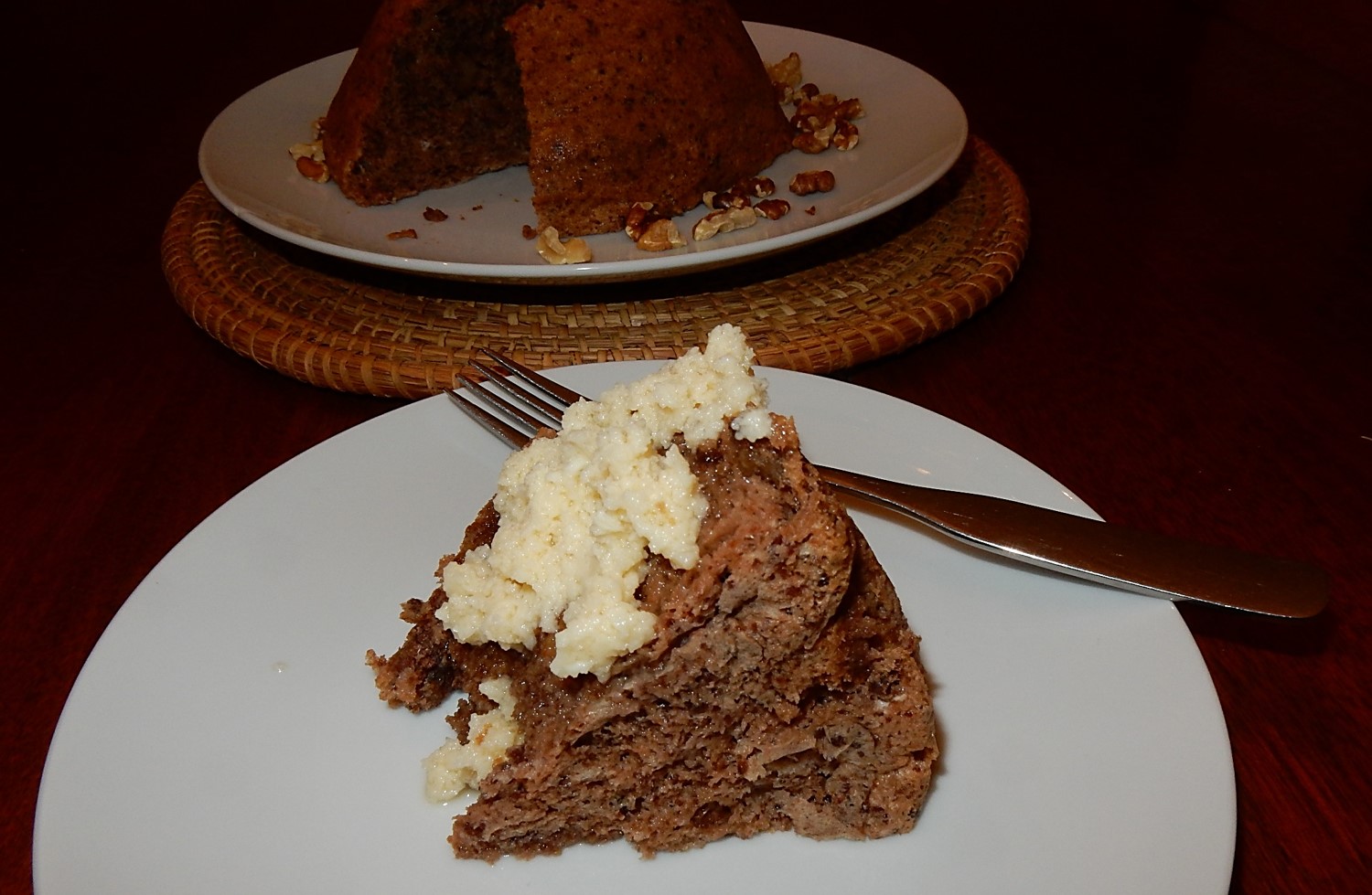
This recipe was worth the time and effort. The pudding was incredible.  I expected the pudding to be heavy and rich–and was thrilled that it actually was moist, yet light, with a hint of chocolate that enhanced the taste of the walnuts. The recipe called for beating 5 egg whites (and only 1/2 cup of flour) which resulted in a very light cake-like dessert.

I served it with Hard Sauce (which is actually a brandy butter). The Hard Sauce partially melted on the warm pudding surface releasing a luscious buttery brandy essence .

Here’s my updated version of the recipe for modern cooks:

Steamed Chocolate Nut Pudding

  • Servings: 5 - 7
  • Difficulty: difficult
  • Print

Steamed Pudding

2 tablespoons sugar

1/2 cup flour

1/4 teaspoon salt

1 ounce unsweetened baking chocolate, grated

1/2 cup milk

5 eggs, separated

1/2 cup sugar

1 cup walnuts, chopped

In a saucepan, combine the 2 tablespoons sugar, flour, salt, and grated chocolate. Gradually stir in the milk to make a smooth mixture; and put on a stove burner at medium heat. Cook until the mixture thickens while constantly stirring. (This mixture become quite thick, so use care not to scorch.) Remove from heat and set aside.

Put the egg whites in a bowl, and beat vigorously until stiff peaks form.

Working quickly (so the egg whites remain beaten), put the egg yolks and sugar in another bowl; and combine. Add the chocolate mixture, and beat until smooth. Stir in the walnuts, and then gently fold in the beaten egg whites.

Put the mixture in a greased mold, and steam for 1 1/2 hours.* Remove from mold and serve warm with Hard Sauce. (This pudding is also excellent cold without the Hard Sauce.)

*Notes: I used a 2 liter mold, but had some extra space at the top. A 1 1/2 quart mold would be large enough. Historically coffee cans were often used as molds. BBC Good Food has an excellent video that succinctly describes how to steam a pudding (or follow the directions that come with the mold).

Hard Sauce

1/2 cup butter

1 cup powdered sugar

1 teaspoon water

2 tablespoons brandy

Cream the butter, then slowly add the powdered sugar while stirring constantly. While continuing to stir, add the water, and then the brandy.

Here are the original recipes:

Source: Lowney's Cook Book (1912)
Source: Lowney’s Cook Book (1912)

There were two Hard Sauce recipes in the cookbook. I adapted the first one.
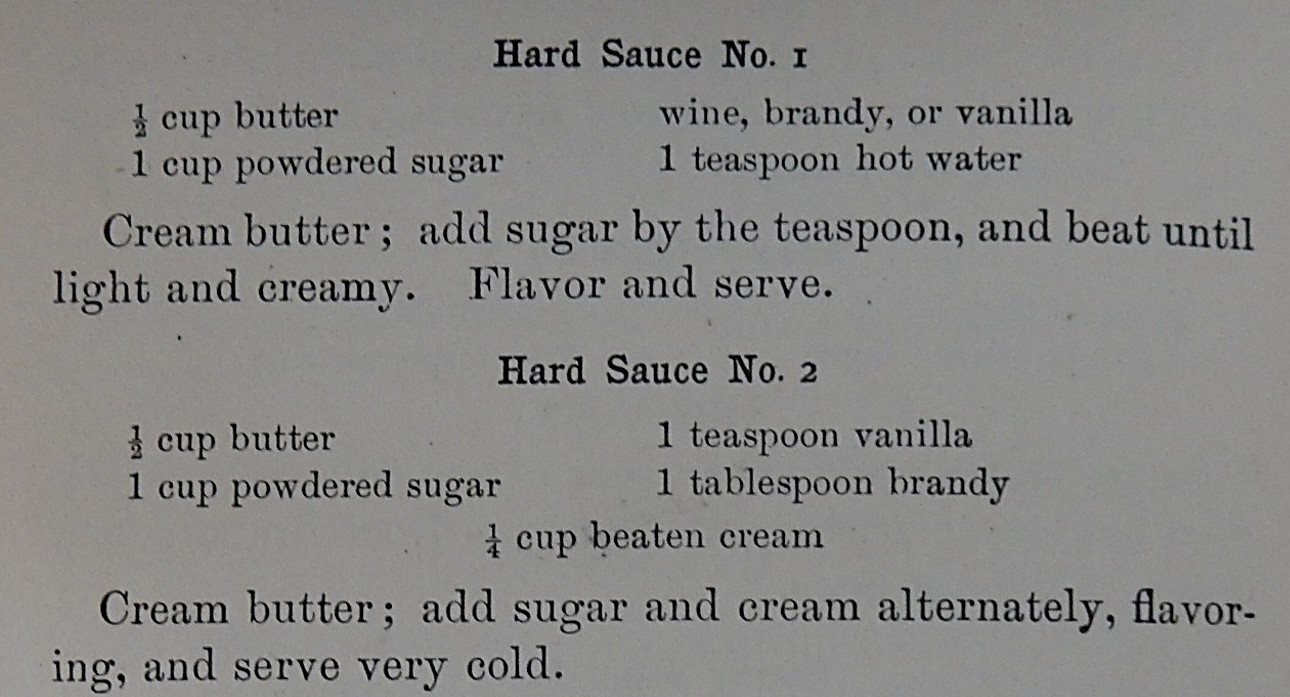
Source: Lowney's Cook Book (1912)
Source: Lowney’s Cook Book (1912)

Whirling Lettuce

lettuce leaves

A hundred-years-ago Good Housekeeping magazine had a column that contained household tips submitted by readers.

Source: Good Housekeeping (January, 1916)

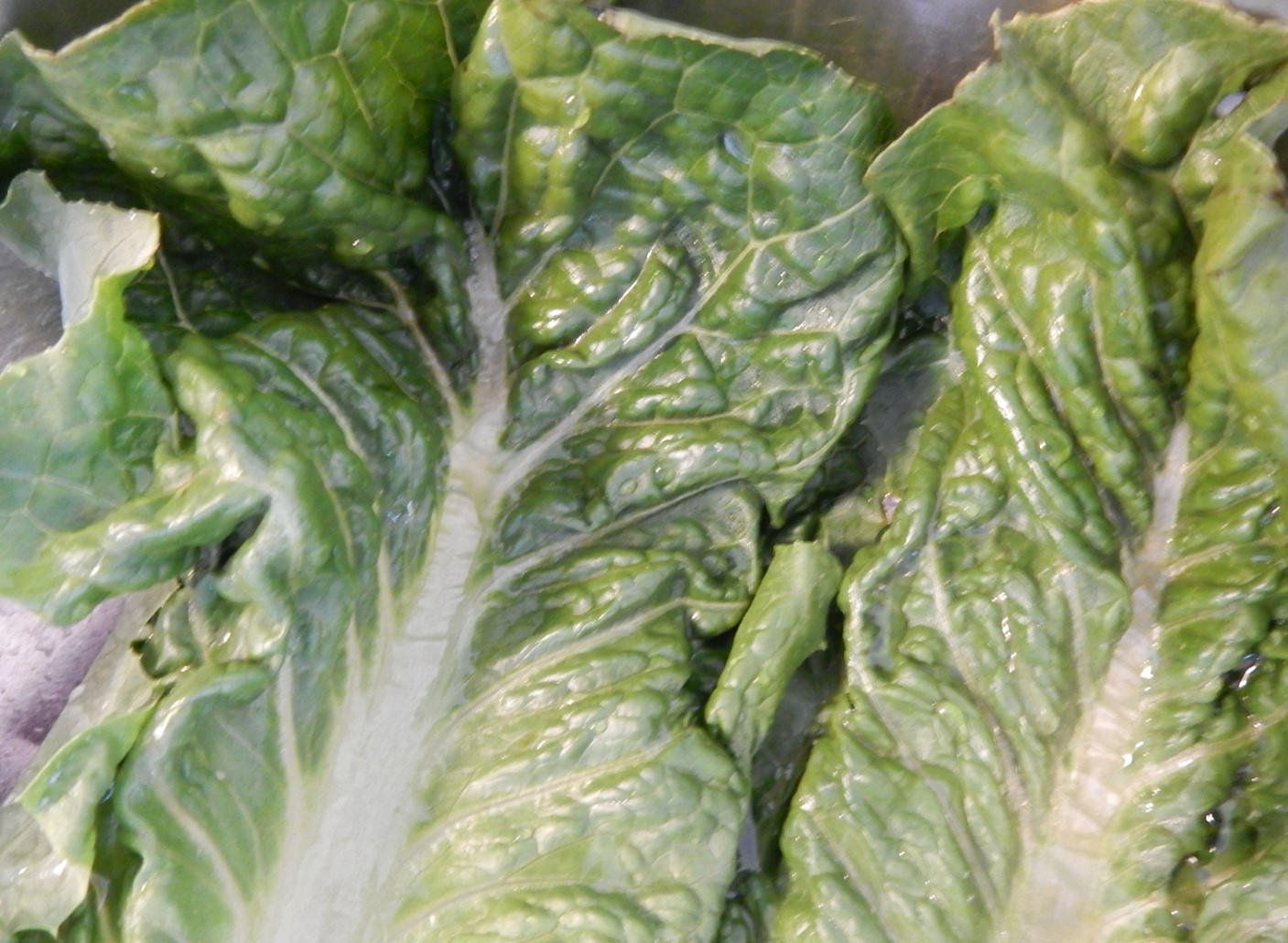
When I wash lettuce, it’s always a little tricky to get it dry before making a salad, so I was very excited when I saw a tip for drying lettuce in the magazine:

To Dry Lettuce for a Salad

The most effective way of drying lettuce, I have found, is to place it in a clean dish towel after washing, gather the sides and corners in the hand so as to form a bag, step to the kitchen door, and whirl the bag at arm’s length three or four times. This drives out almost every particle of water from the lettuce.

Mrs. C. H. C., Colo.

Good Housekeeping (January, 1916)

Of course, I had to give it a whirl.

lettuce whirling

Do I recommend whirling lettuce to dry it?

Naw—I just about froze. It’s way too cold to whirl lettuce in January.

Old-fashioned Silky Cauliflower Soup Recipe

Silky Cauliflower Soup

One of my New Year’s resolutions is to lose a few pounds. I’m trying to eat healthy (and January is the perfect time for soup), so I looked through my hundred year-old cookbooks for a soup that was light yet rich and tasty. I wasn’t sure it was possible to find a soup that met my criteria, but I think that I came up with a soup that fits the bill.

I found a recipe for Cauliflower Soup in Lowney’s Cook Book (1912). This milk-based soup is a very smooth, strained soup—and not very thick; so I think that today it would be considered a “silky” soup.

This Silky Cauliflower Soup is lovely, and has a surprisingly subtle cauliflower taste. The soup will warm you up on a cold winter day–plus, it’s light enough that you don’t need to feel guilty.

Here’s my updated version of the recipe for modern cooks:

Silky Cauliflower Soup

  • Servings: 5
  • Difficulty: moderate
  • Print

1 medium head cauliflower, coarsely chopped

water

4 tablespoons butter

1/3 cup chopped onion

4 tablespoons flour

4 cups water

1 egg yolk, beaten

2 teaspoons salt

1/8 teaspoon ground pepper

2 cups milk

2 tablespoons Parmesan cheese, grated

Put chopped cauliflower in a saucepan and cover with water, bring to a boil and cook until tender. Drain cooked cauliflower and puree in a blender or food processor.

In the meantime, melt butter in a large saucepan; then add the chopped onions and saute until tender. Stir in the flour, and slowly add 3 cups water while stirring constantly. Stir the egg yolk into the remaining 1 cup water; and then add the egg and water mixture to contents of the large sauce pan while continuing to stir constantly. Add the pureed cauliflower, salt, and pepper to the mixture and bring to a boil. Remove from heat and strain. Return the liquid to the pan and stir in the milk. Heat until hot, then stir in the Parmesan cheese and serve.

Here’s the original recipe:

Source: Lowney's Cook Book (1912)
Source: Lowney’s Cook Book (1912)

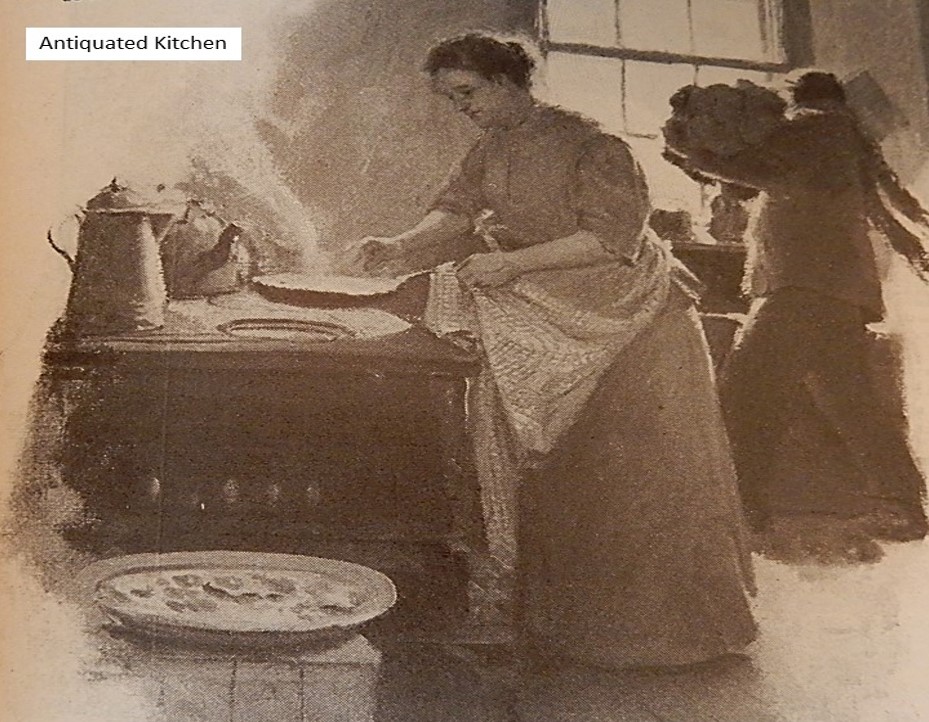
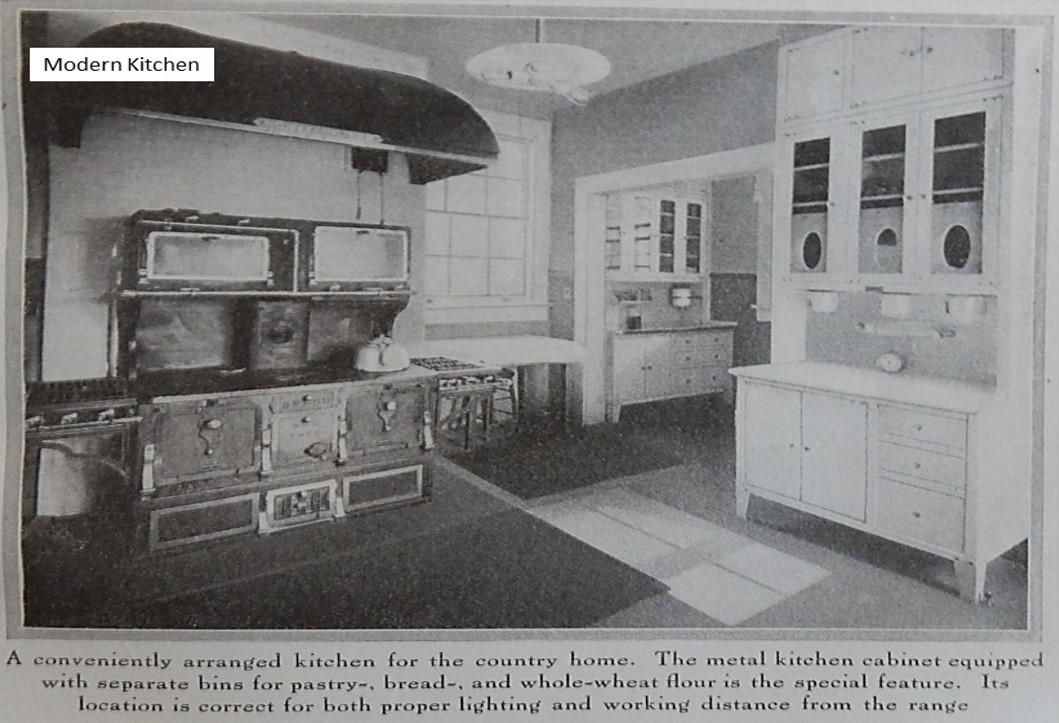
Get Rid of that Antiquated Kitchen – Modernize

Source: Good Housekeeping (November, 1915)

The holidays are winding down and many of us have spent long hours in the kitchen preparing for large family gatherings. Perhaps now is a good time to consider what it was like to prepare meals in kitchens a hundred years ago.

This April, 1915 article in Farm Journal implored farmers to consider how difficult it could be for their wives to cook in antiquated kitchens—and to make sure that modern conveniences were equitably distributed across the farm and the house.

With families averaging 5.2 members in number, the housewife preparing three meals a day, provides in the course of a year 5,694 meals, a discouraging proposition under the best conditions, but cooked in the average kitchen, it becomes deadly monotonous.

The lack of running water, a poor stove, the empty wood box, the heavy teakettle and iron pots, insufficient towels, antiquated woodenware, rusty and battered tin ware, the lack of a pantry, the cold in winter and heat in summer, the lack of screens, –I wonder how many meals the men folks would cook under these conditions.

In these days, when efficiency is required along every line of work. I wonder how our women work against such heavy odds. If the men had to cook and keep the kitchen clean, they would want linoleum on the floor, they would have running water, the stove would not smoke and the wood box would never be empty. There would be good, handy and substantial tools to work with, the teakettle would be easy to lift and easy to clean, the knives would be sharp—oh, I am sure of that!

There would be towels galore, and they would be good ones; a pantry would be built to save running to the cellar, the kitchen would be protected in winter and shaded in summer, doors and windows would be screened, there would be a stool to sit on while doing some kinds of work, and a low, comfortable chair for other work, and a few minutes’ rest, now and then. There would be some good way to prop the ironing-board (no makeshift here) and irons enough to allow time for thorough heating.

As the work is almost entirely done by women, they get along with things as they are, renewing and replacing the old as they have the opportunity.

The farmer and his wife (or daughter, or sister, whoever does the work) should constitute a partnership, and for every convenience secured for his part of the work, there should be one for hers. It need not always represent an outlay of money, but it will represent love, appreciation, the desire to protect and willingness to cooperate, which is the foundation for family happiness and prosperity.

Source: Good Housekeeping (May, 1916)

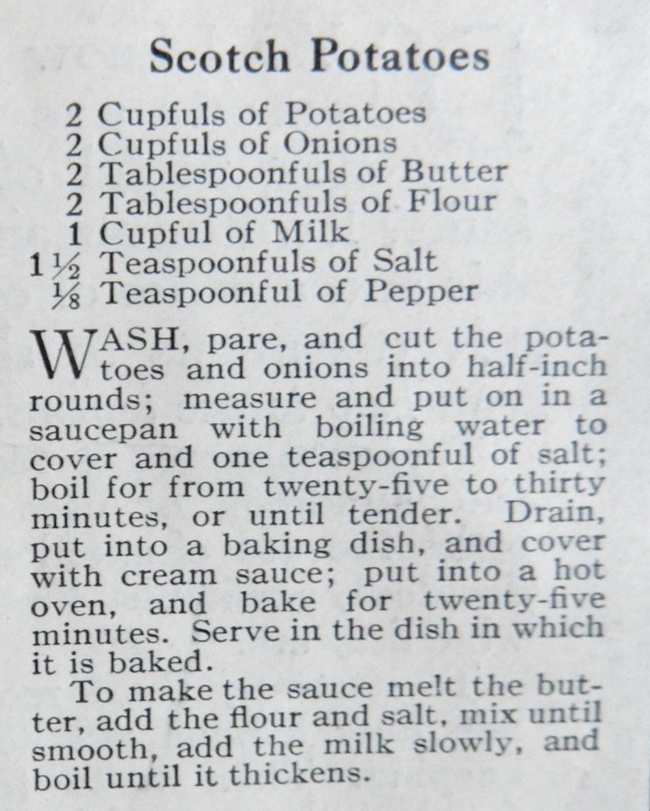
Scotch Potatoes (Scalloped Potatoes and Onions) Recipe

Scotch Potatoes

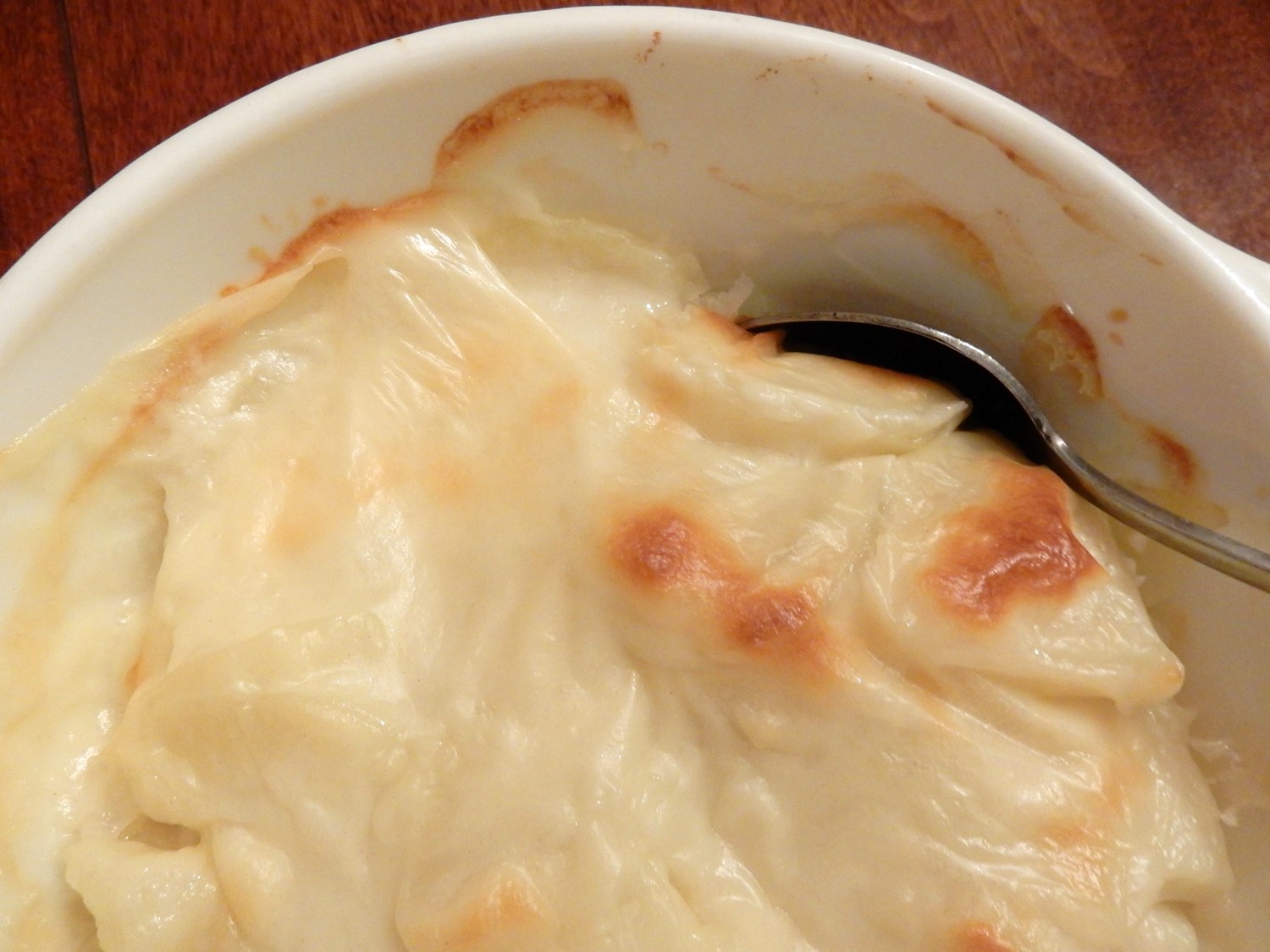
Brrr, it’s cold outside and I’m ready for some comfort foods. When I saw a recipe for Scotch Potatoes in the January, 1916 issue of Ladies Home Journal, I just had to try it.

Scotch Potatoes are very similar to Scalloped Potatoes, but they contain a lot more onions. The recipe calls for a 1:1 ratio of potatoes and onions (2 cups potatoes and 2 cups onions).

This recipe was a winner, and I may never make regular scalloped potatoes again. Scotch Potatoes wonderfully pairs the creamy potatoes with the sweet, bright, complex flavor and texture of the onions to create a lovely taste sensation.

The recipe I typically use for Scalloped Potatoes just has me put the raw potato slices into the casserole dish and then pour white sauce over it. When I bake that casserole I often struggle to get the potatoes tender before the top gets overly brown. One of my favorite things about the Scotch Potatoes recipe is that I had no issues with a burned top and under-cooked potatoes.

This recipe called for boiling the potatoes and onions for a few minutes before putting them into the baking dish. This worked perfectly—and I now wonder why I never thought of doing this before.

Scotch Potatoes (Scalloped Potatoes and Onions)

  • Servings: 6 servings
  • Difficulty: moderate
  • Print

4 medium potatoes, peeled and sliced (approx. 2 cups)

4 medium onions, sliced (approx. 2 cups)

water

1 teaspoon salt

2 tablespoons butter

2 tablespoons flour

1/2 teaspoon salt

1/8 teaspoon pepper

1 cup milk

Preheat oven to 400° F. Put the sliced potatoes and onions into a saucepan, and cover with water. Add 1 teaspoon salt. Bring to a boil, then reduce heat, and simmer until the potatoes are just barely tender (about 12 minutes). Remove from heat and drain.

In the meantime, make a white sauce by melting the butter in another saucepan. Stir in the flour, 1/2 teaspoon salt, and pepper. While stirring constantly, slowly add the milk. Continue stirring until the mixture is hot and begins to thicken.

Place the cooked potatoes and onions in a baking dish. Pour the white sauce over them, and put into the oven. Bake for 25 minutes, or until hot and bubbly, and the top begins to brown. Remove from oven and serve.

Here’s the original recipe:

Source: Ladies Home Journal (January, 1916)

I didn’t make my potato and onion slices as thick as the slices called for in the original recipe. Mine were about 1/4 inch thick, and they worked beautifully in the updated recipe.

Hundred-Year-Old Cranberry Slush (Yuletide Punch) Recipe

cranberry slush

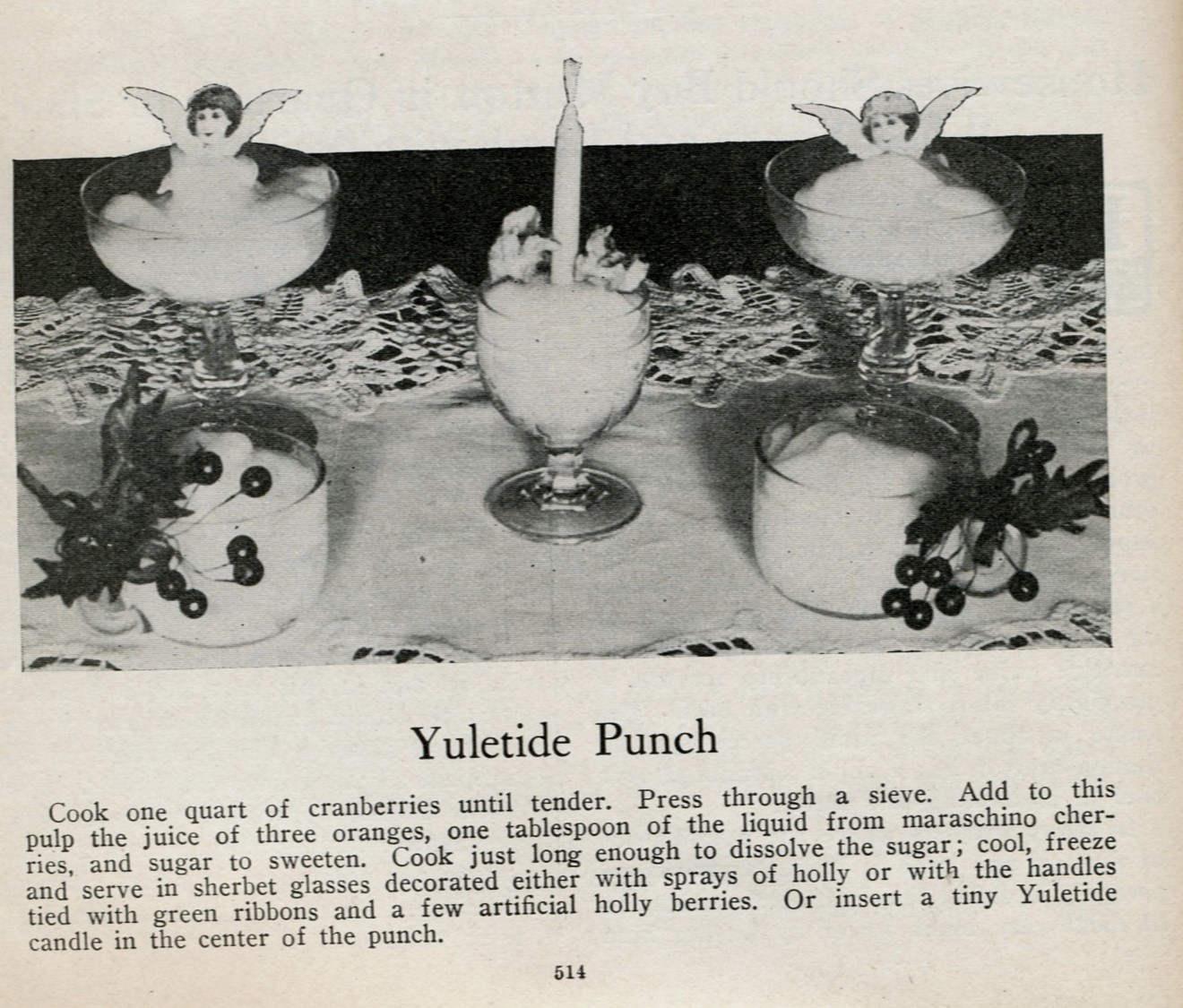
When browsing through a hundred-year-old National Food Magazine, I was amazed to see a recipe for Yuletide Punch that looked like a cranberry slush recipe to me.

Of course, I had to try it. The slush contained freshly made cranberry juice (not the over-filtered store-bought stuff) and orange juice as well as a little maraschino cherry juice. The icy, dusky pink slush was refreshing and had just the right amount of tartness.

This recipe is a keeper. The slush was easy to make, beautiful, and tasted awesome. I’ll definitely make it again.

Here’s my adaptation of the original recipe:

Cranberry Slush (Yuletide Punch)

  • Servings: 4 servings
  • Difficulty: easy
  • Print

3 cups fresh cranberries (1 12-ounce bag)

1 cup sugar

1 cup water

2 medium oranges

1 tablespoon liquid from maraschino cherries

Combine the cranberries, sugar, and water in a large sauce pan. Bring to a boil, then reduce heat and simmer until the cranberries burst and are soft. Remove from heat. Use a strainer to separate the juice from the berries.* Squeeze the oranges, and strain the orange juice. Combine cranberry juice, orange juice, and maraschino cherry liquid. Put the juice mixture in a freezer container and freeze.

To serve: Remove container from freezer 1/2 – 1 hr. prior to serving and allow the mixture to soften for easy serving. Spoon the slush into glasses, and serve immediately.

*Note: The cooked cranberries are not used in this recipe, but can be cooled and served separately.

Adapted from recipe in National Food Magazine (December, 1914)

Here is the original recipe.

Source: National Food Recipe (December, 1914)

Something doesn’t seem quite right with the old photo. The slush in the picture looks white. My slush was a dark pink.