Hundred-Year-Old Cranberry Tarts (Turnovers) Recipe

I tried to make a hundred-year-old recipe for Cranberry Tarts, but I think I actually made Cranberry Turnovers. Is there regional variation  in the meaning of “tart”?

I’m probably just looking for an excuse to justify my mistake, but I’m really hoping that someone other than me thinks that a tart is made by putting a filling in pie crust dough and folding it over.

Let me explain –

On Saturday morning, I made a tasty filling using chopped cranberries and raisins.  I then hummed as I  prepared the pie crust dough, rolled it out, cut it into rounds, put some filling on one-half of each round, flipped the top half over, sealed, and baked.

The results were outstanding. The “tarts” were enticing with a wonderfully balanced filling that was slightly acidic, yet also slightly sweet. All was good.

Then I decided to google “Cranberry Tarts” to see if there were similar modern recipes – and discovered to my horror that I had not made tarts, but rather that I’d made turnovers. Tarts are shallow, open-faced pastry shells with a filling.

My recipe success, suddenly became a recipe disaster. I’d misinterpreted the recipe.

In any case, here’s the original recipe :

Source: American Cookery (November, 1917)

And, here’s the (turnover) recipe updated for modern cooks:

Cranberry Turnovers (Tarts)

  • Servings: 10 - 12 turnovers
  • Difficulty: moderate
  • Print

1 cup cranberries, coarsely chopped

1/2 cup raisins, coarsely chopped

1 cup sugar

3 tablespoons flour

1/2 teaspoon salt

1/2 cup water

milk

sugar

enough pie dough to make a 2 crust-pie (or  use packaged prepared pie crust or puff pastry)

Put the cranberries, raisins, sugar, flour, and salt in a saucepan; stir to combine. Add the water, then bring to a boil using medium heat. Reduce heat and simmer for about 10 minutes. If the filling to too thick, add additional water. Remove from heat.

Preheat oven to 425°  F. If using pie pastry, roll until 1/4 inch thick, then cut int circles or rectangles. (I used an inverted cereal bowl to cut the rounds.) Place 2 tablespoons of the cranberry mixture on one side of each round or rectangle, fold the pastry over and press edges together. Put filled pastries on a baking sheet; brush with milk and sprinkle with sugar. Put in oven and bake until the top is lightly browned (about 20 minutes).

Cook’s note: I needed to add about 1/4 cup more water than the hundred-year-old recipe called for to create a filling that had the typical pie-filling thickness. I also did not cook it for as long as the original recipe called for since it was so thick.

 

Desserts We Can Afford


Photo Caption: Rice cooked with gelatin, molded when cold, and served surrounded with apricots makes a delicious dessert and a very healthful one. (Source: Good Housekeeping, November, 1917)

Do you ever worry about desserts being too expensive?

Well, it was also  a concern a hundred years ago. It was the middle of World War I, and food was costly.  Here’s some excerpts from a 1917 magazine article:

Desserts We Can Afford

Ought we to deny ourselves desserts? With all the stress that is being placed upon economy of food, many housekeepers are asking themselves this question.

But luncheon without dessert, or dinner without dessert, would be disappointing to many of us who crave something sweet with which to top off a meal. And what would the children do if they could not look forward and guess what was coming at dessert-time?

To omit desserts entirely is too much to ask in the name of economy. And it would be an unnecessary denial. At present, desserts often come as a superfluous course at the end of a heavy meal. This is a mistake. Do not omit them altogether, but make them count as food. They may be made from materials which furnish concentrated nourishment and that are rich in energy-yielding material. A simple, light meal, topped off with such a dessert will be rich in food value while being economical.

Just because you don’t like the old-fashioned rice pudding, don’t discard rice altogether for dessert. Rice, gelatin, and milk combine very attractively.

Fruits, home-canned or the commercially tinned variety, preserved or dried, are a source of inspiration for inexpensive dessert combinations. All of them combine exceptionally well with rice.

Good Housekeeping (November, 1917)

I only occasionally eat desserts – though this article brought back memories of always having dessert after both lunch and dinner when I was a child.  I’m probably using my only occasional dessert-eating as an excuse, but I decided to pass on making rice cooked with gelatin and served with canned apricots.

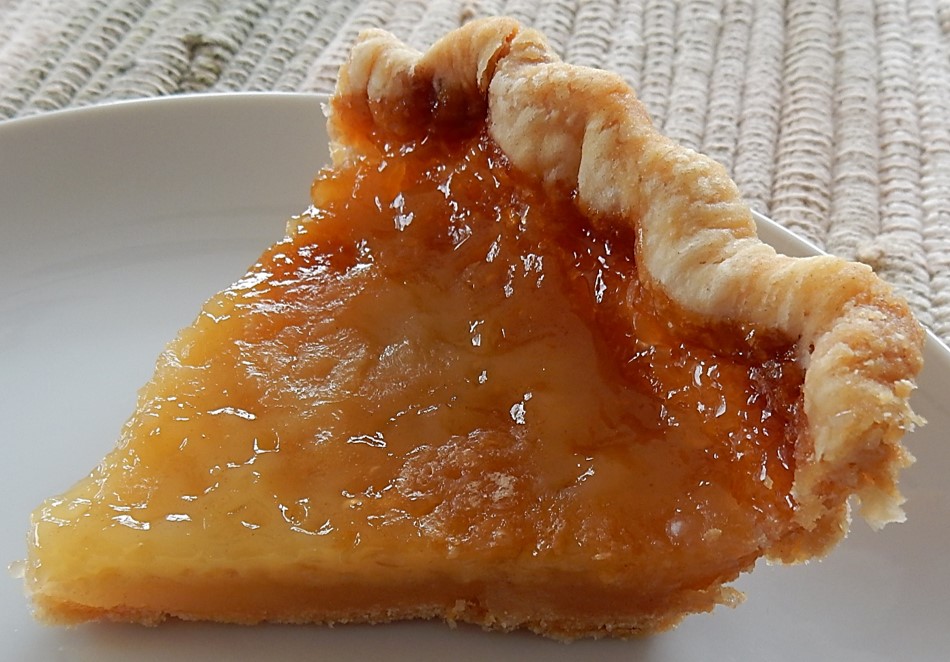
Boiled Cider Pie

Old-fashioned Boiled Cider Pie is a delightful Fall treat. This pie has a smooth and delicate filling with a mild apple flavor and (even though it contains no milk) a lovely custard-like texture.

This recipe is from a 1905 cookbook published by a church in Berwick, Pennsylvania. I found the cookbook last summer when I was visiting the area in Central Pennsylvania where I had lived as a child. My husband and I were to meet someone for lunch – but we finished a visit with another friend earlier than anticipated. So when we saw that a tiny country church was holding a rummage sale, we decided to stop in to fill the time.

There was a sign which said, “Donate whatever you think the items you select are worth.” I was immediately drawn to the book table. There were lots of colorful cookbooks from the 1960s and 70s on the tabke. But then I noticed an a small dog-eared cookbook with  pages browned by age. I gently flipped through the book. Several pages were missing. But I could tell that it was old, really old; and that it was a church cookbook compiled by women in the nearby by town of Berwick.  My heart beat a little faster. I really wanted this book.

But there was no price. I was to donate whatever I thought it was worth.  I dug into my wallet, and pulled out a $1 bill, a $5 bill, and a couple 20’s.

I picked up the 1905 Berwick cookbook, and another small pamphlet from the 1930s that contained recipes. I handed the church member serving as cashier $6 for the two items. She said, “Some of the other cookbooks are nicer, are you sure you want these?”

I said,  “I like old cookbooks” and walked out to the car. The woman obviously felt like I paid more than enough for the items I bought. Yet I’ve felt a little guilty ever since. To me, the hundred-year-old cookbook was a find worth much more than what I paid. Should I have made a larger donation?

Here’s the original recipe:

Source: Berwick (PA) Cook Book, No. 2 (The Ladies of Directory No. 2 of the Aid Society of the Methodist Episcopal Church, 1905)

And, here’s the recipe updated for modern cooks:

Boiled Cider Pie

  • Servings: 6-8
  • Difficulty: moderate
  • Print

2 cups cider

1 egg

1 1/2 cups sugar

3 tablespoons flour

2 cups water

2 8-inch (small) pie shells or 1 9-inch deep-dish pie shell

Put the cider in a saucepan, and bring to a boil using medium heat. Reduce heat and boil gently until it is reduced to approximately 1/2 cup (about 45 minutes). Stir frequently. Remove from heat. Set aside.

Preheat oven to 350° F. Put egg in mixing bowl and beat until smooth. Add sugar and flour; stir until combined. Then stir in the water and boiled cider. Put in pic shell and place in oven. Bake until the top is lightly browned, and the filling does not move in waves. (This pie takes a long time to bake. Start checking it after 45 minutes, but don’t be surprised it it takes more than 1 1/2 hours for the filling to thicken.)  Remove from oven. Cool pie before serving.

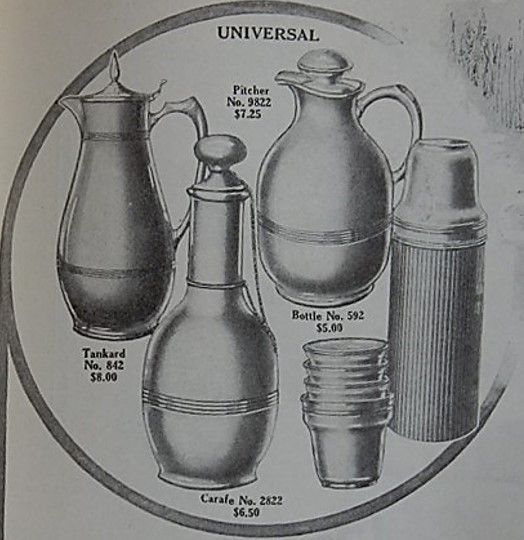
Keep Coffee Warm with a Thermos

Source: Good Housekeeping (October, 1917)

A household hints column in a 1917 issue of Good Housekeeping invited readers to send in their tips for possible publication Readers whose submissions were published received $1 from the magazine. One hint was to keep coffee warm in a thermos bottle when entertaining.

Let the Thermos Help Out

I find my thermos bottle comes in handy when I wish to serve coffee to more people than my percolator will accommodate. My percolator will hold six cups. This I make in the regular way an hour or so before I wish to serve it. Pour it into the thermos bottle, which of course, would keep it hot for hours, and then proceed to make another potful to be ready just in time to serve. The coffee in the thermos bottle I hold in reserve for the second helping.  — Mrs. M.E., Minn.

Good Housekeeping (October, 1917)

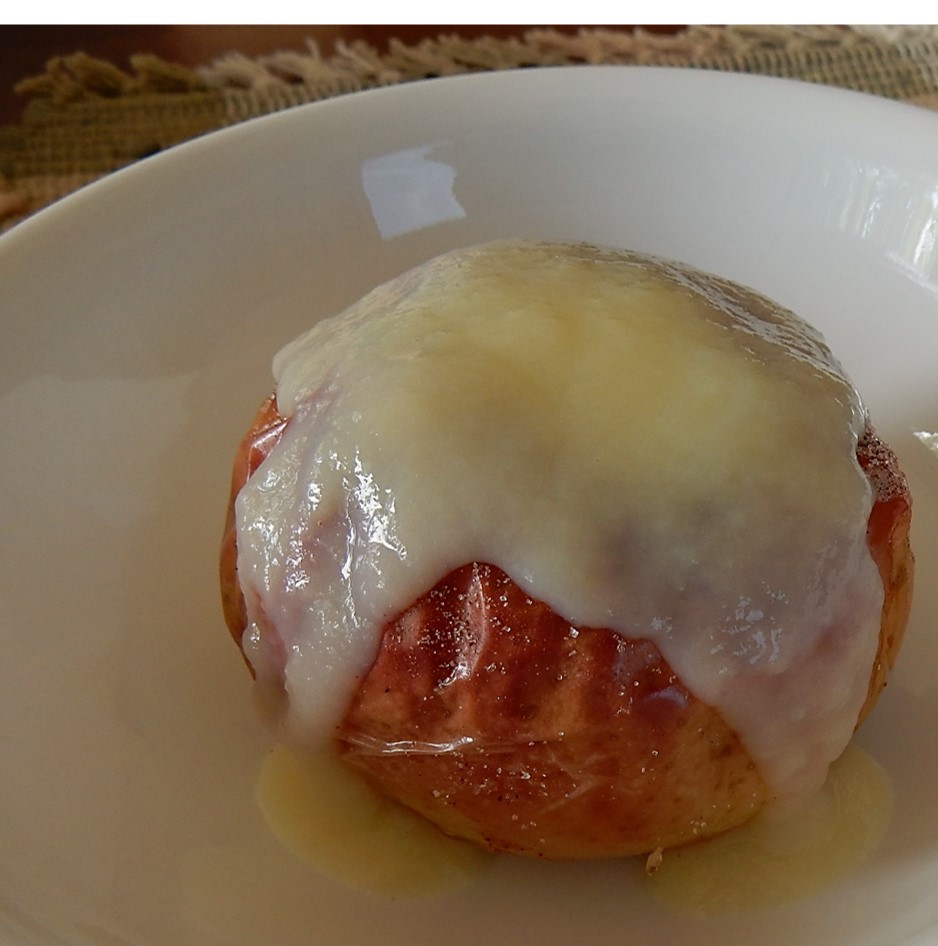
Old-Time Baked Apples with Sauce

Baked apples are one of my Fall comfort foods, so I was thrilled to find a delightful hundred-year-old recipe for them. The recipe had a new (old?) twist – serve the apples with a custard sauce.

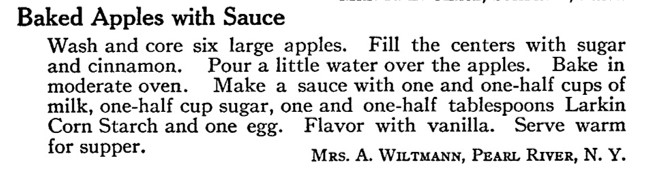
Here’s the original recipe:

Source: Larkin Housewives Cook Book (1917)

And, here’s the recipe updated for modern cooks:

Baked Apples with Sauce

  • Servings: 6
  • Difficulty: moderate
  • Print

3/4 cup sugar

1 teaspoon cinnamon

6 apples (Use an apple variety that keeps its shape when cooked – Rome, Golden Delicious, Granny Smith, Braeburn, etc.)

1/4 cup water

1/2 cup sugar

1 1/2 tablespoons corn starch

1 1/2 cups milk

1 egg. beaten

1 teaspoon vanilla

Preheat oven to 350° F. In a small bowl, combine the cinnamon and sugar. Set aside.

Core apples, and place in a baking dish. (The baking dish will be easier to clean if it is lined with foil.)  Spoon sugar and cinnamon mixture into the center of the apples. (Depending upon the size of the apples, there may be some left-over cinnamon and sugar.) Drizzle a small amount of water over each apple. Place in oven and bake until tender (about 35 – 45 minutes).

In the meantime, make the sauce by putting the sugar and corn starch in a saucepan; stir to combine. Slowly stir in the milk, then put on the stove and bring to a boil using medium heat. Remove from heat and place a small amount (approximately 1 – 2 tablespoons) of hot mixture into dish with the beaten egg, stir quickly. Add the egg mixture to the hot liquid in the saucepan and return to heat. Cook for 1 minute while constantly stirring.  Remove from heat and stir in vanilla.

To serve, spoon sauce over the baked apples. Serve warm.

Soy: The Coming Bean

Soybean Plan (Source: Good Housekeeping, September, 1917)

According to a 2007 CNN story,  “Soybeans, usually in the form of oil, ­ account for an astonishing 10 percent of our total calories in the United States.” It was very different a hundred years ago when soybeans were a new crop in the U.S.  Here’s some excerpts from a 1917 magazine article promoting the use of soybeans. (Back then “soy” and “bean” were two separate words.)

Soy: The Coming Bean

The soy bean, also called the soja bean, is a native of south-eastern Asia, and has been extensively cultivated in Japan, China, and India since ancient times. The beans are there grown almost entirely for human food, being prepared for consumption in many different ways.

The soy is a coming bean if not the coming bean. It is on its way to arrival in the American kitchen and dining room.

The outstanding fact of importance to consumers of food in the United States today is that a nutritious, palatable, easily grown (and therefore eventually cheap) legume is being recommended by the food experts. Pressure of circumstances has revived interest in foods and combinations of food of which the majority were old and have been forgotten. The soy bean, however, is to practically all American cooks and to the large body of food manufacturers an entirely new product.

Good Housekeeping (September, 1017)

Old-fashioned Stuffed Sweet Potato Recipe

Sweet potatoes are the perfect Fall vegetable – they’re both delicious and nutritious. They are a rich source of vitamins A and C, and contain substantial amounts of calcium and potassium.  So when I saw a hundred-year-old recipe for Stuffed Sweet Potatoes, I had to give it a try.

The recipe was a winner. It was easy-to-make, visually appealing, and most important, tasty. Here’s the original recipe:

Source: Larkin Housewives Cook Book (1917)

And, here’s the recipe updated for modern cooks (I halved the original recipe.):

Stuffed Sweet Potatoes

  • Servings: 3 - 4
  • Difficulty: easy
  • Print

3 medium sweet potatoes

1 tablespoon butter

1/4 teaspoon salt

dash pepper

2 teaspoons minced parsley

1 egg white, beaten

Preheat oven to 400° F. Prick each sweet potato several times with the tines of a fork. Place of a foil-lined baking sheet and bake until tender (about 45 minutes – 1 hour, depending upon size).  Take out of oven, and cut each sweet potato in half. Gently scoop out pulp, and put into a bowl. Mash; then add butter, salt, pepper, and parsley. Mix thoroughly, then refill the skins. (The mixture should be heaped and nicely rounded–which means that not all the potato skins will be needed. ) Brush with beaten egg white. Put under the broiler until the top is lightly browned.

I used less salt than called for in the original recipe because it seemed excessive for my taste.