Old-fashioned Cabbage and Beet Salad


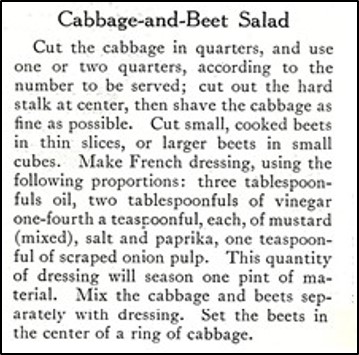
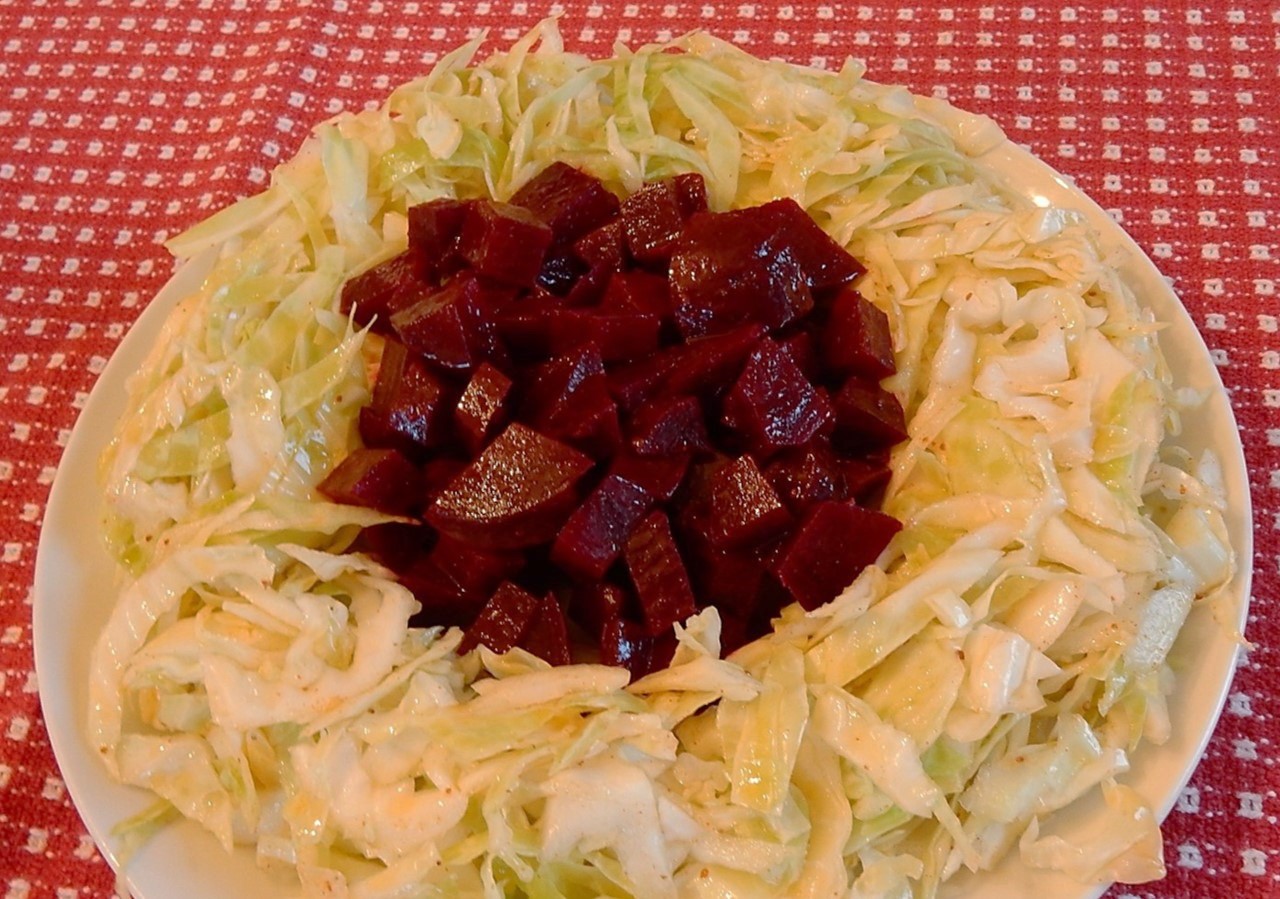
Sometimes salads can seem a bit boring, so I was delighted to find a hundred-year-old recipe for Cabbage and Beet Salad. This salad makes a lovely presentation that is just a tad dramatic. And, a subtle homemade French dressing adds just the right amount of flavor to the salad.

Here’s the photo and recipe for Cabbage and Beet Salad in the hundred-year-old magazine:
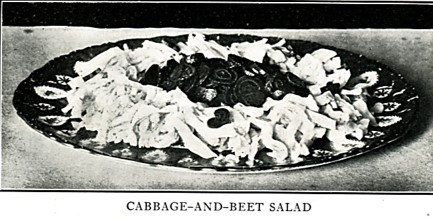
Source: American Cookery (August – September, 1918)

And, here is the recipe updated for modern cooks:

Cabbage and Beet Salad

  • Servings: 5-7
  • Difficulty: moderate
  • Print

1 small cabbage, shredded (about 5 cups shredded cabbage)

2 medium beets, cooked and diced into 1/2 inch cubes (about 1 cup diced, cooked beets)

French Dressing

6 tablespoons olive oil

4 tablespoons vinegar

1/2 teaspoon salt

1/2 teaspoon mustard

1/2 teaspoon paprika

2 teaspoons onion, finely minced

Put shredded cabbage in a bowl; gently stir in 2/3 of the French dressing. Put in refrigerator, and chill for at least 2 hours.

Put diced beets in another bowl; gently stir in 1/3 of the French dressing.  Put in refrigerator, and chill for at least 2 hours.

To serve:  Drain any excess dressing from the shredded cabbage, then arrange the cabbage in a ring with a hole in the center. (I pressed the cabbage into a circular mold, covered with the serving plate, and then quickly flipped and removed mold – but a mold is not necessary.)

Drain any excess liquid from the beets. Place beets in the center of the ring. Serve immediately.

To make French Dressing:  Put olive oil, vinegar, salt, mustard, and paprika in a small bowl; stir to combine. Stir in minced onion.

Food-Related Humor a Hundred Years Ago

Image Source: Larkin Housewives’ Cook Book (1915)

In the early 1900’s magazines often had humor pages. What is considered funny has really changed over the past hundred years, and often the humor in those magazines falls flat (or is even offensive) by modern standards. But, some hundred-year-old humorous stories still make me smile. Here are a few food-related humor items:

Little Elizabeth and her mother were having luncheon together, and the mother, who always tried to impress facts upon her young daughter, said, “These little sardines, Elizabeth, are sometimes eaten by the larger fish.”

Elizabeth gazed at the sardines in wonder and then asked, “But, mother, how do the large fish get the cans open?”

American Cookery August-September, 1918)

“Waiter,” said the indignant customer, “what does this mean? Yesterday I was served for the same price with a portion of chicken twice the size of this.”

“Yes, sir,” answered the waiter. “Where did you sit?” “

Over by the window.”

“Then that accounts for it. We always give people who sit by the windows large portions. It’s an advertisement.”

American Cookery (October, 1918)

A  hobo knocked at the back door, and the woman of the house appeared.

“Lady, I was at the front . . . “

“Poor man!” she interrupted. “Wait till I give you some food, and then you shall tell me your story.” After she had given him a hearty meal she anxiously inquired, “What brave deed did you do at the front? “

“I knocked, “he replied meekly, “but couldn’t make nobody hear, so I came around to the back.”

American Cookery (October, 1918)

Old-fashioned Okra and Tomatoes

I seldom eat okra, but I recently saw some beautiful okra at the local farmers’ market, and decided to give it a try. Then, of course, I had to find a hundred-year-old okra recipe. I found a delightful Okra and Tomatoes recipe in 1904 Kentucky cookbook, called The Bluegrass Cookbook.

The Okra and Tomatoes (and a little onion) were tasty, as well as easy-to-make and nutritious. One drawback – the okra had a bit of a gooey (some call it a slimy) texture; but that’s just par for the course for this vegetable.  No vegetable’s perfect.

Here’s the original recipe:

Source: The Bluegrass Cook Book by Minnie C. Fox (1904)

And, there’s the recipe updated for modern cooks:

Okra and Tomatoes

  • Servings: 3-4
  • Difficulty: easy
  • Print

1 cup okra, sliced

2 medium tomatoes

1/4 cup onion, diced

1 tablespoon butter

1/2 teaspoon salt

1/8 teaspoon pepper

Put okra in a saucepan, and add enough water to just barely cover it. Bring to a boil using high heat, then reduce heat to low and cook until tender (about 10 minutes). Remove from heat, and thoroughly drain.

In the meantime, put a pan of water on the stove; bring to a boil. Drop the tomatoes into the water for about 15 seconds: remove from heat and gently slip the skin off the tomatoes. Core tomatoes, then dice.  Put the diced tomatoes in a saucepan, and using medium heat cook 5 minutes while stirring frequently; then add onions. Continue cooking and stirring until soft and juicy (about an additional 5 minutes). Stir in butter, salt, and pepper. Add cooked okra, and stir gently to combine. Serve immediately.

Note: See the reader comments. Several readers suggested adaptations to this recipe that might improve the texture and make the okra less gooey.

Hundred-year-old Advice for Buying in Quantity

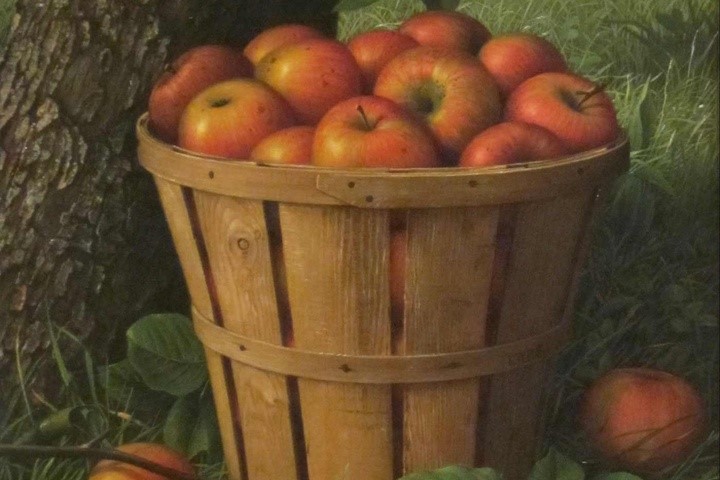
Basket of Apples (1895) by Levi Wells Prentice (Source: Wikimedia Commons)

Today people often buy food in bulk to save money. A hundred years ago people also wanted to purchase food wisely. Here’s some advice in a 1915 home economics textbook:

For a large family with room for storage it is cheapest to buy supplies in quantity. There is, however, even for the small family a real saving in careful buying. For example, if certain package goods are offered for fifteen cents per package or two for twenty-five cents, buy two if they can be used. The two and one-half cents saved on each package may seem a small saving, but in terms of percent it amounts to sixteen and two-thirds percent, or one-sixth of the whole.

A penny saved is a penny earned, and when it is done by careful buying it is far more easily earned than if some sacrifice is made to save it. In buying canned goods a reduction is often secured by taking a dozen cans or a case at a time.

Frequently a whole basket of fresh fruits and vegetables such as peaches and tomatoes can be purchased for little more than the price of a small quantity. If a whole basket is more than is needed for immediate use, one can preserve the surplus by cooking or canning it.

Science of Home Making: A Textbook in Home Economics (1915) by Emma E. Pirie

Old-fashioned Graham Nut Muffins

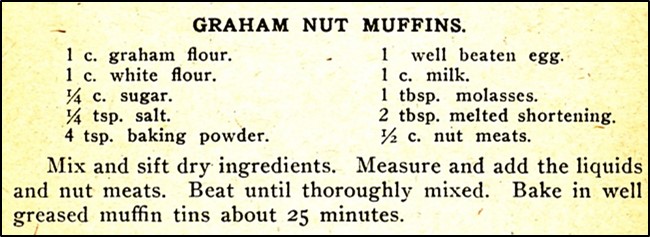
Maybe it’s just me, but I’m soooo tired of the sugary muffins typically sold at coffee shops, so I was pleased to recently find a hundred-year-old recipe for Graham Nut Muffins. The recipe called for just a little sugar (and a little molasses). The nuts embedded in the muffin add flavor and texture. This hearty muffin has a nice texture, is tasty, and is a healthy alternative to sweeter muffins.

Here’s the original recipe:

Source: The Housewife’s Cook Book by Lilla Frich (1917)

And, here’s the recipe updated for modern cooks:

Graham Nut Muffins

  • Servings: approximately 16 muffins
  • Difficulty: easy
  • Print

1 cup graham flour

1 cup all-purpose flour

1/4 cup sugar

1/4 teaspoon salt

4 teaspoons baking powder

1 egg, beaten

1 cup milk

2 tablespoons molasses

2 tablespoons butter, melted

1/2 cup nuts, chopped (I used walnuts.)

Preheat oven to 400° F. Grease muffin pans (or use paper liners). In a mixing bowl combine graham flour, all-purpose flour, sugar, salt and baking powder. Add egg, milk, molasses and butter; then stir just enough to combine. Gently stir in the nuts. Spoon batter into muffin  cups; fill each cup about 3/4ths full. Place in oven. Bake approximately 25 minutes or until lightly browned and the muffins spring back when lightly touched.

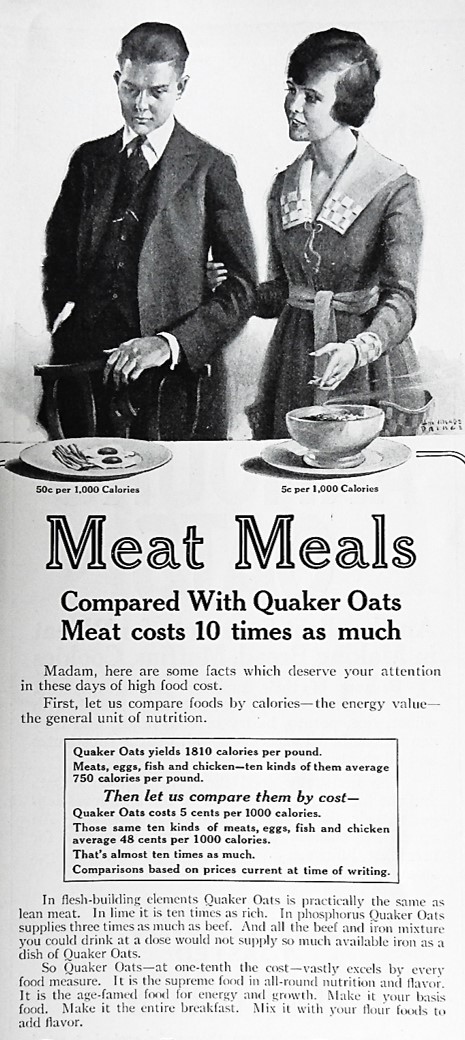
1918 Quaker Oats Advertisement

Source: Ladies Home Journal (May, 1918)

Food is expensive – both a hundred years ago and now. It’s interesting to see how a 1918 advertisement for Quaker Oats framed the cost of meals around calories. Back then, apparently getting more calories per amount spent was considered a good thing.  Today, are people willing to spend more to get fewer calories?

Old-fashioned Tomato and Nut Salad (Stuffed Tomato with Nut Salad)

The dog days of summer are upon us, but the good news is that delectable garden-fresh tomatoes are plentiful.  So I was thrilled to recently find a hundred-year-old recipe for Tomato and Nut Salad.  This is really a stuffed tomato recipe. The tomato is stuffed with a mixture of chopped tomatoes, walnuts, and green pepper, with a little mayonnaise for added flavor and to bind everything together. The crunchy stuffing reminds me of Waldorf salad – though that isn’t exactly an accurate description since there are no apples in this recipe.

The recipe calls for peeling the tomato. I almost skipped this step- but it’s worth doing. The peeled tomato has a lovely velvety surface which adds to the presentation.

Here’s the original recipe:

Source: Lowney’s Cook Book (1912)

And, here’s the recipe updated for modern cooks:

Tomato and Nut Salad (Stuffed Tomato with Nut Salad)

  • Servings: 1 serving per tomato
  • Difficulty: moderate
  • Print

For each serving use the following ingredients:

1 medium tomato

2 teaspoons walnuts, chopped

2 teaspoons green pepper, chopped

2 teaspoons mayonnaise

lettuce leaves, optional

Put a pan of water on the stove; bring to a boil. Drop the tomato into the water for about 15 seconds: remove from heat and gently slip the skin off the tomato.  Using a knife remove the stem end and the firm core from the tomato and discard. Scoop out the tomato pulp and seeds, place in a strainer and drain off any excess liquid. Place pulp in a bowl; add the walnuts and green pepper. Stir in the mayonnaise, then stuff the tomato with the mixture. If desired serve on lettuce leaves.