Law on the Farm

16-year-old Helena Muffly wrote exactly 100 years ago today: 

Wednesday, July 19, 1911: Nothing doing.

Her middle-aged granddaughter’s comments 100 years later:

I guess that it was a slow day on the farm a hundred years ago today, so I’ll tell you about an interesting question and answer column call Law on the Farm that I found in the July 1911 issue of Farm Journal. Here are two questions submitted by Pennsylvania subscribers and the answers:

Will of a Married Woman

Where a married woman dies, leaving her husband, but no children surviving, can she give all of her property by will to her niece to the entire exclusion of her husband?

Pennsylvania Subscriber

No; under the Pennsylvania Act of 1893, a married woman is given full power to make a will, provided, however, that nothing in the act shall affect the husband’s right of courtesy nor his right to take against the will as provided by existing laws.

I wonder if the answer would have been the same if a married man died, leaving a wife, but no children.

Here’s another question that was in the column:

Rights in Running Stream

Has the owner of land through in which a stream runs the right to empty slops and wash water into it or to dam the water up? If he does the latter, has the lower proprietor the right to go on the land and turn the water loose?

Pennsylvania Subscriber

Every one who owns land along a running stream owes to lower proprietors the duty not to pollute the stream, nor to dam up or divert the water so as to cause damage to the lower owners. The proper remedies of the latter, however are by an action for damages or an injunction, and the aggrieved parties are not entitled to come on the land of the upper proprietor and turn the water loose unless such action is urgently necessary to prevent serious injury.

Little Brother Playing with Friend

16-year-old Helena Muffly wrote exactly 100 years ago today: 

Tuesday, July 18, 1911: Besse and her little nephew were out this afternoon.  Jimmie had quite a romp with said fellow. I can’t write very much about myself these days.

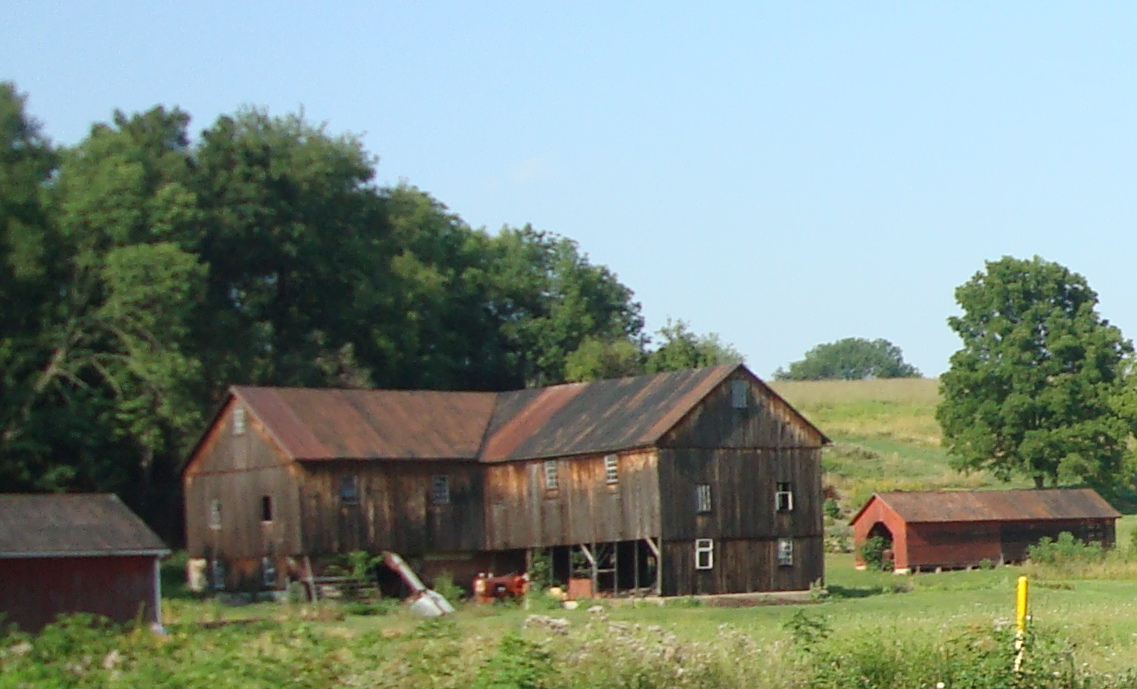
Recent photo of the Muffly farm. If I use my imagination I can almost see 5-year-old Jimmie chasing a friend around the yard.

Her middle-aged granddaughter’s comments 100 years later:

Grandma’s  brother Jimmie was 5-years-old, and her sister Besse was married to Curt Hester. One of Curt’s sisters or brothers must have had a son.

Visiting Friends

16-year-old Helena Muffly wrote exactly 100 years ago today: 

Thursday, July 13, 1911: Accompanied Ruthie up to Oakes’s this evening. She was going to a party this evening, but didn’t do because her friends didn’t go.

Her middle-aged granddaughter’s comments 100 years later:

The Oakes lived half a mile or so from the Muffly’s. Rachel Oakes was a friend of Grandma and her sister Ruth. And, Ruth was dating Jim Oakes.

Recent photo of the farm where Rachel and Jim Oakes lived.

Lawn Dress Finished

16-year-old Helena Muffly wrote exactly 100 years ago today: 

Wednesday, July 12, 1911:  Mother finished my dress today. Now I will have at least one suitable gown for this season. My wardrobe is rather limited, no silks or satins or velvets.

Her middle-aged granddaughter’s comments 100 years later:

Grandma sounds really pleased that the dress is finally finished. It must have turned out well.

It took Grandma’s mother two and one-half weeks to make the dress. On Saturday, June 24 Grandma had written:

Mother cut my lawn dress out this afternoon. Am going to see how long it takes her to finish it. I give her till next Sat.

Grandma hoped that her mother would finish making the dress in one week, but on Saturday, July 1 she wrote:

 . . . Mother hasn’t finished my dress yet. I really need it.

I wasn’t sure what lawn cloth was, so I googled it. Lawn is a light fabric made with a very fine weave. A hundred years ago lawn cloth was generally made using linen; today it is often cotton.

Grandma wearing a dress made out of lawn cloth. I think this photo is her high school graduation photo and that it was taken in 1913, so it probably isn't the dress mentioned in this diary entry.

25 Largest Cities in US, 1911 and 2011

16-year-old Helena Muffly wrote exactly 100 years ago today: 

Friday, July 7, 1911: Nothing much at all to write about.

Her middle-aged granddaughter’s comments 100 years later:

Four days ago, I posted the high temperature in 25 cities for July 3, 1911. At that time I wondered which cities were the largest cities in the US in 1911. Since Grandma didn’t have much to say a hundred years ago today, I’ll tell you what I found.

The 25 largest cities in 1911 were:largest cities, 1911

And, then I wondered which cities are the largest now—and what their rank had been in 1911:

largest cities, 2011

One thing that really surprised me about these lists is that the rank of Detroit was about the same in both 1911 and 2011 (9th in 1911 and 11th in 2011), so I looked at the rank in some of the intervening years. Detroit apparently grew rapidly as the auto industry took off—and it was the 4th largest city in the US by 1920.

For those who care about the details: I used US Census Bureau data for the ranks. The 1911 numbers are based on the 1910 census; the 2011 ranks are based on 2009 estimates. There may be some minor changes in the rank when detailed data become available from the 2010 census.

July 3, 1911: High Temperature in 25 Cities Across US

16-year-old Helena Muffly wrote exactly 100 years ago today: 

Monday, July 3, 1911: My, but I’m so roasted, worse than yesterday, I guess. Made an errand up to McEwensville this evening in behalf of my popper.

This is a recent view of the buildings Grandma would have seen as she walked into McEwensville. A hundred years ago the road would have been dirt.

Her middle-aged granddaughter’s comments 100 years later:

A hundred years ago today the horrible heat wave continued across most of the country. The effects were devastating in this era before electric fans or air conditioning. This is the second day in a row that Grandma said she was roasted.

The Minneapolis Morning Tribune reported the July 3, 1911 temperatures for 25 cities across the nation

HOT WAVE CONTINUES TO EXACT HEAVY TOLL

Scores Throughout Country Succumb and Hundreds Are Overcome

Mercury Officially Climbs to 104 in Four Places Far Apart.

People Seeking Relief in Big Cities Sleep in Parks and Roofs.

High Temperatures in Many Cities on Monday

Louisville, Ky . . . 104

St. Joseph, Mo . . . 104

Davenport, IA . . . 104

Yuma, Ariz. . . . 104

Boston . . . 102

Albany. . .102

Kansas City. . .102

Columbus, O. . . .102

Dubuque, Ia. . . . 102

Fresno, Cal. . . 102

Chicago. .  .100

Harrisburg . . . 100

Fort Wayne . . . 100

Cincinnati. . . 100

Springfield . . . 100

St. Louis . . . 100

Indianapolis . . .100

Wash’ton, D.C. . .  99

New York City . . . 98

Philadelphia. . . 98

Northfield, Vt. . . 98

Pittsburg. . . 98

Lynchburg, Va. . . 98

Wichita, Kan.  . . 98

Minneapolis Morning Tribune (July 4, 1911)

An aside: It’s interesting to see which cities were included in the list, as well  which cities were considered to be so major that they didn’t need state names after them. It’s also interesting to see how some state names were abbreviated in 1911. For example, Ohio was abbreviated with an O.  (I wonder what the abbreviation was for Oklahoma in 1911.)

Hot Weather: Almost Roasted

16-year-old Helena Muffly wrote exactly 100 years ago today: 

Sunday, July 2, 1911: Almost roasted today. Went to Sunday school this afternoon. We had company this evening. One of Ruthie’s future pupil’s and parents.

Her middle-aged granddaughter’s comments 100 years later:

July 2, 1911 was an extremely hot day across the Eastern and Midwestern US. The New York Times reported that on July 2 in  New York City it was:

 . . . the hottest day here in twelve years. Mercury up to 94.5, with 72 per cent. humidity, and next to no breeze.

The paper also reported that:

HARRISBURG, Penn, July 2—The temperature today reached 98.2, the hottest recorded since July 1, 1901, when 100 was the maximum. The intense heat caused much sickness.

New York Times (July 3, 1911)