Old-Fashioned Praline Ice Cream (Prauline Ice Cream)

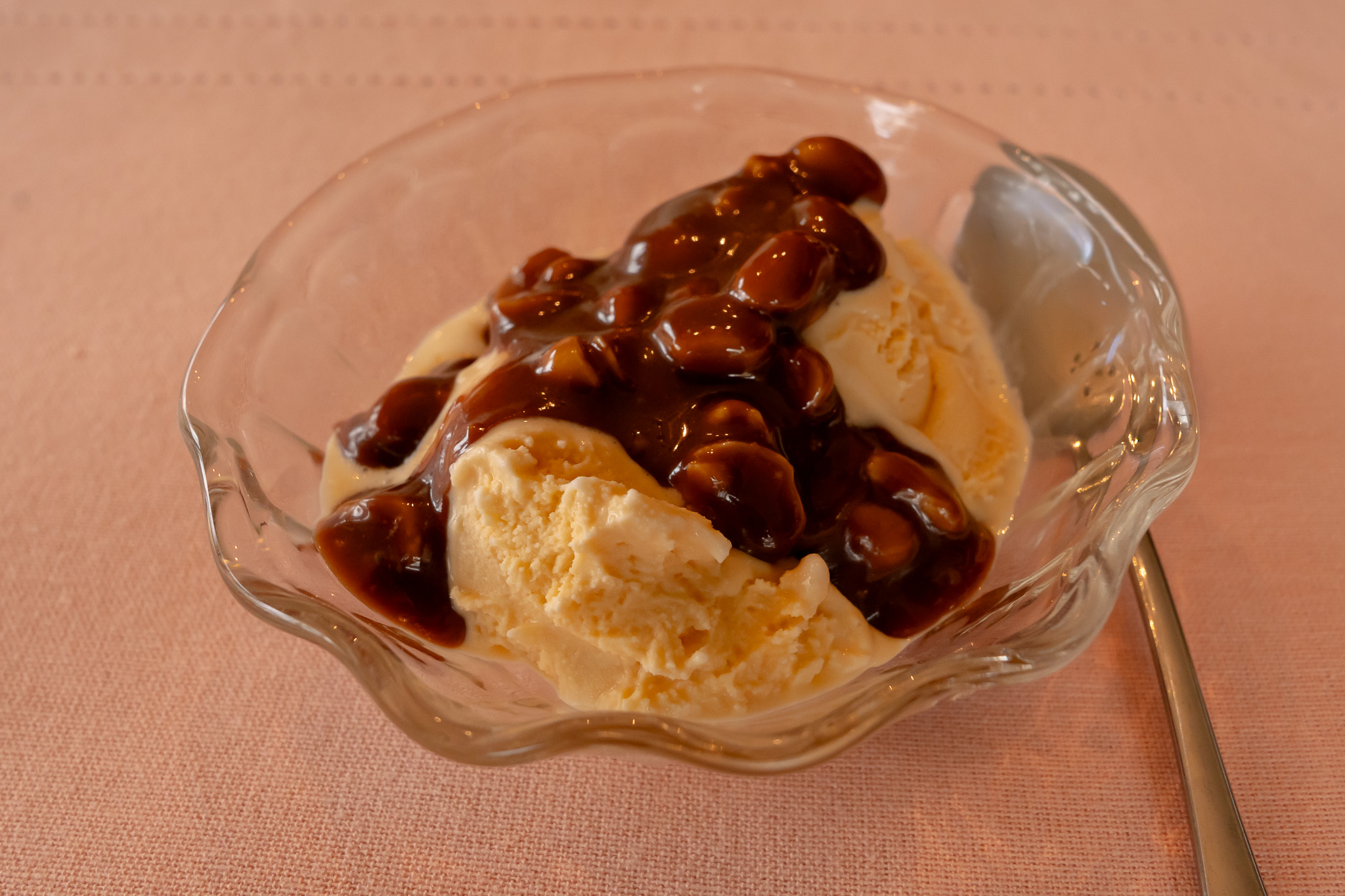
bowl of praline ice cream

Summer has arrived and temperatures are soaring. On hot days, nothing hits the spot like ice cream. I came across a hundred-year-old recipe for Praline Ice Cream and decided to give it a try.

The ice cream was delightful with small pieces of pecans and crunchy caramelized sugar brickle.

Here’s the original recipe:

Recipe for Praline Ice Cream
Source: The Daily Argus-Leader Home Economics and Cook Book, Sioux Falls, South Dakota (1925)

I think that there is a typo in the title of this recipe, and that it is for “Praline Ice Cream” and not “Prauline Ice Cream.”

The recipe called for chopped nuts. Of course, I used chopped pecans. (It just wouldn’t seem like Praline Ice Cream with any other kind of nut.) I did not combine the chopped pecans with the caramelized sugar prior to breaking the caramelized sugar into very small pieces.  Instead, I spooned the caramelized sugar onto a buttered plate to cool, then put the pecans in the pan (which still contained a little melted sugar), and stirred for a minute or two. A mortar and pestle could be used to break the cooled praline mixture into very small pieces. I actually used the “pulse” feature on my blender to create the small pieces. I then combined the pecans and the praline pieces. I’m not sure exactly what was meant when the recipe said to sift the praline mixture after it is broken apart, so I skipped sifting.

I did not use a double boiler, and instead just stirred the milk mixture constantly, which worked fine. I always have difficulty with ice cream recipes that call for adding egg yolks to the hot milk. No matter how hard I stir, I end up with small clumps of cooked egg yolk in my mixture, so I strained it after cooking to remove them.

I did not stir the praline mixture into the milk mixture until the ice cream began to harden in the ice cream freezer. My ice cream freezer directions say that nuts, fruits and other additives should be added about 5 minutes prior to the completion of the churning.

Here’s the recipe updated for modern cooks:

Praline Ice Cream

  • Servings: 6 - 8
  • Difficulty: moderate
  • Print

1/2 cup sugar + 1/2 cup sugar

butter

3/4 cup chopped pecans

2 egg yolks

1/2 teaspoon salt

2 cups milk

2 1/4 teaspoons vanilla

1 cup heavy cream

Caramelize 1/2 cup sugar by putting  in a small cast iron skillet; put over low heat and stir constantly until the sugar turns light brown. Spoon the caramelized sugar onto a lightly buttered plate and let cool. There will be a little sugar that has liquified still in the skillet; add the chopped pecans and stir for 1-2 minutes to lightly toast the pecans and to coat with the sugar. Once the caramelized sugar has cooled, break into very small pieces using a mortar and pestle (or the pulse function on a blender), then combine with the chopped pecans. Set aside.

In a bowl,  combine 1/2 cup sugar, the egg yolks, and salt. Stir until thoroughly mixed and smooth. Set aside.

In a saucepan, scald the milk using medium heat while stirring constantly. Slowly pour the hot milk over the egg yolk and sugar mixture while stirring briskly. Return the mixture to the saucepan, and using medium heat, cook while stirring constantly until the mixture thickens. Remove from heat and strain to remove any small pieces of egg yolk that clumped together during cooking. Chill in the refrigerator.

Shortly before churning the milk mixture into ice cream, whip the cream to the firm peak stage. Stir the vanilla into the chilled milk mixture, then fold in the whipped cream.  Freeze following freezer directions. Add the small pieces of caramelized sugar and pecans about 5 minutes before churning is completed. Continue churning until the caramelized sugar and pecans are distributed throughout the ice cream.

(When I made this recipe, I used a 1 1/2 quart automatic ice cream maker that with a bowl which is frozen in the freezer overnight, but a regular ice cream maker would also work.)

http://www.ahundredyearsago.com

Old-Fashioned Hot Walnut Sandwiches (Walnut Biscuits)

Hot Walnut Sandwiches (Walnut Biscuits)

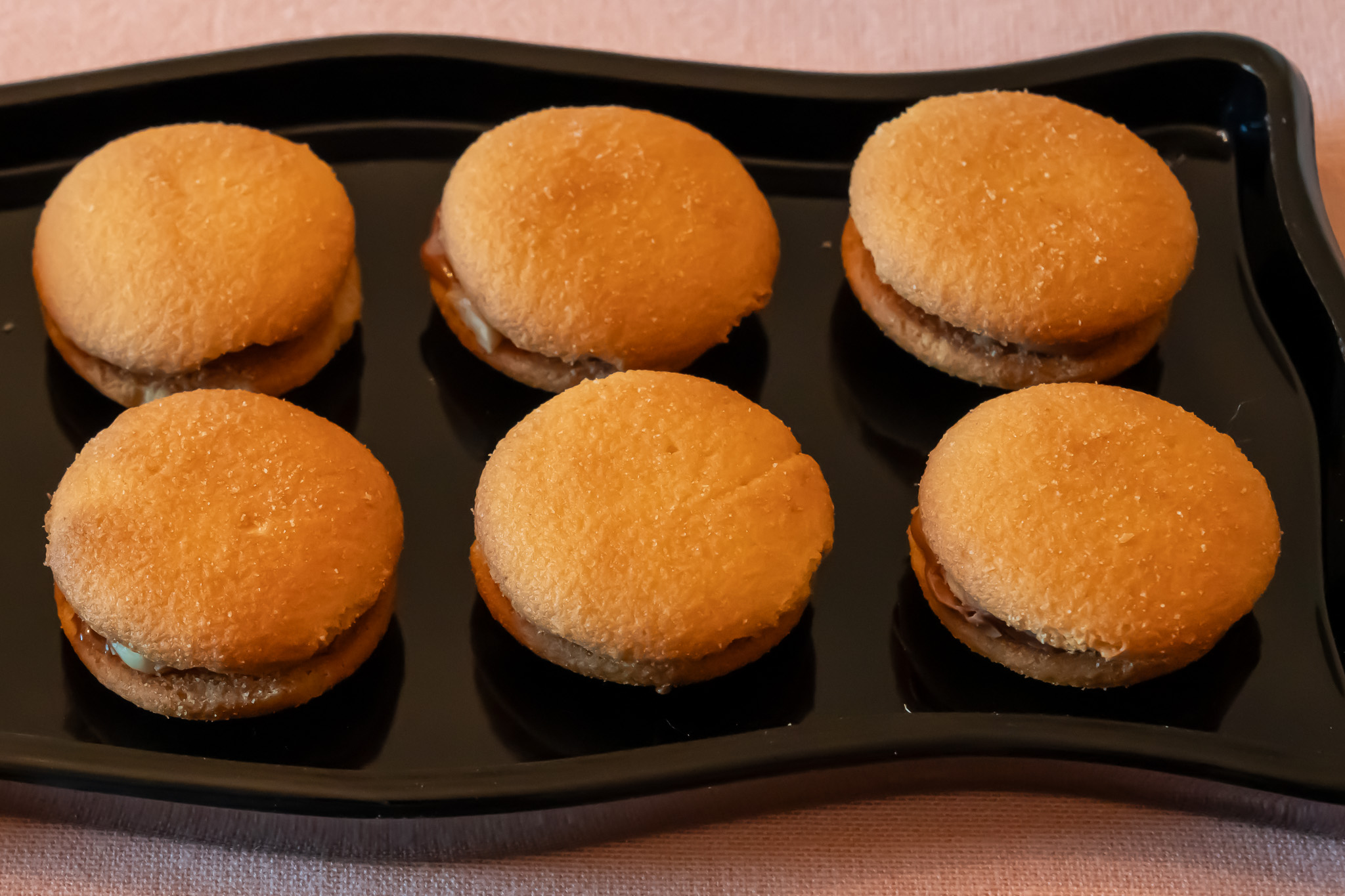
I was intrigued by a recipe in a hundred-year-old newspaper recipe supplement. The recipe title was Hot Walnut Sandwiches, but it was labeled as a biscuit recipe. The recipe called for making baking powder biscuit dough, then putting chopped walnuts between two biscuit rounds, and baking.

This recipe does not call for any sugar, so the Hot Walnut Sandwiches were not sweet and definitely tasted like a baking powder biscuit, but the walnuts were a nice twist and a fun addition. The Hot Walnut Sandwiches were tasty. I especially liked them when I smeared a little butter on them.

Here’s the original recipe:

Hot Walnut Sandwiches (Walnut Biscuits)
Source: The Daily Argus-Leader Home Economics and Cook Book, Sioux Falls, South Dakota (1925)

The recipe calls for putting the chopped walnuts on top of half of the dough, then folding the other half over it, and cutting with a biscuit cutter. This results in a lot of scraps of dough embedded with walnuts. I found that it worked better to cut all the circles first (and re-roll the dough as needed), then put the walnuts on half of the circles and top with the remaining circles of dough.

It’s interesting that the recipe indicated that 3/4 cup of milk should be used, but that it also stated in parentheses that this is 1 1/2 gills of milk. Gills are more commonly used today as a measure for alcohol when making mixed drinks, but apparently a hundred years ago it also was still occasionally used when measuring other ingredients.

Here’s the recipe updated for modern cooks:

Hot Walnut Sandwiches (Walnuts Biscuits)

  • Servings: approximately 12
  • Difficulty: moderate
  • Print

2 cups flour

4 teaspoons baking powder

1/2 teaspoon salt

2 tablespoons shortening

3/4 cup milk

1/2 cup chopped walnuts

Preheat oven to 425° F.  Sift together flour, baking powder, and salt in a mixing bowl. Cut in the shortening, then stir in the milk until combined. On a lightly floured surface, roll the dough until 1/4-inch thick. Cut with a round biscuit cutter. (I used a drinking glass as the cutter.) Sprinkle chopped walnuts on half of the circles, then put the remaining circles on top of the walnuts. Lightly press together. Place on a baking sheet, and bake for 10-12 minutes, or until lightly browned. Serve warm.

http://www.ahundredyearsago.com

Old-Fashioned White Layer Cake with Caramel Nut Filling


slice of white cake with caramel nut filling

Layer cakes with a filling between the layers were very popular a hundred years ago. Modern cookbooks often have a few frosting recipes and maybe one or two cake filling recipes at the end of the Cake chapter, but some old cookbooks have so many filling and frosting recipes that they have a separate chapter for them. For example, a 1925 cookbook, the Rumford Complete Cookbook, has a chapter titled Cake Fillings, Frostings, and Icings. There are eleven cake filling recipes including Fig Filling, Maple Filling, Orange and Walnut Filling, Orange and Coconut Filling, Mocha Filling, Marshmallow Filling, Prune Almond Filling, and Caramel Nut Filling.

All the fillings looked either intriguing or tasty, but I only wanted to make one cake, so I had to pick one. Some of the fruit fillings tempted me, but in the end I decided to make Caramel Nut Filling. I thought that a white cake would work well with this filling, so I flipped back to the Cake chapter and found a recipe for White Layer Cake.

After I assembled the cake with the filling in the middle, I iced it with a Buttercream Frosting. There were no Buttercream Frosting recipes in the Rumford Complete Cookbook. I guess that the author assumed that cooks knew how to make it without a recipe.

The cake was excellent. The cake itself was moist, light, and tender with a delicate vanilla flavor. The filling was a lovely fusion of a rich caramel and crunchy nuts. (I used walnuts.)

Here’s the original cake recipe:

Recipe for White Layer Cake
Source: Rumford Complete Cook Book (1925)

The recipe does not specify which type of “flavoring extract” should be used. I used vanilla. The old recipe says to bake the cake for about twenty minutes. I baked the cake at 350° F. and it actually took about 25-30 minutes until a wooden pick inserted in the center came out clean.

Here’s the original Caramel Nut Filling recipe:

Recipe for Caramel Nut Filling
Source: Rumford Complete Cook Book (1925)

When I read the Caramel Nut Filling recipe, I was not sure what it meant when it said to cook the cream and sugar “till they begin to thicken.” I interpreted it to mean to cook it until it reached the soft ball stage (235° F.). This worked fine, and the filling turned out well.

Here are the recipes updated for modern cooks:

White Layer Cake with Caramel Nut Filling

  • Servings: 10 - 12
  • Difficulty: moderate
  • Print

White Layer Cake

4 egg whites

1/2 cup butter, softened

1 1/2 cups sugar

1/2 cup milk

1 teaspoon vanilla

2 teaspoons baking powder

1/3 teaspoon salt

1 1/2 cups flour

Preheat oven to 350° F. Grease two 9-inch round cake pans; line with waxed paper or parchment paper, then grease again and lightly flour.

Put egg whites into a mixing bowl, and beat until peaks form. Set aside.

Put butter and sugar in a large mixing bowl, then beat to cream. Add milk and vanilla, then add the baking powder, salt, and flour. Beat until well-mixed. Gently fold in the beaten egg whites. Pour half of the batter into each of the two cake pans.

Bake the layers for 25 to 30 minutes or until a wooden pick inserted in center comes out clean. Cool 10 minutes. Remove from pans. Cool the layers before assembling the cake.

Trim cake layers if needed to make even, then put a cake layer on a plate. Spread with the Caramel Nut Filling, and then top with the other layer. If desired, frost the cake. (I used a Buttercream Icing.)

Caramel Nut Filling

1 cup half and half

1 cup brown sugar

1 cup nuts, coarsely chopped (I used walnuts.)

Put the half and half and the brown sugar in a saucepan. Stir to combine, bring to a boil using medium heat. Reduce heat and simmer gently until the mixture reaches the soft ball stage (235° F.). Remove from the heat and stir in the chopped nuts. Spread between the layers of cake.

http://www.ahundredyearsago.com

Directions for Making Hard Boiled Eggs, 100 Years Ago, 50 Years Ago, and Today

Hard boiled egg halfMy husband recently said to me, “You don’t make hard boiled eggs right. The Wall Street Journal says that there are 16 steps involved in making good hard boiled eggs.”

I said, “Is that so there isn’t a green line around the yolk?”

He said, “No, it’s so the yolk has a nice texture.”

He then sent me the article. It was titled, The Science Backed, 16-Step Method for the Perfect Boiled Egg. It basically said to alternate every 2 minutes for 32 minutes between having the eggs in boiling water and tepid (86 degree F.) water.

After reading the article, I said, “That’s stupid. You just put the eggs in a pan of water, bring it almost to a boil, reduce the heat so it stays just below boiling, and time them for 20 minutes. Then you drain them and put them in a pan of cold water for a couple of minutes. Sometimes people make things unduly complicated. If you want 16-step eggs, you’ll have to make them yourself.”

But, the article did make me curious about how people historically made hard boiled eggs. That sent me to a hundred-year-old cookbook to see how they made hard boiled eggs in 1925:

To cook eggs so that they will be firm all the way through and yet not tough or indigestible, put them in a saucepan of boiling water, cover closely and place on the part of the stove where the water will remain very hot, but not boil and let stand for twenty minutes.

The Rumford Complete Cook Book (1925)

I then decided to see what the directions for making hard boiled eggs were midway between a century ago and now. I have a Betty Crocker cookbook published about 50 years ago (actually 49 years ago). It gave both cold water and boiling water methods:

Cold Water Method: Place eggs in saucepan; add enough cold water to come at least 1 inch above eggs. Heat rapidly to boiling. Remove from heat; cover. Let stand 22 to 24 minutes. Immediately cool eggs in cold water to prevent further cooking.  .  .

Boiling Water Method: Place eggs in bowl of warm water to prevent shells from cracking. Fill saucepan with enough water to come at least 1 inch above eggs; heat to boiling. With spoon, transfer eggs from warm water to boiling water. Reduce heat to below simmering; cook 20 minutes. Immediately cool eggs in cold water to prevent further cooking.

Betty Crocker’s Cookbook (1976)

The way I make hard boiled eggs is a variation of the 100-year-old directions as well as of the 50-year-old ones. I may be set in my ways, but I’m sticking with how I’ve always made hard boiled eggs. My bet is that the 16-step method is just a fad.

Old-Fashioned Surprise Salad

Surprise Salad

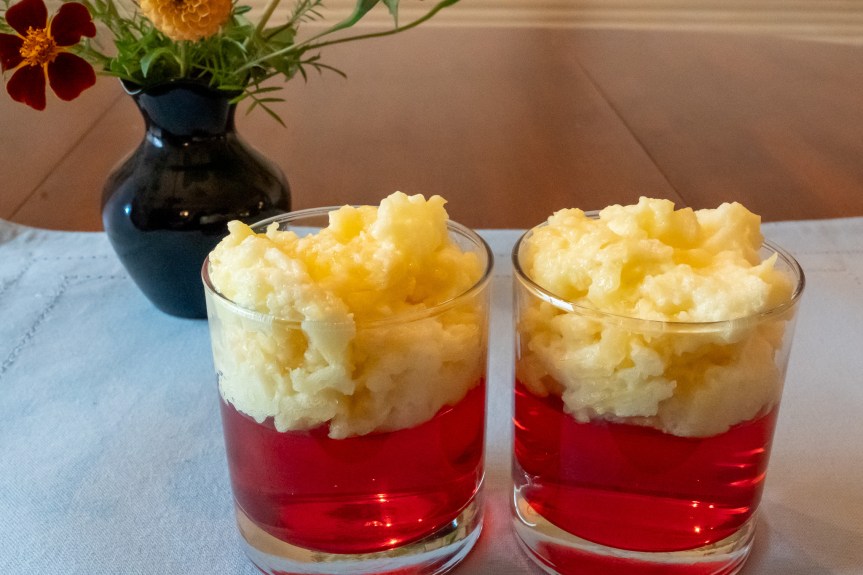
Sometimes recipe titles in old cookbooks do not provide much information about a recipe. For example, I recently came across a recipe for Surprise Salad in a hundred-year-old church cookbook. When I read the recipe, I was surprised to discover (maybe that’s why it’s called Surprise Salad) that it was a fruit salad that called for canned pineapple slices, canned peach halves, and fresh strawberries with marshmallows and a dollop of whipped cream for good measure. The salad is served on lettuce leaves. The ingredients are stacked with a focus on presentation.

I enjoyed the salad (though in some ways- especially if I skipped the lettuce – it seems more like a dessert than a salad). I would make it again. Occasionally, I have friends over and serve a meal based on hundred-year-old recipes. Surprise Salad would be perfect for one of those meals. The ingredients and presentation are different from modern recipes, which could lead to a fun conversation, but I also think that they would enjoy it,

Here’s the original recipe:

Recipe for Surprise Salad
Source: Diamond Jubilee Recipes (Compiled by The Sisters of Saint Joseph, St. Paul, Minnesota, 1925)

I tried dipping the whole strawberries that go on the top in powdered sugar, but I did not like the way it looked so I washed the powdered sugar off the berries.

Here’s the recipe updated for modern cooks:

Surprise Salad

  • Servings: 3
  • Difficulty: moderate
  • Print

1/2 cup strawberries + 3 small strawberries

1 tablespoon sugar

1/4 cup miniature marshmallows, each cut into two pieces

lettuce leaves

3 slices of canned pineapple

3 canned peach halves

1/4 cup whipped cream

Cut the strawberries in half (reserving 3 small strawberries that are left whole). If the berries are large, cut each berry into several pieces. Put the cut berries and cut marshmallows in a small bowl, then add sugar and gently stir to distribute the sugar.  Set aside.

For each serving, arrange lettuce leaves on plate, then put a pineapple slice on the lettuce. Place a peach half (with the center up) in the center of the pineapple slice. Fill the peach cavity with the strawberry and marshmallow mixture. Keep the strawberry/marshmallow mixture as level as possible to make a firm foundation for the whole strawberry that goes on the very top. Top with a spoonful of whipped cream, then garnish with a small whole strawberry.

http://www.ahundredyearsago.com


Old-Fashioned Honey Tea Crackers

honey tea crackers on plate

Want a cross between a cracker and a cookie? If so, I have just the recipe for you. I recently was browsing through a hundred-year-old cooking magazine and came across a recipe for Honey Tea Crackers. The name of the recipe made me salivate, and I was ready to give the it a try. But, when I looked at the recipe a little more, I was a little confused. The recipe called for putting an almond or walnut half on top of each cracker. Crackers don’t generally have nuts on top of them. And, when I thought about it, I realized that most crackers are salty or savory, not sweet.

The more I looked at the recipe, the more I was intrigued I became – and I soon was mixing up a batch of the crackers. Since it seemed unusual to put nuts on crackers, I did not put a nut on top of some of the crackers.

The recipe turned out well, though Honey Tea Crackers are not typical of modern crackers. In addition to honey, the crackers contain allspice as well as some lemon juice and grated lemon rind. The crackers were sweet with the complex undertones of honey and lemon, and a hint of allspice. They have the texture of a cut-out cookie that had been rolled out very thin. I put almonds on some crackers and walnuts on others. Both types of nuts worked well, and I don’t have a preference, but I definitely preferred the crackers that had a nut on top over the plain ones. In hindsight, I wish that had  just followed the old recipe and put a nut on top of all of them.

Here’s the original recipe:

Recipe for Honey Tea Crackers
Source: American Cookery (May, 1925)

I did not dissolve the baking soda prior to adding to the other ingredients, and it worked fine. The mixture, however, seemed very dry, so I added a little more than the 1 teaspoon of water called for in the recipe.

The recipe calls for pricking the crackers “all over.” I was surprised how long it took to prick a lot of crackers, so be sure to allow sufficient time.

Here’s the recipe updated for modern cooks:

Honey Tea Crackers

  • Servings: about 90 crackers
  • Difficulty: moderate
  • Print

3 cups flour

1 teaspoon salt

1 teaspoon allspice

1/4 teaspoon baking soda

3 eggs

grated rind of 1/2 lemon

juice from 1/2 lemon

3 tablespoons honey + 2 tablespoons honey

1 teaspoon water (add more if needed) + 2 tablespoons water

almonds or walnut halves (if desired)

Preheat oven to 350 degrees F.  In a small bowl, mix together 2 tablespoons honey and 2 tablespoons water. Set aside.

Sift together flour, salt, allspice and baking soda. Add eggs, grated lemon rind, lemon juice, 3 tablespoons honey, and 1 teaspoon water; stir to mix. If the dough is too dry, add additional water. On a prepared surface, roll the dough out until it is very thin (1/4 inch or a little less). Cut into circles using a round cutter. (I used a cutter that was 2 inches in diameter.) Put the crackers on a lightly greased baking sheet. Prick all over each cracker with a fork. Brush the crackers with the honey and water mixture. If desired, press an almond or walnut half into the center of each cracker. Put into oven, and bake for 15-20 minutes or until lightly browned.

http://www.ahundredyearsago.com

Old-Fashioned Pound Cake Waffles

Pound Cake Waffles

When browsing through hundred-year-old cookbooks, I came across a recipe for Pound Cake Waffles. The title intrigued me. The recipe called for lots of butter and sugar, and was very similar to actual Pound Cake recipes. I decided to give it a try. The recipe indicated that either lemon or vanilla flavoring could be used in the recipe. I went with lemon extract.

The waffles were lovely with a sunny lemon flavor that worked nicely with the maple syrup that I put on the waffles.

Here’s the original recipe:

Recipe for Pound Cake Waffles
Source: The Rumford Complete Cook Book (1925)

Here’s the recipe updated for modern cooks:

Pound Cake Waffles

  • Servings: 4 - 6
  • Difficulty: moderate
  • Print

3/4 cup butter

1 cup sugar

4 eggs, separated

1/4 cup milk

1 1/4 cups flour

2 teaspoons baking powder

1/2 teaspoon salt

1 teaspoon lemon extract or vanilla (I used lemon extract.)

Beat egg whites, then set aside. Put butter and sugar in a mixing bowl, then beat until creamed. Add the egg yolks and milk, then beat. Add the flour, baking powder, salt, and lemon extract or vanilla; beat until combined. Gently fold in the beaten egg whites. Ladle batter onto a hot waffle iron and cook, following the waffle iron directions.

http://www.ahundredyearsago.com