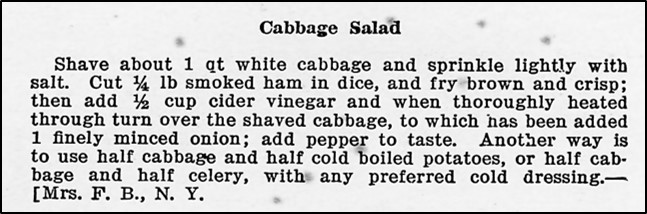
Sometimes coleslaw with its typical sugary, mayonnaise-based dressing can seem like a bit much. I recently came a hundred-year-old dressing for Cabbage Salad with Ham that calls for simply dressing it with warm vinegar. The simplicity of the dressing really brings out the flavor of this salad.
Here is the original recipe:
Source: The Old Reliable Farm and Home Cook Book (1919)
1 quart (4 cups) cabbage, grated (about 1 medium cabbage)
1 medium onion, finely minced
1/4 cup ham, diced
1/2 cup apple cider vinegar
1/4 teaspoon salt
1/4 teaspoon pepper
Combine grated cabbage and minced onion in a bowl. Set aside
Sauté diced ham in a skillet using medium heat until lightly browned. Stir in vinegar, salt, and pepper; heat until hot. Pour heated vinegar over cabbage and onion; stir to combine. Serve.
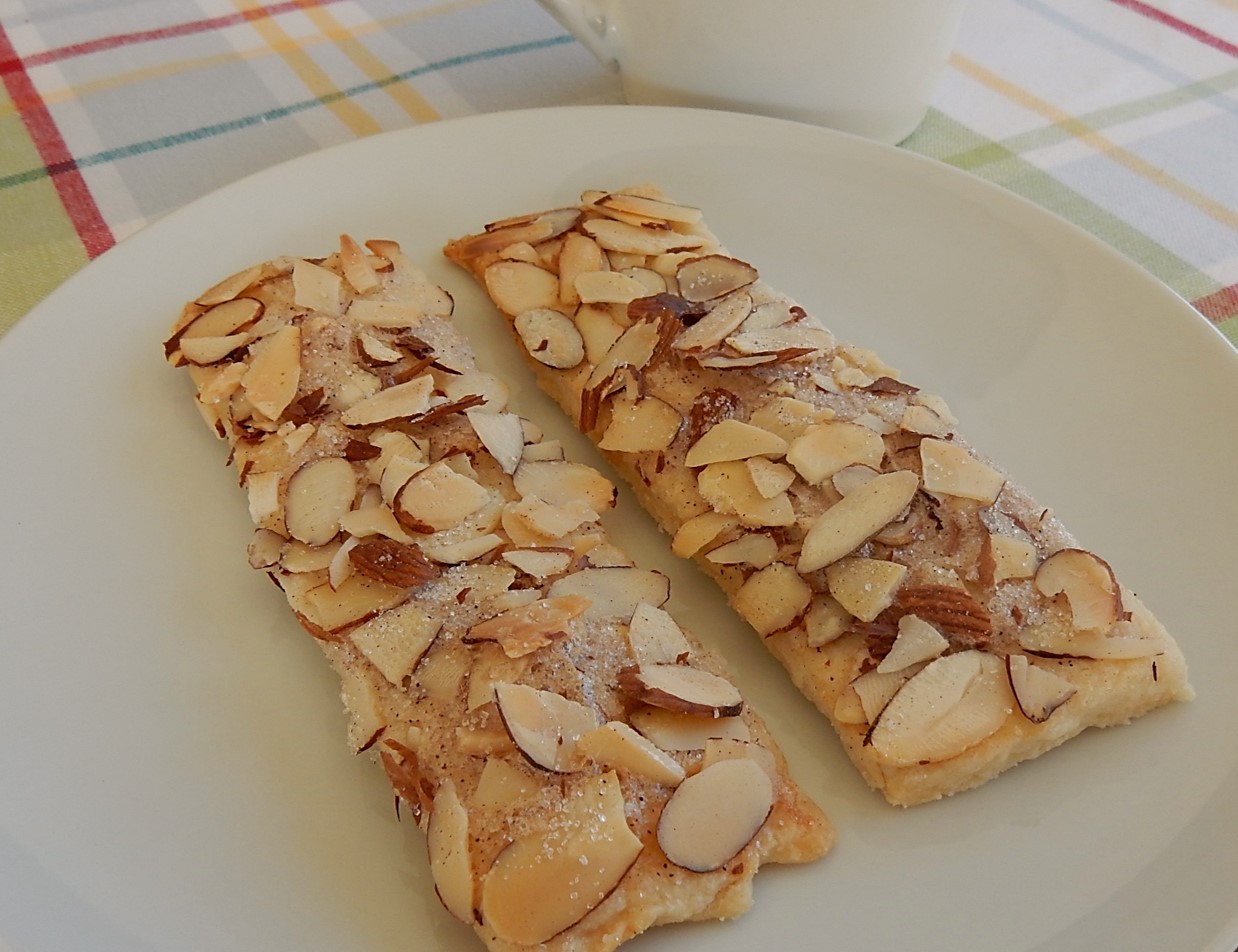
When I make a pie, I sprinkle any remaining pastry scraps with cinnamon and sugar, and then bake until light browned. These scraps are good, but I found a hundred-year-old recipe for Almond Strips that takes it to the next level.
Almond Strips are bars of baked pastry dough topped with cinnamon, sugar, and almond slices. These bars are a great way to use those pastry scraps – yet are so pretty and tasty that they can be served without apology.
Here is the original recipe:
Source: Recipes for Everyday by Janet McKenzie Hill (1919)
pie pastry for a 1-shell pie (or use scraps of pastry dough left-over after making a pie crust)
1 egg white
Put sugar and cinnamon in a small bowl; stir to combine. Then add almond slices; stir. Set aside.
Preheat oven to 425° F. Roll pie pastry into a rectangle 1/4-inch thick. Cut into strips 2 inches X 4 inches. Place strips on a greased cookie sheet. Brush with egg white and sprinkle with sugar/cinnamon/almond mixture. Make sure the sugar and almonds are distributed evenly across the bars. Press lightly. Bake for approximately 10 -15 minutes (or until lightly browned).
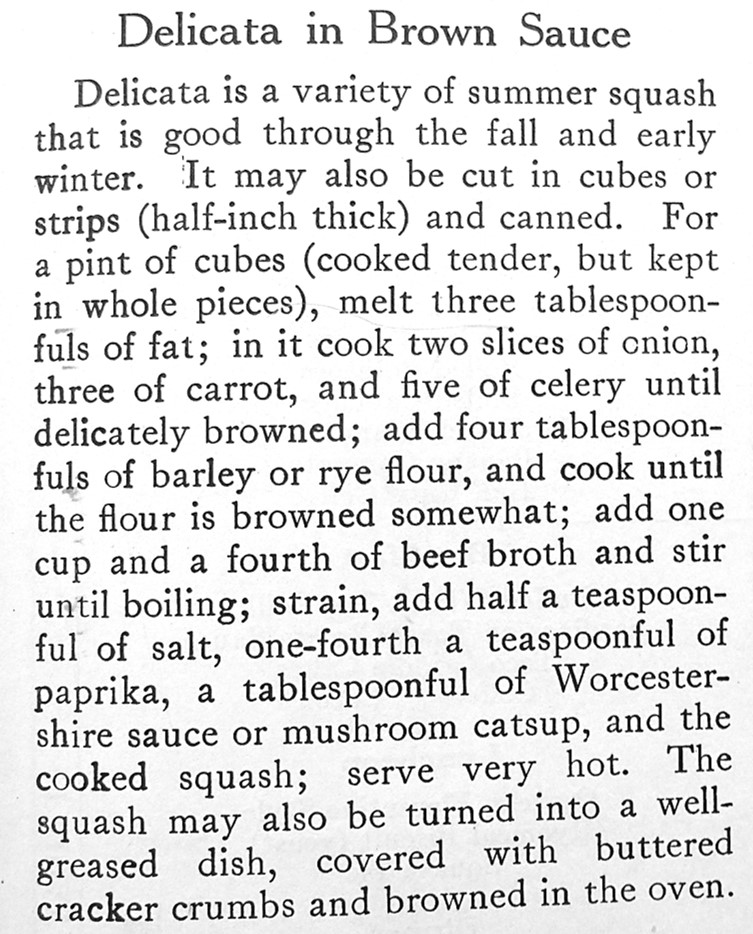
Each Fall I buy a Delicata squash and roast it, but until I came across a hundred-year-old Delicata squash recipe, I never gave any thought to other ways that it might be prepared. It was fun to try a “new” way of serving this old-time squash.
The century-old recipe was for Delicata Squash in Brown Sauce. The recipe called for cubed squash that is served in a delightful classic brown sauce.
Here is the original recipe:
Source: American Cookery (January, 1919)
I made several adaptions and assumptions when making this recipe. I used fresh Delicata squash rather than canned. And, I used butter rather than “fat.”
I was a bit foggy about what was meant by three slices of carrot and five of celery. Does the recipe really mean just a few small pieces of sliced carrot and celery – or was it referring to larger chunks? I made the assumption that the recipe was calling for one carrot and two stalks of celery – but this may not be what the recipe writer intended.
And, have you ever heard of mushroom ketchup? Since I didn’t have any idea what it was, I went with the Worcestershire sauce option.
4 tablespoons rye or barley flour (I used rye flour.)
1 1/4 cups beef broth
1/2 teaspoon salt
1/4 teaspoon paprika
1 tablespoon Worcestershire sauce
Peel squash, halve and remove seeds and membranes; then cut into 1-inch cubes. Place in a saucepan and cover with water. Put on the stove and bring to a boil using high heat; then reduce heat and simmer until tender (about 15 minutes). Remove from heat and drain.
In the meantime, melt butter in a skillet. Add onion, carrot and celery; sauté until tender using medium heat. Stir in the flour, and continue stirring until the flour just begins to brown. Gradually add beef broth while stirring constantly; continue stirring until the mixture comes to a boil. Remove from heat and strain; reserve the strained sauce. (If desired, the cooked vegetables may be served separately; otherwise discard.) Return the strained sauce to the saucepan; stir in salt, paprika, and Worcestershire sauce. Reheat until hot.
To serve, place cooked squash in serving dish. Pour brown sauce over the squash.
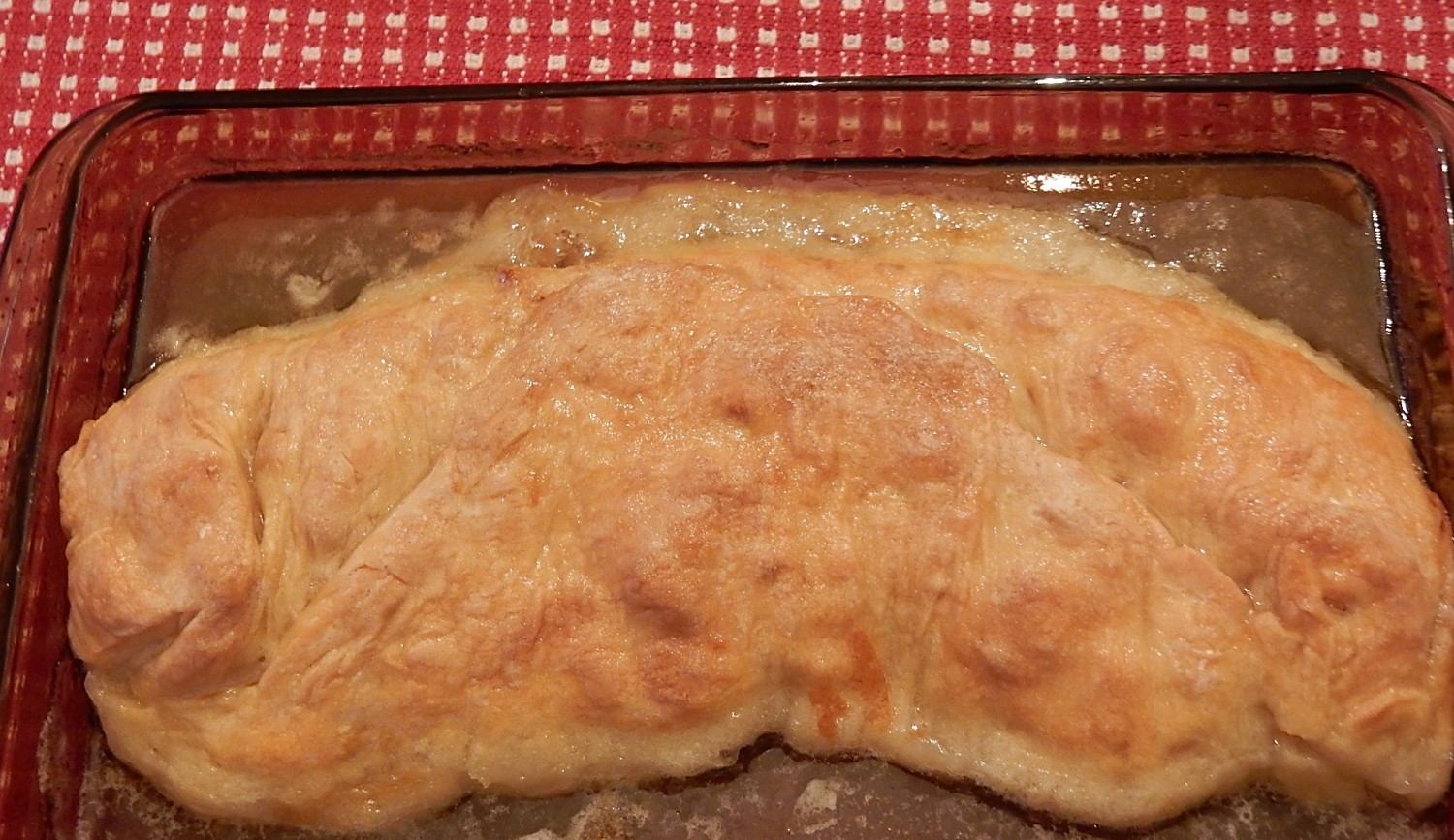
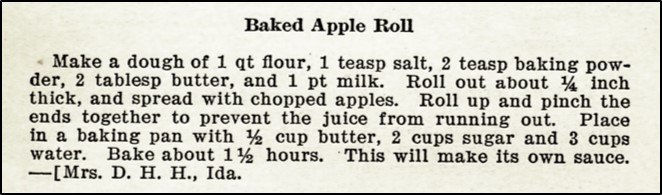
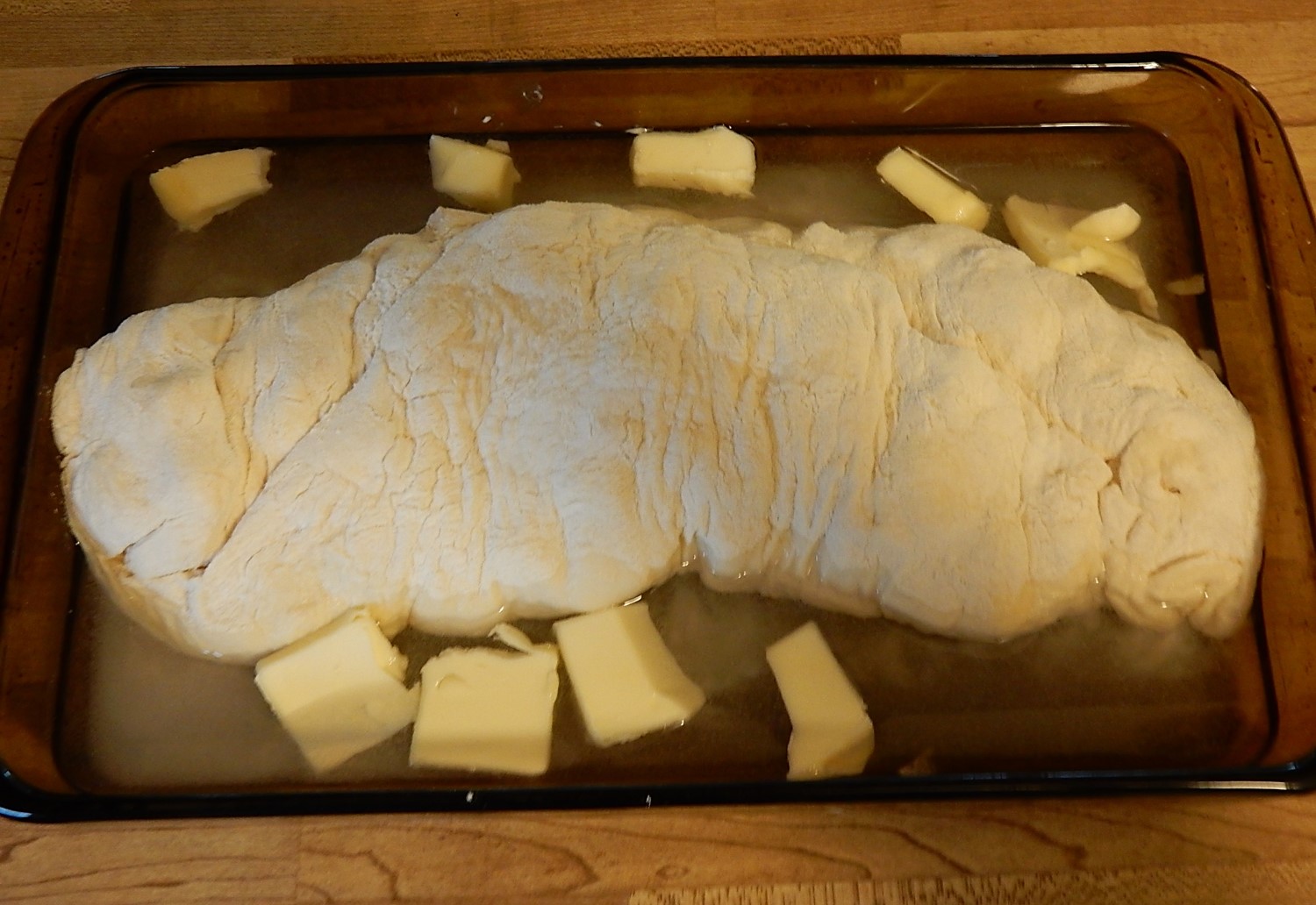
Fall is the season for apples, and the perfect time to make apple desserts. I recently found a lovely hundred-year-old recipe for Baked Apple Roll; however, it has one quirky characteristic. The recipe does not call for any cinnamon.
The Baked Apple Roll is smothered in a very simple sugar, water, and butter sauce. The roll looked beautiful, but (since I’m so used to apple dishes being spiced with cinnamon), the roll tasted bland to me. If I made this recipe again, I might add some cinnamon – though I recognize that wouldn’t hold true to the old recipe.
Here’s the original recipe:
Source: The Old Reliable Farm and Home Cook Book (1919)
When I made the recipe, I halved it, and still had a large roll that made 4-5 servings. Here is the recipe updated for modern cooks.
3 cups chopped apples (about 2-3 large apples) (peel and core before chopping)
1 cup sugar
1 1/2 cups water
Preheat oven to 325° F. In a bowl, combine flour, salt, baking powder, and 1 tablespoon butter. Add milk, and mix using a fork until dough starts to cling together. If it is excessively sticky, add additional flour. Turn onto a well-floured prepared surface, and roll dough into an approximate 11-inch square that is 1/4 inch thick. Evenly spread chopped apples on the rolled dough to within 1/2 inch of the edges. Start at one side and roll. Seal edges by pressing together to help prevent the juice from running out. Place in an oblong baking dish (approximately 7 inches by 12 inches or larger) with the “seam” at the top.
In a bowl, combine the sugar and water. Carefully pour the sugar mixture into the edge of the baking dish. Do not pour it over the top of the roll. Cut the 1/4 cup butter into small pieces, then “dot” the sugar/water mixture with the butter pieces. This will turn into a syrup as it cooks. Bake for 1 hour and 15 minutes. Remove from oven and baste the roll with the hot sugar syrup. Return to oven and bake an additional 15 minutes or until lightly browned. Remove from oven. The roll can be cut into slices, and served hot or cold with the syrup drizzled around the slices.
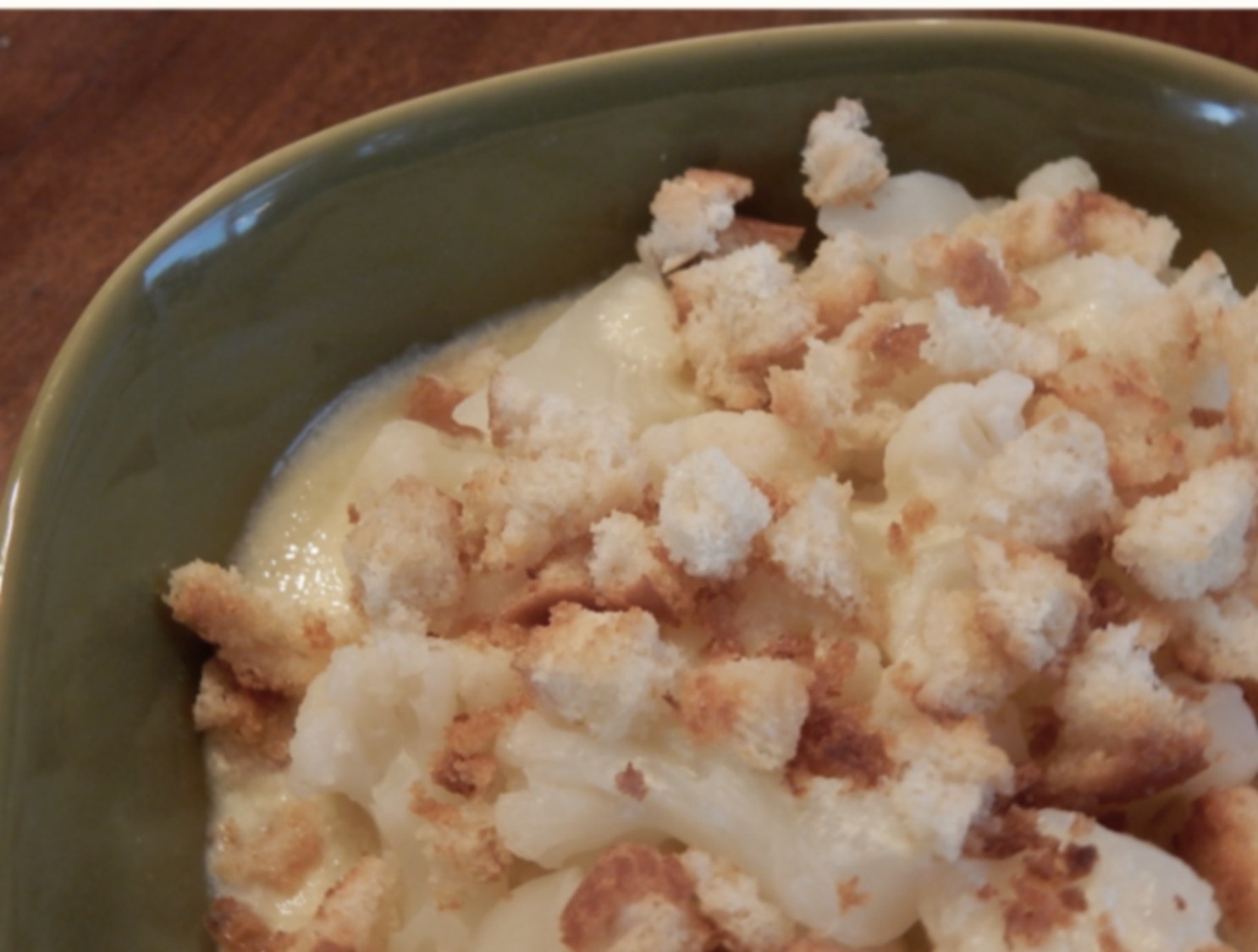
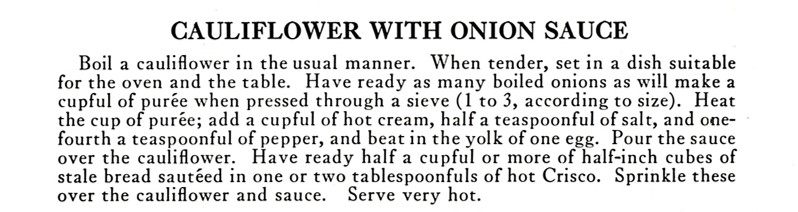
Cauliflower is a delightful fall vegetable, so I was pleased when I recently came across a hundred-year-old recipe for Cauliflower with Onion Sauce. This dish contains cauliflower florets smothered with a rich and creamy sauce made with cream and onion puree. It is then topped with lightly toasted bread cubes.
Here’s the original recipe:
Source: Recipes for Everyday by Janet McKenzie Hill (1919)
Making the sauteed bread cubes brought back warm memories of my mother in law. She often sauteed bread cubes to lightly toast them when making a topping for casseroles or other dishes. I generally go the easier route when making a bread topping, and use fine bread crumbs and skip sauteing them. But I really liked the larger sauteed bread cubes in this dish, and may have to make them again to top other dishes.
I couldn’t bring myself to use Crisco when I sauteed the bread cubes and instead used butter.
Remove outer layer from onions, slice and place in a saucepan. Cover with water, and using high heat bring to a boil. Reduce and cook until tender about 15 minutes. Drain, then press through a sieve or puree (I used a Foley mill.) Combine onion puree, cream , salt, pepper, and egg yolk in a saucepan. Using medium heat, heat until the sauce thickens and is on the verge of boiling. Remove from heat.
Cauliflower
Cut the florets from the head of cauliflower. Place in a saucepan, and cover with water. Bring to a boil, then reduce heat and cook until tender (about 8 -10 minutes). Remove from heat and drain.
Bread Cubes
Cut bread into 1/2 inch cubes. Melt butter in small skillet using medium heat, add bread crumbs. Gently stir occasionally until lightly browned. Remove from heat.
To Serve
Place cauliflower in serving dish. Pour onion sauce over the cauliflower, then sprinkle with sauteed bread crumbs.
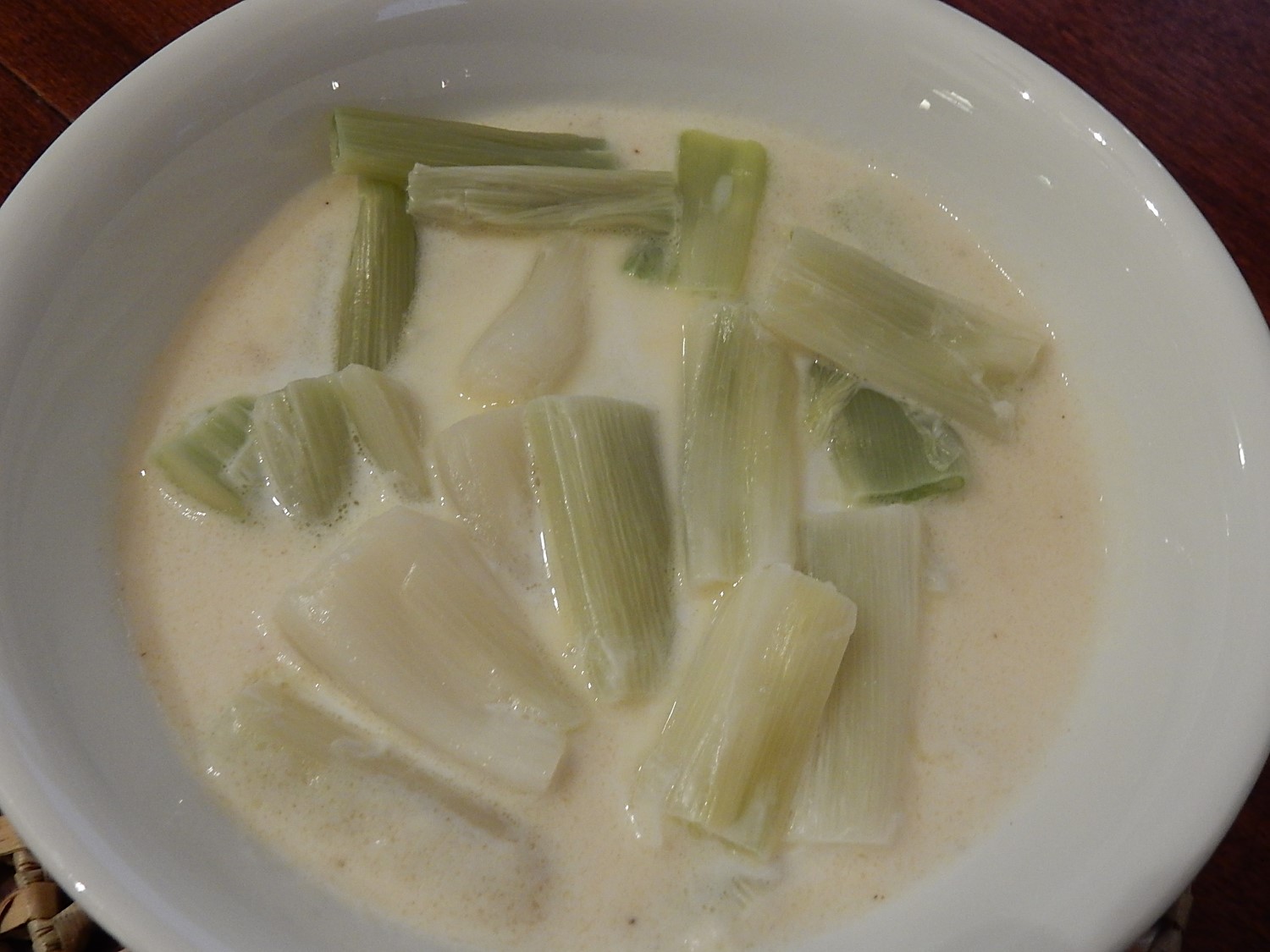
Leeks are a delightful, often under-utilized vegetable, so when I saw a hundred-year-old recipe for Bianca-Style Leeks I knew that I had to give it a try. The mild onion-like flavor of the leeks was accentuated by a delicate chicken broth and cream sauce. This recipe is easy to make, and very tasty. The leeks make a wonderful side dish, and are delightful with beef or pork.
Source: Recipes for Everyday by Janet McKenzie Hill (1919)
When I made this recipe, I couldn’t figure out why the leeks needed to be soaked in cold water for half an hour so I skipped that step. I also didn’t cook the leeks as long as called for in the old recipe. A half hour seemed excessive; they were tender after about 15 minutes. I substituted butter for the Crisco, and made the sauce in a separate pan and then added the leeks – it just seemed easier.
Clean and trim the leeks. Cut crosswise the white and light green parts of the leeks into 2-inch pieces. Place in a saucepan and cover with water; add 1/2 teaspoon salt. Using high heat bring to a boil, then reduce heat and cook until the leeks are tender (about 15 minutes). Remove from heat and drain.
In the meantime, in another pan, using medium heat, melt butter; then stir in the flour, 1/4 teaspoon salt, and pepper. Gradually, add the chicken broth and half and half while stirring constantly. Continue stirring until the white sauce thickens. Add cooked leeks and reheat until the sauce is hot and bubbly while occasionally stirring very gently. Remove from heat and serve immediately.
Last week the eggplants at the farmers’ market just seemed to call me. Their beautiful deep purple color, and smooth curves made them aesthetically pleasing. I also knew that eggplants are known for their versatility because they have little flavor of their own, but rather absorb the flavors of the foods and spices that they are cooked with.
Once I had purchased an eggplant, I had a new challenge – finding a hundred-year-old recipe that called for eggplant.
After browsing through old magazines and cookbooks, I think that I found a winner. Scalloped Eggplant is made by slicing eggplant, then layering it in a casserole dish with grated cheese, and smothering with tomato sauce. It is then baked in the oven until the eggplant is tender.
The Scalloped Eggplant was delicious, and can be served as either a meatless main dish or a hearty side dish.
Here’s the original recipe:
Source: American Cookery (October, 1919)
Today eggplant is generally written as one word, but that has not always been the case. Based on the way it was written in this recipe, it was two words a hundred years ago.
I used cheddar cheese when I made this recipe. And, I didn’t sprinkle the layers in the casserole dish with salt because I had previously soaked the eggplant in salt water. There is also salt in the cheese and tomato sauce. Sometimes I think that people in 1919 liked saltier foods than what we do today.
Peel eggplant and slice it into 1/2 inch slices. In a large bowl, combine the water and salt. Add the eggplant slices. Put a plate or other weight on the eggplant slices to keep them from floating. Let soak for 30 minutes. Drain and rinse.
Preheat oven to 375° F. Pour one-fourth of the tomato sauce in a 1 1/2 quart casserole dish. Next put one-third of the eggplant slices in the dish. Add another fourth of the tomato sauce, then add one-third of the cheese and sprinkle with pepper. Continue layering until all of the ingredients are used, ending with the cheese.
Cover dish and bake in oven for 35 minutes. Remove lid and continue baking until the eggplant is tender (about another 10-20 minutes). Remove from oven and serve.