Old-fashioned Spider Cornbread

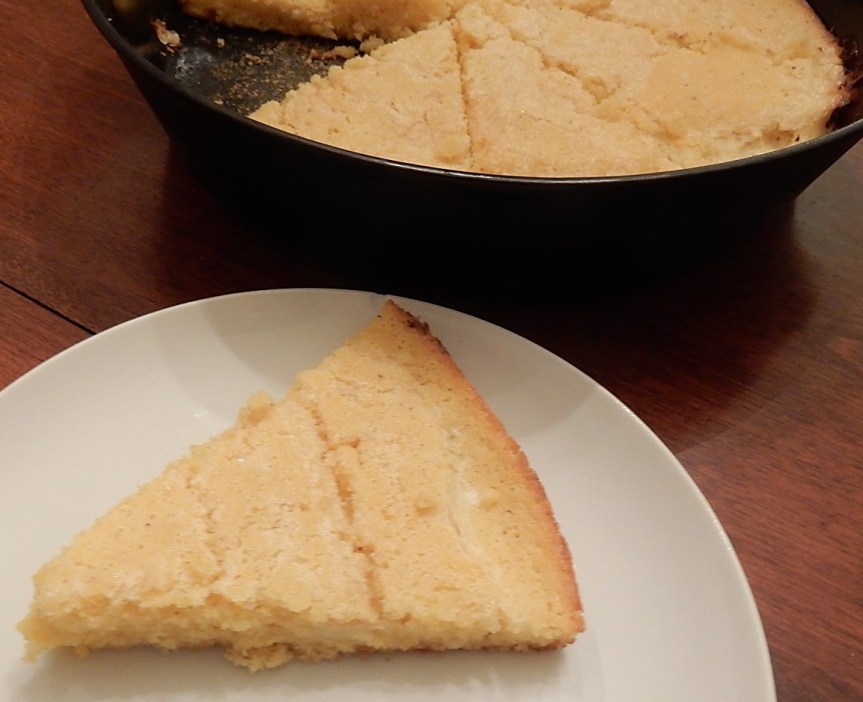
Piece of Spider Cornbread on plate with additional cornbread in background in skilletI was intrigued by a recipe for Spider Cornbread in a hundred-year-old cookbook. What an unusual name! After doing a little research, I discovered that Spider Cornbread is a regional food that is eaten in New English and some other sections of the U.S.
Spider Cornbread has a creamy middle layer that is made by pouring milk on top of the batter after the has been poured into the skillet that will be used to cook the cornbread.

The verdict: The Spider Cornbread was tasty, though the creamy layer wasn’t very thick.  I baked the Spider Cornbread in a 12-inch cast iron skillet. If I made it again, I’d use a slightly smaller skillet – maybe a 10-inch skillet. This would result in a thicker cornbread and  a thicker creamy layer.

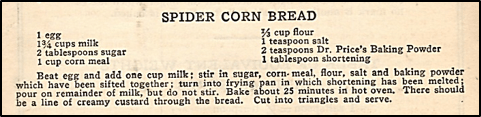
Here is the original recipe:

Recipe for Spider Corn Bread
Source: The New Dr. Price Cook Book (1921) published by the Price Baking Powder Factory

Is “cornbread”, one word or two? I think that it’s one word, but see that the old recipe makes it two words – corn bread. Maybe the two word version is an older way of writing cornbread.

When I made this recipe, I reduced the salt by a small amount, and used 3/4 teaspoon rather than the 1 teaspoon called for in the original recipe.

Here’s the recipe updated for modern cooks:

Spider Cornbread

  • Servings: 6 - 8
  • Difficulty: moderate
  • Print

1 tablespoon shortening

1 egg

1 cup milk + 3/4 cup milk

2 tablespoons sugar

1 cup cornmeal

1/3 cup flour

3/4 teaspoon salt

2 teaspoons baking powder

Preheat oven to 400° F. Grease a 10 – 12 inch cast iron skillet; with the shortening; then put skillet into oven while it is preheating.

In the meantime, put egg in mixing bowl and beat; add 1 cup milk and beat. Add sugar cornmeal, flour, salt, and  baking powder; beat to combine. Remove skillet from oven and pour batter into it. Pour the remaining 3/4 cup of milk on top of the batter, but do not stir. Return skillet to oven, and bake for approximately 25 minutes. When a wooden pick inserted in the center comes out clean, the cornbread is done. Removed from oven and cut into triangles.

http://www.ahundredyearsago.com

Old-fashioned Apple and Celery Salad

Celery and Apple Salad in dish

I always enjoy Waldorf Salad, so was intrigued by recipe for Apple and Celery Salad in a hundred-year-old cookbook. It seemed very similar to Waldorf Salad – but with fewer ingredients (just apples and celery). I wondered, would I miss the nuts and raisins in the typical Waldorf Salad?

The verdict- Apple and Celery Salad was nice, but I prefer Waldorf Salad with the added crunchiness and sweetness of the nuts and raisins.

Here’s the original recipe:

Recipe for Celery and Apple Salad
Source: The New Cookery (1921) by Lenna Frances Cooper

I went with the mayonnaise option when I made this recipe, and I did not garnish with lettuce. (Exactly how do you garnish with lettuce?) I also did not peel the apples. To be totally honest, I somehow failed to notice that the apples were supposed to be peeled until I started writing this post. When I made this recipe, I was in a hurry and just glanced at the recipe, and thought that this would be an easy recipe because it was Waldorf Salad minus half the ingredients. I should have read it more carefully. The salad would be different (and less colorful) if the apples had been peeled.

And I also failed to notice that I was supposed to marinate the apple pieces in lemon juice – but we ate the salad soon after I made it, so the apples didn’t discolor. (I think that coating them with mayonnaise also slows discoloration).

I used just enough mayonnaise to coat the celery and apple pieces (about 1/2 – 2/3 cup).  I previously made the Golden Salad Dressing recipe that is listed in this recipe when I made another recipe from this cookbook: Pineapple and Strawberry Salad with Golden Dressing. Golden Salad Dressing recipe can be found in that post.

I’m now realizing that I barely made the original recipe for Apple and Celery Salad – and am fascinated that I somehow failed to do so many things quite right with such a simple recipe. I guess it’s a lesson learned about carefully reading directions even for the easiest recipes. That said, the recipe turned out well, so the updated recipe for modern cooks is based on how I made it..

Here’s the recipe updated for modern cooks:

Apple and Celery Salad

  • Servings: 5 - 7
  • Difficulty: easy
  • Print

2 cups chopped apples (about 1/2 inch pieces) –The apples can be either peeled or not peeled.

2 cups chopped celery (about 1/2 inch pieces)

1/2 – 2/3 cup mayonnaise

Combine apple and celery pieces; stir in enough mayonnaise to lightly coat the pieces.

http://www.ahundredyearsago.com

Old-Fashioned Baked Bananas

Baked banana on plateI’d never heard of Baked Bananas, so was intrigued when I flipped through a hundred-year-old cookbook and saw not one, but two, recipes for Baked Bananas. The first recipe involved peeling the banana, adding several ingredients and then baking. The second recipe just called for baking the banana in the skin. Over the years, I’ve learned that the easiest and simplest recipes are sometimes the best, so I decided to go with the second recipe.

The Baked Banana was sweet, creamy, and soft – and a nice change of pace from just peeling and eating a banana.

baked banana in dishHere’s the original recipe:

Recipes for Baked Bananas
Source: The Boston Cooking-School Cook Book (1921 Edition)

I made Baked Bananas II.

Here’s the recipe updated for modern cooks:

Baked Bananas

  • Servings: 1
  • Difficulty: easy
  • Print

1 banana per serving

sugar

Preheat oven to 350° F. Put bananas in shallow pan or baking dish; cover. Place in oven and bake until the skin is very dark (almost black). Remove from oven, and let cool slightly; then remove the pulp from the skins and place in serving dish. Sprinkle with sugar.

http://www.ahundredyearsago.com

Chicken à la Crème

Chicken a la Creme on Toast

As the days get shorter and the evenings cooler, I find that I crave comfort foods. So when I saw a hundred-year-old recipe for Chicken à la Crème, I decided to give it a try. Chicken, sliced mushrooms, and chopped red pepper are embedded in a rich, creamy sauce that is served over toast.

This recipe is a keeper. I’ll definitely make Chicken à la Crème again. It is quick and easy to make, and very tasty.

Here’s the original recipe:

Recipe for Chicken a la Creme
Source: Lowney’s Cook Book (1921 Edition)

Is Chicken à la Crème another name for Chicken à la King? A few years ago I made a recipe for Chicken à la King that was similar to this one. Both recipes called for chicken and mushrooms. This recipe called for red pepper; Chicken à la King called for green pepper as well as for a small amount of onion. For this recipe, the sauce was a white sauce; the sauce for Chicken à la King was made using cream, chicken broth, and lemon juice.

Here’s the Chicken à la Crème recipe updated for modern cooks:

Chicken a la Creme

  • Servings: 4 - 6
  • Difficulty: easy
  • Print

4 tablespoons butter

4 tablespoons flour

1/2 teaspoon salt

1/8 teaspoon pepper

1 1/2 cups cooked chicken, cut into small pieces

1/2 cup sliced mushrooms

1 red pepper, finely chopped

2 cup milk

Melt the butter in a saucepan. Stir the flour into the butter; stir in salt and pepper. While stirring constantly, slowly pour in milk and bring to a boil over medium heat. Stir in the chicken, mushrooms, and red pepper. Bring back to a boil; remove from heat. Serve over toast.

http://www.ahundredyearsago.com

Cornflake Fancies

Even though I don’t often think about it, a wide range of commercially-produced foods were available a hundred years ago. Cornflakes was one of those products. According to Wikipedia, William Kellogg invented cornflakes in 1894 to serve to patients at the Battle Creek Sanitarium in Battle Creek, Michigan. They were first mass-marketed in 1906. And, soon thereafter, people began, not only eating them for breakfast, but also using them in recipes.

I came across a recipe for Cornflake Fancies in a 1921 church cookbook. The recipe is made by folding cornflakes and coconut flakes into beaten egg whites that have been sweetened with sugar, and then placing heaping teaspoonfuls of the mixture on a baking sheet. They are then baked until lightly browned The Cornflake Fancies were light and airy, and reminded me a little of Coconut Macaroons, but with a slight crunch from the cereal.

Here’s the original recipe:

Recipe for Cornflake Fancies
Source: Ladies’ Union Cook Book compiled by the Ladies of West Concord Union Church (Concord Junction, MA) (1921)

Here’s the recipe updated for modern cooks:

Cornflake Fancies

  • Servings: about 2 1/2 dozen
  • Difficulty: easy
  • Print

2 egg whites

1/2 cup sugar

1/3 teaspoon salt

2 cups cornflakes

1/2 cup flaked coconut

Preheat oven to 350° F. Put egg whites in bowl and beat until stiff. Gradually add the sugar and salt, while continuing to beat. Fold in the cornflakes and coconut. Drop heaping teaspoons of the mixture about 1-inch apart on a greased baking sheet. Bake until set and lightly browned (about 10 – 12 minutes). Remove from oven, and let sit for about two minutes, then remove from the baking sheet with a spatula. Let cool completely, then store in an airtight container.

http://www.ahundredyearsago.com

Potato Tarts a la Gratin

Potato Tarts a la Gratin on plate

Au Gratin potatoes are a nice comfort food, but they can get boring, so I was intrigued by a hundred-year-old recipe for Potato Tarts a la Gratin.  A muffin tin is lined with pastry dough, then filled with diced au gratin potatoes. The resulting tarts were tasty, visually appealing, and a nice change of pace. They reminded me a bit of the savory hors d’oeuvres served by hotels at events – though they were tastier than many of those hors d’oeuvres.

Here’s the original recipe:

Recipe for Potato Tarts a la Gratin
Source: American Cookery (November, 1921)

I substituted butter for the lard when I made this recipe. Rather than using left-over cold potatoes, I made boiled diced potatoes which I immediately used in the recipe.

When I made the sauce, it seemed rather thin for a tart filling, so I coarsely mashed a few of the diced potatoes and stirred them into the sauce to make it thicker before adding the remainder of the diced potatoes. This worked well.

Here’s the recipe updated for modern cooks:

Potato Tarts a la Gratin

  • Servings: approximately `10 - 12 tarts
  • Difficulty: moderate
  • Print

3 – 4  medium potatoes, diced into 3/4 inch pieces (about 2 cups diced potatoes)

2 tablespoons butter

2 tablespoons flour

1/2 teaspoon salt

1 cup milk

1/2 cup shredded cheese + additional cheese to sprinkle on the top (I used cheddar cheese.)

pastry dough (enough for 1 2-crust pie, or use approximately 4 pre-rolled sheets)

Preheat oven to 425° F. Roll pastry dough and cut into circles. Line the space for each muffin in a muffin pan with the circles of pastry dough. Fit each circle, trim, and flute edges.

Put the diced potatoes in a sauce pan and cover with water. Put on the stove and bring to a boil using high heat; then reduce heat and simmer until the potatoes are tender (about 10 minutes). Drain potatoes. Remove about 1/3 cup of the potatoes from the sauce pan; put in a bowl and coarsely mash using a fork. Set aside both the mashed and diced potatoes

Melt the butter in another sauce pan, then stir the flour and salt into the butter. While stirring constantly, slowly pour in the milk and bring to a boil over medium heat.  Stir in the mashed potatoes and 1/2 cup shredded cheese, continue heating until the cheese melts. Add the diced potatoes. Stir to combine.

Spoon into the pastry shells, and sprinkle additional shredded cheese on top. Bake until hot and bubbly, and the top begins to brown (about 30 minutes).

Blueberries and Boulettes Recipe

Blueberries and Boulettes in dish

Some desserts which were eaten a hundred years ago are seldom seen today. One of those desserts is Blueberries and Boulettes. Boulettes are homemade drop dumplings that are made by dropping heaping teaspoons of dough into rapidly boiling water. Warm boulettes are topped with a little butter, and smothered with blueberries, and a generous sprinkling of sugar.

The Boulettes were fun and easy to make. They only take a few minutes to cook, rising to the top of the water when done. When served with sweetened blueberries, they made a nice old-fashioned summer dessert.

Here’s the original recipe:

Recipe for Blueberries and Boulettes
Source: American Cookery (August/September, 1921)

Here’s the recipe updated for modern cooks:

Blueberries

  • Servings: 6 - 8
  • Difficulty: moderate
  • Print

2 tablespoons butter, melted

3 tablespoons sour cream

3 eggs

1 teaspoon salt

3 cups flour

butter

blueberries

sugar

Combine melted butter and sour cream in a mixing bowl. Add eggs, one at a time, beating each in. Stir in salt, then gradually add and stir in the flour.

In the meantime bring 3-4 quarts of water to a bowl in a large pan. When the water is rapidly boiling, drop heaping teaspoons of the dough into the water, and let it remain until it rises to the top; then remove with a slotted spoon. Serve warm.

To serve, put boulettes in serving dish(es), top with dabs of butter, blueberries, and sugar.

http://www.ahundredyearsago.com