Source: Order of the Eastern Star Relief Fund Cook Book compiled by Michigan Grand Chapter (1923)
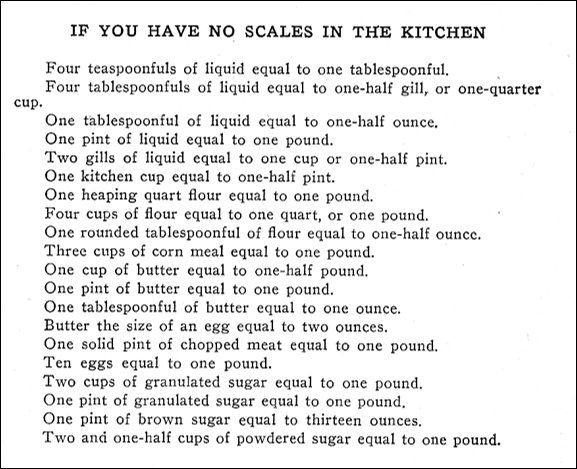
Here’s some hundred-year-old advice about the weight equivalents of various common ingredients. It’s interesting how a given volume of some foods weighs less than other foods. For example, 2 cups of granulated sugar equals a pound, but a pint (2 cups) of brown sugar equals 13 ounces.
I found this list in a cookbook compiled by an organization. It made me smile to see how the one item on the list that spilled over to a second line was out of alignment with the other items in the list. I’d probably do something like that – though maybe that’s how it’s supposed formatted. Not sure.
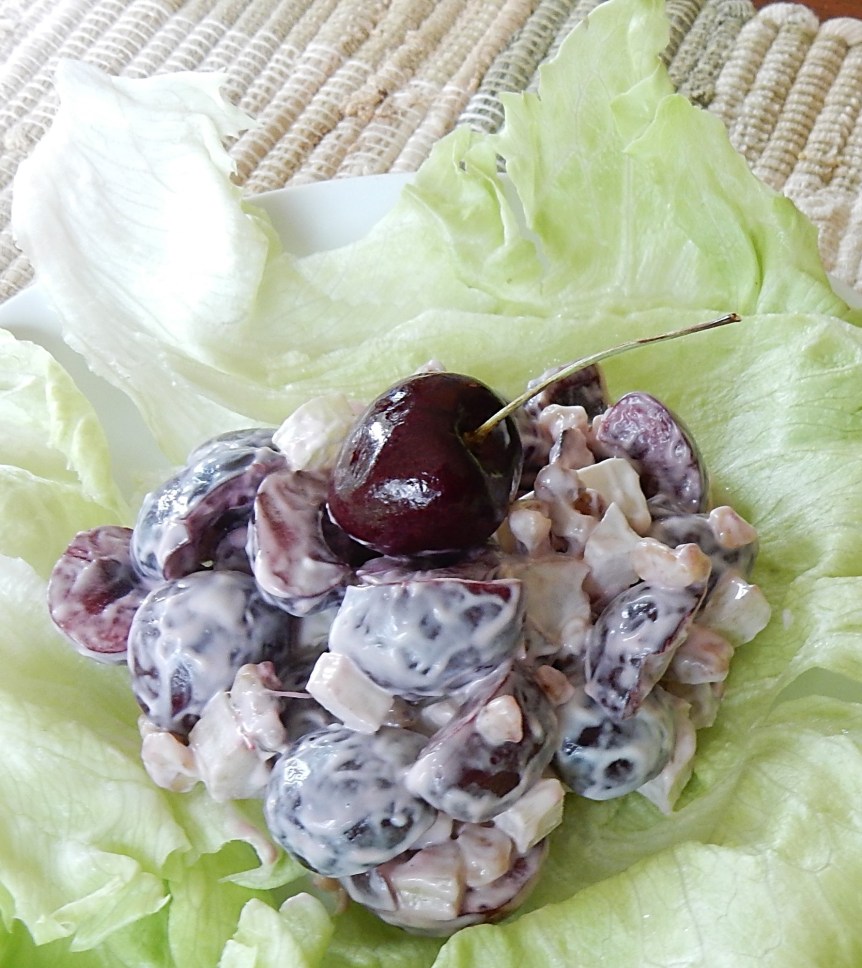
Must a Waldorf Salad be made with apples? I’ve always thought it was an apple salad until I made a Cherry Salad recipe that I found in a hundred-year-old cookbook. The recipe called for cherries, walnuts, celery, and mayonnaise – and it sure seemed like a Waldorf Salad, but was made with cherries rather than apples. The Cherry Salad was delicious, and is perfect for a hot summer day.
The old recipe called for creating individual servings of the salad, which were put in “lettuce nests” on salad plates. I replicated the old recipe and made individual servings, but if I did it again, I would just put the entire salad in a bowl to serve.
Here’s the original recipe:
Source: Cookbook compiled by Bethany Shriner Patrol No. 1, Rochester, NY (1923)
This recipe calls for English walnuts. These are the type of walnuts that are typically sold in stores. They were called English walnuts to differentiate them from black walnuts.
2 cups cherries, pitted (If desired, keep several cherries whole and unpitted for garnishing.)
1 cup walnuts, chopped
1 cup celery, chopped
3/4 cup mayonnaise (Use less if desired)
lettuce leaves (if desired)
If the cherries are large, halve or quarter them; if small they can be left whole. Mix together the cherries, walnuts, celery, and mayonnaise. If desired, for each serving, arrange on lettuce leaves and garnish with a whole cherry; or just put the salad in a dish to serve.
Source: Order of the Eastern Star Relief Fund Cook Book compiled by Michigan Grand Chapter (1923)
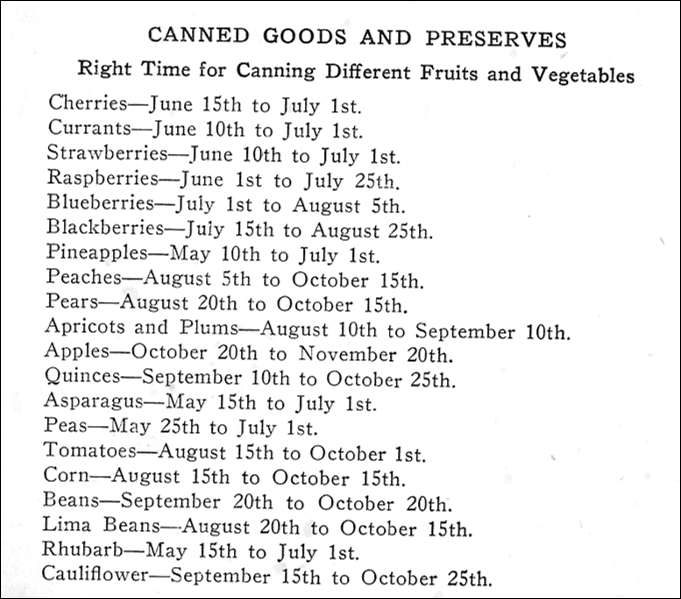
I don’t think that the timeline for canning fruits and vegetables has changed much across the years – though I’m guessing that this timeline is most appropriate for the northern parts of the U.S. since it is from a cookbook compiled in Michigan. The dates probably would be shifted earlier in more southern locales.
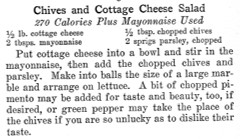
Cottage cheese is a nutritious and healthy food, and I’m always looking for new ways to eat it, so was intrigued when I came across a hundred-year-old recipe for Chives and Cottage Cheese Salad. The salad included cottage cheese, a bit of mayonnaise, chives, parsley and pimiento. The ingredients worked well together, and the salad was very tasty.
A unique feature of the Chives and Cottage Cheese salad was that the mixture was supposed to be shaped into marble-sized balls, and served on lettuce. This gave the salad a very old-fashioned look, though I was a little disappointed that the balls were very moist and didn’t stay together very well.
The verdict: The salad was lovely, but if I made it again, I just put it into a dish and skip shaping it into balls.
Here’s the original recipe:
Source: The Calorie Cook Book (1923) by Mary Dickerson Donahey
1/2 tablespoon chives, finely chopped (Green pepper may be substituted for the chives.) – I used chives.
2 sprigs parsley, finely chopped
1 tablespoon pimiento, finely chopped
lettuce
Put cottage cheese and mayonnaise into a bowl; stir to combine. Add chives, parsley, and pimiento; stir until evenly distributed throughout the cottage cheese mixture. Shape into balls the size of large marbles, and put on a plate covered with lettuce leaves.
I recently was browsing through a hundred-year-old funding-raising cookbook compiled by the Michigan Grand Chapter of the Eastern Star, and was amazed to see a recipe for Club Sandwiches. Somehow I didn’t think that they existed back then – though perhaps I shouldn’t have been surprised because I can remember eating Club Sandwiches with my mother years ago when I was a child at a department store restaurant – so they’ve clearly been around for awhile.
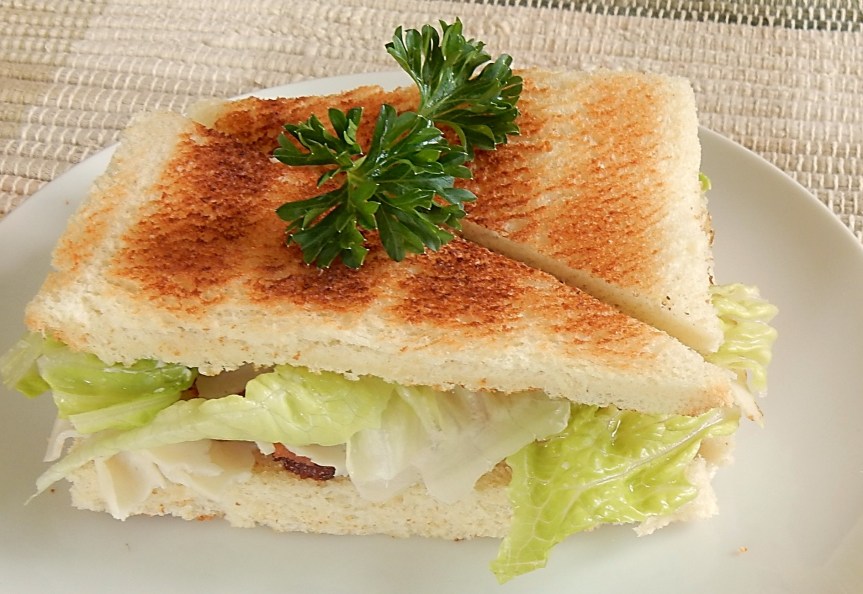
The Club Sandwiches were made about the same as modern ones with bacon, chicken or turkey slices, tomatoes, lettuce, and mayonnaise – though they weren’t double decker and crusts were trimmed off the bread. They were perfect for lunch on a hot summer day.
Here’s the original sandwich:
Source: Order of the Eastern Star Relief Fund Cookbook (Michigan Grand Chapter, 1923)
2 slices tomato or dill pickle slices (I used tomato slices.)
1 ounce thinly sliced roasted chicken or turkey
1 lettuce leaf
mayonaise
parsley sprig (if desired)
Trim crusts from bread, then toast the bread. Spread with butter. On one of the slices of bread, place a layer of bacon. Next add a layer of tomato or pickle slices. Then add the chicken or turkey slices; top with the lettuce. Spread mayonaise on the second slice of bread (on top of the butter), then put this slice of bread on the sandwich as the top cover. Cut the sandwich diagonally to create two triangles. If desired, garnish with a sprig of parsley. Serve immediately.
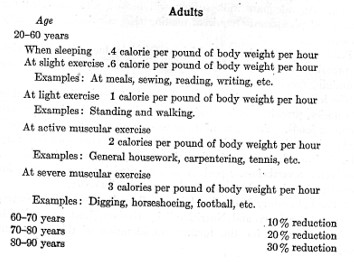
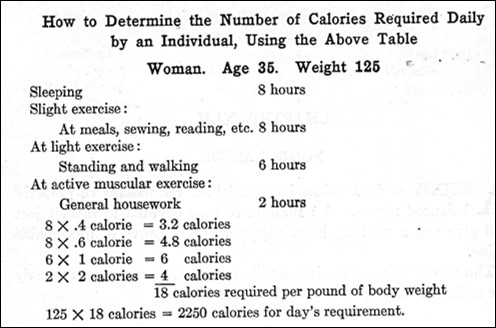
A 1923 cookbook contained directions for calculating the number of calories needed daily. It also provided an example of how to use the chart:
Source: Boston Cooking-School Cook Book (1923)
To see if the number of recommended calories has changed across the years, I used an online calorie calculator to estimate the number of calories needed by a 35 year old woman who weighs 125 pounds. The online calculator asked for height. I used 5′ 4″. I also indicated that the woman did moderate exercise 4-5 times per week. The online calculator said that she needed 1827 calories per day to maintain weight which is 423 calories less than the hundred-year-old estimate that 2250 calories were needed per day – but perhaps doing two hours per day of general housework back then required more calories than moderate exercise 4-5 times per week does today.




 I recently was browsing through a hundred-year-old funding-raising cookbook compiled by the Michigan Grand Chapter of the Eastern Star, and was amazed to see a recipe for Club Sandwiches. Somehow I didn’t think that they existed back then – though perhaps I shouldn’t have been surprised because I can remember eating Club Sandwiches with my mother years ago when I was a child at a department store restaurant – so they’ve clearly been around for awhile.