Do I Have a Seriously Strange Hobby?

image of Morning AgClips webpage

Each morning my husband reads Morning AgClips. A few days ago, he said, “You’ve got to read this. You have a seriously strange hobby.” He was referring to an article titled, Seriously Strange Hobbies You Didn’t Know About.

I read the article and learned about Extreme Ironing where people iron clothes while rock climbing and sky diving, about Cheese Rolling where rounds of cheese are rolled down a hill, and about Soap Bubble Art where people use a variety of techniques to create interesting effects with soap bubbles. And, then the article went on to describe . . . drum rolls please . . . Historical Cooking which “which involves trying out recipes from the past.”

Oh, my goodness, who knew?  Do I have a seriously strange hobby?

Old-Fashioned Blackberry Roly Poly

Blackberry Roly Poly

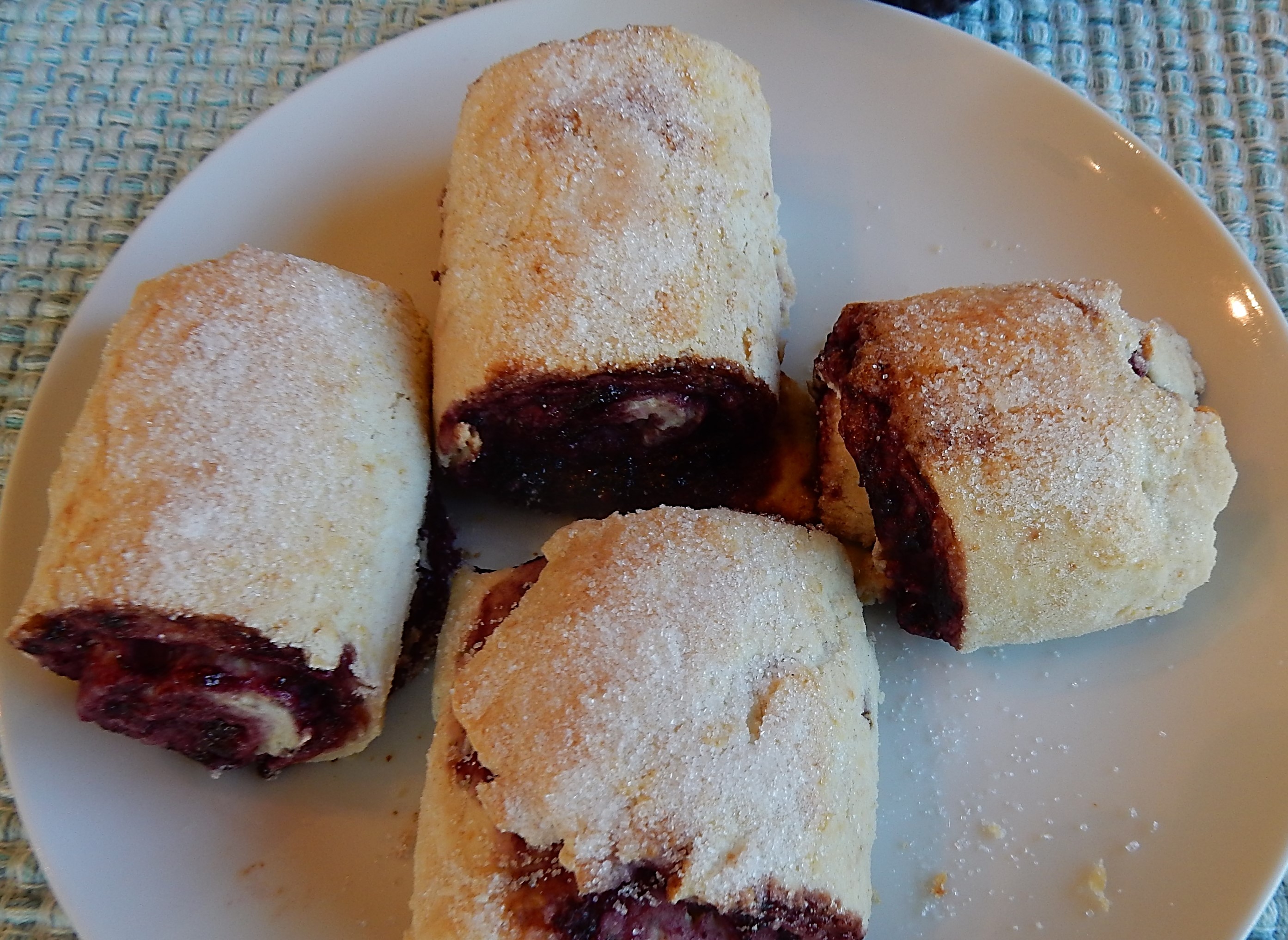
It’s berry season – and time to make berry desserts. I recently came across a recipe in a hundred-year-old cookbook for Blackberry Roly Poly and decided to give it a try. Rectangles of pastry are topped with a sauce made from fresh blackberries, and then rolled and baked. The roly polys are served hot, smothered in additional raspberry sauce.

Blackberry Roly Poly

The BlackBerry Roly Polys were delightful. The pastry was flaky and lovely with the embedded blackberry sauce and topping.

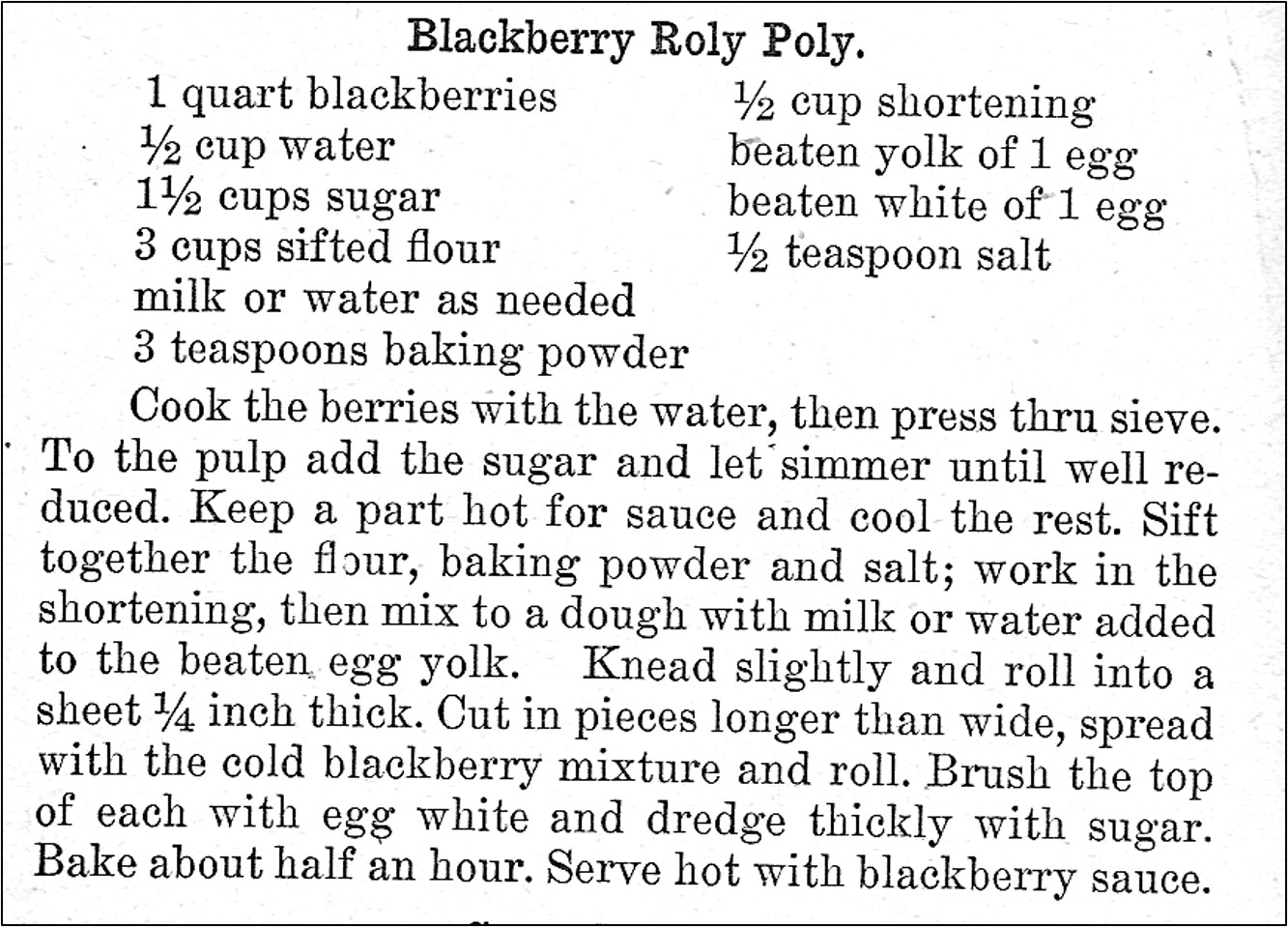
Recipe for Blackberry Roly Poly
Source: The New Home Cook Book: 1924 Edition, Published by Illinois State Register, Springfield, Illinois

Here’s the recipe updated for modern cooks:

Blackberry Roly Poly

  • Servings: about 12 roly poly
  • Difficulty: moderate
  • Print

2 pints blackberries

1/2 cup water +1/2 cup water

1 1/2 cups sugar + additional sugar

3 cups flour

3 teaspoons baking powder

1/2 teaspoon salt

1/2 cup shortening

1 egg, separated (lightly beat, separately, the yolk and white)

Put the blackberries in a saucepan and add 1/2 cup water. Using medium heat, bring to a boil. Then reduce heat and simmer until the berries are very soft; stir periodically. Remove from the heat and press the cooked berries through a sieve. (I used a Foley mill.) Rinse out the saucepan, then put the strained pulp back into the pan. Stir in 1 1/2 cups sugar. Bring to a boil using medium heat, then reduce heat and simmer until the sauce thickens while stirring periodically (about 20-30 minutes). Remove from heat and cool.

In the meantime, Preheat oven to 425°. Sift together the flour, baking powder, and salt, then cut in the shortening.  Add beaten egg yolk and 1/2 cup water; mix using a fork until dough starts to cling together. If needed, add additional water. (If desired, a food processor can be used to make the dough.) Knead dough slightly then roll part of the dough into a rectangle 1/4 inch thick. Cut into small rectangles each about 4″ by 2″. Spread the cooled blackberry sauce onto the small rectangles, and then roll.  (Reserve about a quarter of the sauce to use when serving.) Put on a baking sheet. Brush with egg white, then generously sprinkle with sugar. Bake until lightly browned (about 1/2 hour).

Serve hot with the reserved blackberry syrup that has been reheated .

http://www.ahundredyearsago.com

Reasons Listed in 1924 Cookbook for Using a Pressure Cooker

Pressure cookers
Source: The New Butterick Cook Book (1924)

According to a hundred-year-old cookbook, there are four reasons for using a pressure cooker:

Value of a Steam Pressure Cooker

Less time for cooking – Whatever food is inside the pressure cooker is subjected to moist heat at a high temperature and cooks in much less time than it would at an ordinary temperature in an ordinary kettle. This fact has advantages for the housekeeper who has to meet emergencies in hasty preparation of meals.

Cereals may be deliciously cooked in twenty minutes in the pressure cooker, as compared with three hours of cooking on the stove. Beans may be well cooked in forty minutes instead of requiring five or six hours of cooking on the stove. A steamed pudding placed in the pressure cooker is ready to serve after being cooked for thirty minutes under ten pounds of pressure. Three hours would be required to accomplish this in any other way.

Even beef neck or flank, which would required from three to five hours of cooking on the stove, may be cooked in forty minutes in the pressure cooker.

Less fuel used – In most pressure cookers, only a short period of time is required to attain ten pounds of pressure. A low fire will maintain the pressure throughout the cooking process.

Micro-organisms killed – Micro-organisms that cause spoilage in canned foods are killed at the high temperature made possible by the use of steam under pressure.

using a pressure cooker

Thorough cooking – The combination of high temperature and moist heat attained by the pressure cooker is probably more effective than any other methods of cooking for making certain foods digestible and tender. Cereals, with their large proportion of cellulose, and meats with tough fiber are among such foods.

The New Butterick Cook Book (1924)

Old-Fashioned Honey Muffins

Honey Muffins in Plate

I’m a fan of muffins, so when I saw a recipe for Honey Muffins in a hundred-year-old cookbook I decided to give it a try. In addition to honey, the recipe called for graham flour. Graham flour is a coarsely ground whole wheat flour that contains the endosperm, the bran, and the wheat germ. It is traditionally considered a health food.

The Honey Muffins were not very sweet, but tasted good in a “healthy way.” They are a fairly dense muffin. They were lovely when served with jelly or jam.

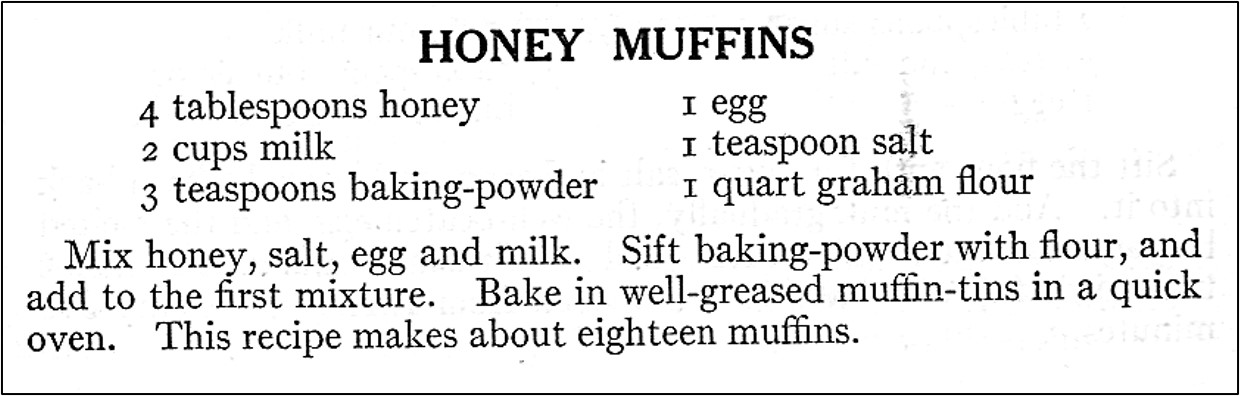
Here’s the original recipe:

Recipe for Honey Muffins
Source: The New Butterick Cook Book (1924)

Graham flour is sometimes difficult to find. Whole wheat flour, preferably coarsely ground whole wheat flour, can be substituted for the graham flour.

Here’s the recipe updated for modern cooks:

Honey Muffins

  • Servings: approximately 18
  • Difficulty: moderate
  • Print

4 cups graham flour (whole wheat flour – preferably coarsely ground – can be substituted for the graham flour)

3 teaspoons baking powder

4 tablespoons honey

1 egg, beaten

1 teaspoon salt

2 cups milk

Preheat oven to 400° F.   Sift the baking powder and graham flour into a mixing bowl.

Put the honey, egg, salt, and milk in a separate bowl; stir to combine. Then add to the flour mixture and stir to combine.

Grease muffin pans (or use paper liners). Spoon batter into muffin cups; fill each cup about 3/4ths full. Place in oven. Bake 20-30 minutes or until lightly browned and the muffins spring back when lightly touched.

http://www.ahundredyearsago.com

Old-Fashioned Rice Pudding and Berries

Rice Pudding with Berries

It’s berry season, so when I saw a recipe in a hundred-year-old cookbook for Rice Pudding with Berries, I decided to give it a try. The Rice Pudding is molded, and served with a berry sauce. I used strawberries, though the recipe says that raspberries (or a mixture of strawberries and raspberries) could also be used.

The Rice Pudding with Berries turned out well, made a nice presentation, and was very tasty.

Here’s the original recipe:

Recipe for Rice Pudding with Berries
Source: The New Butterick Cook Book (1924)

The recipe directions indicate that sugar is needed for both the Rice Pudding and the Berry Sauce, yet the ingredients list only has “powdered sugar” and does not list an amount. It appears that an ingredient (or at least amounts) is missing for this recipe. I decided to use 1/2 cup of granulated sugar in the Rice Pudding, and 1/4 cup of powdered sugar in the sauce. The sauce I made was a bit tart – but I thought that it was lovely. If a sweeter sauce is desired, use more sugar.

Some of the liquid evaporates while cooking the rice, so the cooked Rice Pudding mixture has less volume than the sum of volume of the ingredients. I used a 2 1/2 cup mold.  When the mold was filled, I still had a little extra Rice Pudding which I put into custard cup. A 3 or 3 1/2 cup mold would work better.

Here’s the recipe updated for modern cooks:

Rice Pudding and Berries

  • Servings: 6 - 8
  • Difficulty: moderate
  • Print

4 cups milk

1/2 cup granulated sugar

1/2 teaspoon salt

3/4 cup rice

1/2 teaspoon vanilla

butter or cooking oil

1 pint strawberries or raspberries (or a mixture of both strawberries and raspberries) (I used strawberries.)

1/4 cup powdered sugar

1 1/2 teaspoons cornstarch

1/4 cup water

Put the granulated sugar, milk, and salt in a large heavy saucepan. Stir to combine, then heat using medium heat until the mixture just begins to simmer. Stir in the rice, reduce heat to low and cover. Cook until the liquid is absorbed and the rice mixture is thick (approximately 35-45 minutes). Remove from heat and then stir in the vanilla.

Grease a mold with butter or cooking oil (a 3 – 3 1/2 cup mold works well), then firmly press the rice pudding into the mold. Refrigerate until cold (at least 3 hours).

In the meantime, make a berry sauce by slicing the berries (raspberries can be left whole) and then putting them into a saucepan. (Reserve several berries to use as a garnish.) Stir in the powdered sugar, cornstarch and water. Bring to a boil using medium heat while stirring. Reduce heat; continue cooking and stirring until the strawberry pieces are very soft and the sauce has thickened. (Add a little more water if the sauce it too thick.) Remove from heat and strain. Keep the liquid and discard the cooked berry pieces.

To serve: Losen the edges of the Rice Pudding with a knife or other cooking tool. Dip the mold in hot water, then unmold onto serving plate. Pour the sauce over the Rice Pudding, and garnish with berries.

http://www.ahundredyearsago.com

Why is it so Difficult to Find Graham Flour?

Definition of graham flour
Source: The New Butterick Cook Book (1924)

Graham flour is a coarsely ground whole wheat flour that contains the endosperm, the bran, and the wheat germ. Year ago it was considered a health food. Graham flour is named after its inventor Sylvester Graham. He began making graham flour in the 1830s, and promoted it as part of a health movement which encouraged eating vegetarian meals and unseasoned foods.

A hundred years ago graham flour was a popular type of flour, and cookbooks contained recipes for graham bread, graham muffins, graham pudding, and other graham foods.  Several years ago I bought graham flour at my local store and made a couple old recipes that used graham flour for this blog:

Graham Nut Muffins

Steamed Graham Pudding with Lemon Sauce

Orange Nut Bread

Graham Popovers

However, when I recently wanted to make a recipe from a 1924 cookbook that called for graham flour, I looked for it at half a dozen stores and couldn’t find it. I eventually bought some (at an outrageous price) off the internet.  Each of those stores probably sold at least two dozen other types of flour, some of which sounded very exotic to me. But, why no graham flour? Have tastes changed so much across the past hundred years that a food that once was a common staple is now extremely difficult to find?

While searching for information on graham flour, I learned that modern graham flours sometimes have most of the wheat germ removed to prolong shelf life and to help keep it from going rancid. Some websites say that coarsely ground whole wheat flour can be substituted for graham flour, though as with modern graham flours, most of the wheat germ may have been removed. I guess that even if I follow an old recipe calling for graham flour exactly that I’m probably not accurately replicating it. Sigh. . .