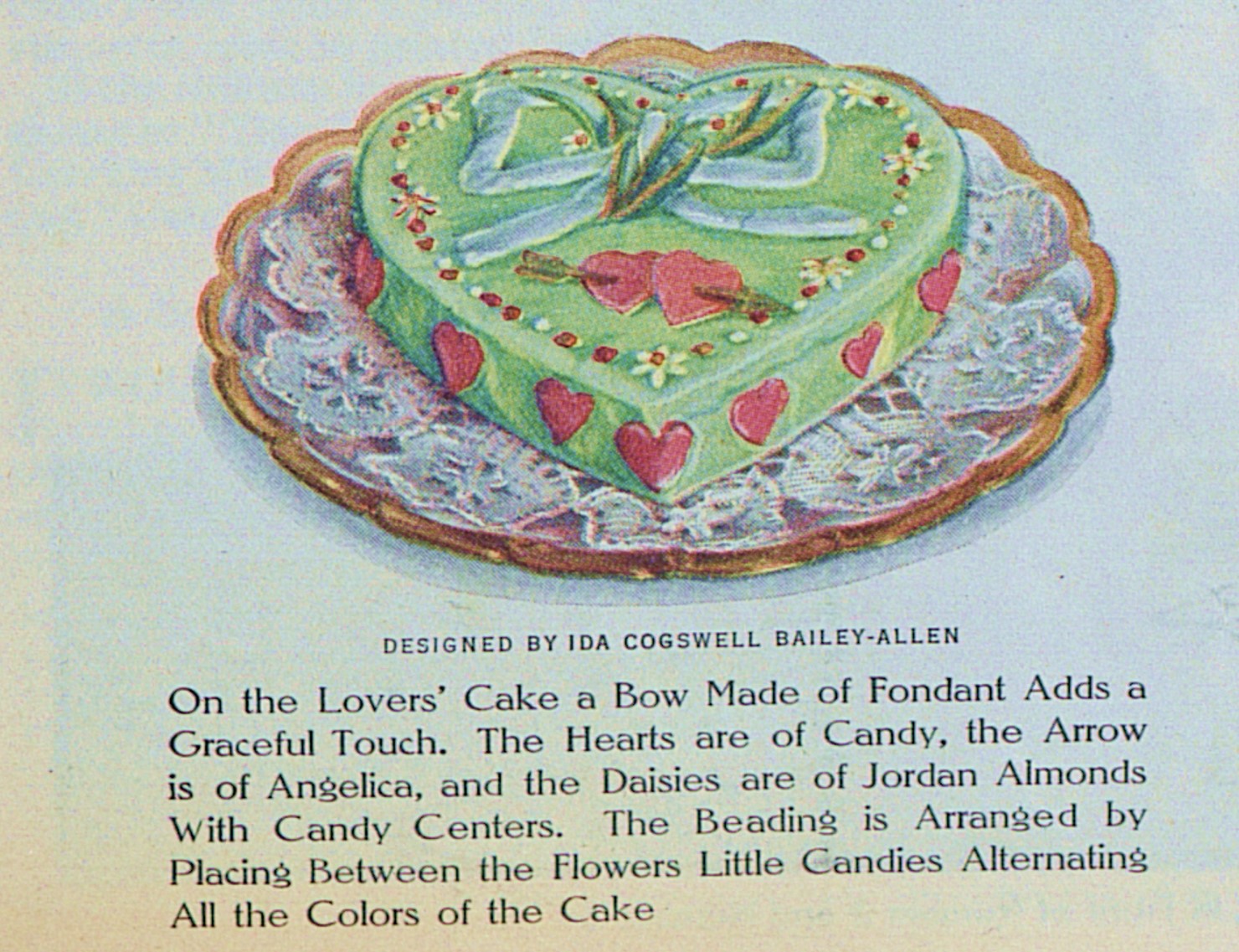
A hundred-years-ago people often made cakes for Valentine’s Day parties and luncheons. Here’s some examples from the February, 1914 issue of Ladies Home Journal.
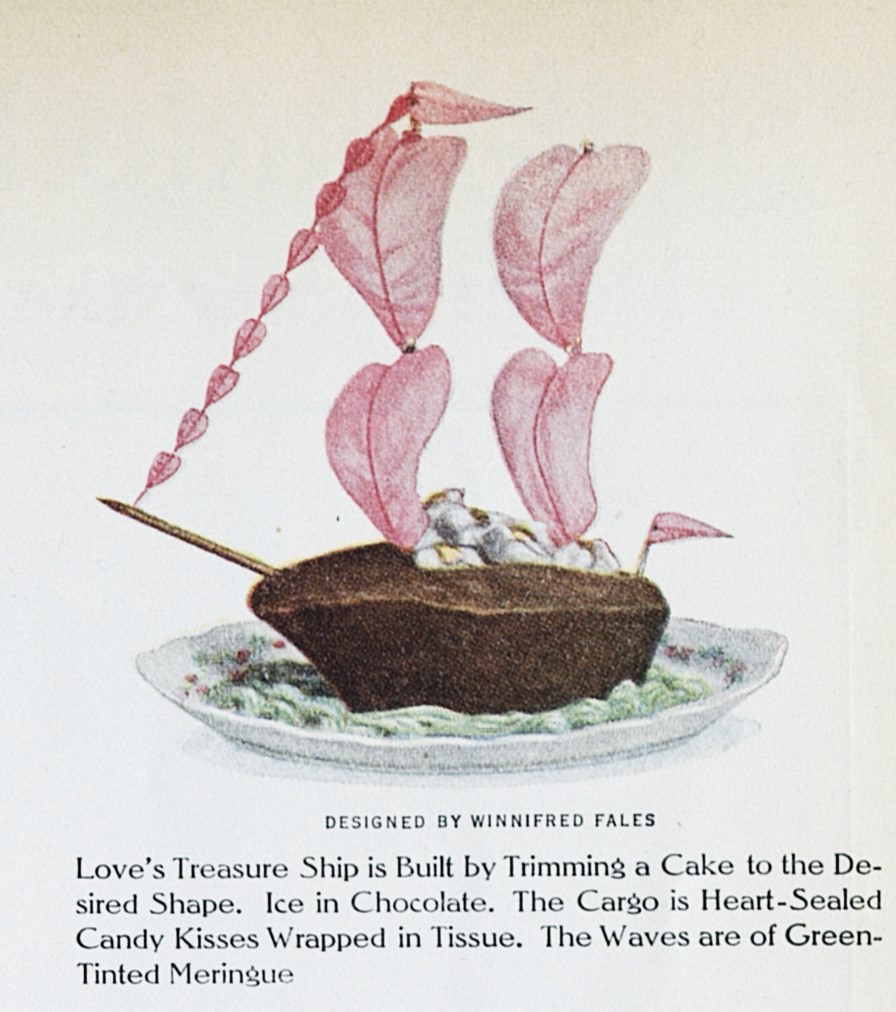
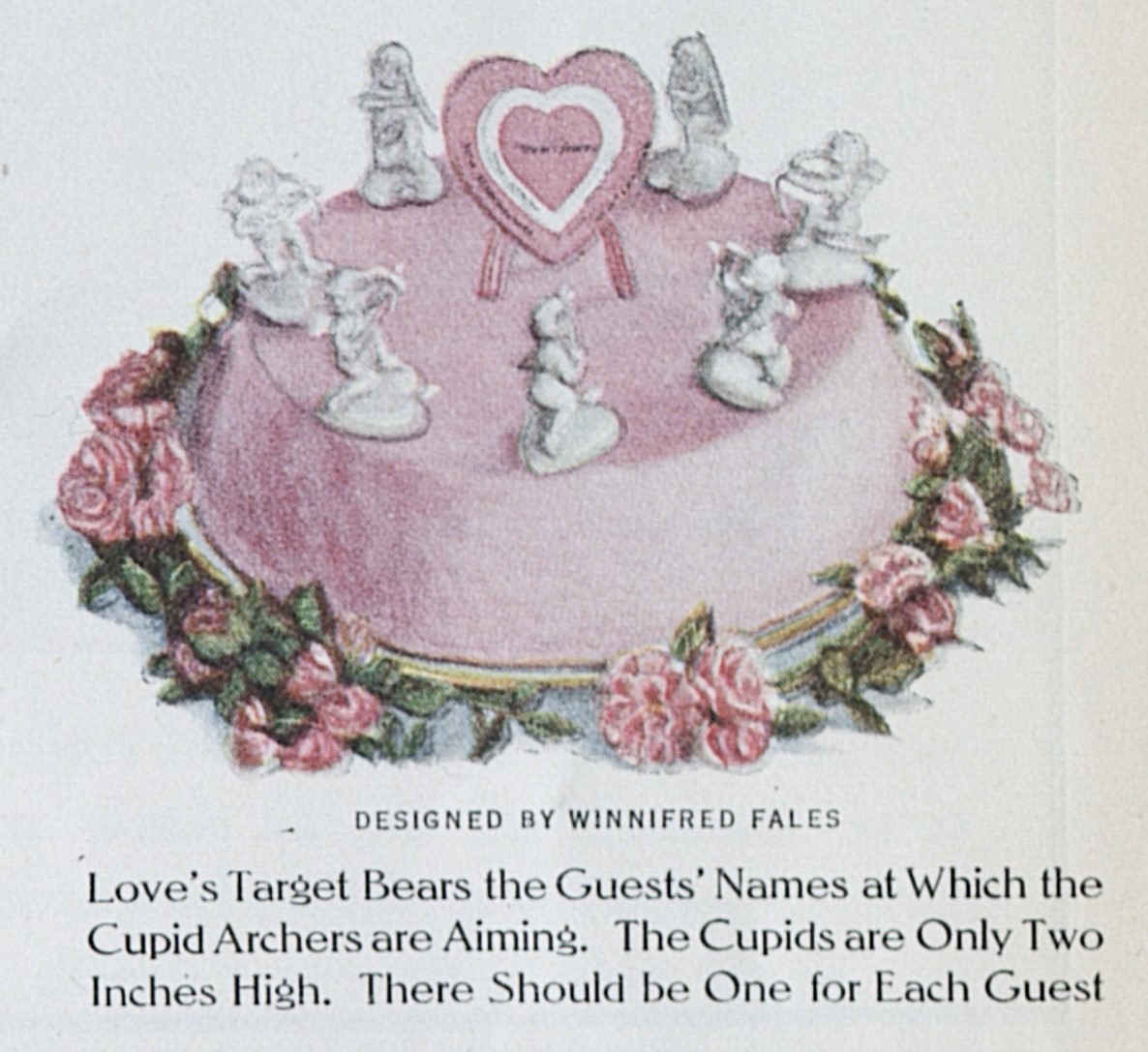

A hundred-years-ago people often made cakes for Valentine’s Day parties and luncheons. Here’s some examples from the February, 1914 issue of Ladies Home Journal.

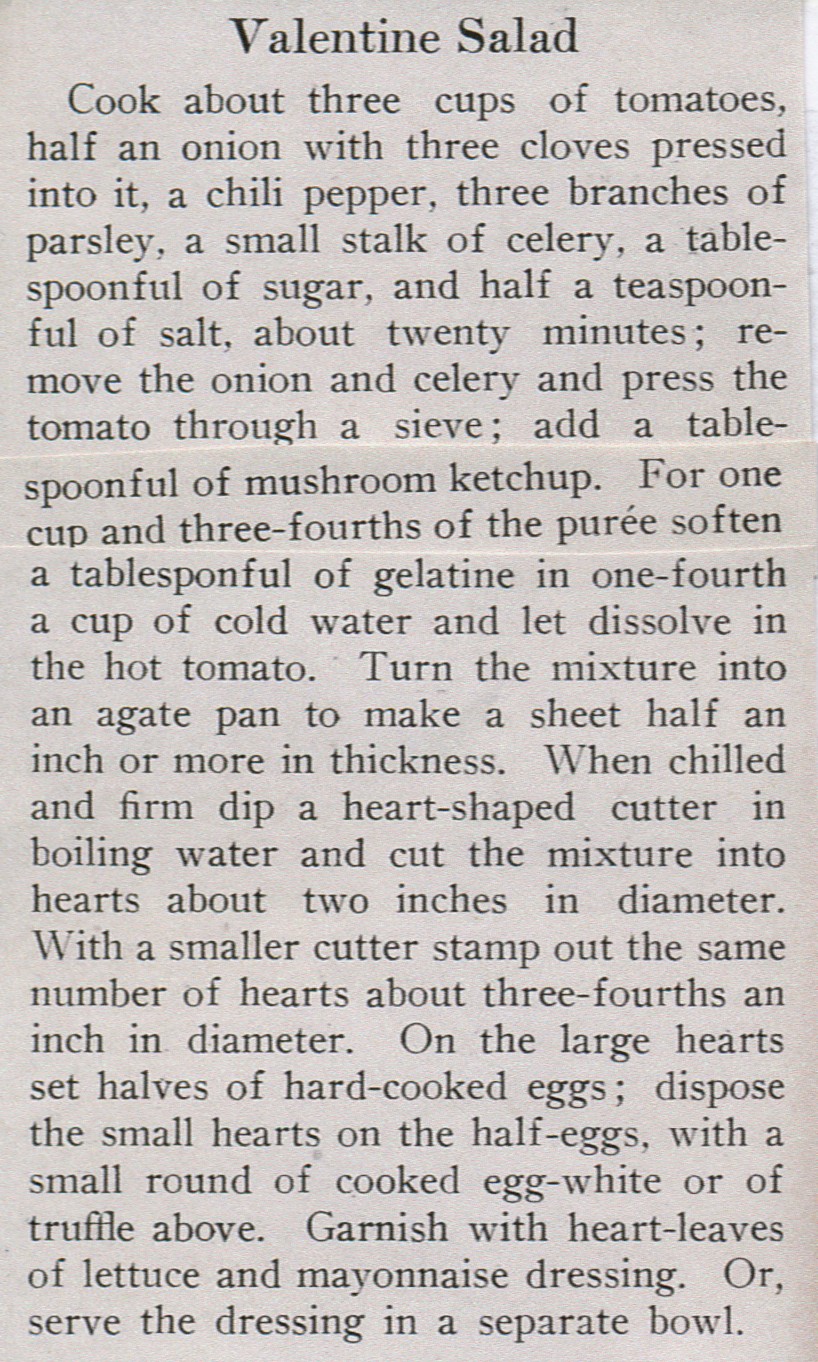
Several days ago I posted a list of food suggestions for a Valentine’s Day party from a hundred-year-old issue of Boston Cooking School Magazine. The magazine included the recipe for one of the suggestions –Valentine Salad–so, I decided to make it for my sweetheart.
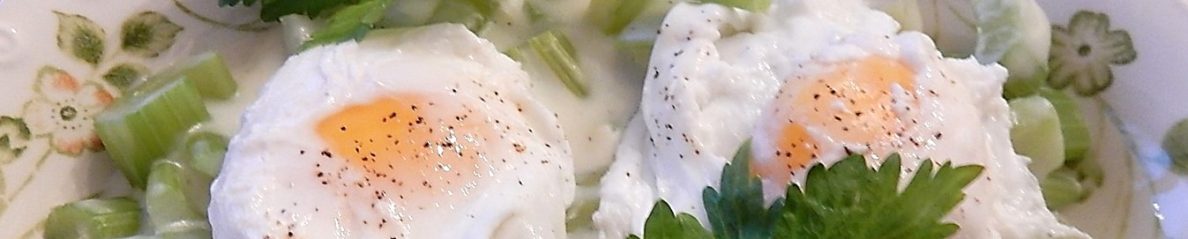
Valentine Salad actually was an old-time tomato aspic cut into heart shapes, with hard-boiled egg slices. The aspic is a jellied savory mixture of homemade tomato and other vegetable juices.
The presentation was a bit much with the heart-shaped lettuce and aspic, but the Valentine Salad had a surprisingly nuanced and sophisticated tangy tomato flavor. My husband said it tasted like a Bloody Mary without the alcohol.
Here’ s my adaptation of the original recipe for modern cooks:
3 cups diced tomatoes
1/2 medium onion
3 cloves
1 jalapeno pepper (chopped)
3 parsley stems
1 stalk celery (chopped)
1 tablespoon sugar
1/2 teaspoon salt
1 tablespoon (1 packet) gelatin
1/4 cup cold water
1 hard-boiled egg (sliced)
Romaine lettuce leaves, cut into heart shapes
mayonnaise (optional)
Combine tomatoes, onion, cloves, parsley, celery, sugar, and salt in a large saucepan. Bring to a boil, then reduce heat and simmer for 20 minutes. Remove from heat and strain. Reserve the juice.*
In a small bowl, dissolve the gelatin in the cold water. Then add to the gelatin mixture to the hot vegetable juice. Pour into a flat pan approximately 6″ X 6″. Refrigerate until firm. Briefly dip bottom of pan in hot water, then slide the jellied mixture onto a plate. Cut part of the jellied mixture into hearts about two inches in diameter. With a smaller cutter, cut the same number of hearts about 3/4 inch in diameter.
To assemble – For each serving, place a lettuce leaf on a plate, top with a large heart. On top of the heart place a egg slice, followed by a small heart. Garnish with small pieces of hard-boiled egg.
If desired serve with mayonnaise.
*The cooked vegetable mixture can be saved and used in a different recipe. For example, I served it over rice.
Here’s the original recipe:

If you are planning a Valentine’s Day party you might like these “holiday spread” suggestions.
Come back on Sunday if you’d like to see the recipe for Valentine Salad. I’m going to make it, and I’ll let you know how it turned out.

It is so important to communicate information clearly. Today when people use the term data visualization they are generally referring to computer software that creates easily-to-understand graphics.
But, sometimes I’m blown away by the creativity of the graphics in old books. I absolutely love a picture in a hundred-year-old home economics book that compares 100 calorie portion sizes for milk and cream.
I knew that skim milk has fewer calories than whole milk— but I’ve never been quite sure how to use that information to answer practical questions like: If I switch from whole milk to skim milk, how much more skim milk can I drink without gaining weight?
Now I know the answer–about 1/2 cup more. Of course, this picture has limitations–Where’s the 1% and 2% milk?

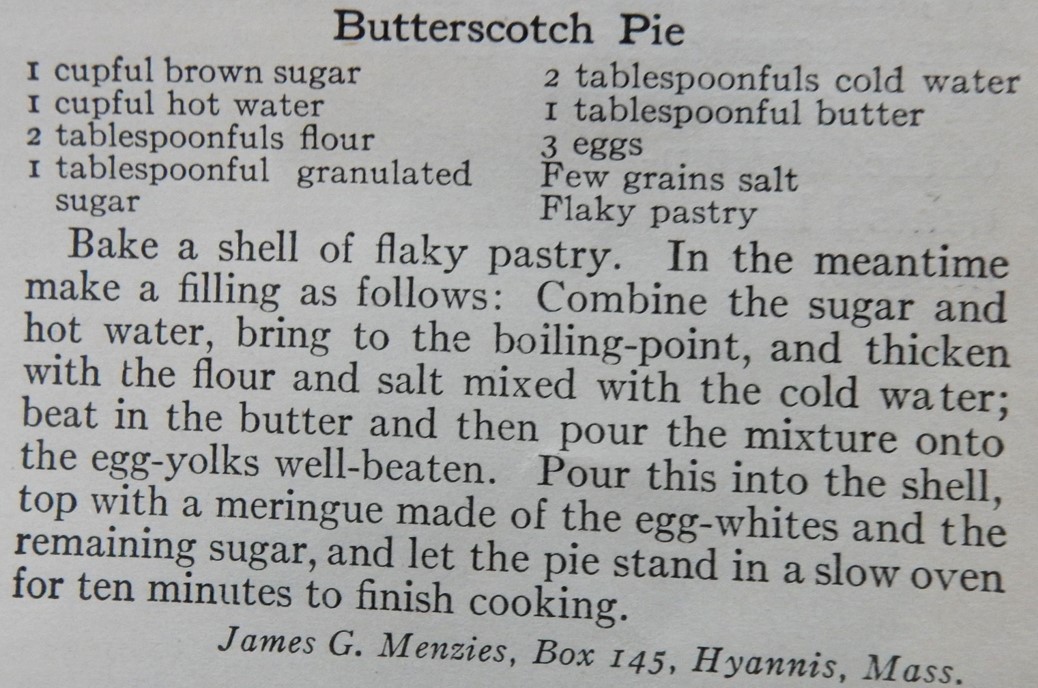
People knew how to make lovely pies a hundred years ago. An old-time winter favorite was Butterscotch Pie with Meringue Topping. I found this classic recipe in the February, 1916 issue of Good Housekeeping.
The Butterscotch Pie is irresistible with a smooth, buttery pudding and a light, delightful meringue. Here’s my adaptation of the recipe for modern cooks:
1 cup brown sugar
1 cup hot water
2 tablespoons flour
1/8 teaspoon salt
1 tablespoons cold water
3 egg yolks, beaten
1 tablespoon butter
1 8-inch (small) baked pie shell
3 egg whites
1 tablespoon granulated sugar
Preheat oven to 325° F. Combine brown sugar and hot water in a saucepan, bring to a boil. In the meantime, in a small bowl combine the flour and salt. Gradually stir the cold water into the flour mixture to create a smooth paste; then stir in the beaten egg yolks. Add one tablespoon of the hot sugar liquid to flour and egg yolk mixture and stir to combine; then add several additional tablespoons of the hot sugar liquid while stirring constantly. When enough liquid has been added to make a thin paste, stir the flour and egg yolk mixture into the remaining hot sugar mixture in the saucepan. Using medium heat, bring to a boil while stirring constantly; reduce heat and simmer while continuing to stir until the mixture thickens. Remove from the heat and stir in the butter. When the butter is melted, pour into the pie shell.
To prepare the meringue, put the egg whites into a mixing bowl. Beat until peaks form, then beat in the granulated sugar. Spoon the meringue onto the top of the pie, and then swirl. Use care to get the meringue spread all the way to the edge of the pie. Bake in the oven for approximately 10 minutes or until the meringue is a light brown.
Here is the original recipe:
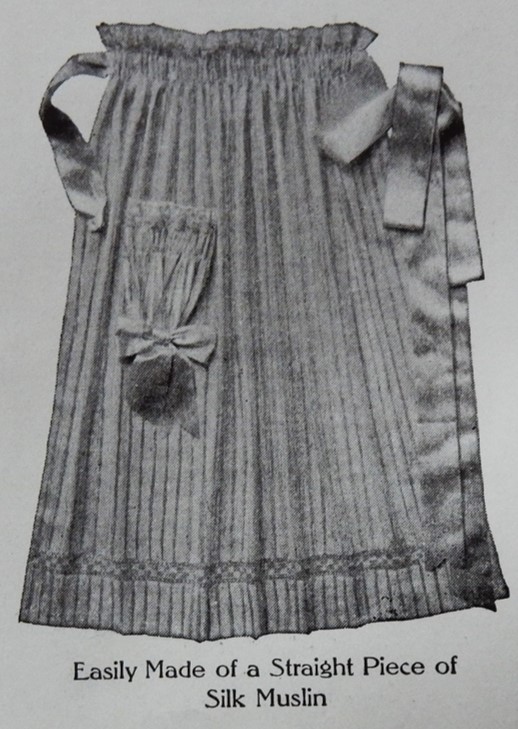
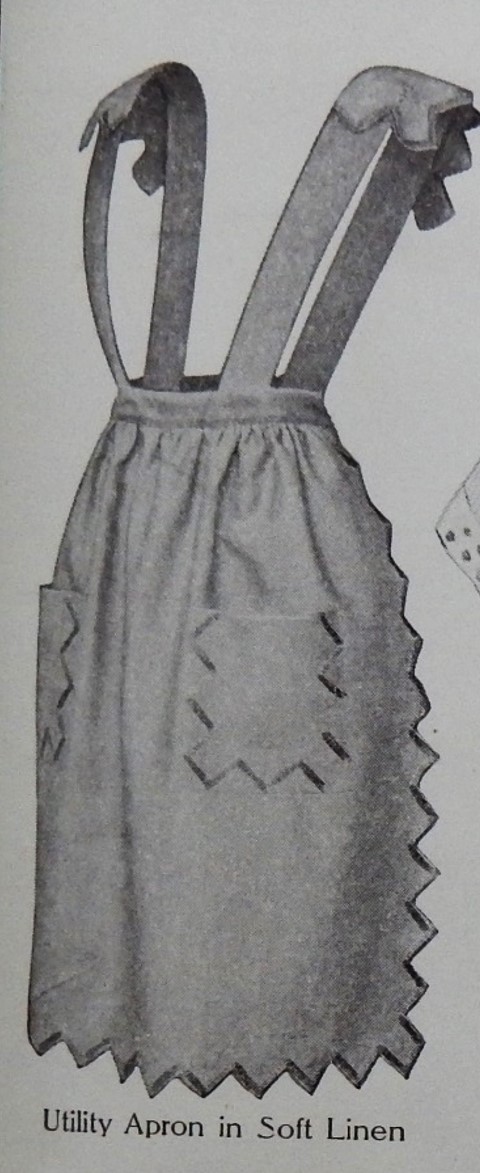
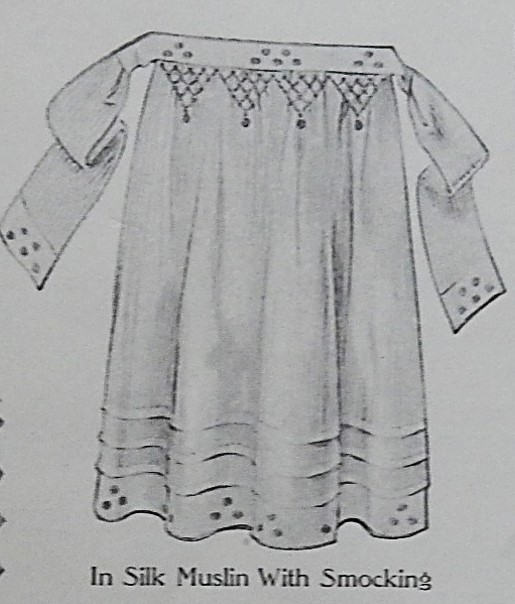
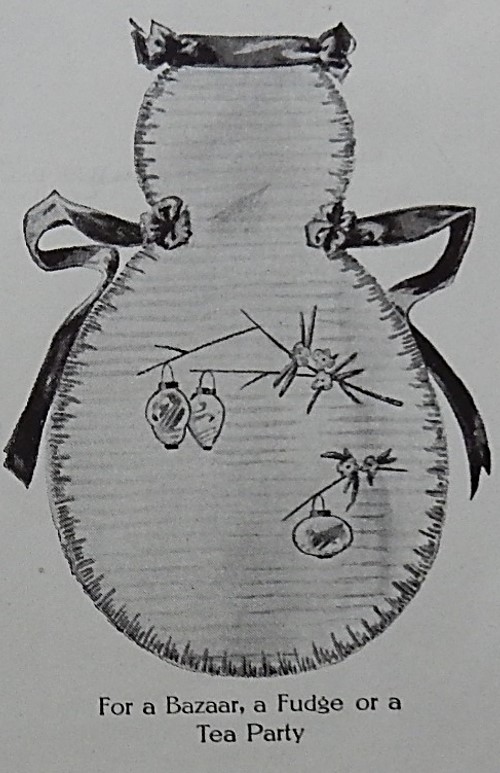
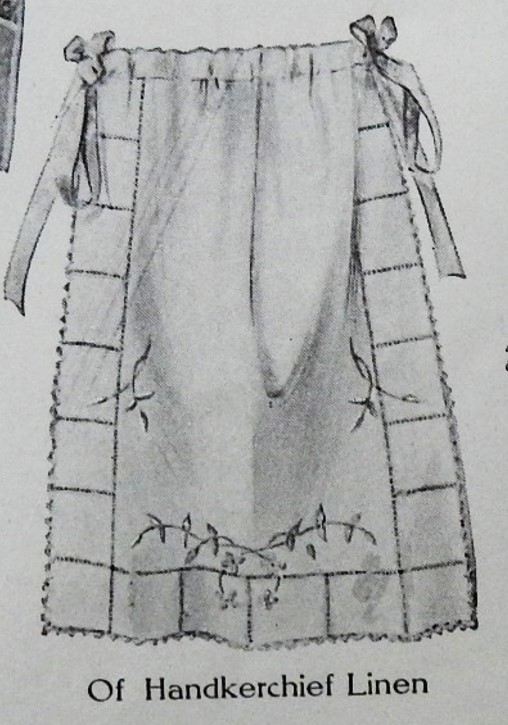
Are some aprons more stylish and youthful-looking than others? I never thought about it until I saw an article in the March, 1916 issue of Ladies Home Journal titled, “The New Girlish Apron: Daintily Made in Handwork.”
I always think that I look like my grandmother when I wear an apron – but perhaps my aprons are just dowdy.
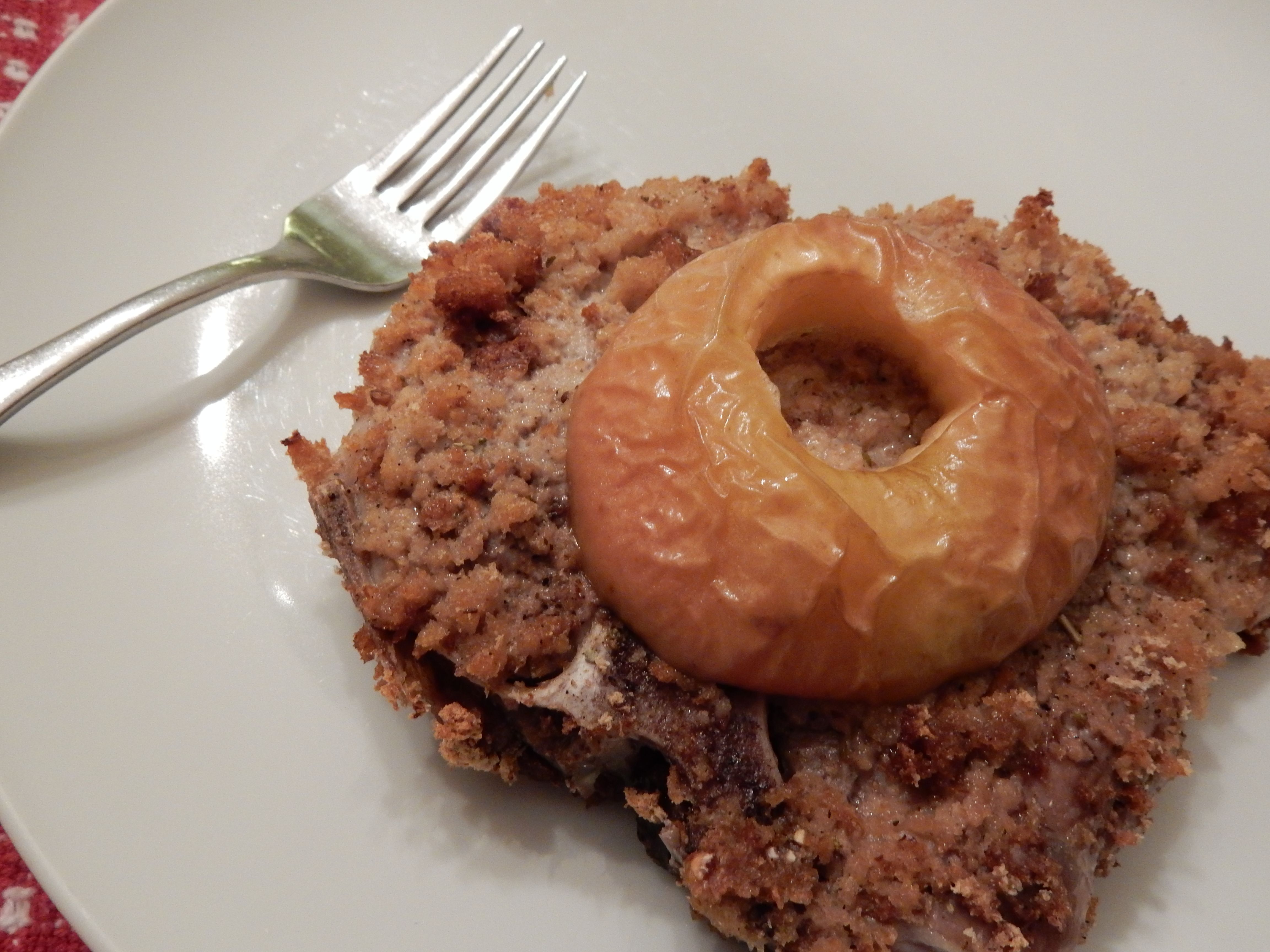
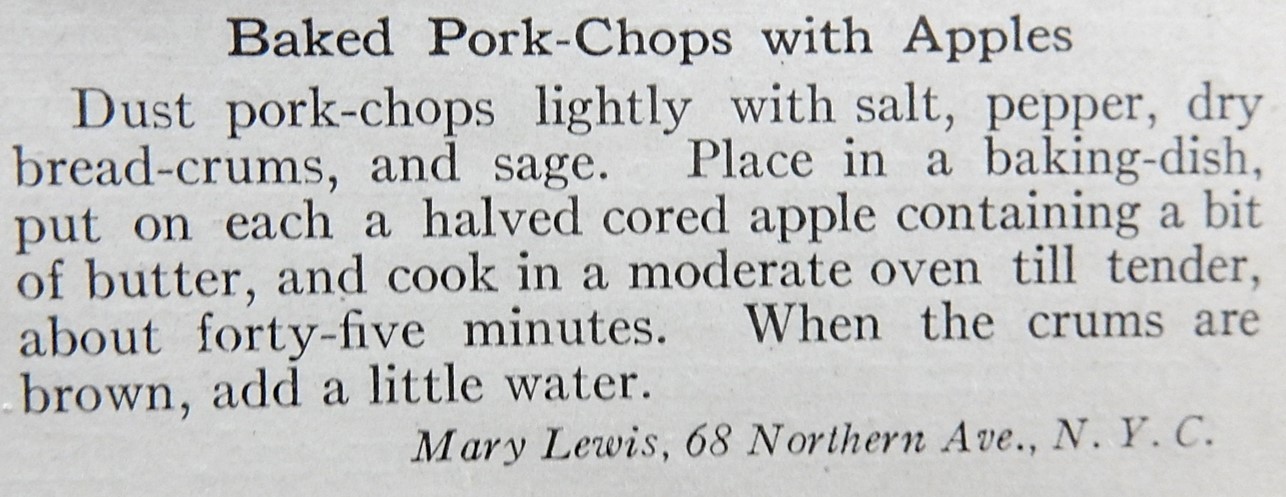
Pork chops are a food that I crave in mid-winter, but would seldom think about eating in July. Maybe it brings back vague memories of eating freshly butchered pork in January when I was a child. When I saw an intriguing recipe in the January, 1916 issue of Good Housekeeping for Baked Pork Chops with Apples, I immediately knew that I wanted to try it. The old magazine featured the recipe–and even included a picture.

The top of a baked apple showily topped each pork chop for a lovely, yet decidedly old-fashioned, presentation. The pork chops had a nice, slightly crispy, bread crumb coating with sage undertones that blended nicely with the tanginess of the baked apples.
Here’s how I adapted the recipe for modern cooks:
1/2 cup bread crumbs (fine)
1/4 teaspoon salt
1/8 teaspoon pepper
1/4 teaspoon rubbed sage
3 pork chops
3 apples
1 tablespoon (3 teaspoons) butter
Preheat oven to 375° F. Combine bread crumbs, salt, pepper, and sage. Coat the pork chops with the bread crumb mixture and put in a baking dish or oven-proof skillet. Cut the top 1 1/2 inch off the apples and core. (Reserve the remainder of apple for use in another recipe.) Center a cored apple top on each pork chop; place 1 teaspoon of butter in the center of each apple. Bake for 45 minutes or until the pork chop is thoroughly cooked.
And, here is the original recipe: