Hundred-Year-Old Description of a “Mixed Grill”

Picture from magazine article titled "Mixed Grill"
Source: American Cookery (May, 1925)

When I think of the 4th of July, I think of friends gathering, cookouts, and backyard barbeques, so I was excited when I saw an article in a 1925 issue of American Cookery magazine titled “Mixed Grill.” I can’t quite tell if the author is only discussing broiling food in the house or if it is inclusive of outdoor grills. (I picture outdoor grilling becoming popular in the mid-20th century, but maybe some people had an outdoor grill a hundred-years-ago). Here are a few excerpts from the article:

Is a “Mixed Grill” as new to other housewives as it is to me, I wonder?

A “Mixed Grill” is, in short, only a mixed grill. It works out as a combination of almost endless variety, all cooked on the same broiler and leaving only that broiler to be washed – an excellent quality anywhere, and invaluable where time is short and space is limited. As for possible variations, anything edible, not too thick, too small, or too soft may be used. There is no limit, except the taste of the family, and the wit of the cook- also, it must be granted the size of the broiler.

Take, for example, a foundation of chop and potato. My husband has sausage, tomato, and mushroom with his. I have banana (which he detests) with mine, and a shirred egg is slipped in for a guest who is forbidden meat. Except for the chops, all these things are odds and ends, found in the pantry.

The process is simple, but requires more watchfulness and judgment than broiling one thing alone.

A gas broiler is more convenient than coal, as there is no smoke. A broiler with wires closer together than usual is a conveniences, but not a necessity.

Almost everything used in a grill, except tomato, needs to be dipped in oil, and a brush, kept for the purpose, with a cup of oil, is a great help. As a general rule, dry things should be oiled and moist ones egged and crumbed.

Lay the prepared articles on the broiler, putting the thicker ones where they will come directly under the flame. Finish cooking on one side, then pull the pan well out and turn quickly with a broad spatula or two knives, to avoid piercing.

Since, however, the special quality of a mixed grill is the perfection of each individual flavor, simple butter, salt, and pepper are better than a more elaborate sauce.

The grilled articles are necessarily thin, and cool fast, so special care must be taken to have service quick.

American Cookery (May, 1925)

On the 4th, I’m planning to make steaks, roasted asparagus, and roasted green, yellow, and orange peppers. Hmm. . . I guess that is a mixed grill.

Have a wonderful 4th!

Old-Fashioned Praline Ice Cream (Prauline Ice Cream)

bowl of praline ice cream

Summer has arrived and temperatures are soaring. On hot days, nothing hits the spot like ice cream. I came across a hundred-year-old recipe for Praline Ice Cream and decided to give it a try.

The ice cream was delightful with small pieces of pecans and crunchy caramelized sugar brickle.

Here’s the original recipe:

Recipe for Praline Ice Cream
Source: The Daily Argus-Leader Home Economics and Cook Book, Sioux Falls, South Dakota (1925)

I think that there is a typo in the title of this recipe, and that it is for “Praline Ice Cream” and not “Prauline Ice Cream.”

The recipe called for chopped nuts. Of course, I used chopped pecans. (It just wouldn’t seem like Praline Ice Cream with any other kind of nut.) I did not combine the chopped pecans with the caramelized sugar prior to breaking the caramelized sugar into very small pieces.  Instead, I spooned the caramelized sugar onto a buttered plate to cool, then put the pecans in the pan (which still contained a little melted sugar), and stirred for a minute or two. A mortar and pestle could be used to break the cooled praline mixture into very small pieces. I actually used the “pulse” feature on my blender to create the small pieces. I then combined the pecans and the praline pieces. I’m not sure exactly what was meant when the recipe said to sift the praline mixture after it is broken apart, so I skipped sifting.

I did not use a double boiler, and instead just stirred the milk mixture constantly, which worked fine. I always have difficulty with ice cream recipes that call for adding egg yolks to the hot milk. No matter how hard I stir, I end up with small clumps of cooked egg yolk in my mixture, so I strained it after cooking to remove them.

I did not stir the praline mixture into the milk mixture until the ice cream began to harden in the ice cream freezer. My ice cream freezer directions say that nuts, fruits and other additives should be added about 5 minutes prior to the completion of the churning.

Here’s the recipe updated for modern cooks:

Praline Ice Cream

  • Servings: 6 - 8
  • Difficulty: moderate
  • Print

1/2 cup sugar + 1/2 cup sugar

butter

3/4 cup chopped pecans

2 egg yolks

1/2 teaspoon salt

2 cups milk

2 1/4 teaspoons vanilla

1 cup heavy cream

Caramelize 1/2 cup sugar by putting  in a small cast iron skillet; put over low heat and stir constantly until the sugar turns light brown. Spoon the caramelized sugar onto a lightly buttered plate and let cool. There will be a little sugar that has liquified still in the skillet; add the chopped pecans and stir for 1-2 minutes to lightly toast the pecans and to coat with the sugar. Once the caramelized sugar has cooled, break into very small pieces using a mortar and pestle (or the pulse function on a blender), then combine with the chopped pecans. Set aside.

In a bowl,  combine 1/2 cup sugar, the egg yolks, and salt. Stir until thoroughly mixed and smooth. Set aside.

In a saucepan, scald the milk using medium heat while stirring constantly. Slowly pour the hot milk over the egg yolk and sugar mixture while stirring briskly. Return the mixture to the saucepan, and using medium heat, cook while stirring constantly until the mixture thickens. Remove from heat and strain to remove any small pieces of egg yolk that clumped together during cooking. Chill in the refrigerator.

Shortly before churning the milk mixture into ice cream, whip the cream to the firm peak stage. Stir the vanilla into the chilled milk mixture, then fold in the whipped cream.  Freeze following freezer directions. Add the small pieces of caramelized sugar and pecans about 5 minutes before churning is completed. Continue churning until the caramelized sugar and pecans are distributed throughout the ice cream.

(When I made this recipe, I used a 1 1/2 quart automatic ice cream maker that with a bowl which is frozen in the freezer overnight, but a regular ice cream maker would also work.)

http://www.ahundredyearsago.com

Old-Fashioned Lettuce, Cucumber, and Chive Salad

Lettuce, Cucumber, and Chive Salad

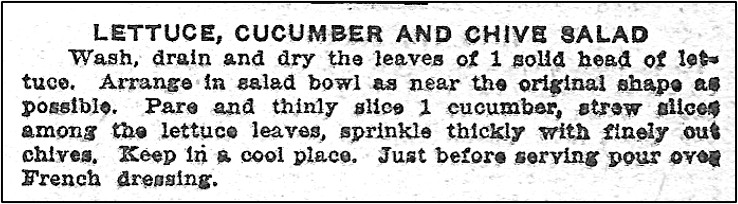
I’m enjoying making various summer salads, so when I saw a recipe in a hundred-year-old cookbook for Lettuce, Cucumber, and Chive salad, I decided to give it a try. The salad had a light vinaigrette-style dressing on it and was lovely.

Here’s the original recipe:

Recipe for Lettuce, Cucumber, and Chive Salad
Source: The Daily Argus-Leader Home Economics and Cook Book, Sioux Falls, South Dakota (1925)

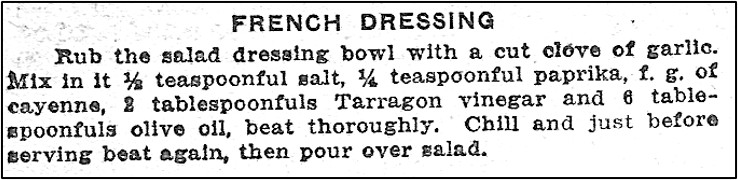
And, here is the original recipe for French Dressing:

Recipe for French Dressing
Source: The Daily Argus-Leader Home Economics and Cook Book, Sioux Falls, South Dakota (1925)

I had a lovely bunch of leaf lettuce that I used to make this recipe. I’m not sure what type of lettuce the recipe author anticipated cooks using, but I did not try very hard to arrange the leaves as near as possible to the original shape. I thought that it was more important to have the lettuce in bite-size pieces than to worry about the shape.

The recipe called for serving this salad with French Dressing. I used a French Dressing recipe that was in the same cookbook as the salad recipe. It is a vinaigrette-style recipe and is quite different from the modern commercially-produced, orange-colored French Dressing. I’ve seen many French Dressing recipes in various hundred-year-old cookbooks over the years, and they have all have been vinaigrettes. I’m not sure when the shift occurred to the orange-colored type of French Dressing.

The French Dressing recipe called for a f.g. of cayenne (red pepper). I have no idea what unit of measure an “f.g.” is, but assumed that it wasn’t calling for much, so I interpreted it to mean a dash.

Here’s the recipe updated for modern cooks:

Lettuce, Cucumber, and Chive Salad

  • Servings: 3 - 4
  • Difficulty: moderate
  • Print

1 head/bunch lettuce

1 cucumber, peeled and thinly slices

3 tablespoons chives, finely chopped

Dressing

1 clove garlic

1/2 teaspoon salt

1/4 teaspoon paprika

dash cayenne (red pepper)

2 tablespoons tarragon vinegar

6 tablespoons olive oil

Wash and dry the lettuce, then tear into pieces and arrange on plates or in a bowl. Put the chopped chives on top of the cucumber slices.  Just before serving, top with the dressing.

To make dressing, cut the garlic clove in half, then rub a small bowl with the cut garlic. Put the salt, paprika, cayenne pepper, tarragon vinegar and olive oil in bowl and stir vigorously to combine.

http://www.ahundredyearsago.com

Keeping the Ice Bill Down

ice boxWhew, prices have gone up a lot recently. Every time I go to the supermarket, I’m shocked how high my grocery bill is. But cooks a hundred years ago had some expenses that I don’t have, such as the purchase of ice. Here’s what it said in the April, 1925 issue of American Cookery magazine:
Keeping the Ice Bill Down

Exit the coalman; enter the iceman! That is how a well-known cartoonist typifies the coming of summer and the end of winter. And he means, of course, that no sooner is the item of fuel expense cancelled than the cost of ice begins boring a hole in the budget. Truly, a philosophical way of expressing a common truth.

The lengthy article contained advice for both icebox and refrigerator owners. Tips for icebox owners included:

  • Keep your ice chamber filled. It saves the ice and preserves the food.
  • A small piece of ice may seem more economical, but is it? When it melts, the food spoils and the walls of the ice chamber grow warm.
  • Remove or place all the food at one time, as quickly as possible, opening and shutting the door but once.

The article also addressed electric refrigerators:

With the rapid development of electricity, ice machines are being installed in the most modern refrigerators. . . Mechanical ice refrigeration has come and is here to stay.

Old-Fashioned Hot Walnut Sandwiches (Walnut Biscuits)

Hot Walnut Sandwiches (Walnut Biscuits)

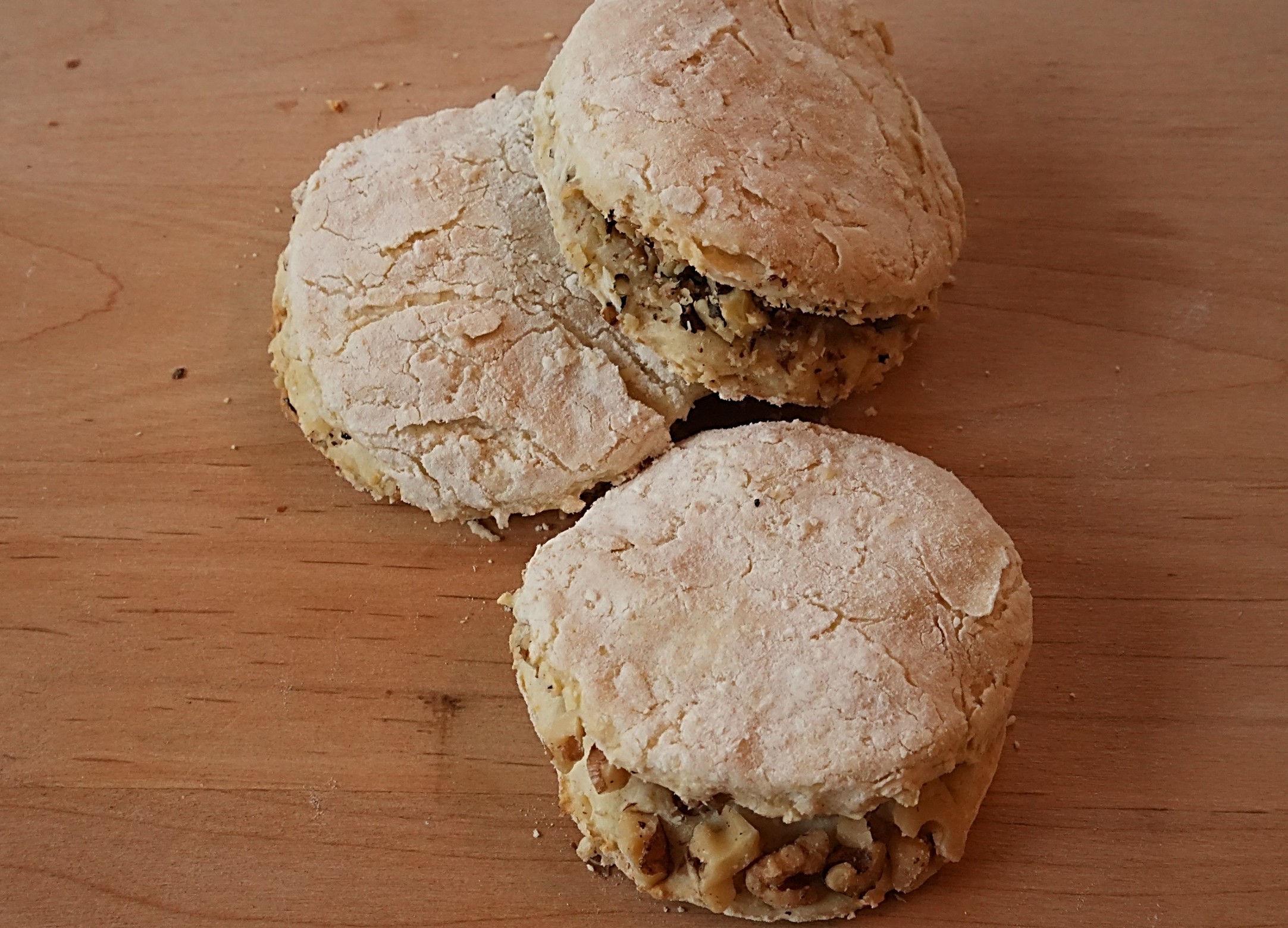
I was intrigued by a recipe in a hundred-year-old newspaper recipe supplement. The recipe title was Hot Walnut Sandwiches, but it was labeled as a biscuit recipe. The recipe called for making baking powder biscuit dough, then putting chopped walnuts between two biscuit rounds, and baking.

This recipe does not call for any sugar, so the Hot Walnut Sandwiches were not sweet and definitely tasted like a baking powder biscuit, but the walnuts were a nice twist and a fun addition. The Hot Walnut Sandwiches were tasty. I especially liked them when I smeared a little butter on them.

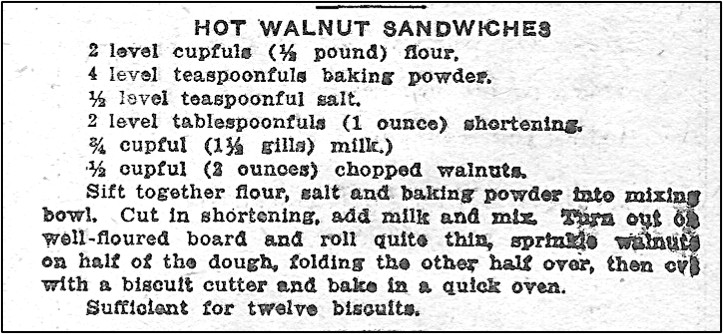
Here’s the original recipe:

Hot Walnut Sandwiches (Walnut Biscuits)
Source: The Daily Argus-Leader Home Economics and Cook Book, Sioux Falls, South Dakota (1925)

The recipe calls for putting the chopped walnuts on top of half of the dough, then folding the other half over it, and cutting with a biscuit cutter. This results in a lot of scraps of dough embedded with walnuts. I found that it worked better to cut all the circles first (and re-roll the dough as needed), then put the walnuts on half of the circles and top with the remaining circles of dough.

It’s interesting that the recipe indicated that 3/4 cup of milk should be used, but that it also stated in parentheses that this is 1 1/2 gills of milk. Gills are more commonly used today as a measure for alcohol when making mixed drinks, but apparently a hundred years ago it also was still occasionally used when measuring other ingredients.

Here’s the recipe updated for modern cooks:

Hot Walnut Sandwiches (Walnuts Biscuits)

  • Servings: approximately 12
  • Difficulty: moderate
  • Print

2 cups flour

4 teaspoons baking powder

1/2 teaspoon salt

2 tablespoons shortening

3/4 cup milk

1/2 cup chopped walnuts

Preheat oven to 425° F.  Sift together flour, baking powder, and salt in a mixing bowl. Cut in the shortening, then stir in the milk until combined. On a lightly floured surface, roll the dough until 1/4-inch thick. Cut with a round biscuit cutter. (I used a drinking glass as the cutter.) Sprinkle chopped walnuts on half of the circles, then put the remaining circles on top of the walnuts. Lightly press together. Place on a baking sheet, and bake for 10-12 minutes, or until lightly browned. Serve warm.

http://www.ahundredyearsago.com

Is Steam Hotter When the Lid is on a Pan?

Drawings of steam in saucepans
Source: School and Home Cooking (1925) by Carlotta C. Greer

Sometimes I learn bits of cooking trivia when browsing through hundred-year-old books. For example, a 1925 home economics textbook explains that when there is pressure (such as when the lid is on a pan), the steam is hotter than if there is no pressure.

Steam Under Pressure

Which is hotter, – the “steam” (i.e., water vapor) coming from boiling water in an uncovered saucepan or teakettle or the “steam” which has been held underneath the lid of a covered saucepan or teakettle? Steam confined in a small space or held under pressure may reach a temperature higher than that of boiling water.

School and Home Cooking by Carlotta C. Greer (1925)