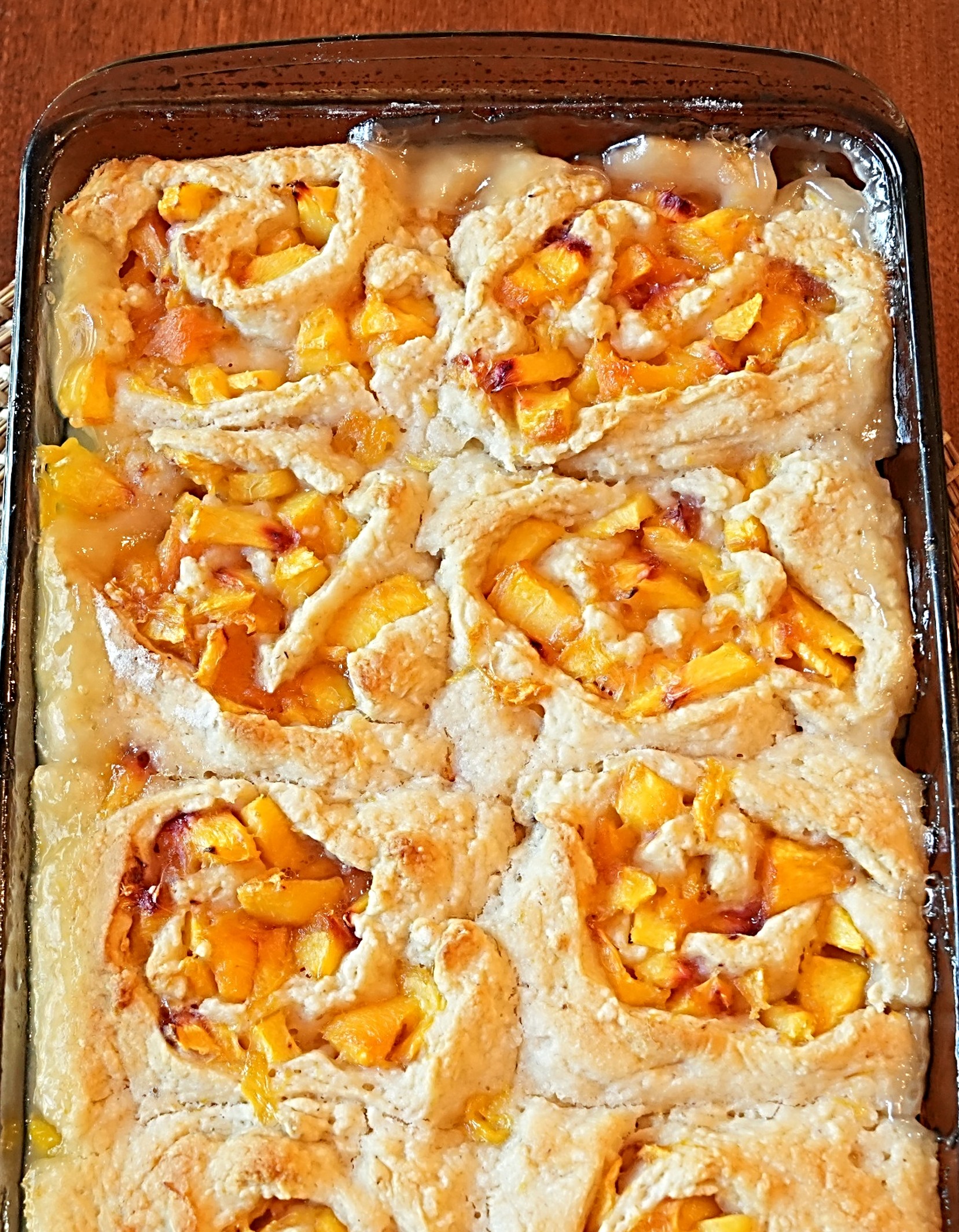
I’m enjoying ever last minute of these final days of summer. Canoeing, swimming in the lake, state fair . . . and summer produce . . . tomatoes, watermelon, cucumbers, peaches. A few days ago, I bought some lovely peaches, so decided to try a hundred-year-old recipe for Peach Roll.
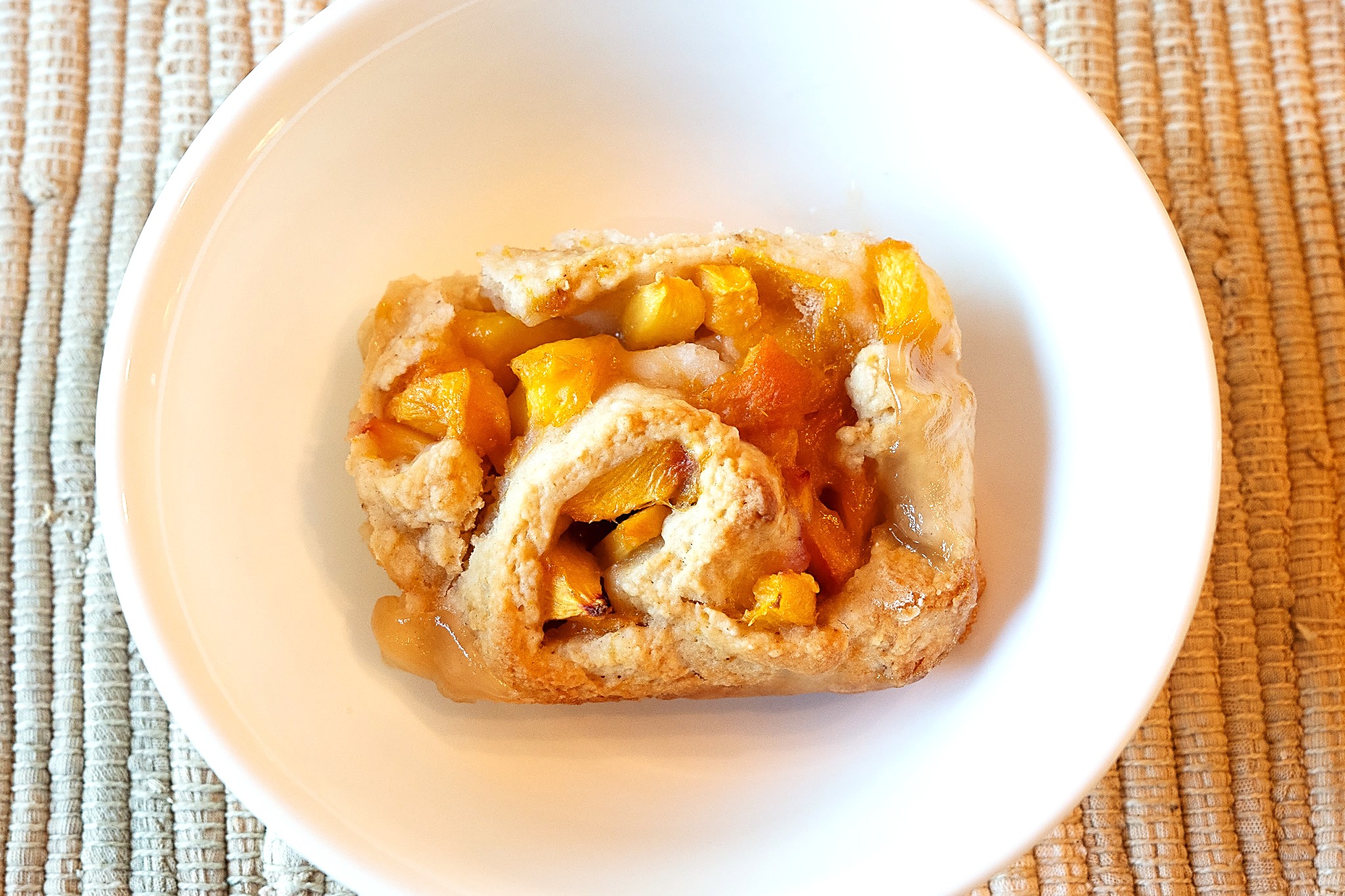
The Peach Roll was a delightful comfort food. Chopped peaches were rolled into a biscuit dough. The dough was then sliced and placed in a flat baking dish. A sugar syrup was poured over the slices, and the dish was baked until it was lightly browned and the syrup was hot and bubbly.
Peach Roll is similar in taste to Peach Cobbler, but the presentation is different. I like to serve Peach Cobbler with a little milk, so poured a little milk over the Peach Roll slices when I served them, but it is lovely either with or without the milk.
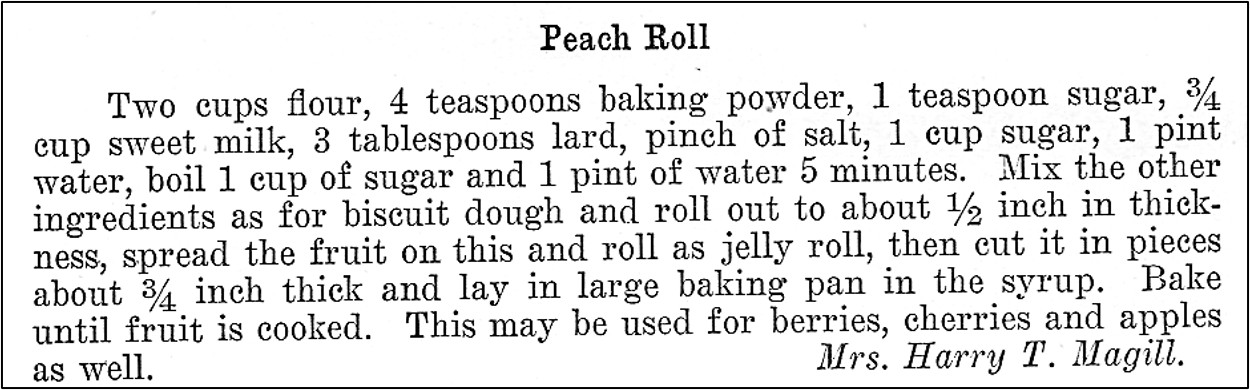
Here is the original recipe:
When I made this recipe, I peeled and coarsely chopped four peaches, which made about 3 cups of chopped peaches. This amount worked well when I made the roll.
The recipe called for cutting the roll into 3/4 slices. This seemed very thin to me. Each of my slices were about 1 1/4 inches thick which worked well with the pan that I used.
I substituted butter for the lard.
Here is the recipe updated for modern cooks:
Peach Roll
2 cups flour
4 teaspoons baking powder
1 teaspoon sugar
1/8 teaspoon salt
3 tablespoons lard or butter, softened
3/4 cup milk
3 cups coarsely chopped peaches (about 4 peeled peaches)
Sugar Sauce
1 cup sugar
2 cups water
Step 1. Preheat oven to 375° F.
Step 2. Put the flour, baking powder, sugar, and salt in a mixing bowl; stir to combine.
Step 3. Cut in the lard or butter; then add the milk and stir with a fork until a dough forms.
Step 4. Put the dough on a prepared surface and roll into a rectangle about 8″ by 12″ and 1/4 inch thick.
Step 5. Put the chopped peaches on the rolled out dough, and spread to evenly distribute.
Step. 6. Gently roll the dough into a log (like a jellyroll).
Step 7. Cut the roll into slices about 1 1/4 inch thick.
Step 8. In the meantime, put the sugar and water in a saucepan. Using medium heat bring to a boil, then reduce heat and simmer for 5 minutes. Remove from heat.
Step 9. Put the cut slices of the roll into a baking dish approximately 7″ by 12″ by 2.” Pour the sugar syrup over the slices.
Step 10. Place in the oven and bake until the syrup is bubbly and the top is lightly browned.

Thank you for the recipe. I love baking with peaches almost as much as I love eating peaches!
I think that you’ll like this recipe.
That looks like a really good peach recipe.
It was tasty.
Wonderful recipe!!
It’s yummy.
This sounds delicious! The original recipe was a lot more confusing than some of the other 100 year old recipes. It was interesting the amount of fruit wasn’t included, just completely up to your discretion. It wasn’t mentioned if the fruit was fresh, cooked, or canned. It is almost as if the fruit was an afterthought.
It did seem like a particularly confusing recipe. As you noted, it’s really strange that a recipe for Peach Roll says absolutely nothing about the peaches.
Oh, I’ve never come across pouring milk over a baked pudding! Is that a typical American thing? I can see it might work well, and not be too rich for the enjoyment of the dish.
Since I grew up in Pennsylvania and this recipe was from a Pennsylvania cookbook, my sense is that milk may have been put on Peach Roll when it was made a hundred years ago. I don’t think that most people in the U.S. today would put milk on a cobbler or shortbread. However, as a child we always put milk on these types of recipes.
Sounds like a plan!
It is a pretty roll. I think I will put ice cream on mine, though.
Ice cream would be lovely on the Peach Roll.
Wish I had one right now!
This recipe would be a true test to one’s self-control – yummy!
I have that problem with a lot of desserts. 🙂
This sounds so delicious! Thanks for your recipe update, Sheryl. 😊
It was delicious.
What a wonderful way to savor late-summer peaches! 🍑 Adapting those vintage recipes is always such a fun puzzle—it’s wild how older cookbooks often completely skipped details like fruit measurements! Serving it with a splash of milk sounds like such a cozy, nostalgic touch; do you think vanilla ice cream or a dollop of whipped cream would work just as well?
Making old recipes is always a fun adventure. The Peach Roll would be lovely with ice cream or whipped cream.
I’ve never heard of this, but it sure looks tasty!
It was yummy.