
The iconic novel jazz age novel, The Great Gatsby, was published in 1925. Here’s a description of the foods served at one of Gatsby’s parties:
On buffet tables, garnished with glistening hors d’œuvres, spiced baked hams crowded against salads of harlequin designs and pastry pigs and turkeys bewitched to a dark gold. In the main hall a bar with a real brass rail was set up, and stocked with gins and liquors and with cordials so long forgotten that most of his female guests were too young to know one from another (Chapter 3).
There apparently were a variety of salads that had “harlequin designs.” I knew that “harlequin” can mean a masked comic character who wears bright clothes, but I was uncertain of the meaning of the word in this context, so I looked it up. According the Cambridge Dictionary, another definition of harlequin is, “fancifully varied in color, decoration, etc.”
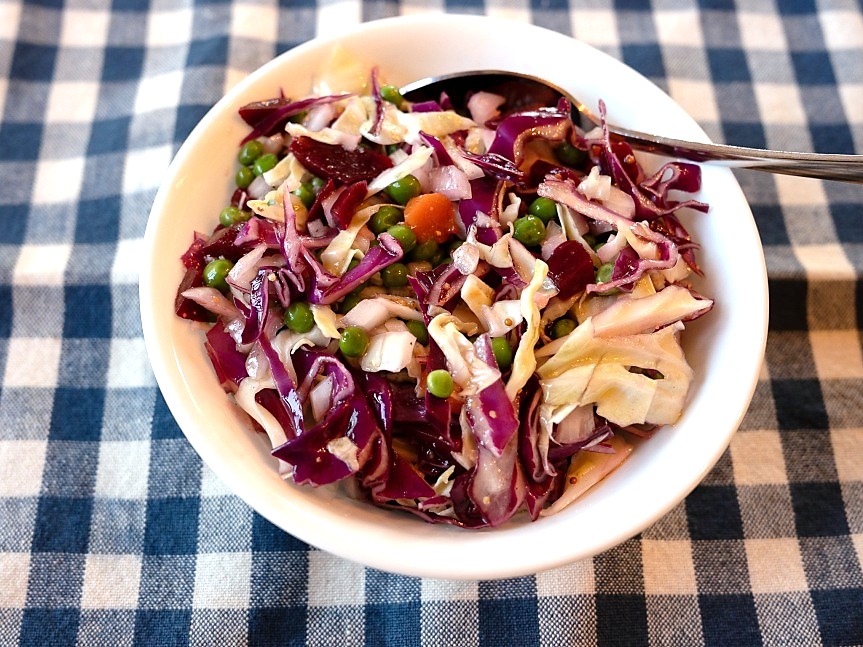
“Salads of harlequin designs” sounds beautiful, so when I came across a recipe in a hundred-year-old cookbook for Harlequin Salad, I just had to give it a try. The tasty, colorful, vibrant salad contained shredded red and green cabbage, chopped beets and carrots, peas, and onion in a vinaigrette dressing.
Here’s the original recipe:

The recipe called for French peas. I assumed this referred to green peas. It also called for white cabbage. I assume this is another name for the typical green cabbage.
I mixed all the ingredients together since the recipe said that “the effect is better if they are mixed,” though I’m intrigued by the possibility of creating an incredible harlequin design by arranging in “heaps.”
Here is the recipe for French Dressing that was in the same cookbook that contained the Harlequin Salad recipe:
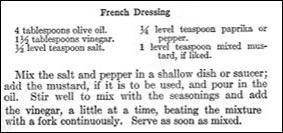
Both the salad recipe and the salad dressing recipe called for salt and pepper (or paprika). I only put the seasonings in the dressing, and used 1/8 teaspoon of pepper and 1/8 teaspoon of paprika (as well as 1/3 teaspoon salt).
And, here’s the recipe updated for modern cooks:
Harlequin Salad
1 cup red cabbage, finely shredded
1 cup green cabbage, finely shredded
1 cup onions, chopped
1 cup green peas (I used frozen peas that had been thawed.)
1/2 cup cooked beets, coarsely chopped (cool before layering in jar)
1/2 cup cooked carrots, coarsely chopped (cool before layering in jar)
dressing (see below)
Put all ingredients (except dressing) in a bowl and lightly toss to mix. Gently stir in the dressing, then chill for at least an hour.
Dressing
1/3 teaspoon salt
1/8 teaspoon pepper
1/8 teaspoon paprika
1 teaspoon prepared mustard
4 tablespoons olive oil
1 1/2 tablespoons vinegar
Put the salt, pepper, paprika, and mustard in a small bowl; stir to combine. Add the olive oil and stir until mixed. Slowly add the vinegar, a little at a time, while stirring continuously with a fork.

I enjoyed reading about why harlequin appealed to you. I am glad to have seen your salad, but I would rather look at it than eat it.
🙂 Nice to hear you enjoyed the post even if this isn’t a salad for you.
No wonder people from that age had, in general, smaller waist lines. ‘Real food’ was in vogue. ‘Take away’ food was yet to be discovered/created. I’m definitely going to use the term ‘Harlequin Salad’.
Homemade food is so much healthier than much of what people eat today.
It’s lovely to look at but I can’t get past the peas. I would probably give it a try at least once!
This recipe would work fine if you just omitted the peas.
It is very colorful and nutritious. The dressing looks good, but I was wondering if it was enough for 5-7 servings.
I tend to prefer fairly light amounts of dressing, and I thought that the amount of dressing I made based on the old recipe worked fine, but it probably depends upon how much dressing you like on salads. If you wanted more dressing, you could double the recipe (or make 1 1/2 times the recipe).
I do like the less dressing. I was thinking that currently, we tend to really load the dressing on.
Sometimes when I order a salad at a restaurant, the salad is just swimming in dressing – and I think, “I should have asked for the dressing on the side.” But I never seem to remember to actually do that.
I started doing that.
I can see cooking the beets for this salad ( not that I would eat them)….but why cook the carrots?
Did you enjoy the salad?
Depending upon how firm you prefer carrots in salads, the carrots could probably be either cooked or uncooked in this salad. I cooked the carrots until they softened a little but were still slightly firm (I want to say I cooked them until they were al dente, but I think that’s a pasta term.)
It is always such fun to read your posts and then follow up about early recipes, especially via the newspaper archives. Harlequin salad, and the concept of such a dish–not necessarily a salad, has an interesting, and probably unexpected by any of us in this time, origin. Curiosity is a surprisingly interesting hobby. And being a person who does not understand the love affair many have with the humble onion, I enjoyed the recipe that mentioned the “judicious use of thin slivers of onion.”
Love the phrase, “judicious use of thin slivers of onion.” Some recipe authors are really good writers.
So pretty!
It did look nice.
Good grief! This looks suspiciously like my grandmother’s Summer Salad! I was not a fan but my mother loved it! I suspect the dressing she used was an oil and vinegar (which was the big turnoff for me)… I’ll have to show this to Sparky as it is right up his alley!
I like how your grandmother gave the salad a name based upon the season of the year when the ingredients were readily available. Did she also make a “winter salad?”
I loved that you included your story along with the recipe! It sounds very refreshing!
I’m glad you enjoyed this post. The salad was tasty.
Great story, thanks!
You’re welcome. It’s wonderful to hear that liked the story.
I’m appreciating the stories behind these wonderful recipes!
It’s nice to hear that you enjoy the stories and background information.