
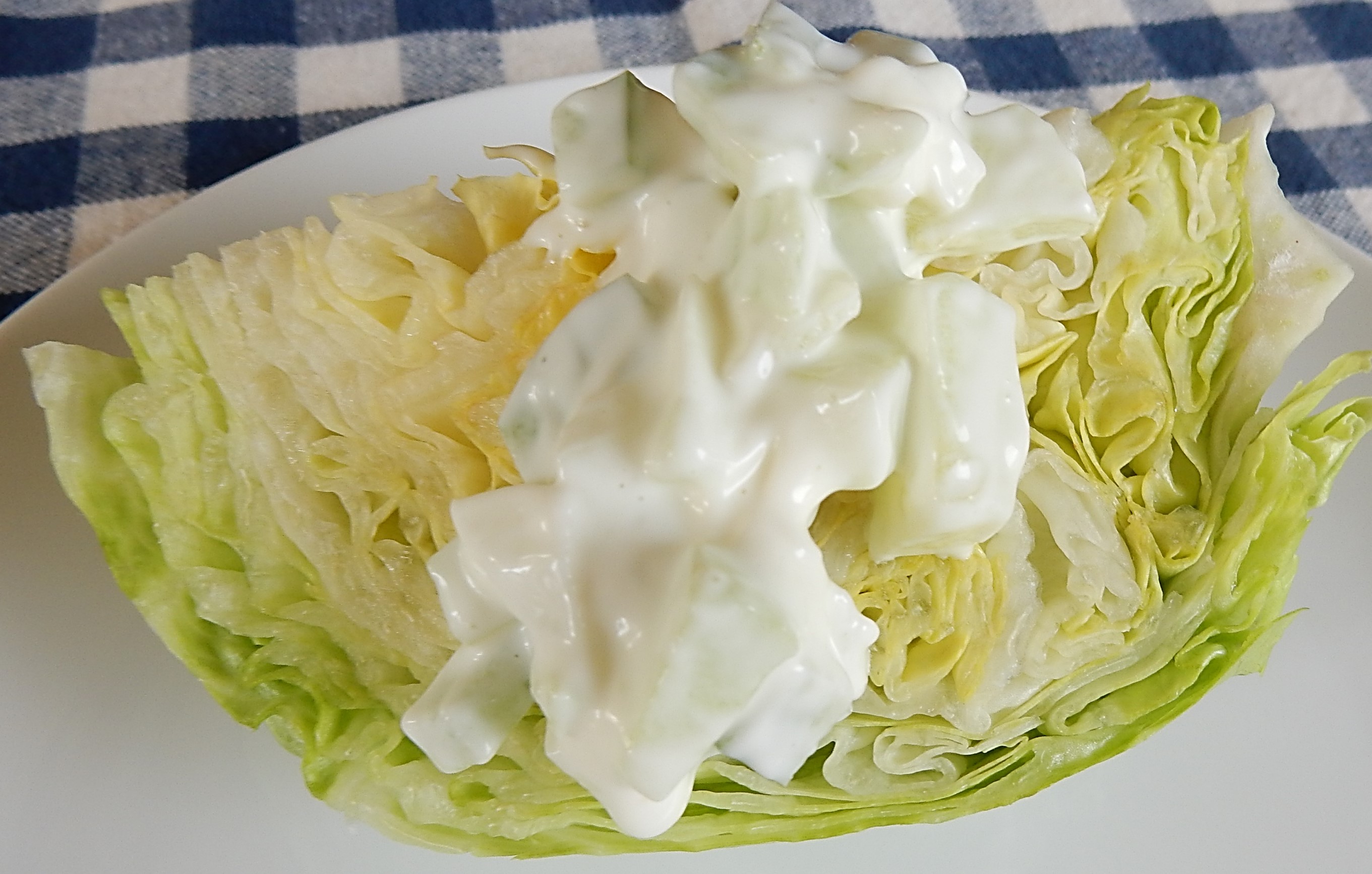
 A hundred years ago salad options during the winter months were more limited than they are today. Here is what it said in a 1925 cookbook:
Almost every variety of vegetables and fruits may be made into salads. Eggs are used also, as well as many kinds of fish and meat. Vegetable salads are the most common and should therefore receive first consideration.
Naturally, lettuce heads the list. It is more popular because we can get it when other vegetables are almost unobtainable. The round, close heads are more generally used than the long-leaf variety. Curly lettuce, while pretty, is tougher than either of the other two. Lettuce contains little nutriment, but is rich in mineral salts. . .
In winter, when fresh salad plants are hard to obtain, a tomato jelly or salad made from canned or fresh (cooked) string beans, or even from the remains of baked beans seasoned with parsley and onion juice, is economical and satisfying.
Rumford Complete Cook Book (1925)

Eating seasonally was the only choice a hundred years ago!
I was going to note that as well.
The courthouse in Sheridan Wyoming has a large photograph of the town, from the hill where it is located, taken about 120 years ago. Prominent in the photograph is a grocers noting that it bought, and sold, vegetables. Now, if you are eating local vegetables there, it’s because they came out of somebody’s garden. In the winter, there couldn’t have been much to buy, or sell.
You are right, it was limited! Even the foods that were shipped were seasonal items- citrus in the winter, apples in September, and few things were available all year!
I wish that my local stores would buy vegetables from small local producers.
I think that people appreciated the various fruits and vegetables more when they were only available seasonally. I can remember how special the first strawberries of the season were each year when I was a child. Now they are available year round (and generally less tasty since they are produced to withstand being shipped long distances).
There’s still a lot I won’t bother with in the winter. I wait for local asparagus even though I can purchase it just about any time of year, it’s just not the same. Fresh blueberries are across the board disappointing because the varieties they grow to ship are never worth eating.
I agree! There’s no comparison between the thin stalks of asparagus stores sell in the off-season and the tender, sweet (and generally thicker) stalks available in the spring. Corn on the cob is another vegetable that I will only buy in-season and locally.
Oh yes, it’s tempting, but always disappointing!
Salad were not even very popular in the winter when I was growing up.
I have similar memories. Jello salads were popular – other types not so much though remember my mother serving leaf lettuce that she raised in her garden with a cream dressing
Iceberg lettuce was the “only” green salad we had growing up. Mama found it a delight after growing up on a desert ranch in the 30’s and 40’s.
I also remember that (except for the leaf lettuce that my mother raised each spring in her garden) that the only lettuce we had when I was a child was iceberg lettuce. When I was a young adult, I heard that romaine lettuce had more nutrients, and can remember taking a romaine lettuce salad to a party and feeling very knowledgeable and sophisticated.
And there I was hoping you would opt for the tomato jelly or the green beans and parsley and onion juice salad.
Just in case you want to make Tomato Aspic to celebrate Valentine’s Day next month, I have the recipe for you. Years ago I made Valentine Salad (Heart-Shaped Tomato Aspic with Hard-Boiled Egg). 🙂
I thought I remembered that post, and sure enough, I had commented on it! It was a pretty salad; apparently I should add ingredients for tomato aspic to my shopping list.
In Texas they are proud of serving salad, like you offered a picture of, as a “wedge salad”. Some places don’t offer an alternative to that. In the 1920s (and earlier) iceberg was shipped on ice by truck or train from California. Burpee celebrated its minerals and vitamins in the 1890s. It took perhaps centuries to develop into the product we know today, according to some.
You’re absolutely right. Sometimes we tend to forget how good the transportation system was in the U.S. a hundred years ago, and how they could ship iceberg lettuce (as well as some other vegetables) across the country. Plant breeders have done much across the years to create the vegetable varieties we buy. It’s fun to look at old catalogs from Burpee and other companies.
Interesting!
It’s fascinating to think about how food options were more limited a hundred years ago during the winter months.
That looks good!
The photo is of a recipe that I made several years ago (and it may not actually be a very good example of a historically accurate winter lettuce salad). In hindsight maybe I shouldn’t have used this photo. But in any case, here’s the link to the post:
Lettuce with Cucumber Sauce – A Hundred Years Ago
So simple but good!
Lettuce salads with a nice dressing are very tasty.