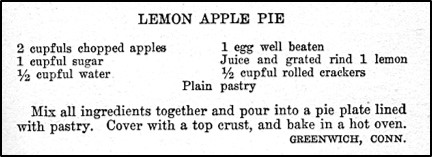
I love to read rich decriptions of food written by skilled food bloggers – even when it’s a bit over the top. Extravagant food descriptions aren’t new. Here are some excerpts from a fictional story that appeared in a 1920 magazine:
A Lunch Box Romance
From early youth Lucena Cottle had thirsted in secret for a romance and now she was face to face with her thirtieth birthday and none had come her way. Sidtracked by circumstances in the home of her widowed cousin-in-law, Mrs. Drusill Fifer, who took boarders for a livelihood.
However, as it chanced, the rank and file of Mrs. Fifer’s boarders- slangy young clerks, mostly whose brains ran to “swell” ties, “grand” movie shows and the like – made slight impression upon the fancy of Lucena. One, only one, was there whose stock stood high with her, and the, sad fact, was as helplessly shy as she, herself.
Dutton Filbert was not stylish, and his ties never bothered him. He was with an automobile company, and no doubt wore greasy overalls when at work, but he was always neat in the house, and Lucena liked his twinkling brown eyes.
The task of filling Mr. Filbert’s lunch basket daily was Lucena’s and one that she executed with zest. For, of all branches of cuisine duty, the preparing of sandwiches was one she especially loved and excelled in. No crude structures of slab-like bread and ragged gristly meat were those turned out by Lucena. Her’s – to see them was to taste them, and to taste them was to call for more. And no day-in-day-out sameness of construction dulled the appetite of the fortunate partaker thereof. One day, sliced cold, roast beef, thin, even, finely lean with narrow edging of delicate fat, nestled between the smooth, daintily battered slices of white bread and brown. Another day plentiful shavings of sweet, boiled ham, mustard-embellished, took the place of beef; or minced chicken, mingled with gravy, or scrambled egg, skillfully blended with chopped bacon of the alluring streak-of-fat-and-streak-of lean kind, serves as filling.
There were jelly tumblers of creamy rice pudding, and meringue custards, and marvelous mixtures of savory and spicy things baked in little brown casseroles; there were crisp, golden-brown turn-overs, fat and bulgy, merely hinting by a splash or two of candied red or orange-tinted juice, at the delights of their interiors, and cakes, never alike, two days in succession, but ranging widely from thin-edged wafers to wedges and triangles of loaf and layer cakes.
Mr. Filbert fully realized he was a lucky man.
One day Lucena got together a new gingercake that was a dream of joy – a sublimated thing, spice-breathing, raisin-spotted, of a spongy lightness and a delightsome dark red-brown hue. She placed two large blocks in Mr. Filbert’s lunch basket, and when next she overhauled the latter, she found not so much as an edge or a corner left. She did, however, find a bit of paper folded up in the napkins, which bore the following tribute:
Oh, gentle lady, who dost make
Such heart-enthralling gingercake,
Accept from me my thanks sincere
For treat the best I’ve had this year;
I’d like to ask you, if I may,
Please make another one someday.
—-
After that they took a walk and had a talk; and about the week next there’ll be a wedding.
Lucena laughed and said, “I don’t know what you call a courtship. It was all straightforward and right, and it came about through the medium of the lunch basket.”
American Cookery (April, 1920)

 I love apple pies, but sometimes I get bored by the typical cinnamon-flavored pie, so when I saw a recipe for Lemon Apple Pie in a hundred-year-old cookbook, I decided to give it a try.