Old-fashioned Chocolate Mint Sauce for Ice Cream


Last week I did a post on a hundred-year-old recipe for Mint Syrup. In that post, I said that the syrup could be used in coffee (it’s delicious) – but several readers suggested that it would be wonderful on ice cream, especially if it was mixed with chocolate syrup.

Well, great minds think alike – and it goes across the years. The magazine that contained the Mint Syrup recipe, also contained a recipe for Chocolate Mint Sauce for Ice Cream.

This sauce was much thicker than most modern chocolate syrups, but it was delightful on vanilla ice cream. The hundred-year-old recipe calls for lots of brown sugar and only one tablespoon of cocoa. I expected the syrup not to be chocolaty enough – but I was wrong. It had just the right amount of chocolate with the brown sugar apparently contributing to the rich flavor.

Here’s the original recipe. (I’m also including the Mint Syrup recipe, so that you don’t need to go back to last week’s post.)

Source: Good Housekeeping (August, 1917)

I found this recipe challenging. When I made it, the sauce quickly hardened into a candy-like consistency. I reheated it and added butter. I then removed from the heat and stirred rapidly until the sauce began to thicken – and it again got too thick, so I  added water (quite a bit of it), and stirred until the consistency seemed right for a sauce.

Here is the recipe updated for modern cooks – though I feel like it still needs a bit more tweaking. If you try this recipe, I hope you’ll add comments about how well it turned out – and whether you made additional revisions to the recipe.

Chocolate Mint Sauce

  • Difficulty: difficult
  • Print

Chocolate Mint Sauce

2 cups brown sugar

1 tablespoon cocoa

1 cup milk

2 tablespoons butter

1 cup mint syrup (see recipe below)

1/2 – 1 cup water, if needed

Put the brown sugar and cocoa in a sauce pan; stir to combine. Gradually add the milk while stirring. Bring to a boil using medium heat, then reduce heat and cook until it forms a soft ball when dropped into cold water (238° F.).  Remove from heat, stir in the butter. After the butter has melted,  add the mint syrup.  Stir rapidly until the sauce begins to thicken; add water if the sauce is too thick.  Serve on ice cream.

Mint Syrup

1 cup sugar

1/2 cup water

1/2 cup mint leaves

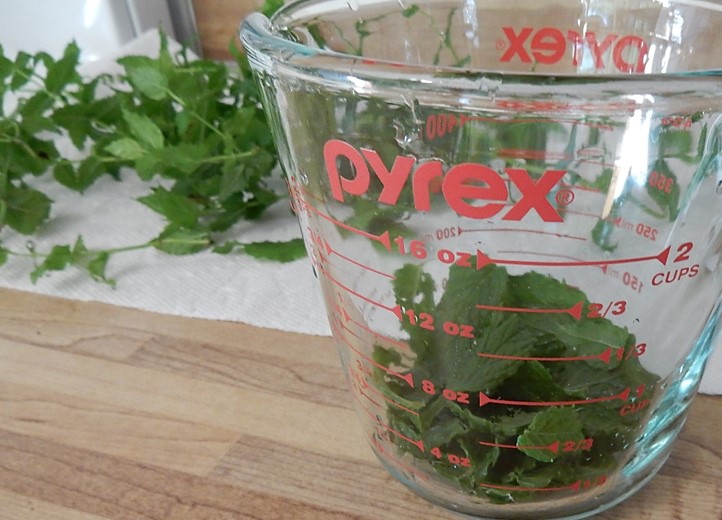
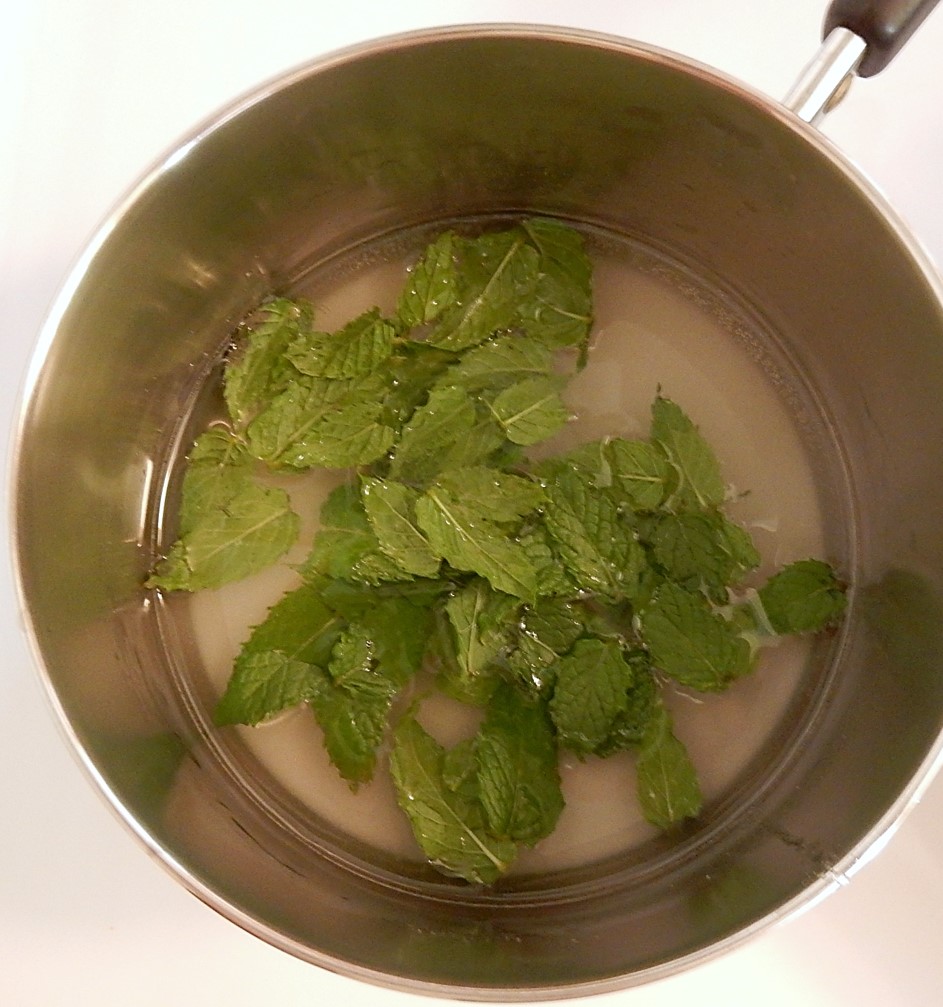
Combine the sugar and water in a saucepan; then add the mint leaves. Bring to a boil using medium heat. Reduce heat and simmer until the liquid begins to thicken to a syrup consistency (about 20 minutes). Remove from heat; strain and cool.
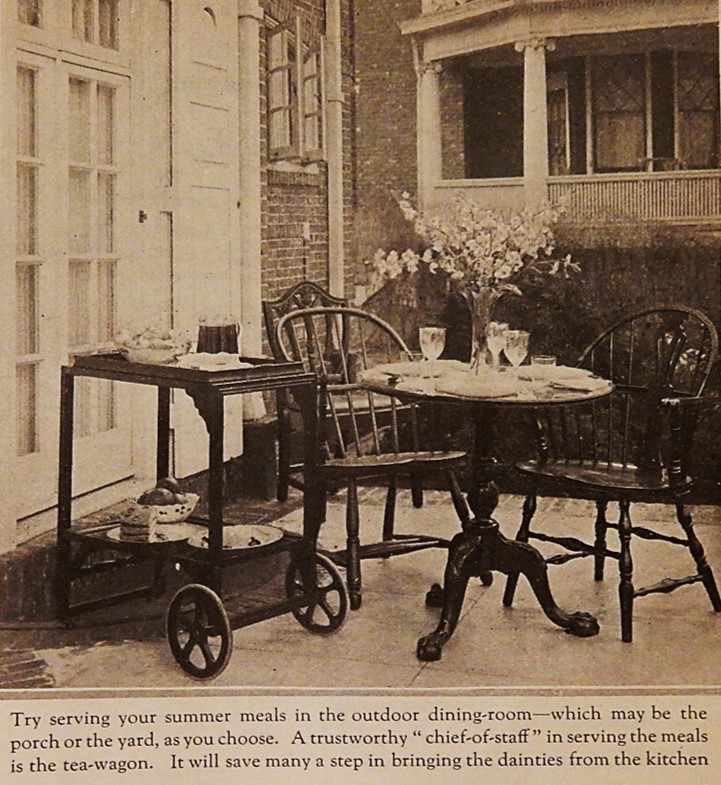
1917 Picture of a Tea Wagon

Source: Good Housekeeping (August, 1917)

I get ideas for posts from many sources.  The inspiration for today’s post was a comment by a reader, Mona Gustafson Affinitolast week.  She is writing a book set in the early 1900’s about her father called My Father’s House. She asked:

Have you run across tea wagons?  My sister  remembers fondly visiting the neighbor lady who served lovely little sandwiches and cookies, beautifully laid out on a tea wagon. My mother requested one for years, but, sadly, never got it. I’m trying to understand why as I work on “My Father’s House.”

This week I was flipping through 1917 issues of Good Housekeeping, and low and behold, there was a photo of a tea wagon illustrating an article on “Outdoor Meals.”

The caption of the photo contained the only mention of the tea wagon, but Mona, I hope it helps.

Hundred-Year-Old Mint Syrup Recipe

I love fine coffee – and I hate to admit it, but I like it even better when I add a little flavored coffee syrup. I often feel guilty. Many commercial coffee syrups contain corn syrup and have lots of artificial ingredients.

I no longer need to feel guilty. I found a recipe for the perfect Mint Syrup in the place I would have least expected – in a hundred-year-magazine.   It’s made with fresh mint leaves and there’s not a bit of corn syrup in it (though there is lots of sugar, so maybe I should continue to feel just a bit guilty). This simple syrup highlights the bright, complex nuanced flavor of  the mint, and is wonderful in coffee and other beverages and foods.

Here’s the original recipe:

Source: Good Housekeeping (August, 1917)

And here is the recipe updated for modern cooks:

Mint Syrup

  • Difficulty: easy
  • Print

1 cup sugar

1/2 cup water

1/2 cup mint leaves

Combine the sugar and water in a saucepan; then add the mint leaves. Bring to a boil using medium heat. Reduce heat and simmer until the liquid begins to thicken to a syrup consistency (about 20 minutes). Remove from heat; strain and cool.

Hundred-Year-Old “Peasant” Tablescape

Source: American Cookery (November, 1916)

A century ago luncheons with friends often had beautiful tablescapes designed by the hostess. There  are many lovely tablescape ideas and examples in hundred-year-old magazines. Here’s a suggestion for how to create a Peasant Table:

The “Peasant Table” is always in favor for luncheons, especially informal affairs. The one pictured has a long runner of white linen decorated with a crochet insertion and finished with a crochet edge. A grass receptacle in the center contains a flower holder in which tall spikes of zinnias appear to be growing in a natural clump. Four plain brass candlesticks frame the floral centerpiece. A brass bowl at each end flanks the candlestick, and it contains a floating pool of zinnia leaves and blossoms. Individual blue and white flower holders to match the blue and white dishes, contain zinnias also. Crochet doilies are used at the plates instead of linen, to relieve the plainness of the runner.

American Cookery (November, 1916)

Hundred-year-old Tomato and Cucumber Salad Recipe

I love all the fresh summer produce at the farmer’s market. Two of my favorites are tomatoes and cucumbers, so when I saw a hundred-year-old recipe for Tomato and Cumber Salad I knew that I had to give it a try.

The salad  was delightful, and had a light vinaigrette dressing that enhanced the sliced vegetables.

Source: American Cookery (October, 1916)

Source: American Cookery (October, 1916)

When I made this recipe, I halved it and I still had more dressing than I needed. Here’s the recipe updated for modern cooks:

Tomato and Cucumber Salad

  • Servings: 3-4
  • Difficulty: easy
  • Print

1 large cucumber

2 tomatoes

1/4 cup olive oil

2 tablespoons apply cider vinegar

1/4 teaspoon salt

1/8 teaspoon pepper

1/2 tablespoon onion, grated

Slice the tomatoes, and pare the cucumbers with a regular knife and then slice (using a fluted knife if desired). Arrange the sliced cucumbers and tomatoes in a serving dish. Set aside.

To make the dressing, put the olive oil, vinegar, salt, pepper, and grated onion in a small bowl. Mix thoroughly and then pour the desired amount over the tomatoes and onions.

Extra dressing may be refrigerated and kept for several days.

My fluted cucumbers didn’t look like the ones in the old photo. Maybe they used a different type of knife.

Will Whole-Wheat Flour Keep?: Hundred-year-old Advice

Source: Good Housekeeping (July, 1917)

It’s fun to read household advice columns in hundred-year-old magazines. Ever wonder whether whole-wheat flour keeps as well as white flour? Well, here’s an old Q&A which answers that very question:

Will Whole-Wheat Flour Keep? 

Is it true that whole-wheat four becomes rancid a few days after milling? This statement was made in public by a representative of a well-known milling company. Why is not this flour more generally milled and why is the price higher than that of white flour? 
L.W.L., New Mexico

It is not true that whole-wheat flour becomes rancid a few days after milling. I have kept whole-wheat flour more than four months in hot weather without damage. It should be kept in a cool, dry place, such as a well-ventilated cellar, in a heavy wood container. The same remark is true of whole corn-meal. Whole-wheat flour is not more generally milled because so few people ask for it. Just as soon as people demand whole-wheat flour and whole corn-meal, the mills and the grocers will supply it. It costs more than white flour because there is so little demand for it. The price should be considerably less than that of white flour. 

Good Housekeeping (September, 1917)


Old-fashioned String Beans with Bacon Recipe

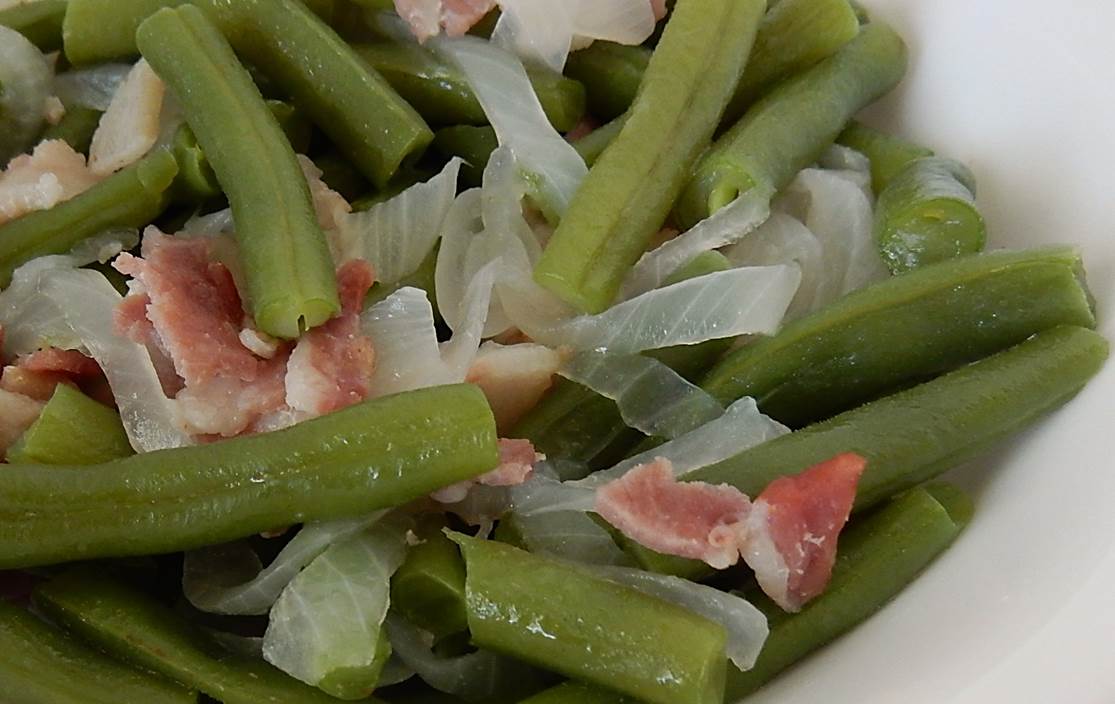
String Beans with Bacon (and onions) are delicious, and they are quick and easy to make. This hundred-year-old recipe brings back vague memories of string bean dishes from my childhood.

The recipe calls for cooking the beans until they are tender – and I cooked them for about 20 minutes. They weren’t crisp like the beans often prepared using modern recipes – but I found them to be a refreshing change, and enjoyed this dish’s old-fashioned goodness. The recipe is definitely a keeper.

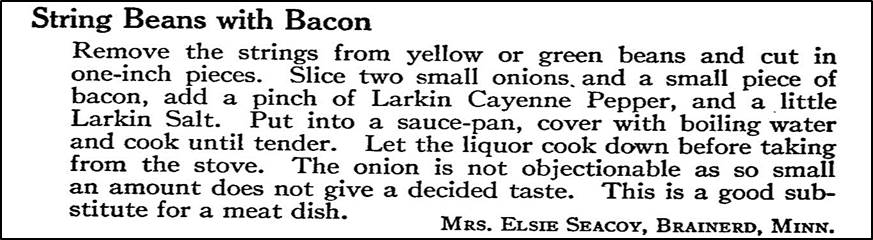
Here’s the original recipe:

Source: Larkin Housewives’ Cook Book (1917)

Here’s the recipe updated for modern cooks:

String Beans with Bacon

  • Servings: 3
  • Difficulty: easy
  • Print

1 pound string beans (use either yellow or green beans)

2 small onions, thinly sliced

1 slice bacon, chopped

water

1/8 teaspoon salt

dash cayenne (red) pepper

Clean string beans, remove tips, and snap into 1-inch pieces. Place in a saucepan. Add the sliced onions and  chopped bacon; then just barely cover with water, and add the salt and cayenne pepper.  Place on the stove and bring to a boil using high heat; then reduce to a simmer. Cook for approximately 20 minutes, then remove from heat, drain any excess liquid (a little is okay), and serve.