
16-year-old Helena Muffly wrote exactly 100 years ago today:
Sunday, October 22, 1911: While walking to Sunday School this afternoon, I saw three men taking a man and n_____ woman to jail. Anyway that’s very likely where they’ll land before long. It’s raining tonight real hard.
Her middle-aged granddaughter’s comments 100 years later:
Whew, this diary entry upsets me. Grandma spelled out n___ in her handwritten entry in the diary, and her attitude bothers me a lot.
Grandma would have walked a mile or so on country roads to get to Sunday School in McEwensville.
Central Pennsylvania was not very diverse a hundred years ago, but a few Blacks lived in the area. C.V. Clark, in a presentation to the Northumberland County Historical Society, mentioned that in the late 1800’s a freed slave named Eliza lived in McEwensville–and her descendents probably were still living in the area in 1911.
I know that times were different back then, but the bottom line is that Blacks were often treated terribly a hundred years ago. To help better understand what things were like in 1911 I’d like to share some disturbing information that I recently discovered.
The last lynching in Pennsylvania occurred on August 13, 1911. Zachariah Walker was lynched in Coatesville which is near Philadelphia.
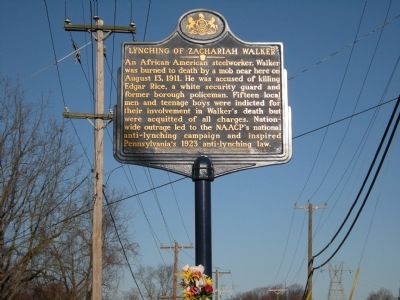
The inscription on the historic maker about the lynching says:
LYNCHING OF ZACHARIAH WALKER
An African American steelworker, Walker was burned to death by a mob near here on August 13, 1911. He was accused of killing Edgar Rice, a white security guard and a former borough policeman. Fifteen local men and teenage boys were indicted for their involvement in Walker’s death but were acquitted of all charges. Nationwide outrage led to the NAACP’s national anti-lynching campaign and inspired Pennsylvania’s 1923 anti-lynching law.
Even though Grandma lived more than a hundred miles from Coatesville, she probably was aware of the lynching. The local paper, The Milton Evening Standard periodically ran stories about it.

I know what you mean. I often wanted to edit and “clean up” language in my uncle Ralph’s letters. He didn’t seem to be particularly demeaning by the use of nigger, spick, dago, etc. It is just the way it was. In fact, I had a hard time typing the above words — as if I were at fault. Perhaps were take this politically correctness too far — my uncle Ralph did not seem to be a bigot, he just used the words and meanings of his times. I do wrestle with this dichotomy of words, intent, and historical description.
Certainly the words were more commonly accepted in early generations, but even then they were derogatory and diminishing terms. And unfortunately, I have ample evidence of bigotry in my own family’s history aside from language used. It is difficult to address.
Thank you for so wonderfully expressing what I had been thinking and feeling. Some words and thoughts are difficult to address!
Sheryl, this seems like it was a pretty confronting post for you. It’s easy for us to forget times were different then and attitudes very different. Joan makes some very valid points.Sometimes it’s “just” the language of the times, but as with the lynching, sometimes it does reflect the attitude. You are however not responsible for how they spoke or their attitudes. The fact that it disconcerted you shows clearly this is not your attitude.
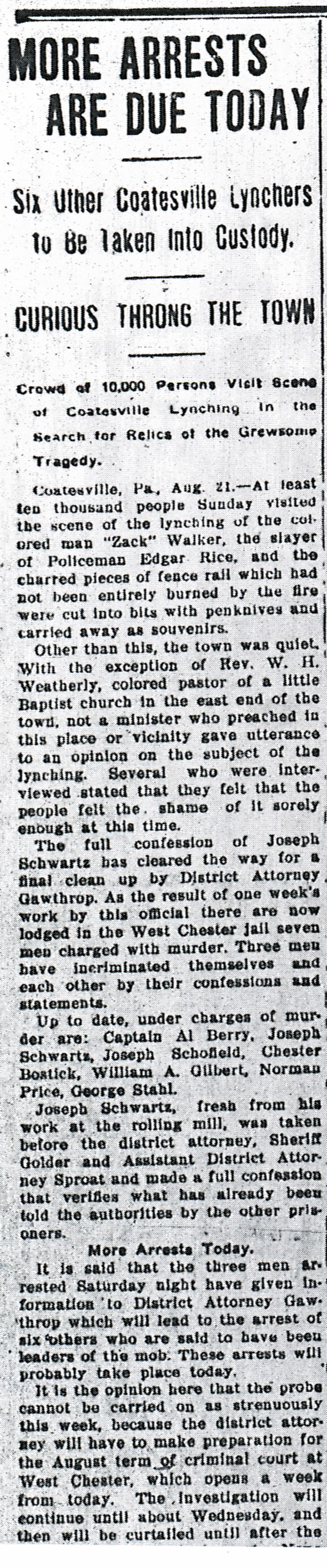
This IS an upsetting post. Who wants to see the poor attitudes of our ancestors? I also have had to deal with this when I have heard stories of “my” past. But the newspaper article you posted in some ways is even more upsetting with no one speaking up, even pastors, and people getting souvenirs of the charred fence…
I appreciate the comments of the previous readers.
Thank you all for taking the time to share your thoughts. We are grappling with some extremely important issues that family historians sometimes face. It is hard and there may be no “right” answers. Each of us probably will make different decisions regarding how to handle controversial text in our family documents.
Grandma‘s diary entry probably represents a typical perspective of her community in 1911. I don’t think any less of her because of what she wrote. But, I also believe that it’s important to address controversial issues—and not ignore them. Most days the diary entries deal with topics that are fun to write about—and that my readers enjoy reading about. But, I also think it is important to think about the larger historic context that the diary fits within, and deal with topics that make me uncomfortable –even when it is unpleasant to do so.
Thanks for sharing. I’m his great niece. So his blood runs through my veins. I was raised by his niece, Onetta Walker. Although she lived to 104, she NEVER mentioned a single word of Uncle Zach’s lynching to me. I only learned of it in 2020. Gram was born September 18, 1911. I was born in Coatesville Hospital and had NO idea of the legacy which had begun only 50 years before I was born…I’m praying to transform my Lynching Legacy to one of Love.
And, thank you for taking a few moments to write a comment. Your great uncle’s story is such a sad and upsetting one – both on a personal level and as a commentary on the times. It’s intriguing how important family stories sometimes don’t get shared across the generations. Thank goodness you finally learned of this legacy. Best wishes as you work to transform this lynching legacy into one of love.
This proves that there is H❤️PE! Once again, thank you so much for sharing. It means more that you can imagine. Your post is actually life-giving and plays a key role in transforming my lynching legacy into one of L❤️VE. Did you ever imagine that on G❤️❤️D Friday 2023 that your Grandma’s life would spark something beautiful? May God bless you. Please feel free to reach out to me. I am grateful I was blessed to serve these United States of America 23 years. I was actually born at Coatesville Hospital. I had the honor of becoming the FIRST FEMALE TO ATTEND THE THEN ALL-MALE VALLEY FORGE MILITARY ACADEMY AND COLLEGE EARLY COMMISSIONING PROGRAM THUS BECOMING THE FIRST FEMALE OFFICER EVER COMMISSIONED FROM THE ACADEMIC INSTITUTION. Feel free to look me up (Shanda Taylor Boyd).
Take Care
You’re very welcome. It’s really amazing how all the the pieces of a very complicated puzzle fit together in ways that are leading to the beautiful things you are doing now. Congrats on being the first female to attend Valley Forge.