18-year-old Helena Muffly wrote exactly 100 years ago today:
Tuesday, November 25, 1913:Nothing to write.
Her middle-aged granddaughter’s comments 100 years later:
Since Grandma didn’t write much a hundred years ago today, I’m going to share a great hundred year old recipe for Cranberry Conserve.
Cranberry Conserve
1 quart cranberries
1/3 cup water
Juice and pulp of 2 oranges
Grated rind of half an orange
2 cups sugar
1/2 cup chopped raisins
1 cup walnuts, chopped
Wash the cranberries and put into a medium saucepan. Add the water, oranges, sugar and raisins. Cook until the cranberries burst and are soft. Remove from heat, and stir in nut meats. Put into a bowl and chill.
Adapted from recipe in Ladies Home Journal (November, 1913)
This dish is excellent. The orange and raisins nicely balance the tartness of the cranberries, and the nuts add a nice texture. This recipe is a keeper and I plan to make it for Thanksgiving.
18-year-old Helena Muffly wrote exactly 100 years ago today:
Monday, August 11, 1913:Am busy planning.
Source: Ladies Home Journal (July, 1911)
Her middle-aged granddaughter’s comments 100 years later:
Grandma was planning for the Sunday School picnic. The previous day she wrote:
We have decided to have our S.S. picnic next Wed. . .
I wonder what she needed to plan. . . . activities? . . . what food to bring?
August would be the perfect time for watermelon.
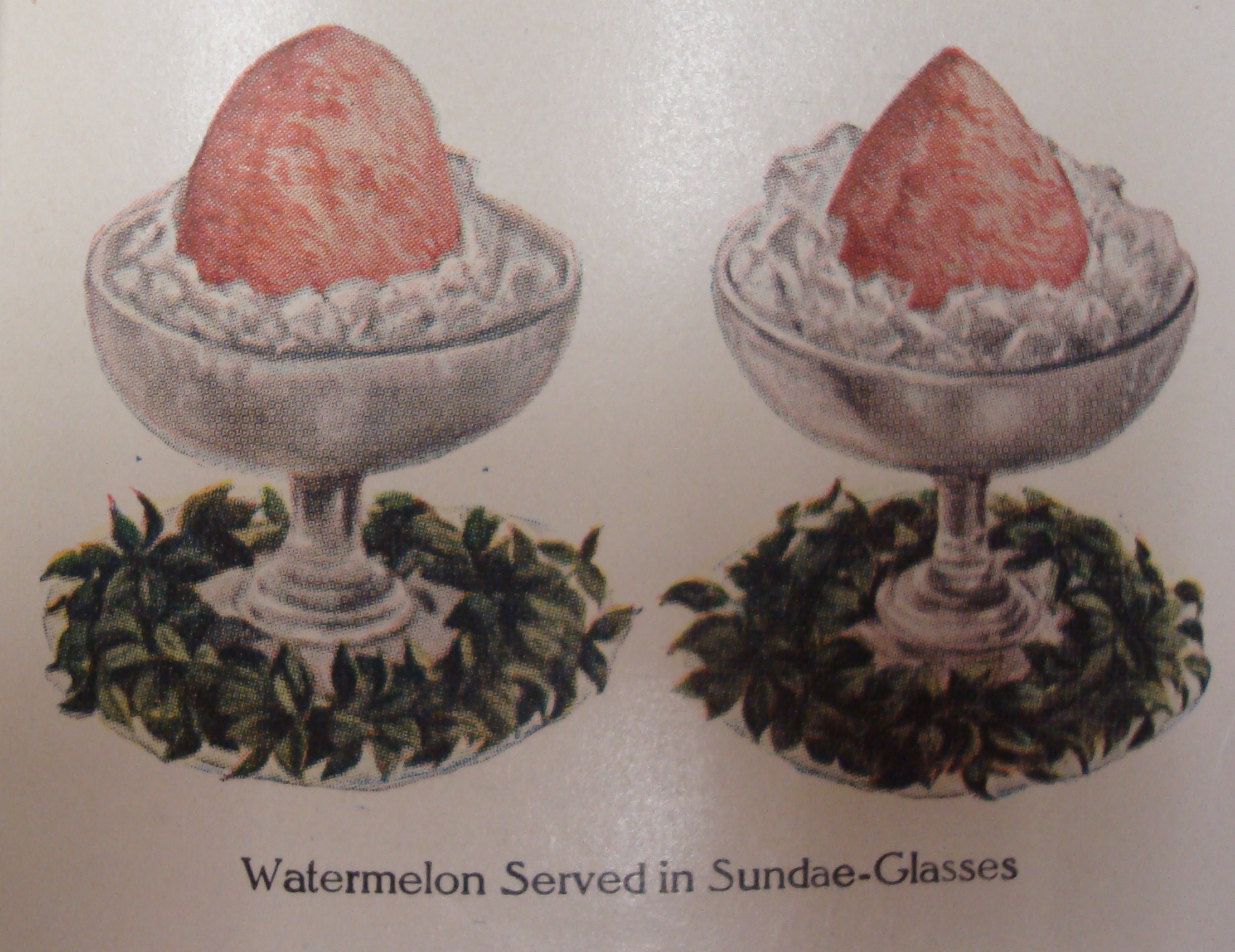
Grandma probably wouldn’t have done anything as fancy as the suggestion for serving watermelon in Ladies Home Journal:
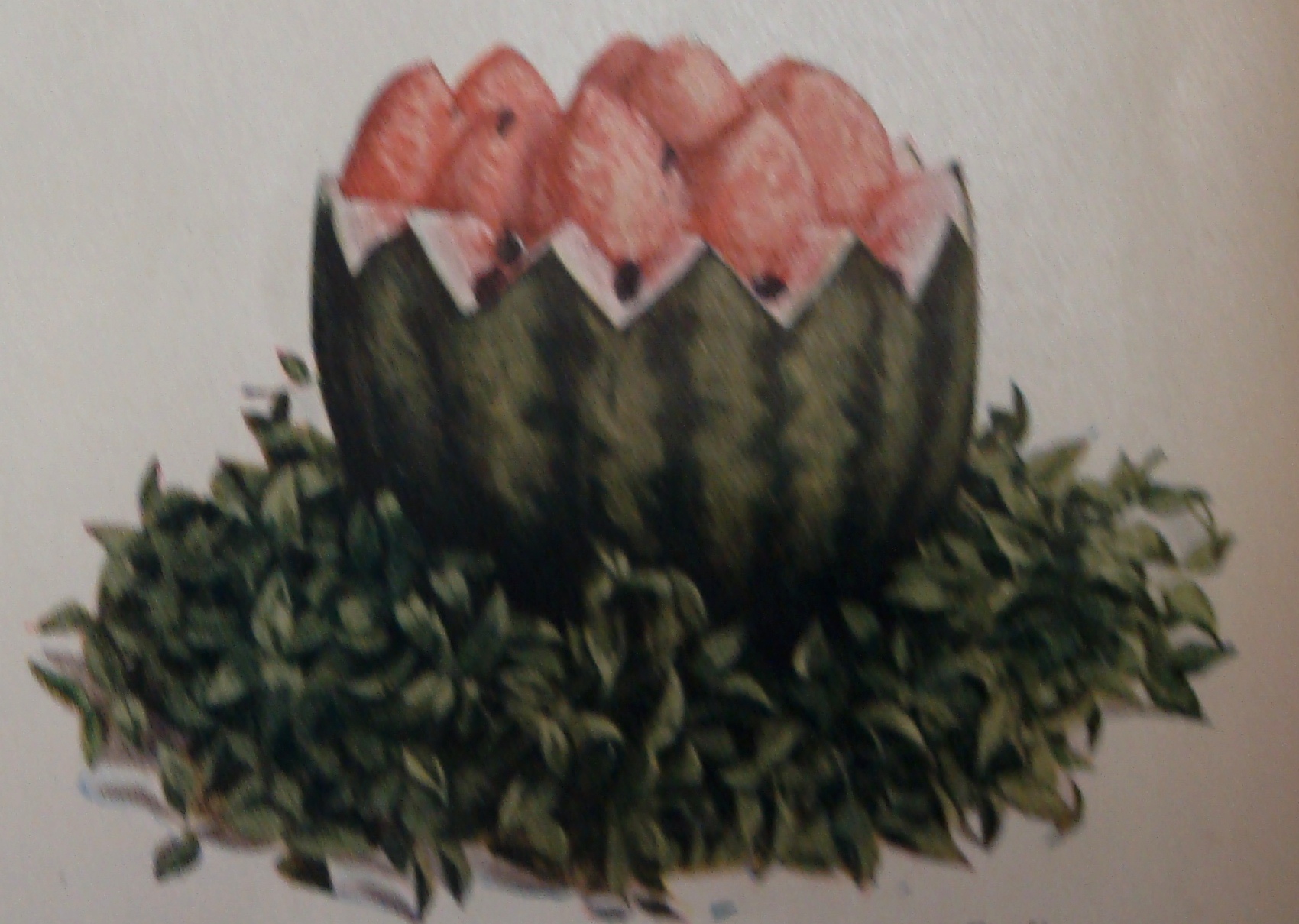
An unusually nice way to serve watermelon is to have the pulp removed from the whole melon which has first been cut in halves, and replaced on cracked ice in half of the rind arranged in bowl fashion. Cone-shaped portions may then be served individually in sundae glasses, or cut in cubes in sherbet-cups.
18-year-old Helena Muffly wrote exactly 100 years ago today:
Wednesday, August 6, 1913: That’s all.
Her middle-aged granddaughter’s comments 100 years later:
Yesterday, I shared an article about “new’ gadgets a hundred years ago that can be used to making canning easier. Since Grandma didn’t write much in this diary entry, I’m going to dig deeper into one statement in that article. It said:
Canning is a great improvement over the old-fashioned way of preserving fruits pound for pound, and if canned properly fruits will retain their fresh and natural flavor.
Ladies Home Journal (May, 1913)
I wondered what that meant and then came across another article about Sun-preserved Preserves. That article contained a letter from a reader explaining how to make and market sun-preserved preserves.
Sun-preserved Preserves
The thing I knew I could do better than most people was to make preserves. My specialties were sun-cooked strawberry and cherry preserves.
I chose only the finest, most perfect fruit, seeding the cherries carefully by hand. I weighed the fruit and made a syrup of an equal amount of the best granulated sugar, using just enough water to melt the sugar and prevent burning. When the sugar was melted I dropped the fruit in carefully and let it boil, about five minutes in the case of the strawberries and ten minutes for the cherries.
I then removed the preserves to a large platter and placed them out in the sunshine, covering closely with large pieces of glass. It may be necessary to use mosquito netting also. About two days of direct sunshine usually cooks the preserves sufficiently. I tried to put them in glass jars while still hot from the sun’s rays. This is not necessary, but they are nicer if canned before the juice sets.
The next problem was to find a market for my wares, which were strictly first class, and, beautiful in shape and color. For these I must ask a good price.
I lived about a hundred miles from a large city, in a village where there was no market for my goods at any price, so I took to scanning the society columns of the city papers and thus listed the names and addresses of the people I wanted to reach. To these I wrote personal letters describing my preserves and setting my price. To a few prominent ladies I sent small samples. The responses were numerous enough to give me several very busy summers.
Ladies Home Journal (July, 1913)
Sometimes when I read old recipes like this one I just roll my eyes and throw up my hands. These directions don’t sound like they would produce a safe, sanitary food—yet Sun-preserved Preserves apparently were considered a gourmet food a hundred years ago. So I googled “Sun Preserves” and found a New York Times article that explains how to make them using modern processes and procedures.
17-year-old Helena Muffly wrote exactly 100 years ago today:
Monday, February 3, 1913: It was simply enchanting this morning. The snow came down in fluffy flakes. It was an unusual sight. Had a pain this morning. Guess four dishes of ice cream was most too much for my capacity.
Caption: Vanilla Ice Cream with Chocolate Sauce Plate XX. For Receipt see pages 247 and 299. Source: Lowney’s Cook Book (1912)
Her middle-aged granddaughter’s comments 100 years later:
The previous day the Muffly’s made ice cream. It must have tasted really, really good if Grandma ate four dishes (even if she’s paying for her indulgence). Maybe she ate it with warm chocolate sauce.
Here is a hundred-year-old recipe for vanilla ice cream and chocolate sauce:
Vanilla Ice Cream
4 cups milk
1 cup sugar
3 eggs
1 tablespoon vanilla
1/3 teaspoon salt
This is the simplest and cheapest ice cream made. One pint of cream added is an improvement.
Scald the milk in double boiler. Mix eggs, sugar and salt; added scalded milk to them; return to double boiler and cook until mixture thickens and is of a smooth and creamy consistency.
Strain into a cold dish. Add vanilla and cool before putting mixture in ice cream freezer.
Chocolate Sauce
2 ounces Lowney’s Premium Chocolate
1 cup sugar
1/4 teaspoon salt
1 teaspoon vanilla
Cook all the ingredients except vanilla twelve minutes; add vanilla, and serve hot. This sauce is especially good served with Vanilla Ice Cream.
Lowney’s Cook Book (1912)
Lowney’s Cook Book was published by a company that made baking chocolate. I assume that any brand of unsweetened chocolate could be substituted for the Lowney’s Premium Chocolate in the chocolate sauce recipe.
For more old ice cream recipes and related information see:
Old-time Vanilla Ice Cream Recipes (These recipes are different than the one above. It’s interesting to see the variation in the old recipes.)
17-year-old Helena Muffly wrote exactly 100 years ago today:
Thursday, March 28, 1912:Nothing really of great importance. Now that Ruth is at home I don’t have to do as much in the morning as I was accustomed to doing. Ruth made some fudge this evening. It was Jimmie’s earnest desire.
Sugar Taffy
Her middle-aged granddaughter’s comments 100 years later:
Whew, I’m amazed how often fudge or other candies are mentioned in the diary.
Over the past 15 months, I’ve made 7 different candy recipes. Below I rank them from my personal favorite to my least favorite—and provide links to the post that contains the recipe.
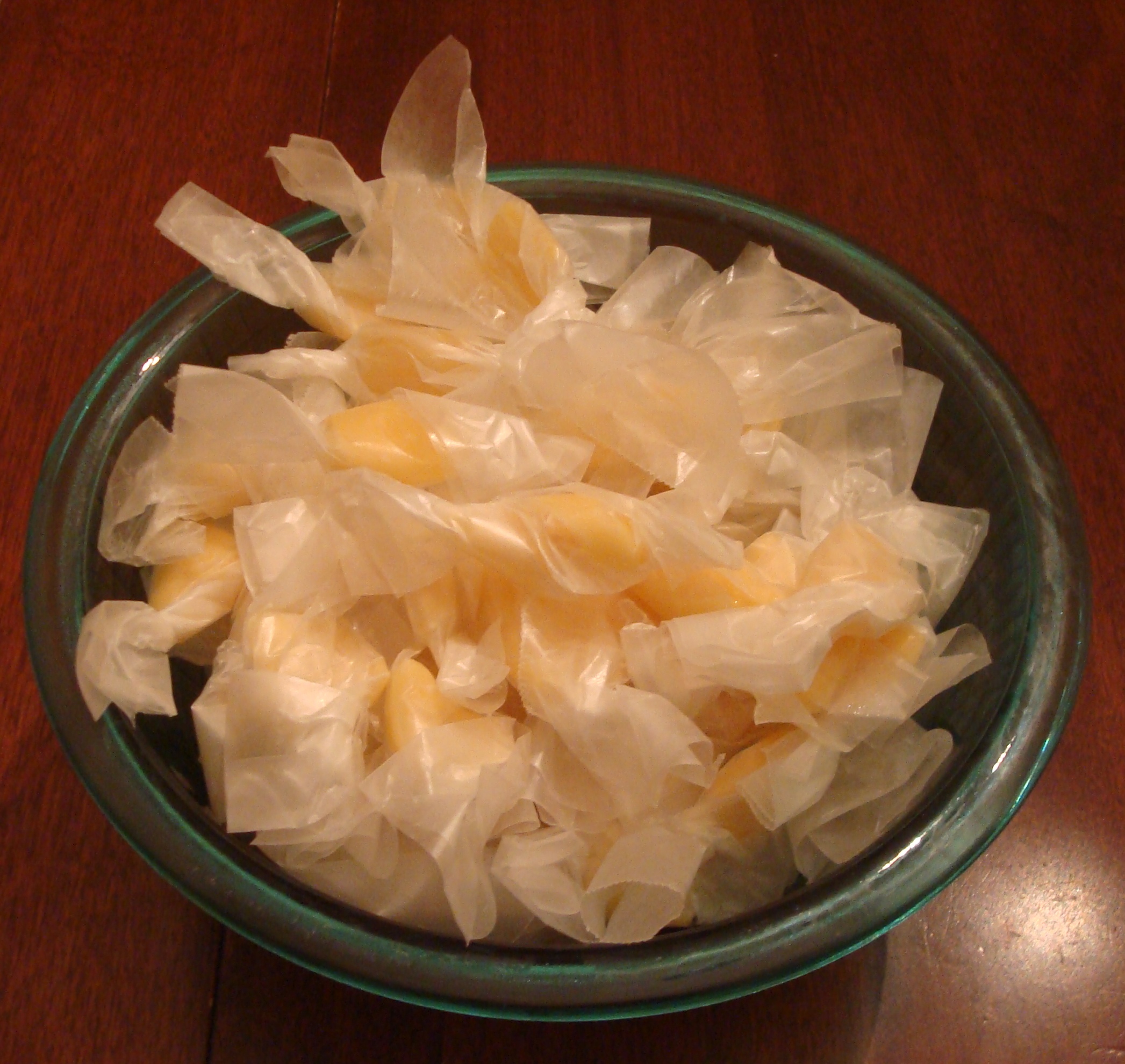
1. Sugar Taffy—This recipe turned out fantastically and tastes much better than modern taffy. My family ate all of the taffy within a day or so.
Cocoa Fudge
2. Cocoa Fudge—This fudge recipe was excellent—however, the recipe only made a small amount of fudge. I’d double (or triple or quadruple) the recipe if I made it again.
3. Chocolate Fudge- No. 1—This is also a very good fudge recipe. I had a difficult time deciding whether to rank Cocoa Fudge or this one higher.
4. Butterscotch— Old-fashioned butterscotch isn’t anything like the artificially-colored orange butterscotch disks that they make today. Instead it is rather it is similar to Werthers Original Candy.
5. Chocolate Fudge No. 2—This fudge contains molasses and has a very old-fashioned taste, but I loved the complex undertones. I especially liked it when I added walnuts.
6. Sour Cream Fudge—This is a light-colored fudge that does not contain any chocolate. It had a good taste although I had to cook it a very long time (over an hour) and even then it seemed a bit soft.
7. Coffee Candy—This candy had a great taste, but I didn’t get something quite right because it crumbled. A reader suggested that it might make a good ice cream topping.
16-year-old Helena Muffly wrote exactly 100 years ago today:
Tuesday, February 27, 1912: Quite uneventful. Ruth went up to Oakes this evening, but I staid at home and studied my lessons.
Devil's Food Cake (Hundred-Year-Old Recipe)
Her middle-aged granddaughter’s comments 100 years later:
Since this diary entry is self-explanatory, I’m going to go off on a tangent.
I recently bought a 1912 cookbook off EBay. My daughter glanced through it and noticed that the devils food cake recipe seemed very different from today’s recipes.
So we decided to compare a devils food cake made with a modern recipe with one made using a hundred year old recipe.
In the early 1900s angel food cakes and devils food cakes were seen as the polar opposites—one was white and light; the other dark and heavy.
The cake made with the hundred year old recipe was a dense chocolate spice cake. The recipe called for mashed potatoes (mashed potatoes ?!?!), cinnamon, nutmeg and nuts. It reminded us of gingerbread–though ginger was not an ingredient. I’ve never eaten anything exactly like it—but the cake was very good and I’d make it again.
100 Year-Old-Recipe
Calumet Devil’s Food Cake (Chocolate Spice Cake)
2 cups flour
2 level teaspoons Calumet (or any other brand) baking powder
2 level teaspoons cinnamon
1/2 teaspoon nutmeg
1 3/4 cups granulated sugar
1/2 cup milk
3/4 cup butter
2 eggs
1 cup warm mashed potatoes
2 squares unsweetened chocolate
1 cup chopped nuts
Preheat oven to 350 degrees. Grease and flour baking pan, 13 X 9 X 2 inches. Melt butter and chocolate. Combine with all of the other ingredients except nuts. Beat until well-blended. Stir in nuts.
Pour into pan. Bake approximately 45-50 minutes or until pick comes out clean.
Adapted from the recipe in Calumet Baking Powder Reliable Recipes (1912)
The modern devils food cake recipe that my daughter made was from my Betty Crocker Cookbook. The recipe called for red food coloring—but otherwise seemed similar to other modern chocolate cake recipes. The cake was awesome.
Devils Food Cake
1 3/4 cups all-purpose flour
1 cup granulated sugar
1/2 cup brown sugar (packed)
1 1/2 teaspoons soda
3/4 teaspoon salt
1 1/4 cups buttermilk
1/2 cup shortening
2 eggs
2 ounces melted unsweetened chocolate (cool)
1 teaspoon vanilla
1/2 teaspoon red food color
Heat oven to 350 degrees. Grease and flour baking pan, 13x9x2 inches, or two 9-inch or three 8-inch round layer pans. Measure all ingredients into large mixer bowl. Blend 1/2 minute on low-speed, scraping bowl constantly. Beat 3 minutes high-speed, scraping bowl occasionally. Pour into pan(s).
Bake oblong about 40 minutes, layers 30-35 minutes or until wooden pick inserted in center comes out clean. Cool.
(Recipe suggests using chocolate or cream cheese frosting.)