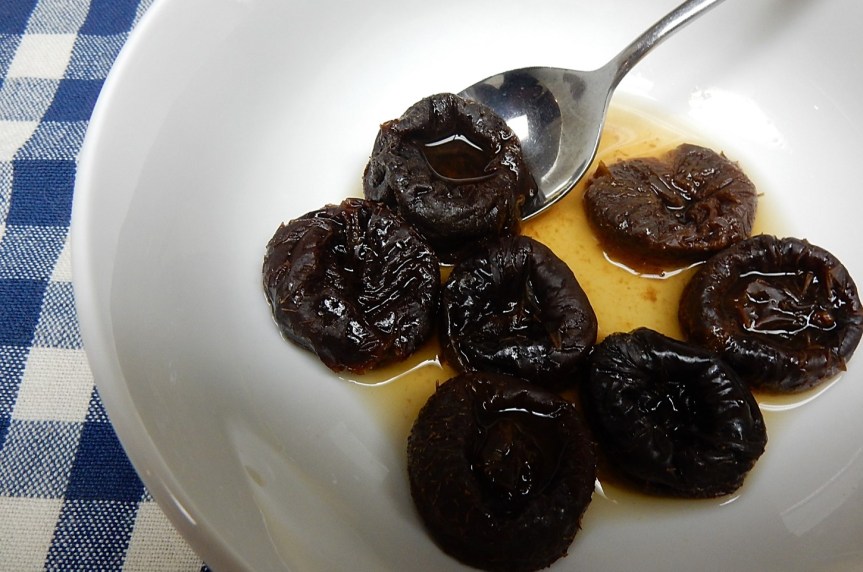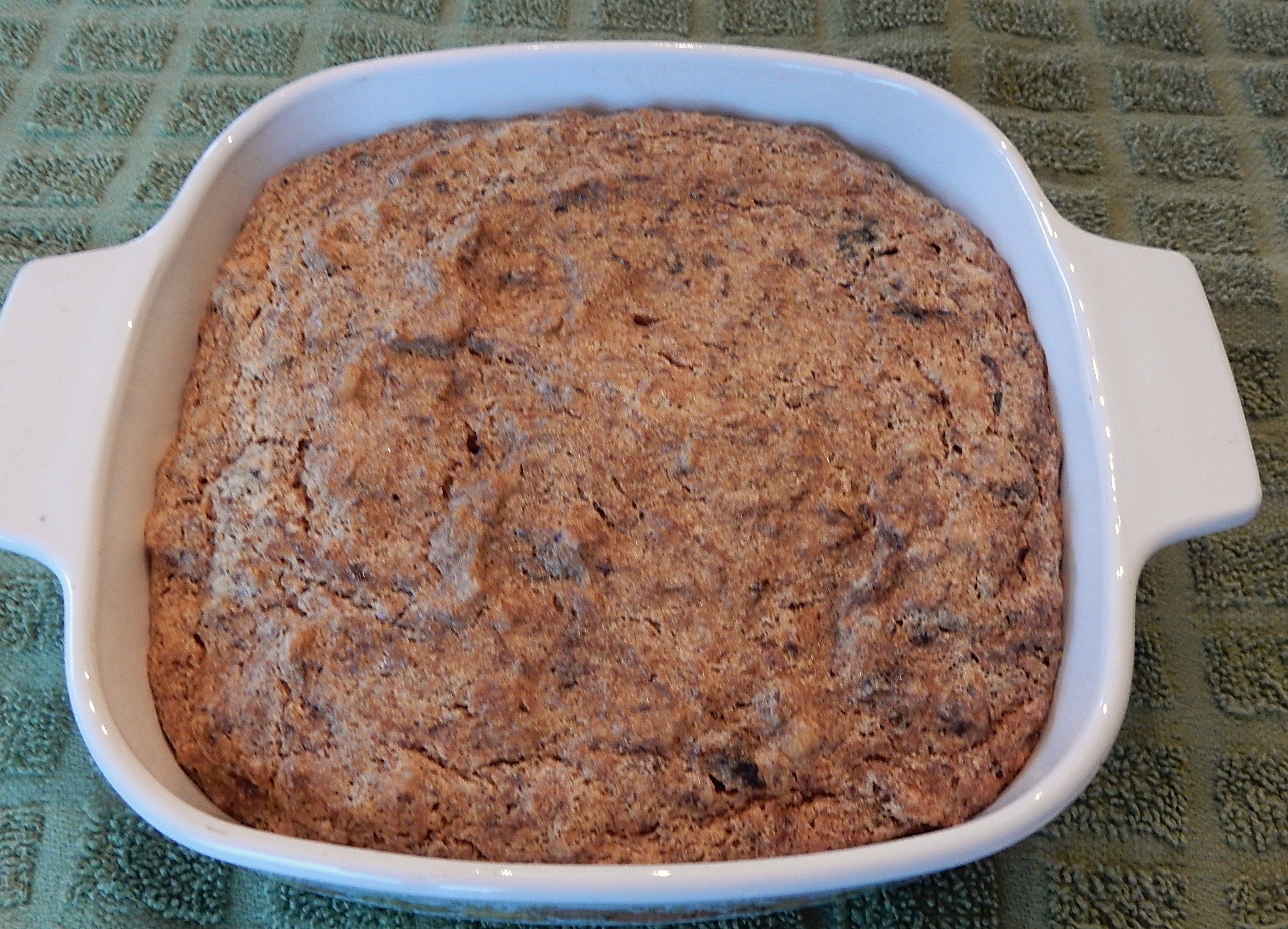
Old-Fashioned Prune Souffle

Prune Souffle

There are lots of food trends and fads. Some foods become more popular over time; other decrease in popularity. Prunes are a food that were much more popular a hundred years ago than what they are now – though personally, I like them. So when I saw a recipe for Prune Souffle in a 1924 cookbook, I decided to give it a try while recognizing that prunes are not trendy.

The Prune Souffle didn’t puff up like the typical souffle. It was very rich, and contained chopped walnuts which added a nice crunch. The dominant flavor was the prunes, though there was a hint of cinnamon. I’m not sure exactly how I’d rate this dessert. It’s definitely different than what I expected, and it’s richer than I’d like; but in an old-fashioned way, it was tasty.

Here’s the original recipe:
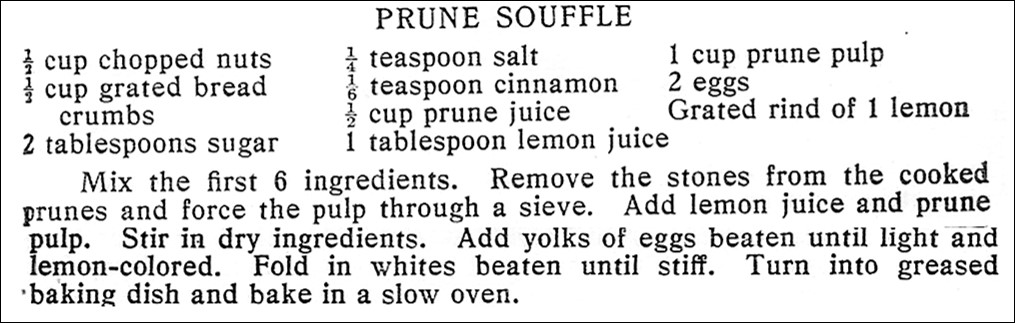
Recipe for Prune Souffle
Source: The Metropolitan Cook Book (Published by Metropolitan Life Insurance Company, 1924)

I’m not sure why the souffle did not puff up. It called for several fairly heavy ingredients – the chopped nuts and prune puree which may have weighted it down. Also, since the old recipe calls for a “slow oven,” I baked the souffle at 325° F.  but maybe it would have worked better if it had been baked at a higher temperature.

When I made this recipe I wasn’t sure how many prunes were needed to get 1 cup of pulp, but I estimated that I’d need about 1/2 pound of prunes.  I cooked the prunes for about 30 minutes get them nice and soft, and then put them through a Foley Mill. (Another option would be to puree them.) I ended up with a little less than 1 cup of pulp, but went with it.

Here is the recipe updated for modern cooks:

Prune Souffle

  • Servings: 4 - 6
  • Difficulty: moderate
  • Print

1/2 pound prunes

water

2 eggs, separated

1/2 cup chopped nuts (I used walnuts.)

1/2 cup grated bread crumbs (I grated 1 slice of bread.)

2 tablespoons sugar

1/4 teaspoon salt

1/6 teaspoon cinnamon

1 tablespoon lemon juice

grated rind of 1 lemon

Preheat oven to 325° F. Put prunes in a saucepan and cover with water; bring to a boil then reduce heat and gently simmer until soft. Remove from heat and drain; reserve 1/2 cup of the prune juice. (If there is less than 1/2 cup of prune juice, add water to make 1/2 cup.) Puree the prunes or use a Foley Mill to press through a sieve. Set aside.

Beat egg whites until fluffy and stiff. Set aside.

Put the chopped nuts, bread crumbs, sugar, salt, cinnamon, lemon juice, grated lemon rind, pureed prunes, 1/2 cup of prune juice, and egg yolks in a mixing bowl; stir to combine. Fold in the beaten egg whites. Put in a 1-quart baking dish, and bake until the top is lightly browned and starting to crack (30-40 minutes). Can be served warm or cold.
http://www.ahundredyearsago.com

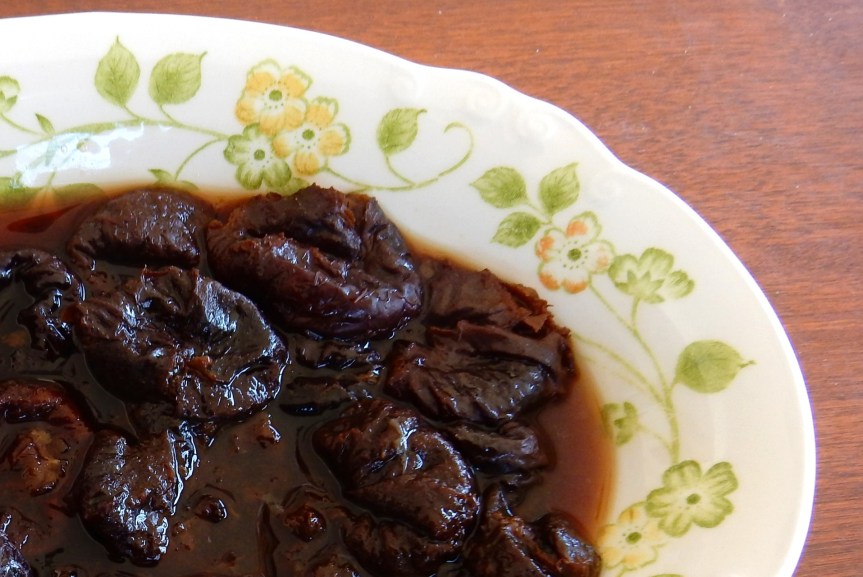
Old-fashioned Cinnamon Prunes

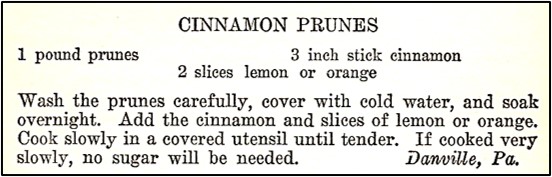
Stewed prunes are delicious, so when I saw a hundred-year-old recipe for Cinnamon Prunes, I decided to give it a try. The recipe called for adding both stick cinnamon and lemon or orange slices to prunes and water, and then stewing. The Cinnamon Prunes were tasty with a sunny citrus undertone and a hint of cinnamon. The recipe’s a keeper. I’ll definitely make it again.

Here’s the original recipe:

Recipe for Cinnamon Prunes
Source: Good Housekeeping’s Book of Menus, Recipes, and Household Discoveries

When I was flipping through a hundred-year-old recipe book published by Good Housekeeping, I was intrigued by this recipe – and then when I saw that the recipe author was from Danville, Pennsylvania, I just knew that I needed to make it. I grew up about 20 miles from Danville – and I seldom see recipes from this area of central Pennsylvania in hundred-year-old cookbooks. The cookbook doesn’t give the author’s name – and maybe it’s a stretch – but could my ancestors have known the author?

When I made this recipe I skipped the overnight soaking of the prunes. I have vague memories of prunes being very dry years ago – and that they needed to be soaked for a long time before cooking; however, modern prunes are generally moist, and just heating them with a little water is sufficient to get prunes that are nice and soft.

Here’s the recipe updated for modern cooks:

Cinnamon Prunes

  • Servings: 4 - 6
  • Difficulty: easy
  • Print

1 pound (16 ounces) prunes

water

1 stick (approximately 3 in.) stick cinnamon

2 lemon or orange slices (I used lemon slices.)

Put prunes in a saucepan and cover with water; add stick cinnamon and lemon or orange slices. Using medium-high heat, bring to a boil, then reduce heat and simmer for 15 minutes. Can be served warm or cold.

http://www.ahundredyearsago.com

Old-fashioned Stewed Prunes

stewed prunes

Hundred-year-old cookbooks sometimes contain very basic recipes, such as a recipe for stewed prunes. I’m a little surprised when an author puts such a simple recipe in a cookbook – though I also find it fascinating how basic foods have changed over the past hundred years. Back then (and even when I was young) prunes were very dry and needed extensive soaking and cooking to make tender stewed prunes; whereas today many supermarket prunes are very moist when taken out of the package and need to be stewed for only a few minutes.

Here’s the original recipe:

Recipe for Stewed Prunes
Source: The New Cookery (1921) by Lenna Frances Cooper

One-half pound of prunes is about 1 cup of prunes. I’m not clear why the directions refer to 1/4 cup of sugar and 1 tablespoon of lemon for each two cups of prunes. Maybe the author was referring to the volume of prunes after they are soaked. In any case, when I updated the recipe, rather than trying to estimate the volume of the prunes, I assumed that the recipe calls for adding 1/4 cup sugar and 1 tablespoon lemon (if desired).

And, here’s the recipe updated for modern cooks:

Stewed Prunes

  • Servings: 3 - 5
  • Difficulty: easy
  • Print

1/2 pound prunes (approximately 1 cup prune)

1 cup water (more may be needed if the prunes are very dry.)

1/4 cup sugar, if desired

1 tablespoon lemon juice, if desired

Put prunes and water in a saucepan. If desired, stir in the sugar. Bring to a boil using high heat, then reduce heat until it simmers. Cook until the prunes are tender and the liquid is syrupy (about 15 minutes – if the prunes are moist; longer if they are very dry). Remove from heat, and, if desired stir in the lemon juice.

http://www.ahundredyearsago.com

Cranberries with Prunes

cranberries with prunes 2

Cranberries are beginning to appear in the produce section at my supermarket.  I remembered seeing a recipe for Cranberries with Prunes in a 1915 issue of Good Housekeeping, and just had to give it a try.

Cranberries with Prunes are a lovely taste treat with bright notes of both fruits.  The rich sweetness of the prunes mingles with the tart cranberries to create a vibrant mixture.  Like many hundred-old-recipes, this classic recipe is simple to make with only four ingredients.

This recipe combines two super foods. Both cranberries and prunes are noted for having lots of antioxidants, fiber, and other good things. Amazingly, even though terms like antioxidant were unknown to cooks a hundred years ago, people seemed to have an intuitive sense of healthy food combinations.

Cranberries with Prunes

3 cups cranberries
1/2 cup sugar
1 cup water
1 cup prunes

Combine cranberries, sugar, and water in a large saucepan. Bring to a boil using medium heat; then reduce heat and simmer until cranberries burst. Add prunes and remove from heat. Cool before serving.

Adapted from recipe in Good Housekeeping (November, 1915)

I’m often amazed how foods and cooking techniques have changed over the past hundred years. As with many old recipes, I needed to adapt this recipe. The original recipe provided detailed directions for preparing the prunes.

Cover the prunes with water and soak overnight. Simmer gently till thoroughly tender. Take up with a skimmer, and when perfectly cool slip out the stones. Add the cranberries to the water in which these were boiled, pouring in more water if necessary. . .

The prunes I used were already pitted and very moist, so there was no need to soak them overnight or to pit.