Elected President of Literary Society

17-year-old Helena Muffly wrote exactly 100 years ago today: 

Friday, February 7, 1913: We had our literary meeting this afternoon and also elected officers to take the place of the old ones. They had to go and elect me president.

Building that once houses McEwensville School.

Her middle-aged granddaughter’s comments 100 years later:

Way to go Grandma!—You’ve put so much energy into the Literary Society and it’s awesome that you’re now the president.

On November 1, 1912, you wrote:

We organized a Literary Society at school this afternoon. I am one of the committee. Just what I wanted to be.

Why was there an election just three months after the society was organized? Were there problems with the previous officers. . .or had they always planned to have elections every couple of months?


Did Students Memorize Dates in History a Hundred Years Ago?

17-year-old Helena Muffly wrote exactly 100 years ago today: 

Tuesday, February 4, 1913: We had an exam in General History this morning. It was a review of all we had gone over this year. I was so afraid I’d make a sorry mark, so I began to review but I didn’t get over it all. I got some things wrong, but then I know I got more right. At least I think so.

Picture on page 155 of the hundred-year-old textbook
Roman Fleet (Source: Outlines of General History by V.A. Renouf)

Her middle-aged granddaughter’s comments 100 years later:

Did Grandma need to memorize dates for the exam?

Here’s what the Suggestions for Teachers section of a hundred-year-old text-book had to say about memorizing dates:

In conclusion, I will touch on the question of learning dates. These should be memorized by all students. It is well to bring as many events as possible into relation with a memorized date. The few students who have a ready memory for dates can be encouraged to remember most or all of them; but the majority of the class should not be burdened with more than are necessary for a correct general perspective of the centuries.

Outlines of General History (1909)  by V.A Renouf

Would a history teacher today agree or disagree with this suggestion?

The book also included some sample questions that teachers might use. I did a previous post that included a few of the sample questions:

History Test Questions a Hundred Years Ago

Tired of Winter

17-year-old Helena Muffly wrote exactly 100 years ago today: 

Saturday, February 1, 1913:

                       February

 A hope of the coming spring time,

When all the trees are in bloom

When the cold of the Winter has vanished

Onto the gathering gloom.

I guess I spent today at home doing a little bit of work for the benefit of someone other than myself. Tweetie arrived about four o’clock.

DSC05178

Her middle-aged granddaughter’s comments 100 years later:

Grandma began each month with a poem.  This poem accurately expresses how I feel. I’m tired of the gloom and ready for spring!

(I’m keeping my fingers crossed that the groundhog doesn’t see his shadow tomorrow.)

What work did Grandma have to do? Was it housework for her mother . . . or farmwork for her father?

At least it sounds like the day got better as it progressed. Tweetie was a nickname for Helen Wesner. She was a friend of Grandma’s.

1913 Broadway Plays

17-year-old Helena Muffly wrote exactly 100 years ago today: 

Monday, January 27, 1913: We went to town this evening to practice for our play.

broadway.3
Nearly Married at the Gaiety Theatre on Broadway in New York City

Her middle-aged granddaughter’s comments 100 years later:

Grandma wrote the previous Monday that she was going to be in a her class play. This was the first play practice.

In my imagination I see a  member of the cast saying, “If we practice hard, I bet our play will be as good as a Broadway play.”

Here’s what the November, 1913 issue of Dress and Vanity Fair magazine had to say about several Broadway plays that were playing in New York a hundred years ago:

In a Lighter Vein on Broadway

The Marriage Market at the Knickerbocker Theatre

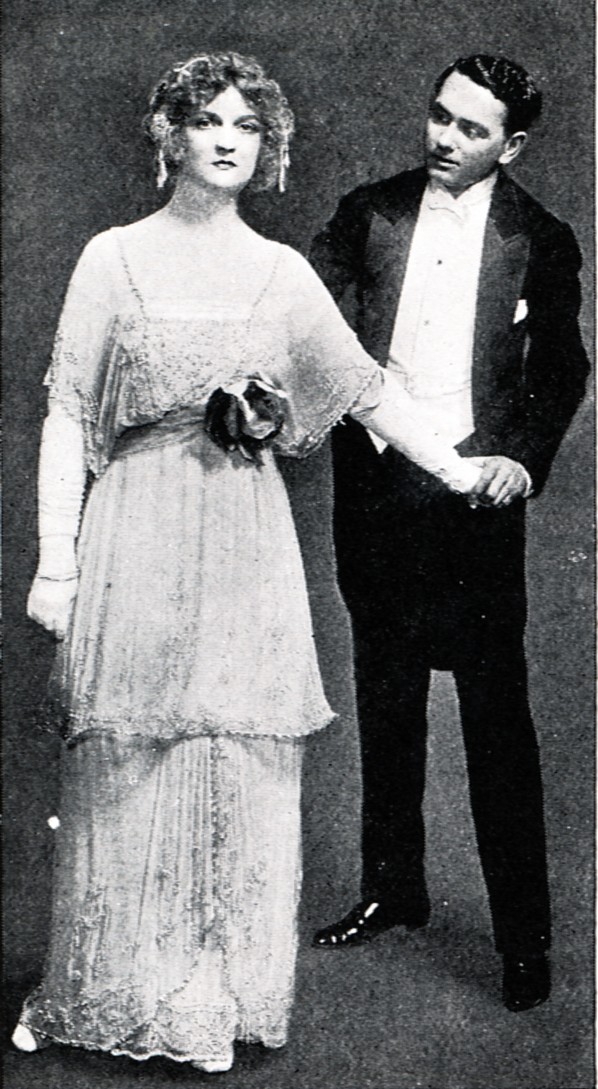
In this picture from The Marriage Market the small but sweet voice of Mr. Donald Brian is being lifted up in a duet with Miss Venita Fitzhugh. Until this moment when he has just taken her hand she had not recognized him once since the first act. She met him as a cowboy then and married him in a fit of pique. Since that time he has been disguised as a common sailor on her father’s yacht, but she did not recognize his face at all, and now that he looks so stunning in evening clothes and a clean shirt she cannot believe that it is really he.

Who's Who at the Criterion
Who’s Who at the Criterion

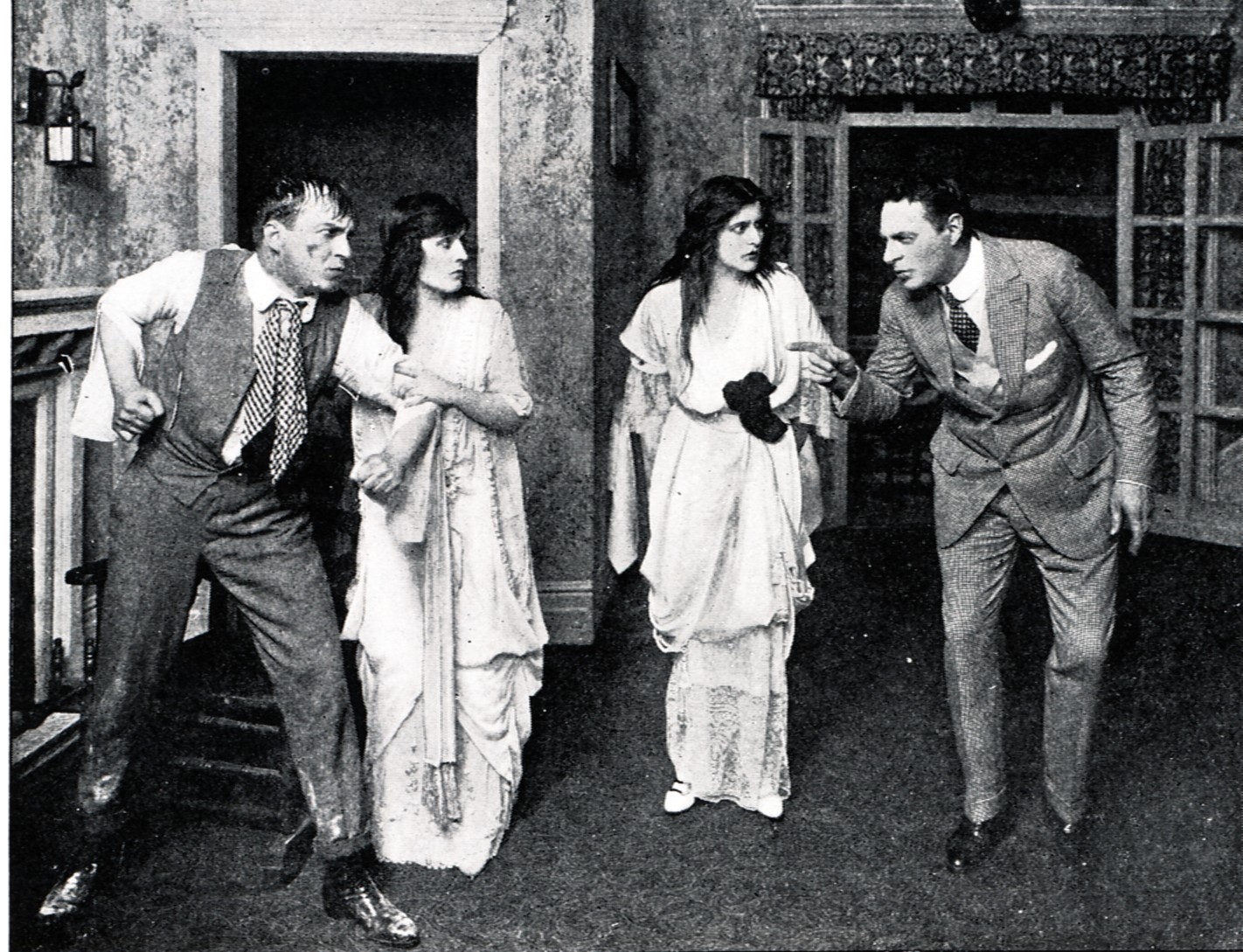
Mr. Richard Harding Davis’s’ comic mystery play Who’s Who finds Mr. William Collier and his adopted son William Collier, Jr. The youngster has a savings bank in his hand with which he is constantly blackmailing the villagers in his bland and child-like way. Mr. Collier who has been held up by the child is expostulating vigorously, paternally, almost expletively.

Dress and Vanity Fair (November, 1913)

Old Cross-Stitch Examples

17-year-old Helena Muffly wrote exactly 100 years ago today: 

Sunday, January  26, 1913: Went to Sunday School this afternoon. Besse was out.

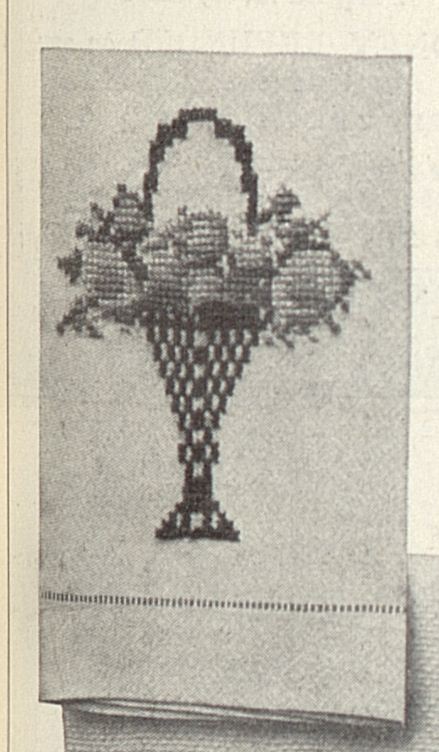
Source of Pictures: Ladies Home Journal (May, 1913)

Her middle-aged granddaughter’s comments 100 years later:

Grandma’s sister Besse was married and lived in nearby Watsontown.  Sometimes Besse brought needlework or sewing along when she came to visit. For example, on August 9, 1912 Grandma wrote:

We had sort of s sewing bee here today. Besse was out and brought some of her stuff along.

On this January day, a hundred years ago, perhaps the sisters did cross-stitching while they chatted.

Cross-stitch and crochet work using same rose pattern

Close Relationship Between School and Community

17-year-old Helena Muffly wrote exactly 100 years ago today: 

Friday, January 24, 1913: Didn’t have any visitors at our literary meeting this afternoon, and I was rather glad that we didn’t.

DSC07012
Recent photo of old McEwensville School building.

Her middle-aged granddaughter’s comments 100 years later:

Members of the Literary Society at Grandma’s high school presented recitations and dialogues at their meetings. Apparently, guests were always welcome.

Grandma’s went to a tiny one-room high school (The high school was on the second floor of the building; there was a primary school on the first floor).

The school was such an integral part of the social fabric of the community that it merited mention in the diary not when there were visitors at the meeting, but rather when there were none.

The school obviously had many limitations, yet I have a gut feeling there was something special about the small community-based schools a hundred years ago.

According to the June, 1913 issue of The Rural Educator:

We must, at the outset, recognize that the social institutions are the machines through which social energy works. There is abundant social energy in every rural community. The center of intellectual activities of the community should be the rural school.

DSC07017

1913 Welch’s Grape Juice Advertisement

17-year-old Helena Muffly wrote exactly 100 years ago today: 

Thursday, January 23, 1913: Bout the same as ever.

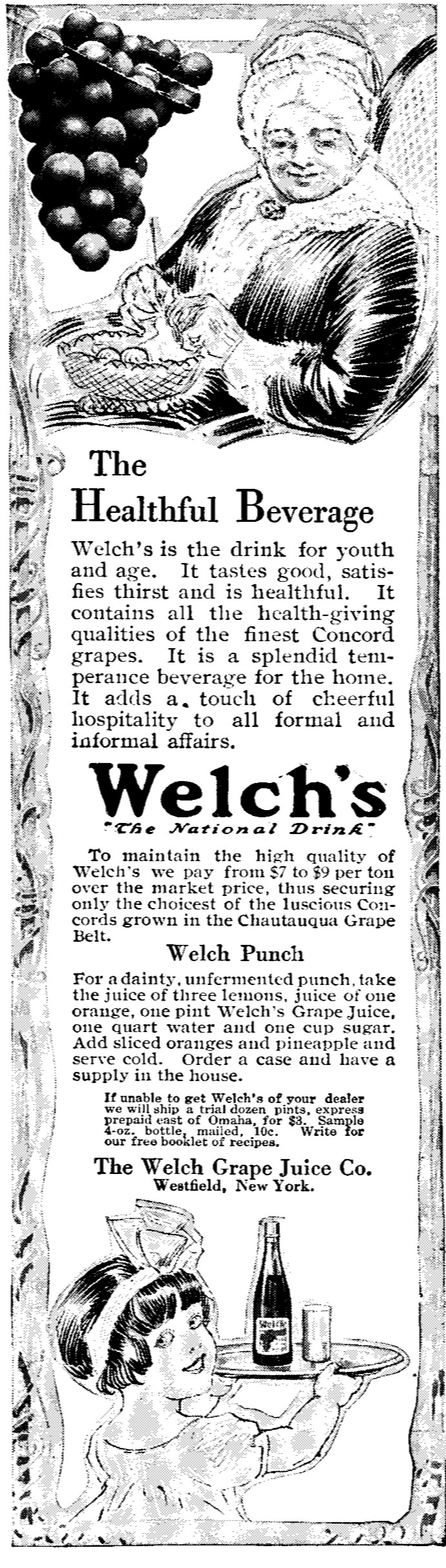
1913 Welch's Grape Juice AdversitementThe

Healthful Beverage

Welch’s is the drink for youth and age. It tastes good, satisfies thirst and is healthful. It contains all the health-giving qualities of the finest Concord grapes. It is a splendid temperance beverage for the home. It adds a touch of cheerful hospitality to all formal and informal affairs.

Welch’s

“The National Drink”

To maintain the high quality of Welch’s we pay from $7 to $9 per ton over the market price, thus securing only the choicest of the luscious Concords grown in the Chautauqua Grape Belt.

Welch Punch

For a dainty, unfermented punch, take the juice of three lemons, juice of one orange, one pint Welch’s Grape Juice, one quart water and one cup of sugar. Add sliced oranges and a pineapple and serve cold. Order a case and have a supply in the house.

If unable to get Welch’s of your dealer we will ship a trial dozen pints, express prepaid east of Omaha, for $3. Sample 4-oz bottle, mailed 10¢. Write for our free booklet of recipes.

The Welch Grape Juice Co.

Westfield, New York

Her middle-aged granddaughter’s comments 100 years later:

Since Grandma didn’t write much, I’ll share old ad I found in the February, 1913 issue of National Food Magazine.