18-year-old Helena Muffly wrote exactly 100 years ago today:
Saturday, July 5, 1913:Ruth and I went up to McEwensville this evening. I wanted to go up to church. There was a festival, so I went there for awhile, but didn’t have a very good time.
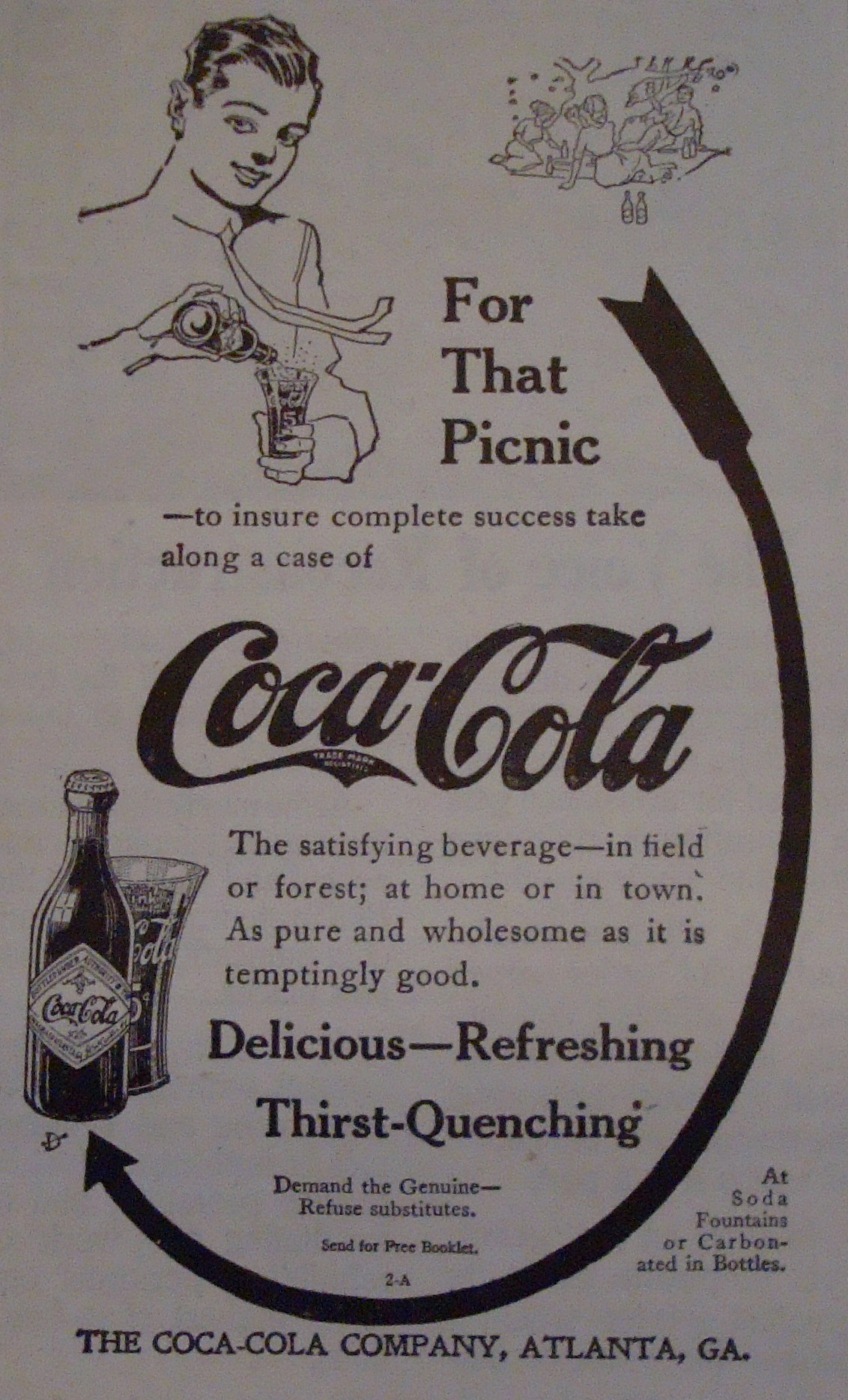
The satisfying beverage—in field or forest; at home or in town. As pure and wholesome as it is temptingly good .
Delicious—Refreshing
Thirst—Quenching
Demand the Genuine—
Refuse substitutes.
Send for Free Booklet.
2-A
At Soda Fountains or Carbonated in Bottles.
THE COCA-COLA COMPANY, ATLANTA, GA.
Her middle-aged granddaughter’s comments 100 years later:
It sounds like fun to go to a festival on a Saturday evening after a hard week of work. Why didn’t Grandma have a very good time?. . . Did her sister Ruth enjoy herself?
What foods did they eat at the festival? Was Coca Cola sold?
18-year-old Helena Muffly wrote exactly 100 years ago today:
Friday, July 4, 1913: Wasn’t much celebrating done at this house today. I saw a balloon go up or rather I saw it after it had gone up. Saw a few fireworks this evening, but that was at a distance.
Source: Milton Evening Standard (July 2, 1913)
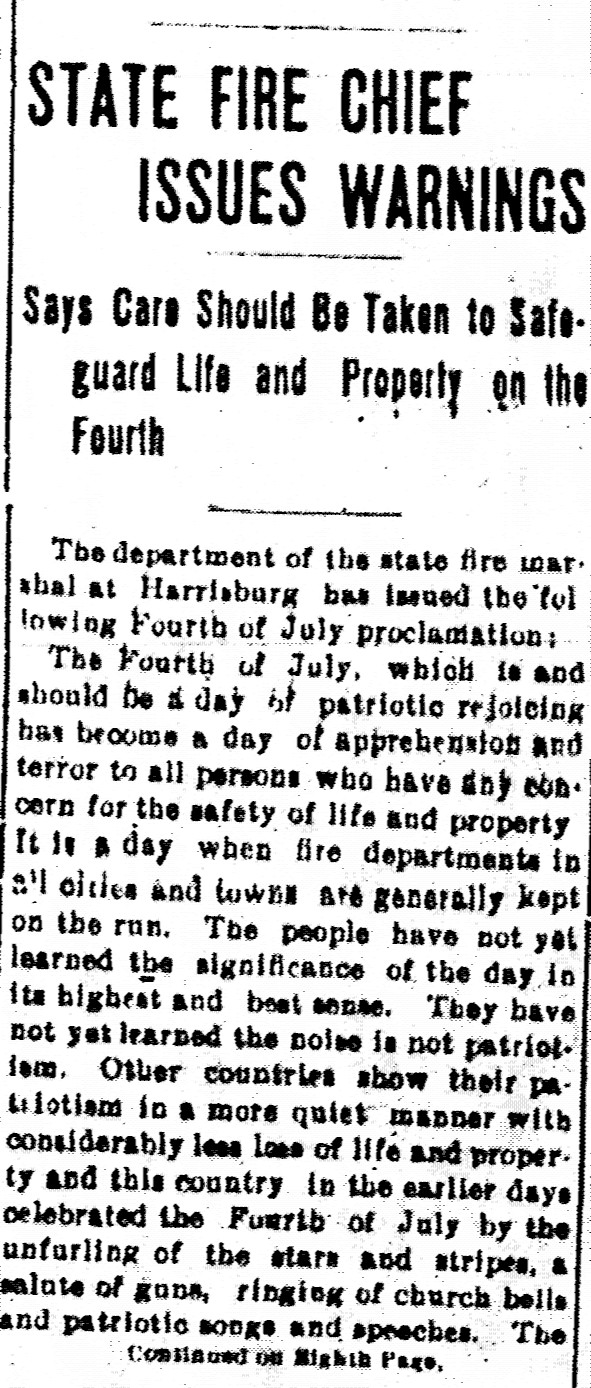
STATE FIRE CHIEF ISSUES WARNINGS
Says Care Should Be Taken to Safeguard Life and Property on the Fourth
The department of the state fire marshal at Harrisburg has issued the following Fourth of July proclamation:
The Fourth of July, which is and should be a day of patriotic rejoicing has become a day of apprehension and terror to all persons who have any concern for the safety of life and property. It is a day when fire departments in all cities and towns are generally kept on the run. The people have not yet learned the significance of the day in its highest and best sense. They have not yet learned the noise is not patriotism. Other countries show their patriotism in a more quiet manner with considerably less loss of life and property and this country in the earlier days celebrated the Fourth of July by the unfurling of the stars and stripes, a salute of guns, ringing of church bells and patriotic songs and speeches. . .
Her middle-aged granddaughter’s comments 100 years later:
Sounds like Grandma had a pleasant and safe 4th.
A hundred years ago many leaders thought that electric light displays could be a modern replacement for fireworks. You might enjoy reading this post I did last year:
Her middle-aged granddaughter’s comments 100 years later:
Speck is an old-fashioned term for weight. I think that the way it is used in this sentence has Pennsylvania Dutch or German origins.
I bet Grandma lost a pound or two. I’ve chased pigs a few times in my life and they are darn hard to catch.
I’m not talking about greased pigs that are sometimes seen in competitions at fairs. I’m referring to chasing a run of the mill farm pig that has escaped from a field or pen. You’d think that it would be easy to chase back into the field or pen. Wrong!!
When chasing a cow, all you need to do to get it to turn is to stand in front of it—and the cow will immediately turn and can be directed back into the pen or field. Pigs, however, are very smart (and surprisingly fast), and they know where you want them to go. No matter what you do, a pig will refuse to head in the direction you want it to go. If you stand in front of a pig to try to make it turn, it will almost run you over as it continues going wherever it feels like going.
18-year-old Helena Muffly wrote exactly 100 years ago today:
Monday, July 1, 1913:
The hottest month of the whole year ‘round.
We may surely call July
When the sun shines down and makes us brown.
Then, oh then we often sigh.
(For a day in winter.)
The beginning of this month finds me at the same things I was doing yesterday.
Her middle-aged granddaughter’s comments 100 years later:
In the diary Grandma began each month with a poem. I’ve periodically pondered whether she wrote the poems herself—or got them from some other source.
Over time, I’ve gradually (with the help of some blog readers) come to the conclusion that she wrote them herself. This poem provides even stronger evidence that she wrote them herself.
The previous day she complained about getting a tan and this poem continues along the same vein.
I’m getting a liberal covering of tan on my arms. As for my hands they experienced that some time ago.
I decided to see how Grandma’s poems have changed across the years. Surprisingly (at least to me) the poems she wrote in July, 1911 and July, 1912 had similar themes to this one.
Her middle-aged granddaughter’s comments 100 years later:
Two days ago Grandma wrote that she had to help make hay. They probably were still making hay. I picture Grandma leading horses, or using a pitchfork to sling hay onto the wagon, with the hot sun beating down on her.
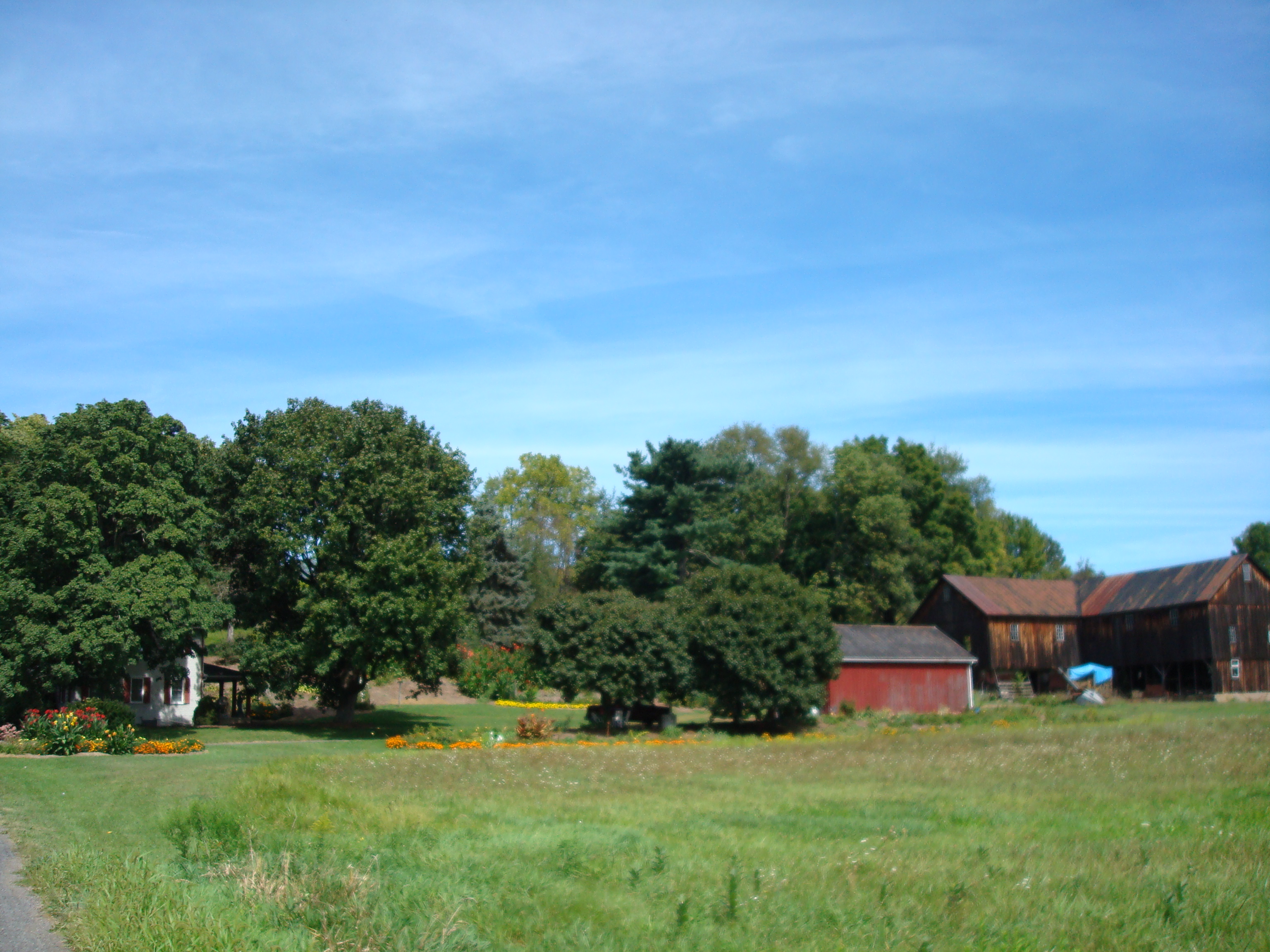
An aside: I’m intrigued by the picture that I found to illustrate this post. Is it my imagination or is there a huge bridge in the background of this 1913 photo? There couldn’t have been many bridges like that a hundred years ago in agricultural areas. Does anyone have any idea where the photo may have been taken?
18-year-old Helena Muffly wrote exactly 100 years ago today:
Sunday, June 29, 1913: Went to Sunday School this afternoon. Tweet came down this evening.
Source: Milton Evening Standard (June 26, 1913)
Her middle-aged granddaughter’s comments 100 years later:
Tweet was a nickname of Helen Wesner. She was a friend of Grandma’s .
Did Grandma and Tweet gossip about the latest news in McEwensville a hundred years ago tonight?
An aside–All of the pieces don’t quite fit together in this post, so feel free to take the information with a grain of salt, but here goes—
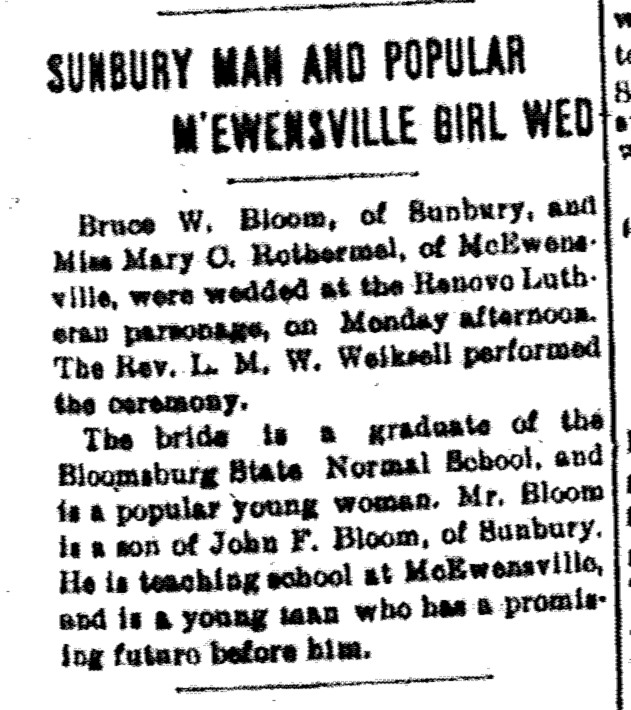
Grandma’s former teacher at McEwensville got married. . .to a former student!
On August 26, 1912 Grandma described Bruce Bloom, her teacher during her senior year:
. . . He is rather wide, wears a pair of pinchers, and has yellow hair. Not so very cross, but I believe he could be.
The newspaper clipping says that Bruce married Mary C. Rothermel of McEwensville on the previous Monday (June 23, 1913).
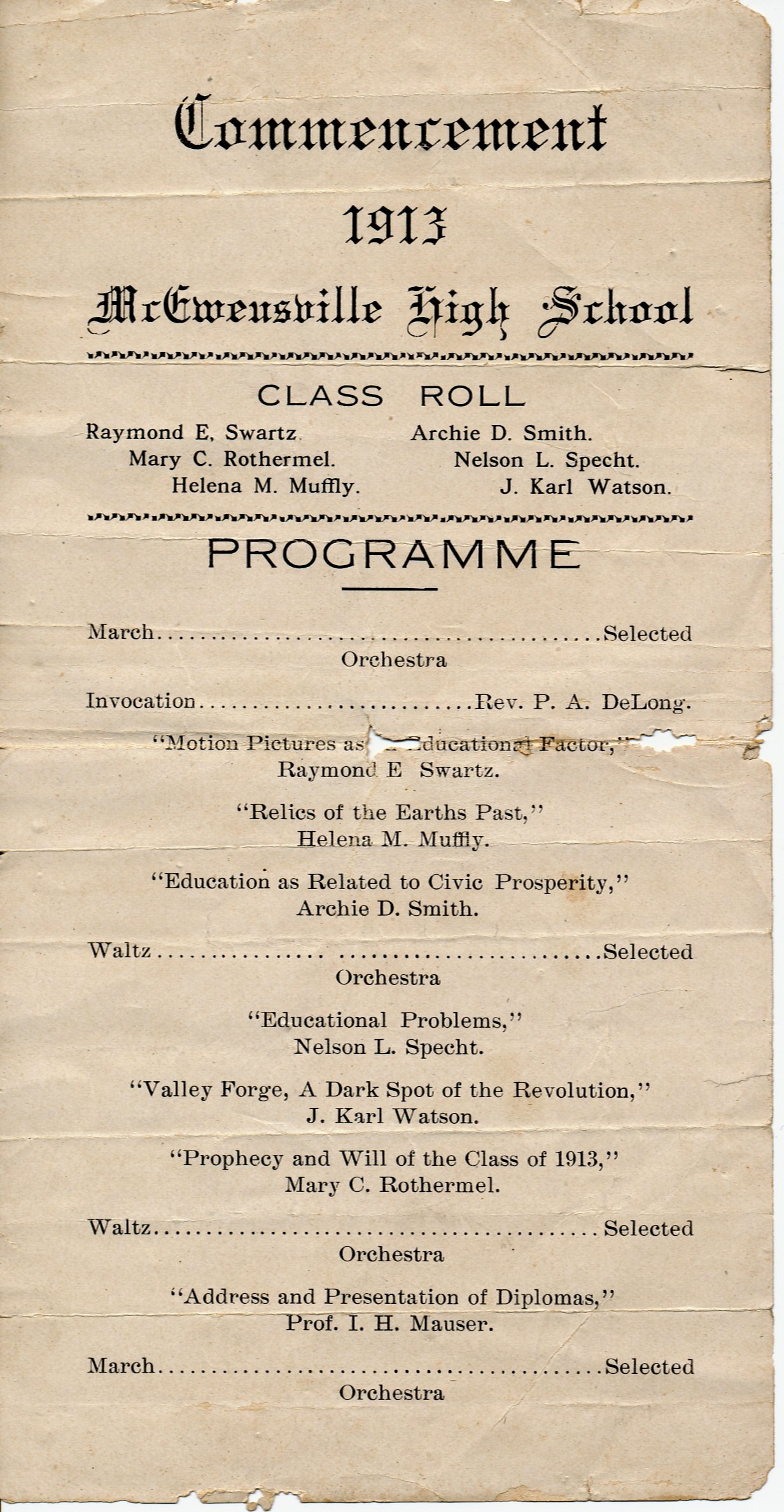
I have the 1913 commencement program for McEwensville High School and it indicates that Mary C. Rothermel (as well as Grandma) were members of the class of 1913.
Now to the part about all of the pieces not quite fitting together—the newspaper article indicates that Mary C. Rothermel was a graduate of Bloomsburg State Normal School which suggests that she was a little older and not a recent graduate of the high school. . . But in a tiny village like McEwensville how could there have possibly been two Mary C. Rothermels?
I’m probably way off base—and trying to create something to gossip about a hundred years later when there really is nothing of particular interest—but I almost want to argue that the newspaper made a typo and that the groom rather than the bride was the graduate of Bloomsburg State Normal School.
And, while I’m worrying about the details, there’s another little thing that bothers me–Why did Bruce and Mary get married in Renovo on a Monday at the church parsonage? Mary was from McEwensville; Bruce was from Sunbury which is about 20 miles south of McEwensville. Renovo is a very remote town way up in the mountains about 75 miles northwest of McEwensville. Did they elope?
Whoa! I need to rein myself in. . . Improbable as it seems, there probably were two Mary C. Rothermels in McEwensville . . . and the boring newspaper clipping probably accurately tells the entire story.
18-year-old Helena Muffly wrote exactly 100 years ago today:
Saturday, June 28, 1913: Got initiated into the hay field this afternoon, and I can say that I didn’t stay there very long either.
Source: Ladies Home Journal (July, 1913)
Her middle-aged granddaughter’s comments 100 years later:
How did Grandma manage to convince her father that she didn’t need to help for very long? It takes a lot of labor to make hay, and I’m surprised that he allowed her to be a slacker.
First the grass needed to be cut, and periodically turned as it dried.
After the grass had dried into hay, it was loaded onto wagons. Horses needed to be held and led as the hay was gathered, and workers needed to fork it onto the wagon.
And, of course, this all needed to be done very quickly—with eyes always looking towards the sky for any clouds that might suggest an impending storm. As the old saying says—Make hay while the sun shines.
You may also enjoy a previous post about how hay was unloaded from wagons a hundred years ago and moved into the haymows in the barn: