Writing Another Essay

17-year-old Helena Muffly wrote exactly 100 years ago today: 

Wednesday, March 12, 1913:  Am trying to write my essay.

Lewis Hine's picture of child coal miners (Source: Wikimedia Commons)
Lewis Hine’s picture of child coal miners (Source: Wikimedia Commons)

Her middle-aged granddaughter’s comments 100 years later:

Hmm…  Did Grandma have to write another essay?

During much of February she was working on an essay about the Revolutionary War. Her teacher was going to give the student who wrote the best Revolutionary War essay a two and a half dollar gold piece. . . Grandma hasn’t mentioned it in the diary in quite awhile. I suppose she didn’t win the coin.

What was this essay about? . . .

I find that I want to ask myself: If I lived a hundred years ago, what would I have enjoyed writing an essay about?  I know that the lens is all wrong, but here are some topic ideas that I think would have been interesting.

  • Should child labor be banned? — Child labor was very controversial in 1913. There were many coal mines in the southeastern part of the county where Grandma lived that used a lot of child labor, so this might have made a good essay topic.
  •  The reasons why women should have the right to vote—It seems obvious today, but women’s suffrage was an arguable point in 1913.
  • The problem of adulterated foods—This was just a few years after the publication of Upton Sinclair’s book, The Jungle—and many people were very worried about the chemicals put into processed foods.
  • Should alcohol be prohibited?  The prohibition movement was gathering steam in 1913, and taking either side of this issue would have made a good essay topic.
  • Planting trees on clear-cut land to improve the environment. People were worried about the environment in 1913. One concern was all of the erosion that was occurring due to the clear-cutting of old-time forests.
Chose a Date for the Play

17-year-old Helena Muffly wrote exactly 100 years ago today: 

Tuesday, March 11, 1913: We decided tonight to have our play on the fifth of April.

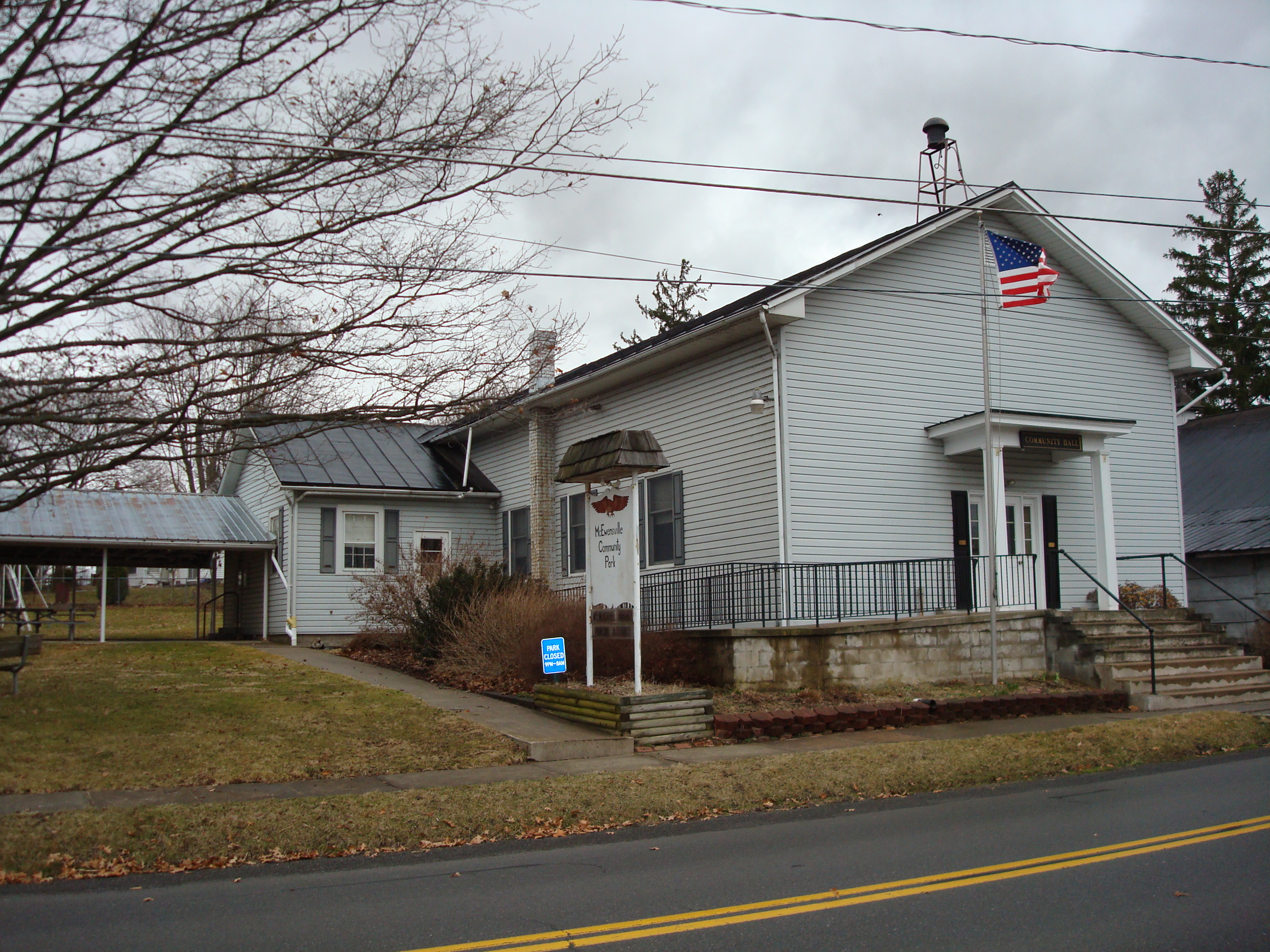
McEwensville Community Hall
The play was probably was held at the McEwensville Community Hall. The same building has served as the town’s community hall for more than 100 years.

Her middle-aged granddaughter’s comments 100 years later:

The previous evening Grandma did not go to play practice because it was raining. Probably the practice was canceled on the 10th and moved to the 11th due to the inclement weather. In general it seemed play practice only took place once—or maybe twice–a week.

Grandma had been going to play practices since January 27. She had the role of Chloe, the servant.  It seems somewhat surprising that the date of the play was only now selected. The cast probably wanted to be confident that they knew their lines and were ready for the play before choosing a date.

I suppose there was no need to rush to select the date since  the play was probably the only upcoming event in the small town of McEwensville–and nothing else was vying for the venue.

Didn’t Go To Play Practice

17-year-old Helena Muffly wrote exactly 100 years ago today: 

Monday, March 10, 1913:  It rained tonight so we didn’t go up to practice.

A recent rainy day in McEwensville

Her middle-aged granddaughter’s comments 100 years later:

Grandma was in the class play. Did some of the cast members show up for practice? . . or did everyone independently decide that the weather was too bad?

Today we’d text, email, or call if we couldn’t get to a play practice or meeting. A hundred years ago, did people just use their own judgment to determine whether an event was probably canceled due to weather?

Wooltex Spring Coat Advertisement

17-year-old Helena Muffly wrote exactly 100 years ago today: 

Sunday, March 9, 1913:  Went to Sunday School this afternoon. It was so nice out. Felt most too warm with my jacket on going up.

1913-04-39.b

Wooltex

The W. BLACK COMPANY

Designers

Wooltex Coat $15.00

Model 2249

An Extraordinary

Demonstration of Wooltex Value.

A handsomer coat for general service could scarcely be designed at any price than this model, No. 2249. It comes in whip cords, diagonal worsteds, find fancy diagonals, and a variety of fancy worsteds. Trimming is with inserts of self or contracting color broadcloth, and with buttonholes and invorine buttons to match inserts. Price but $15.00.

There are a few woman in every city who are always  “well-dressed”.

They are not always the richest.

Go see the Wooltex spring models and know why so many of them wear Wooltex coats and suits.

The Store That Sells Wooltext Coats, Suits, Skirts

(Source: Ladies Home Journal, April, 1913)

Her middle-aged granddaughter’s comments 100 years later:

The online Weather Channel forecast for McEwensville for today is a low of 31° and a high of 52.° Sounds like a nice day—though still jacket weather. It may have been a just a little bit nicer on this date a hundred years ago.

How to Wash Hair Brushes and Combs

17-year-old Helena Muffly wrote exactly 100 years ago today: 

Saturday, March 8, 1913:  It was kind of dull here today. Nothing much of anything doing.

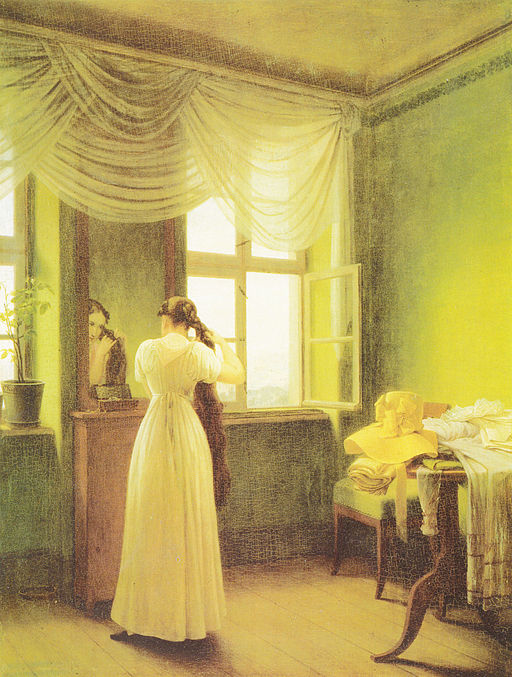
In Front of the Mirror by Georg Friedrich Kersting (Source: Wikimedia Commons)

Her middle-aged granddaughter’s comments 100 years later:

Hmm—What boring chores did Grandma need to do on a dull Saturday in March? ’

When I was a child, a weekly Saturday chore was to wash all the hair brushes and combs. I wonder if Grandma also did this when she was young,

I think that the reason we washed the brushes and combs was to have clean ones after we washed our hair. (We only washed our hair once a week back then.)

Here’s how to wash brushes and combs:

Add two or three tablespoons of baking soda to a small pan filled very hot water. (I use very hot tap water.) Swish the brushes and combs through the water—and “comb” the brushes with the combs. This cleans both the brush bristles and the comb teeth. Rinse with cool water. Lay on counter to air dry.

My sense is that people brushed their hair a lot more in the old days—and that brushing was one way to distribute, or remove, the oil and dirt between washings.

I can remember those old luxurious boar hair brushes that we used to have. Can you still buy them?

Selected Graduation Invitations

17-year-old Helena Muffly wrote exactly 100 years ago today: 

Wednesday, March 5, 1913: We had a class meeting tonight to decide some things. One was we selected our invitations.

Metal movable type similar to what the printer may have used to make the invitations (Source: Wikipedia)

Her middle-aged granddaughter’s comments 100 years later:

Grandma was in her last year at McEwensville High School. Her class apparently was selecting what the invitations to their graduation would look like. I think that you’d call Grandma a senior, but I’m not sure since the school was an old-fashioned 3-year high school.

I think this is what was involved in getting invitations—

One of the class members probably visited the shop of a printer and got some sample invitations. The samples may have been glued into a book.  There probably were different prices for different invitation styles.

Once the class selected an invitation style, the words that would go on the invitation, and the number of invitations needed, the information would have been taken back to the printer.

The printer would then have ordered the blank invitations from his supplier. Once the blank invitations arrived, the printer would set up the type-face and print a copy for the class to proof.

Once the proof was approved, the invitations would be printed.

Whew, that’s a lot of steps (and I probably missed a few). It’s so much easier today with the internet.

Sunday Visitors

17-year-old Helena Muffly wrote exactly 100 years ago today: 

Sunday, March 2, 1913: Went to Sunday School this morning. Besse and Curt were out this afternoon. Went to church this evening.

House Besse and Curt lived in. (I'm not sure whether they lived there as early as 1913).
Recent picture of house Besse and Curt lived in. It’s just outside of nearby Watsontown. (I’m not sure whether they lived in this house as early as 1913).

Her middle-aged granddaughter’s comments 100 years later:

Grandma’s oldest sister Besse was married to Curt Hester. They were frequent Sunday visitors.

When I was young, Sunday afternoon was considered the perfect time to visit friends and relatives. People generally didn’t work on Sunday, or clean house on Sunday. Stores were closed.

We’d often get unexpected “company” on Sunday afternoons. We looked forward to getting these visitors. There was no expectation that people would call ahead to see if we were busy. No matter what we were doing (and we were probably just reading or playing games), we’d welcome the guests—and would consider ourselves fortunate that people liked us enough to visit. I picture that the customs were similar a hundred years ago.

Today, it’s considered impolite to stop by someone’s house without first texting, emailing, or calling first. Sometimes I think that people were more hospitable years ago (or maybe they were just less polite).